May 24

What was advertised in a revolutionary American newspaper 250 years ago today?
Pennsylvania Journal (May 24, 1775).

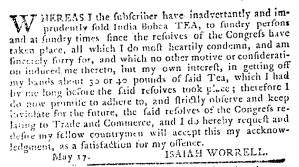
“I … have inadvertently and imprudently sold India Bohea TEA, to sundry persons and at sundry times.”

Isaac Worrell needed to do some damage control when others discovered that he had been selling tea in violation of the third article of the Continental Association in the spring of 1775.  That nonimportation agreement, devised by the First Continental Congress the previous fall, stated “we will not purchase or use any Tea imported on Account of the East India Company, or any on which a Duty hath been or shall be paid; and, from and after the first Dat of March next, we will not purchase or use any East India Tea whatever.”  Yet Worrell had not abided by those terms.

In an advertisement that first appeared in the May 17, 1775, edition of the Pennsylvania Journal and ran again the following week, Worrell confessed that he “imprudently sold India Bohea TEA, to sundry persons and at sundry times since the resolves of the Congress have taken place,” though he claimed that he had done so “inadvertently.”  Readers may have been skeptical that a prohibited act that occurred repeatedly happened “inadvertently.”  All the same, Worrell hoped that they would take note of his explanation for the infractions and accept his apology.  He asserted that he had “no other motive or consideration … but my own interest, in getting off my hands about 30 or 40 pounds of said Tea.”  He also contended that he acquired the tea “long before the said resolves took place,” hoping that would make his offense seem less serious.  At least he had not actively ordered or received new shipments.

Worrell assured his community that he had reformed.  “I do now promise to adhere to, and strictly observe and keep inviolate for the future,” he proclaimed, “the said resolves of the Congress relating to Trade and Commerce.”  He hoped that would be sufficient that “my fellow countrymen will accept this my accknowledgment, as a satisfaction for my offence.”  The Continental Association called for breaking off all ties, commercial and social, with those who violated it, yet Worrell hoped that his apology would outweigh his flimsy excuses to restore him to the good graces of the public. That he managed to sell “30 or 40 pounds of said Tea,” however, suggests that many others did not obey the terms of the Continental Association.  Loyalists accused Patriots of cheating, especially when it came to tea.  Worrell’s notice seems to support such allegations.
May 17

What was advertised in a revolutionary American newspaper 250 years ago today?

Pennsylvania Journal (May 17, 1775).

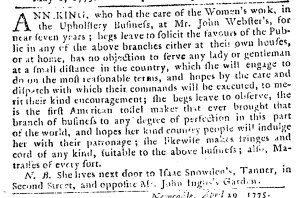
“ANN KING … had the care of the Women’s work, in the Upholstery Business, at Mr. John Webster’s.”

Ann King promoted her experience and expertise when she advertised her services in the May 17, 1775, edition of the Pennsylvania Journal, following an example set by artisans, male and female, who placed notices in newspapers during the era of the American Revolution.  She explained that she “had the care of the Women’s work, in the Upholstery Business, at Mr. John Webster’s, for near seven years.”  Although she had worked with Webster for quite some time, he had not acknowledged her contributions to his enterprise in his own advertisements.  Artisans only occasionally mentioned their assistants in their newspaper notices, yet King’s advertisement testified to the invisible labor performed by employees (as well as family members) in many workshops.  In particular, she reveals that women, whether employees or relative, participated on the production side even though editorials usually depicted them exclusively as consumers.

King took pride in her work.  She proclaimed that she “is the first American tostel [tassel] maker that ever brought that branch of business to perfection in this part of the world.”  If readers had ever admired the tassels that adorned any of the furniture upholstered in Webster’s workshop, then they should hire King when they were in the market for that item.  Even if they were not familiar those tassels, King hoped that her long tenure in a workshop operated by an “Upholsterer from London” who had served “several of the nobility and gentry, both in England and Scotland” would recommend her to prospective clients.  She intended for Webster’s reputation to bolster her own.  In addition to tassels, King “likewise makes fringes and cord of any kind,” part of the “Women’s work” she had overseen for Webster, and even “Mattrasses of every sort.”  She did so with “care and dispatch,” hoping to “merit [the] kind encouragement” of her patrons.

Female shopkeepers and milliners occasionally placed newspaper advertisements, far outnumbering the female artisans who did so.  King took to the public prints to advance her business, demonstrating that women did work alongside men in workshops, though their endeavors were sometimes cast as “Women’s work.”  Webster upholstered furniture “in the best and newest taste” for many years, depending on King and other women for assistance with the final product.  King then leveraged that experience in her effort to earn her livelihood by contracting directly with customers.

May 10

What was advertised in a revolutionary American newspaper 250 years ago today?

Pennsylvania Journal (May 10, 1775).

“The manufacturing of all sorts of Sugar Wares.”

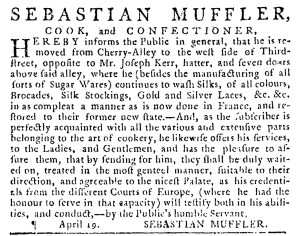
In the spring of 1775, Sebastion Muffler, “COOK, and CONFECTIONER,” ran a newspaper notice to promote his “manufacturing of all sorts of Sugar Wares” at a new location on Third Street in Philadelphia.  Customers would no longer find him in Cherry Alley.  Muffler joined the ranks of confectioners who advertised their services in American port cities, including Peter Lorent in Boston, Frederick Kreitner in Charleston, and P. Lenzi in New York.  Like most of his counterparts, he touted his prior experience on the other side of the Atlantic.  To that end, Muffler proclaimed that he earned “his credentials from the different Courts of Europe, (where he had the honour to serve …)”  That experience, he asserted, “will testify both in his abilities, and conduct.”  The cook and confectioner hoped that would entice “Ladies, and Gentlemen” to hire him.  Upon doing so, they could depend on being “duly waited on, [and] treated in the most genteel manner, suitable to their direction.”  Furthermore, Muffler declared himself “perfectly acquainted with all the various and extensive parts belonging to the art of cookery.”  Accordingly, his clients should anticipate dining “agreeable to the nicest Palate.”

Despite this depiction of his mastery of “the art of cookery” and “manufacturing of all sorts of Sugar Wares,” Muffler apparently depended on a side hustle to earn his livelihood.  He advised readers of the Pennsylvania Journal that he “continues to wash Silks, of all colours,” and other items “in as compleat a manner as is now done in France, and restored to their former new state.”  That was an impressive feat, but not a service directly related to his primary occupation.  In the largest and most cosmopolitan city in the colonies, Muffler needed to supplement the income he earned as a cook and confectioner by providing unrelated services.  Perhaps he hoped that he could eventually establish himself well enough to cultivate a market for his culinary services that made cleaning fabrics unnecessary.  Until then, he included his other occupation in his advertisements.  He hoped that his secondary headline, “COOK and CONFECTIONER,” would attract attention, using it to direct prospective customers to both related and unrelated services.

April 26

What was advertised in a revolutionary American newspaper 250 years ago today?

Pennsylvania Journal (April 26, 1775).

“He still carries on the Cabinet business … no advantages shall be taken of the present times.”

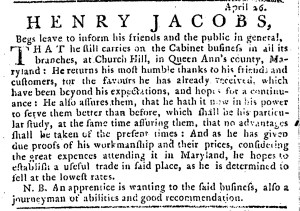
Henry Jacobs had confidence in the circulation of the Pennsylvania Journal when he placed an advertisement in the spring of 1775.  Addressing “his friends and the public in general,” he declared that he “still carries on the Cabinet business in all its branches, at Church Hill, in Queen Ann’s county, Maryland.”  That small town on the colony’s eastern shore was approximately eighty miles from Philadelphia, the bustling port where William Bradford and Thomas Bradford printed the Pennsylvania Journal, yet Jacobs considered advertising in that newspaper a sound investment.  He may not have expected to gain any customers in Philadelphia, but he realized that the Pennsylvania Journal served an extensive readership in Pennsylvania, New Jersey, Delaware, and Maryland.  That meant that “the public in general” in Queen Anne’s County might see his advertisement as copies of the Pennsylvania Journal circulated there.

Yet some of the language in his advertisement suggests that Jacobs did not yet have friends and customers in Maryland.  Near the end of his notice, he stated that he “hopes to establish a useful trade in said place,” indicating that he may have been a newcomer there.  Perhaps Jacobs relocated from Philadelphia.  When he announced that he “still carries on the Cabinet business … at Church Hill,” the “still” may have referred to pursuing his trade but not the location.  Jacobs’s advertisement might have been a moving notice, alerting customers that he left one town and opened a workshop in another.  He hoped to maintain at least some of his former clientele.  If that was the case, it also helps to explain why he chose to advertise in a newspaper published in Philadelphia rather than the Maryland Gazette printed in Annapolis.  Furthermore, he sought an apprentice and a journeyman “of abilities and good recommendation,” possibly seeking staff to assist him at his workshop in a new town.

Like many other colonizers who advertised goods and services, Jacobs expressed gratitude to “his friends and customers, for the favours he has already received.”  Doing so signaled to readers not familiar with him or his furniture that he was an established artisan.  He underscored his skill and experience when he trumpeted that he “has given due proofs of his workmanship.”  Jacobs intended to bolster his reputation, especially when he stated that customers previously placed orders “beyond his expectations.”  Such appeals could have resonated with customers in both Philadelphia and Queen Anne’s County.  The primary purpose of his advertisement, after all, was not to proclaim “his most humble thanks” but instead to drum up new business.  To that end, he asserted that he “hath it now in his power to serve [his customers] better than before,” though he did not explain what he meant when he gave those assurances.  If he had been in Church Hill for some time, perhaps he made improvements to his workshop or acquired new tools.  If he was new to town, he may have referred to his new workshop.  Whatever the case, he promised that “no advantages shall be taken of the present times.”  Jacobs likely had not heard about events at Lexington and Concord on April 19 when he composed his advertisement and submitted it to the printing office.  The “present times” became more complicated as the imperial crisis became a war.

April 19

What was advertised in a revolutionary American newspaper 250 years ago today?

Pennsylvania Journal (April 19, 1775).

“WANTED, at the AMERICAN MANUFACTORY … A Quantity of WOOL, COTTON, FLAX, and HEMP.”

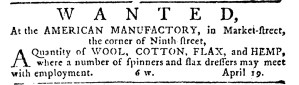
In the middle of March 1775, supporters of a “FUND for establishing and carrying on an AMERICAN MANUFACTORY, of LINEN, WOOLLEN,” and textiles made of other items met at Carpenters’ Hall in Philadelphia to learn more about the undertaking.  They pledged their support by signing their names to “Subscription Papers” or “general Proposals,” either at the meeting or at the London Coffee House in advance.  The organizers and the “Subscribers” sought to encourage “domestic manufactures” (products made in the colonies) as alternatives to imported goods.  Entrepreneurs had been pursuing that goal for more than a decade during the imperial crisis, though many devoted more effort during the times that colonizers adopted nonimportation agreements as political leverage.  In the spring of 1775, those involved with the “AMERICAN MANUFACTORY” did so as part of the Continental Association.  Its eighth article called for “encourage[ing] Frugality, Economy, and Industry; and promot[ing] Agriculture, Arts, and the Manufacturers of this Country.”

A month later, advertisements concerning the venture simultaneously appeared in the Pennsylvania Gazette and the Pennsylvania Journal on April 19.  “WANTED, At the AMERICAN MANUFACTORY,” the notices advised, “A Quantity of WOOL, COTTON, FLAX, and HEMP.”  Readers could demonstrate their commitment to the cause by supplying the resources necessary to produce textiles in the colony.  The advertisement also noted that “a number of spinners and flax dressers may meet with employment” at the manufactory, contributing to the success of the Continental Association while earning their livelihoods.

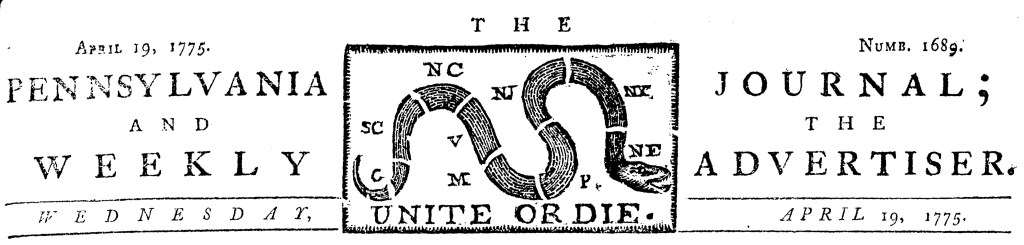
When the printers of the Pennsylvania Gazette and the Pennsylvania Journal distributed the weekly issue of their newspapers on April 19, they were not yet aware of the momentous events that happened at Lexington and Concord in Massachusetts that morning, though it would not take long for word to spread to Philadelphia and throughout the colonies.  Historians have long debated when the American Revolution began, echoing the question that John Adams posed to Thomas Jefferson in 1815: “What do We mean by the Revolution?  The War?  That was no part of the Revolution.  It was only an Effect and Consequence of it.  The Revolution was in the Minds of the People, and this was effected, from 1760 to 1775, in the course of fifteen Years before a drop of blood was drawn at Lexington.”  Establishing the “AMERICAN MANUFACTORY” in Philadelphia before the war, according to Adams, was part of the revolution.  Today, however, the 250th anniversary of the battles at Lexington and Concord offers a convenient moment for commemorating the American Revolution by aligning it with the Revolutionary War that secured independence for a new nation composed of thirteen former colonies.  For readers of the Pennsylvania Journal in 1775, the political cartoon depicting a severed snake with the motto “UNITE OR DIE” had already been spreading its message for many months.  The masthead, the articles and letters, and many of the advertisements had been part of a revolution that was already occurring “in the Minds of the People.”

Pennsylvania Journal (April 19, 1775).

April 5

What was advertised in a colonial American newspaper 250 years ago today?

Pennsylvania Journal (April 5, 1775).

“JOHN MITCHELL’s WINE, SPIRIT, RUM, and SUGAR STORES.”

John Mitchell operated an alcohol emporium in Philadelphia in the 1770s.  In April 1775, he advertised his “WINE SPIRIT, RUM, and SUGAR STORES” on Front Street, inviting customers in the city and its hinterland to purchase his wares and then retail them at their shops or taverns or enjoy imbibing them at home.  To entice prospective customers, he compiled a lengthy list of his current selection along with a pledge to “keep a constant supply of the above Articles” to avoid disappointments associated with selling out of any favorites.

His inventory included, for instance, “BEST Genuine Madeira Wines,” “Excellent bottled Claret,” “Genuine new and old Port Wine,” “Teneriffe and Fyal Wines,” “Red Lisbon Wine,” “Genuine old French Brandy,” “Shone’s, Ben. Kenton and Parker’s best London bottled Porter,” “Genuine Button and Taunton Ale,” and “West-India and New-England Rum,” along with many other choices.  For many items, Mitchell listed several sizes, indicating that customers could purchase the right amount for their home or business.  He sold Madeira by the gallon or in barrels of various sizes, including “by the pipe, hogshead, [and] quarter-cask.”  The bottled porters came “by the hogshead, hamper or dozen” to meet the budget and the convenience of his customers.

The format of Mitchell’s advertisement highlighted the choices.  Rather than list his wines and spirits in a dense paragraph, as many advertisers did when they sought to demonstrate the selection of goods they offered to consumers, Mitchell devoted one line to each item.  That made it easier for readers to peruse his catalog while also creating visual elements that differentiated his advertisement from news items and other notices that consisted of blocks of text justified on both the left and the right.  The variations in white space that resulted from centering each item on its own line made “Best Genuine Madeira Wines,” “Teneriffe and Fyal Wines,” “Genuine old French Brandy,” and “Spanish Brandy” even more visible within the advertisement.  Both the extensive accounting of wines and spirits and the design of Mitchell’s notice contributed to attracting the attention of prospective customers.

March 1

What was advertised in a colonial American newspaper 250 years ago today?

Pennsylvania Journal (March 1, 1775).

“THE American Edition of Swan’s British Architect.”

Less than a year after arriving in Philadelphia from London, John Norman, an engraver, embarked on producing an “American Edition of Swan’s British Architect” in the spring of 1775.  He unveiled the project with an advertisement in the March 1 edition of the Pennsylvania Journal, advising the public that he was “Now PUBLISHING” the volume “by SUBSCRIPTION” and seeking supporters to reserve their copies.  He asked those who did so to make a deposit and pay the remainder “at the delivery of the book,” noting that the total price “is Ten Shillings less than the London edition.”

The Continental Association, a nonimportation, nonconsumption, and nonexportation agreement devised by the First Continental Congress in response to the Coercive Acts, was in effect at the time that Norman advertised his American edition of Swan’s British Architect.  His project adhered to the eighth article, which called for “promot[ing] Agriculture, Arts, and the Manufacturers of this Country,” while the subject matter, all sorts of architectural elements in fashion in England, suggested that colonizers continued to value transatlantic cultural ties and their identity as members of the British empire.  The dispute with Parliament had intensified, but most still hoped for a redress of grievances and return to amiable relations.

In addition to the newspaper advertisement, Norman printed more extensive “proposals, with a specimen of the plates and letter press,” that interested parties could view at his house.  Prospective subscribers could learn more about the project and assess the quality of the engravings before placing their orders.  To further entice them, Norman declared that the “names of the subscribers to this useful and ornamental work will be published.”  Just as disseminating subscription proposals was a common marketing strategy in eighteenth-century America, so was publishing the list of subscribers.  In other circumstances, the “gentlemen” who subscribed wanted to see their names alongside those of other genteel members of their community.  That was still the case for this book, yet they likely also wished to see their names in print as they for supporting for an American edition.  Norman offered an opportunity to simultaneously demonstrate their commitment to both the arts and the Continental Association.

February 1

What was advertised in a colonial American newspaper 250 years ago today?

Pennsylvania Journal (February 1, 1775).

“No advantage shall be taken on account of the troubles between Britain and America.”

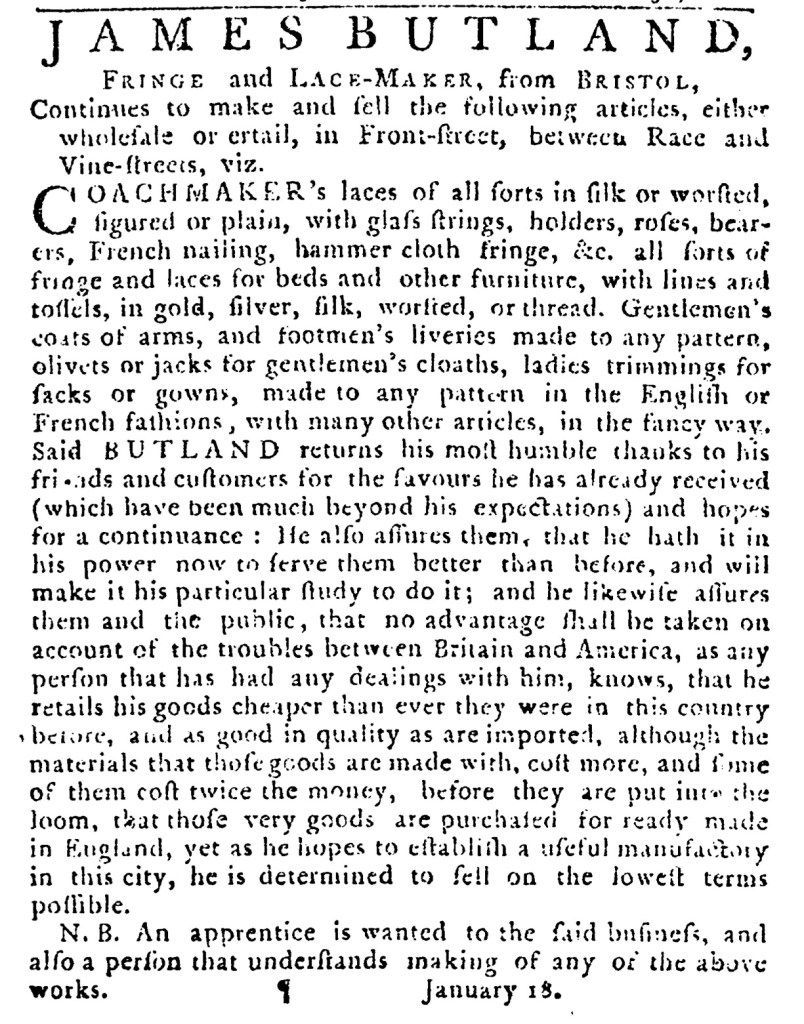
James Butland, a “FRINGE and LACE-MAKER, from BRISTOL,” set up shop in Philadelphia in the 1770s.  In an advertisement in the February 1, 1775, edition of the Pennsylvania Journal, he informed the public that he made and sold “COACHMAKER’s laces of all sorts in silk or worsted,” “all sorts of fringe and laces for beds and other furniture,” and other trimmings according to “any pattern in the English or French fashions.”

Colonizers observed the Continental Association, a nonimportation agreement enacted by the First Continental Congress in response to the Coercive Acts, at the time that Butland placed his advertisement.  Butland certainly had the Continental Association, in particular, and the imperial crisis, more generally, in mind when he made his pitch to prospective customers.  He made assurances to “the public, that no advantage shall be taken on account of the troubles between Britain and America.”  In other words, he would not raise prices on the fringe and lace he produced locally at a time that patriots refused to purchase imported goods.  Butland asserted that he had been in Philadelphia long enough that former customers knew his reputation on the matter: “any person that has had any dealings with him, knows, that he retails his goods cheaper than ever they were in this country before, and as good in quality as are imported.”  He did so even though “the materials that those goods are made with, cost more, and some of them twice the money, before they are put into the loom” compared to readymade alternatives from England.  That Butland offered such low prices under those circumstances suggested a significant markup on imported fringe and lace.

Butland did his part to satisfy consumers and to serve the American cause as the imperial crisis intensified.  Beyond his pledge not to gouge his customers with unreasonable prices during the boycott of imported goods, he sought to increase the inventory of locally produced fringes and laces available to them.  He planned “to establish a useful manufactory in this city,” vowing “to sell on the lowest terms possible.”  To that end, he sought an apprentice and an employee to assist him and aid in expanding his business.  As his advertisement made clear, Butland did his part as a producer to honor the Continental Association.  Readers now had a duty as consumers to do their part to support his endeavor.

January 25

What was advertised in a colonial American newspaper 250 years ago today?

Pennsylvania Ledger (January 25, 1775).

“PROPOSALS For Printing by Subscription, a FREE and IMPARTIAL WEEKLY NEWS-PAPER.”

As the imperial crisis intensified, the number of newspapers published in Philadelphia, the largest city in the colonies, grew significantly.  Throughout the early 1770s, readers had access to Dunlap’s Pennsylvania Packet, the Pennsylvania Gazette, and the Pennsylvania Journal.  Until February 1774, the Pennsylvania Chronicle had also circulated in Philadelphia.  Less than a year after that newspaper folded, Benjamin Towne commenced publication of the Pennsylvania Evening Post, the first tri-weekly newspaper attempted in that city, on January 24, 1775, and James Humphrey, Jr., distributed the first issue of the Pennsylvania Ledger four days later.  Enoch Story and Daniel Humphreys also advertised plans for another newspaper, the Pennsylvania Mercury.  They published their inaugural issue in April 1775, two weeks before the battles at Lexington and Concord.

On January 25, the Pennsylvania Journal carried the proposals for both the Pennsylvania Ledger and the Pennsylvania Mercury, placing them side by side on the final page.  As was customary, the printers gave an overview of why they wished to publish their newspapers, explained what subscribers could expect among the contents, and listed the conditions for subscribing.  Among the various purposes the Pennsylvania Mercury would serve, Story and Humphreys included, “To communicate advertisements of every kind.”  The printers of both proposed newspapers sought advertisements, an essential revenue stream for any printer publishing a newspaper.  After noting the prices for subscriptions to the Pennsylvania Ledger, Humphreys indicated, “Advertisements to be inserted on the same terms as is usual with the other papers in this city.”  For the Pennsylvania Mercury, Story and Humphreys declared, “The Rates of the Paper and Advertisements will be the same with those now printed in this City.”  Dunlap’s Pennsylvania Packet and the Pennsylvania Journal both gave the price for subscriptions – “Ten Shillings per Annum” – in their colophons, but none of the newspapers then printed in Philadelphia regularly published what they charged for advertising.  Apparently, according to the proposals for the Pennsylvania Ledger and the Pennsylvania Mercury, none offered better deals than others.

Story and Humphreys did give a bit more attention to advertising in their proposals.  “All Advertisements,” they promised, “shall be inserted in order as they come in, and shall appear in a fair and conspicuous manner.”  They did not mean that paid notices would literally appear one after the other in the order received at the printing office but rather that a compositor would set type in that order and integrate them into the layout of the newspaper without privileging any later arrivals over those submitted sooner.  After all, newspaper printers sometimes inserted notes that advertisements had been omitted due to lack of space.  Story and Humphreys signaled that they would not take anything into consideration beyond the order that advertisers delivered their notices when delaying publication of some.  They also acknowledged that compositors arranged content to make pieces of different lengths complete columns and fill pages.  During that process, they would not privilege any advertisements over others, displaying each “in a fair and conspicuous manner.”  With such appeals, Story and Humphreys solicited the trust of prospective advertisers who wanted a good return on the money they invested in disseminating information in the Pennsylvania Mercury.

Neither of these proposals for new newspapers discussed advertising extensively, but each did seek advertisers along with subscribers.  Whatever goals they expressed for circulating news as the political situation deteriorated, the viability of pursuing their ideals of publishing “improving, instructive and entertaining” information depended in large part on recruiting advertisers as well as enlisting subscribers.

December 28

What was advertised in a colonial American newspaper 250 years ago today?

Pennsylvania Journal (December 28, 1774).

“No advantage of the times taken.”

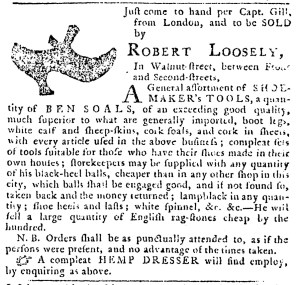
In the early 1770s, Robert Loosely sold “SHOEMAKER’s TOOLS” and materials at his shop on Walnut Street in Philadelphia.  In an advertisement he ran in the Pennsylvania Chronicle in May 1772, he advised the public that he “served his apprenticeship in England, and for some years carried on a considerable trade there.”  During that time, he “became acquainted with the most reputed manufacturers of tools and leather.”  After migrating to Philadelphia, he put his knowledge and connections to good use in importing and selling only the highest quality items connected to that trade.

Loosely did not rehearse that history when he advertised in the Pennsylvania Journal in December 1774.  Perhaps he believed that prospective customers were familiar enough with his reputation that he no longer needed to do so.  He did, however, continue to make appeals to quality and even offered a money-back guarantee for some of his wares.  He described his tools and soles as “exceeding good quality,” even “much superior to what are generally imported.  When it came to “black-heel balls” used to blacken the edges of heels and soles, Loosely told shopkeepers that they “may be supplied with any quantity … cheaper than in any other shop in this city.”  Furthermore, those items “shall be engaged good, and if not found so, taken back and the money returned.”  He trusted that his confidence would entice prospective customers to purchase from him over his competitors.

In a nota bene, Loosely encouraged customers to send orders rather than visiting his shop, declaring that they “shall be as punctually attended to, as if the persons were present.”  In addition, he assured readers, “no advantage of the times taken.”  He referred to the Continental Association, a nonimportation agreement enacted by the First Continental Congress in response to the Coercive Acts.  With imported goods curtailed after December 1, he could have raised prices, yet he abided by the ninth article that asserted, “Venders of Goods or Merchandise will not take Advantage of the Scarcity of Goods that may be occasioned by this Associacion, but will sell the same at the Rates we have been respectively accustomed to do for twelve Months last past.”  Politics and commerce interested in Loosely’s marketing efforts in the final days of 1774.