January 11

What was advertised in a revolutionary American newspaper 250 years ago today?
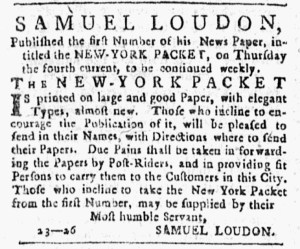
New-York Journal (January 11, 1776).

“SAMUEL LOUDON, Published the first Number of his News Paper, intitled the NEW-YORK PACKET.”

After spending several weeks distributing subscription proposals for a new newspaper, the New-York Packet, Samuel Loudon released the first issue on schedule on January 4, 1776.  On that day, Loudon’s notice that he planned to establish the newspaper appeared for the fourth and final time in the New-York Journal.  A week later, a new advertisement promoting the New-York Packet ran in the New-York Journal.  The notation at the end, “23-26” (corresponding to the issue numbers), indicated that Loudon planned for that notice to run for four consecutive weeks as well.

In it, the printer announced that he “Published the first Number of his News Paper … on Thursday the fourth current, to be continued weekly.”  He then provided an abbreviated version of the subscription proposal, stating that the New-York Packet “IS printed on large and good Paper, with elegant Types, almost new.”  For readers who did not subscribe in time to receive that “first Number,” it was not too late to start a subscription that included the first issue and all subsequent issues.  “Those who incline to encourage the Publication of it,” Loudon advised, “will be pleased to send in their Names, with Directions where to send their Papers.”  Loudon had disseminated the subscription proposals widely, including in the Connecticut Journal and the Pennsylvania Gazette.  He hoped to gain subscribers far beyond the city where he printed the New-York Packet.  To that end, he promised that “Due Pains shall be taken in forwarding the Papers by Post-Riders, and in providing fit Persons to carry them to the Customers in this City.”  That was a necessary part of satisfying both subscribers and advertisers.

Despite the fanfare around its founding, the New-York Packet lasted only eight months.  Loudon suspended the newspaper shortly before the British occupation of New York.  Unfortunately, surviving issues have not been digitized for greater access, so advertisements and other content from the New-York Packet will not appear in the Adverts 250 Project, though advertisements about the newspaper inserted in other publications testify to its short run at the beginning of the Revolutionary War.
December 1

What was advertised in a revolutionary American newspaper 250 years ago today?

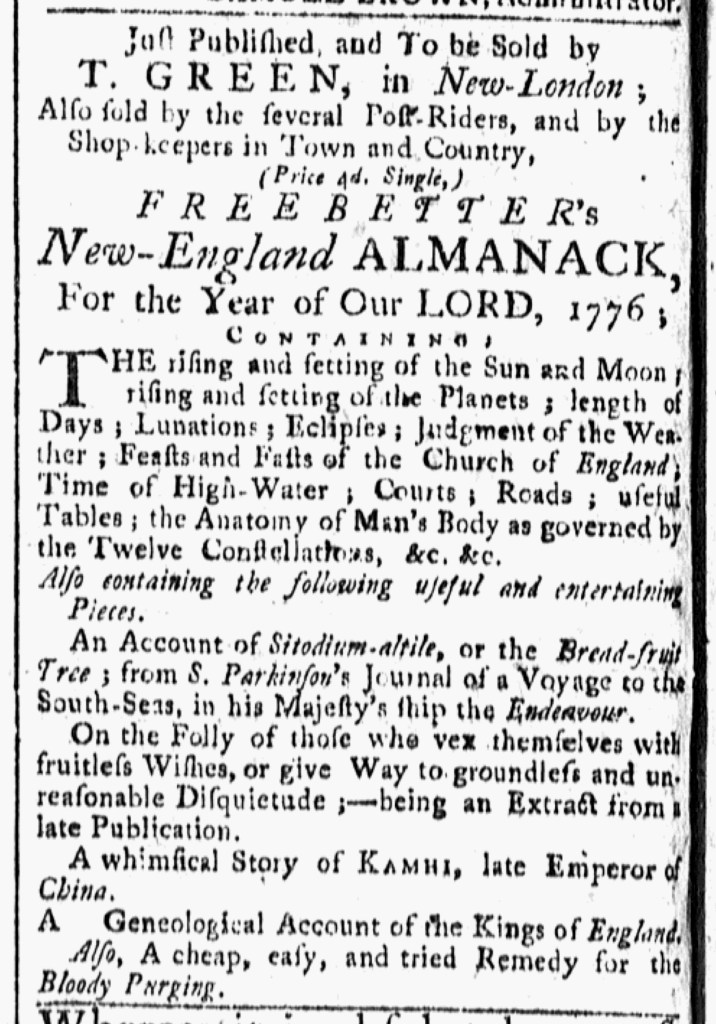
Connecticut Gazette (December 1, 1775).

“Sold by the several Post-Riders, and by the Shop-keepers in Town and Country.”

With only a month until the new year began, Timothy Green, the printer of the Connecticut Gazette, advertised “FREEBETTER’s New-England ALMANACK, For the Year of Our LORD, 1776.”  He emphasized items that usually appeared in almanacs and called attention to special features.  The former included the “rising and setting of the Sun and Moon; rising and setting of the Planets; length of Days; Lunations; Eclipses; Judgment of the Weather; Feasts and Fasts of the Chrich of England; Times of High-Water; Courts; Roads; useful Tables; [and] the Anatomy of Man’s Body as governed by the Twelve Constellations.”  The special features included a “whimsical Story of KAHM, late Emperor of China,” and a “Geneological Account of the Kings of England.”  They also included an “Account of Sitodium-altile, or the Bread-fruit Tree; from S. Parkinson’s Journal of a Voyage to the South-Seas, in his Majesty’s ship the Endeavour” and an essay on “the Folly of those who vex themselves with fruitless Wishes, or give Way to groundless and unreasonable Disquietude; –being an Extract from a late Publication.”  Green may have intended those excerpts as teasers to encourage readers to purchase the original works at his printing office in New London.

To acquire the almanac, however, customers did not have to visit Green or send an order to him.  Instead, he advised that “the several Post-Riders” with routes in the region and “the Shop-keepers in Town and Country” also sold “FREEBETTER’s New-England ALMANACK, For … 1776.”  The printer established a distribution network for the useful reference manual.  Shopkeepers often stocked a variety of almanacs so their customers could choose among popular titles.  Printers sometimes offered discount prices for purchasing multiple copies, usually by the dozen or by the hundred.  That allowed retailers to charge competitive prices to generate revenue with small markups over what they paid.  In this instance, Green did not indicate how much shopkeepers paid for the almanac, only that it sold for “4d. Single” or four pence for one copy.  That constrained shopkeepers when it came to marking up prices.  In addition to shopkeepers, “several Post-Riders” sold the almanac.  That arrangement meant greater convenience for customers and, printers hoped, increased sales and circulation.  In the 1770s, printers in New England began mentioning postriders in their advertisements for almanacs and other printed materials, perhaps acknowledging an existing practice or perhaps establishing a new means of engaging with customers.  The price that Green listed in his advertisement also kept customers aware of reasonable prices charged by post riders.

November 29

What was advertised in a revolutionary American newspaper 250 years ago today?

Pennsylvania Gazette (November 29, 1775).

“We, the subscribers, do recommend the above named John Spering as a Rider.”

In the fall of 1775, John Spering, a resident of Easton, took to the pages of the Pennsylvania Gazette to announce that he “proposes to ride POST” between Philadelphia and Northampton.  Along the way he would make stops in “Germantown, Bussel-town [now Bustleton], Four-lane-end [now Langhorne], Newtown, Durham, Easton, Bethlehem, and Northampton.”  Until January 1, he would depart Philadelphia each Wednesday evening.  In January, February, and March, he planned to scale back service to “once every fortnight,” presumably due to the weather, and then resume weekly service on April 1.  He assured “All Gentlemen and ladies who are pleased to encourage this undertaking” that they “may depend upon being punctually served, and that the greatest care will be taken of such letters, or other things,” such as small parcels, entrusted to him.  Given that the Pennsylvania Gazette circulated widely beyond Philadelphia, Spering hoped that his advertisement would attract patrons in the many towns along his route.

He also realized that most prospective customers did not know him and thus might be cautious about handing over letters and packages.  To address such concerns, he included a character reference signed by nine residents of Easton.  “We, the subscribers,” they declared, “do recommend the above named John Spering as a Rider, as we believe he will perform his duty therein faithfully and honestly.”  They noted that Spering had been “a resident in Easton for upwards of thirteen years, where he has, during that time, behaved himself very well.”  Prospective clients could have confidence that he would faithfully deliver their letters without tampering with them.  The signatories would have been as unknown to most readers as Spering, but the titles that accompanied some of their names testified to their trustworthiness and standing in their community: “Lewis Gordon, Esq; Henry Fullert, Esq; Dr. Andrew Ledlie, [and] Jacob Orndt, Esq.”  That so many of his neighbors endorsed Spering at the risk of their own reputations may have helped to convince the “Gentlemen and Ladies” that Spering addressed to avail themselves of his services when they had letters to post.

August 30

What was advertised in a revolutionary American newspaper 250 years ago today?

Pennsylvania Journal (August 30, 1775).

“The first Publication of all New Pamphlets may be had of the Rider.”

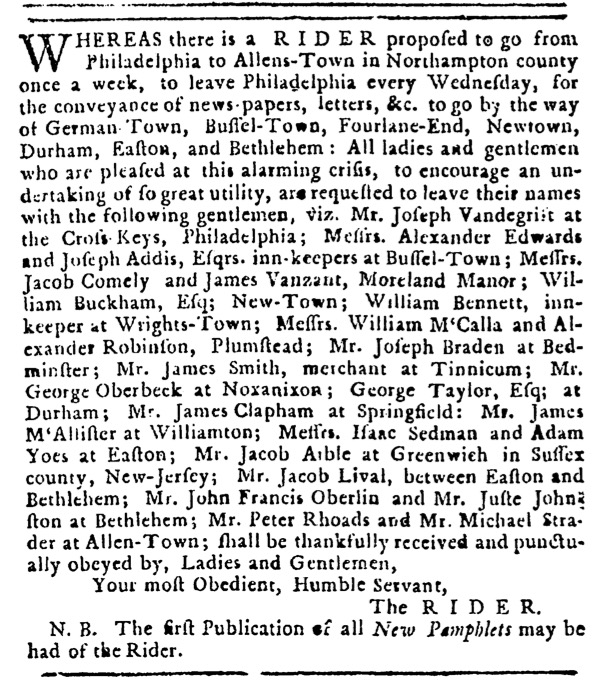
An anonymous post rider advertised his services in the August 30, 1775, edition of the Pennsylvania Journal, stating that the “Proposed to go from Philadelphia to Allens-Town in Northampton county once a week.”  He intended to depart from Philadelphia each Wednesday, the same day that a new issue of the Pennsylvania Journal, a weekly publication, hit the streets.  Subscribers to that newspaper along his route would benefit from the quickest possible access to the news in the latest edition.  Although “The RIDER” did not give details about collecting fees, he likely envisioned providing his services via subscription, similar to the plan that Thomas Sculley outlined in an advertisement for his route between Philadelphia and Lewes, Delaware, in the Pennsylvania Ledger a month earlier.  Both post riders contributed to an expanding communication infrastructure.  The same issue of the Pennsylvania Journal that carried the anonymous rider’s advertisement also featured a notice that gave the days the new Constitutional Post departed Philadelphia to carry letters to “New-York, Connecticut, Rhode-Island, Massachusetts-Bay, [and] New-Hampshire.”

The rider framed carrying “news-papers, letters, &c.” as a public service at an important moment, instructing “ladies and gentlemen who are pleased at this alarming crisis, to encourage an undertaking of so great utility … to leave their names with the following gentlemen.”  He then listed twenty-three associates in sixteen towns, demonstrating that he had already devoted significant effort to establishing a network for transmitting information.  The outbreak of hostilities in Massachusetts, the “alarming crisis,” made it more important than ever that colonizers residing in smaller towns gained regular access to newspapers and correspondence.  Some were so eager to read the latest news that they may have been stealing copies of Dunlap’s Maryland Gazette.  The rider aimed to keep colonizers along his route well informed.  “The first Publication of all New Pamphlets,” he stated in a nota bene, “may be had of the Rider.”  The “&c.” (or etc.) in “news-papers, letters, &c.” included the political pamphlets and sermons about current events so often advertised in the Pennsylvania Journal and other newspapers printed in Philadelphia.  Post riders in New England had sometimes acted as local agents for disseminating political pamphlets earlier during the imperial crisis.  The anonymous rider joined their ranks, delivering “news-papers, letters, &c.” with a purpose beyond merely earning his own livelihood.

July 29

What was advertised in a revolutionary American newspaper 250 years ago today?

Pennsylvania Ledger (July 29, 1775).

“All Letters Post free, and small bundles not exceeding eight ounces, carried gratis for any Subscriber.”

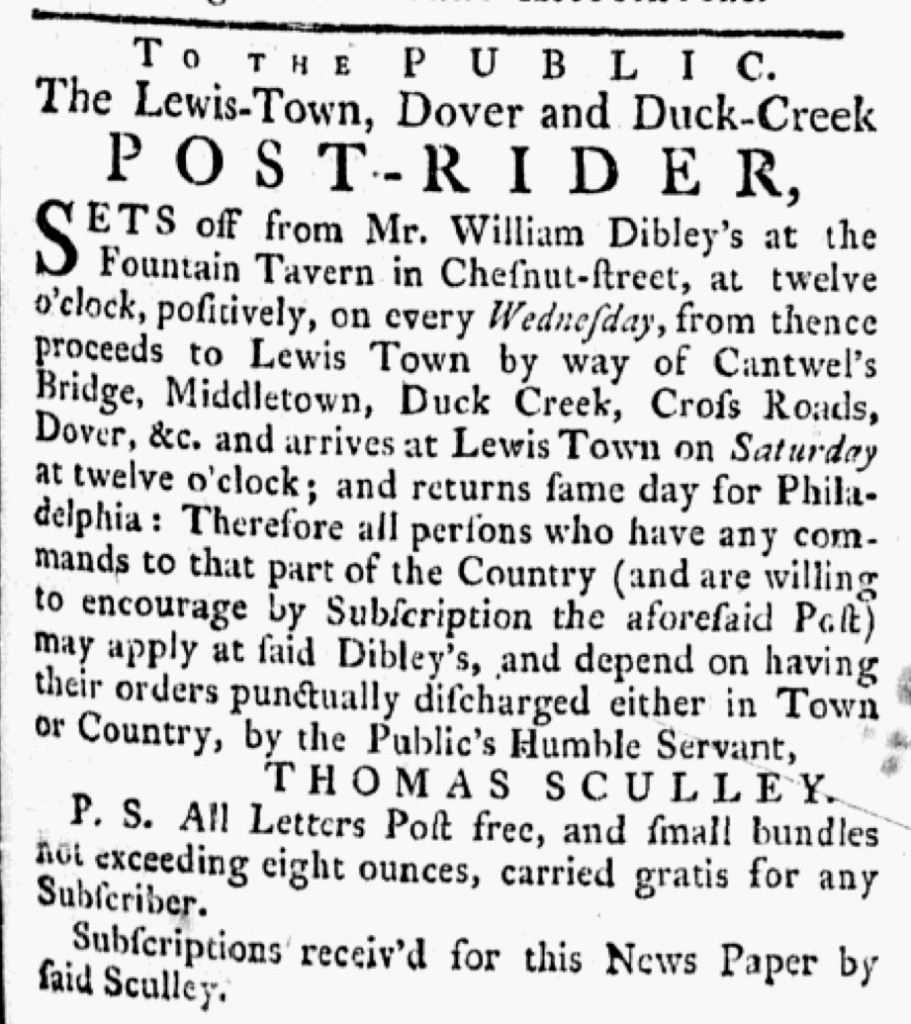
As the Revolutionary War commenced, Thomas Sculley, a post rider, followed a route that connected several towns in Delaware to Philadelphia.  At noon on every Wednesday, he departed from William Dibley’s Fountain Tavern on Chestnut Street and made for Lewis Town (now Lewes).  He stopped at Middletown, Dover, and other towns along the way, delivering letters, newspapers, and packages.  That took three days.  Sculley arrived at Lewis Town by noon on Saturday and started the return trip later the same day.  Presumably he made it to Philadelphia on Tuesday, giving customers an opportunity to consult with him at the Fountain Tavern.

Sculley placed an advertisement for his services in the July 29, 1775, edition of the Pennsylvania Ledger.  Like some other post riders, he did not charge solely by the letter, package, or newspaper subscription but instead marketed a subscription service.  Subscribers paid a set fee on a regular basis whether they made use of the service or not.  In return, they could post as many letters as they wished as well as send “small bundles not exceeding eight ounces.”  Anything else incurred additional charges.  Even if customers did not use Sculley’s service every time he rode between Philadelphia and Lewes, the subscription fee could have been a bargain compared to paying for each letter or package each time.  In addition, Sculley intended for subscriptions, if paid on time, to yield steady income that made serving his route possible. Prospective customers who wanted to make sure that a post rider was available when they desired needed to support the enterprise with their subscriptions, not just when they had letters and packages to send.

Sculley also accepted subscriptions for the Pennsylvania Ledger.  He may have also delivered other newspapers printed in Philadelphia at the time, including Dunlap’s Pennsylvania Packet, the Pennsylvania Evening Post, the Pennsylvania Gazette, and the Pennsylvania Journal.  Subscriptions to his service also supported dissemination of news about the imperial crisis, the hostilities that had recently commenced in Massachusetts, the meeting of the Second Continental Congress in Philadelphia, and reactions from throughout the colonies.  Post riders like Thomas Sculley played an important role in the communications infrastructure that disseminated news during the era of the American Revolution.

June 18

What was advertised in a revolutionary American newspaper 250 years ago this week?

Massachusetts Spy (June 14, 1775).

This Paper now has the greatest advantage for News, from ALL quarters, of any in this Province.”

Isaiah Thomas, the printer of the Massachusetts Spy, took his press and left Boston just before the battles at Lexington and Concord in April 1775.  He announced his intention to continue publishing the newspapers at a new printing office he established in Worcester, safely away from the British officials he angered with his advocacy for the patriot cause.  Printing his newspaper in another town at the beginning of the Revolutionary War meant building up a new customer base, something that Thomas diligently endeavored to do.  During the first months that he published the Massachusetts Spy in Worcester, he regularly placed advertisements promoting the newspapers and encouraging colonizers in central Massachusetts and beyond to become subscribers.

Interspersed with news on the third page of the June 14, 1775, edition of the Massachusetts Spy, Thomas placed a notice that proclaimed, “This Paper has now the greatest advantage for News, from ALL quarters, of any in this Province.  Those who incline to become customers may know the Conditions, by turning to the last Page, column 3d.”  Readers who followed those instructions encountered the “PROPOSALS For continuing the Publication of The MASSACHUSETTS SPY, OR American ORACLE of LIBERTY,” including the extensive list of local agents who received subscriptions in nearly three dozen towns in Worcester County.  Those proposals had appeared in every issue of the Massachusetts Spy since Thomas began printing it in Worcester on May 3, initially on the front page and then migrating to the last one.

In addition to the proposals, readers found another notice from Thomas, one that furthered his argument that his newspapers “has now the greatest advantage from News, from ALL quarters, of any in this Province.”  He announced that he “has engaged Two RIDERS, one to go from hence to CAMBRIDGE and SALEM, the other to PROVIDENCEand NEWPORT.”  The printer then explained that the “great advantage that will arise to the Public, from their going to, and coming from, the places abovementioned, is well known, especially with regard to fresh and authentic intelligence.”  The rider that went east gathered the latest news from the siege of Boston, while the rider who headed south acquired newspapers from other colonies that made their way by land and sea to the printing offices in Rhode Island.  Thomas did not exaggerate in describing his network for receiving news to reprint in the Massachusetts Spy as superior to any other newspaper then published in the colony.

That was not the only notice in which Thomas discussed the communications infrastructure he developed in the spring of 1775.  Two weeks earlier, he announced a plan to establish riders to both Cambridge and Providence.  A week later, he ran an advertisement about a new “Post-Rider to Cambridge and Salem” who covered one of the proposed routes and another advertisement abut a “Post-Rider to Providence and Newport” who followed the other one.  Both appeared again in the June 14 issue, supplementing the proposals and Thomas’s other notices promoting the Massachusetts Spy.  He devoted more space to his own advertisements than paid notices from customers!  The success of the enterprise, however, depended on the public.  Thomas “begs the assistance of the public to support this undertaking, by promoting the circulation of News-Papers, and helping the Riders to such business as they may be thought capable of transacting.”  The printer did not focus solely on distributing the Massachusetts Spy but instead the “circulation of News-Papers” in general.  That contributed to his livelihood, but that was not the printer’s only purpose.  Having already witnessed the power of the press, he aimed to keep the public informed about current events, charging them with taking some responsibility in that endeavor.

June 10

What was advertised in a revolutionary American newspaper 250 years ago today?

Providence Gazette (May 10, 1775).

“A regular Intercourse between the Colonies, at this critical Juncture, is of the utmost Importance.”

As the imperial crisis intensified in the spring of 1775, Isaiah Thomas, the printer of the Massachusetts Spy, left Boston just before the battles at Lexington and Concord.  He had previously planned to establish a printing office in Worcester, setting up a junior partner to publish the town’s first newspaper.  When he left Boston because his political principles and advocacy put him in jeopardy with royal officials, however, he also decided to transfer his newspaper to Worcester and become the local printer.  After revising his plans, he set about expanding the infrastructure for collecting and distributing news in central Massachusetts.

Worcester, previously lacking a printer and a newspaper, became a much more important hub for disseminating information.  Tarent Putnam aimed to be part of that transformation, announcing in the Providence Gazette that he “has began to ride Post from Providence to Worcester, and proposes, on receiving proper Encouragement, to continue his Ride weekly.”  He departed Providence on Saturdays, “immediately after the Publication of the Providence Gazette,” and returned on the following Thursday.  Thomas published the Massachusetts Spy (now branded the Massachusetts Spy, Or, American Oracle of Liberty) on Wednesdays, which meant that Putnam carried newspapers hot off the presses in both directions.  In addition to carrying letters, the postrider accepted subscriptions “for the Providence or Worcester Papers” and promised that he would “faithfully execute any other Business that may be entrusted to him.”

Yet he did not offer these services merely to earn his own livelihood.  Instead, he asked colonizers to consider the impact they could have on current events if they supported his undertaking.  Putnam asserted that “a regular Intercourse between the Colonies, at this critical Juncture, is of the utmost Importance.”  Accordingly, he “flatters himself that the Friends of Liberty and the Rights of Mankind will afford him every Encouragement.”  Putnam did more than move letters and newspapers from one town to another; he made important contributions to the flow of information that kept citizens informed as the siege of Boston continued and the imperial crisis became a war for independence.  The stakes were high … and readers had an opportunity to play their part by supporting Putnam’s “POST from Providence to Worcester.”  In hiring his services, they simultaneously became better informed themselves and aided the American cause by keeping communities in New England and beyond better connected and aware of the latest information regarding current events.

May 31

What was advertised in a revolutionary American newspaper 250 years ago today?

Massachusetts Spy (May 31, 1775).

The Publisher of this paper will be supplied with the most early and authentic Intelligence from all parts of the continent.”

Four weeks after commencing publication of the Massachusetts Spy in Worcester at the beginning of May 1775, Isaiah Thomas continued building the infrastructure necessary to operate a successful newspaper.  The Massachusetts Spy had been published in Boston since July 1770, but Thomas removed his press from the city and sent it to Worcester shortly before the battles at Lexington and Concord.  He had previously intended to install a junior partner in a printing office in Worcester and oversee publication of a new newspaper from afar, but he became increasingly nervous about remaining in Boston since his ardent advocacy for the patriot cause drew the attention of British officials and Loyalist colonizers. Fearing for his safety, he revised his plans, removing the Massachusetts Spy to Worcester and giving it a new secondary title, American Oracle of Liberty.

In the May 31 edition, Thomas continued to run subscription proposals that gave information about the newspaper, including its size (“large folio”), day of publication (“every WEDNESDAY Morning, as early as possible), and price (“Six Shillings and Eight Pence per annum”).  He also solicited advertisements and listed about two dozen local agents who accepted subscriptions in various towns in Worcester County.  In addition to the subscription proposals, Thomas inserted a new notice that announced, “In a few days a rider will be established to go from this town to Cambridge,” where the Massachusetts Provincial Congress met during the siege of Boston, “and on suitable encouragement another appointed to go to Providence, exclusive of the public Post-riders.”  Why did Thomas hire his own riders?  He explained that “the publisher of this paper will be supplied with the most early and authentic Intelligence from all parts of the continent,” the latest news “which he will ever furnish his readers, as soon as possible after it comes to his hands.”  Although Worcester is the second largest city in New England today, it was a small town in 1775.  It was not a hub for collecting information about current events, but Thomas aimed to change that.  He devised a plan for getting letters from Cambridge and newspaper from throughout the colonies via Providence.  Moving the Massachusetts Spy to Worcester meant establishing new means of gathering the news to collate into the newspaper to keep readers well informed.  Thomas was so committed to that endeavor that he employed his own riders rather than depending solely on those who already had routes that connected Worcester to Cambridge or Providence.

May 25

What was advertised in a revolutionary American newspaper 250 years ago today?

New-England Chronicle (May 25, 1775).

“CONSTITUTIONAL POST … to the CAMPS at ROXBURY and CAMBRIDGE.”

During the siege of Boston that followed the battles at Lexington and Concord in the spring of 1775, Nathan Bushnell, Jr., advertised his services as a post rider along a route that connected Boston and New London.  He placed advertisements simultaneously in the New-England Chronicle, published in Cambridge, and the Connecticut Gazette, published in New London.  With militia unites from throughout New England converging on Boston, the demand for his services significantly increased.

Bushnell asserted that he was affiliated with the Constitutional Post, a network operated independently of the British postal system.  William Goddard, formerly the printer of the Maryland Journal and the Pennsylvania Chronicle, founded the Constitutional Post in 1774.  As an alternative to the British postal system, it allowed colonizers to send letters and to disseminate newspapers without interference from British officials.  The first route connected Philadelphia and Baltimore, but the Constitutional Post extended to New England by the time the Revolutionary War began.  Bushnell mentioned several associates, each with established routes between towns in Connecticut, Massachusetts, and Rhode Island.

Although Bushnell accepted correspondence of all sorts, he emphasized letters sent to soldiers away from home now that the imperial crisis had taken a new turn.  He rode to “the CAMPS at ROXBURY and CAMBRIDGE, and as often as practicable, to BOSTON.”  On the return trip, he carried “Letters from the Camps.”  In a nota bene, he advised that “when Letters are directed to private Soldiers, the Regiment they belong to may be mentioned” to aid in efficient delivery.

This was such an important service, especially considering the events unfolding in New England, that Bushnell did not expect those who sent letters to fund it by themselves.  Instead, he placed subscription papers “in the Hands of Gentlemen in several Towns … to encourage this expensive Undertaking — and the smallest Favours will be acknowledged.”  The post rider anticipated that subscribers would make pledges to fund the enterprise, recognizing its value and affirming their support of an alternative to the Parliamentary Post.  As the Smithsonian Institution’s National Postal Museum notes, the Constitutional Post “proved quite popular as a way of rejecting British rule.”

February 15

What was advertised in a colonial American newspaper 250 years ago today?

Essex Journal (February 15, 1775).

“We have enlarged our Paper to such a Size, that no one of our Customers can find fault.”

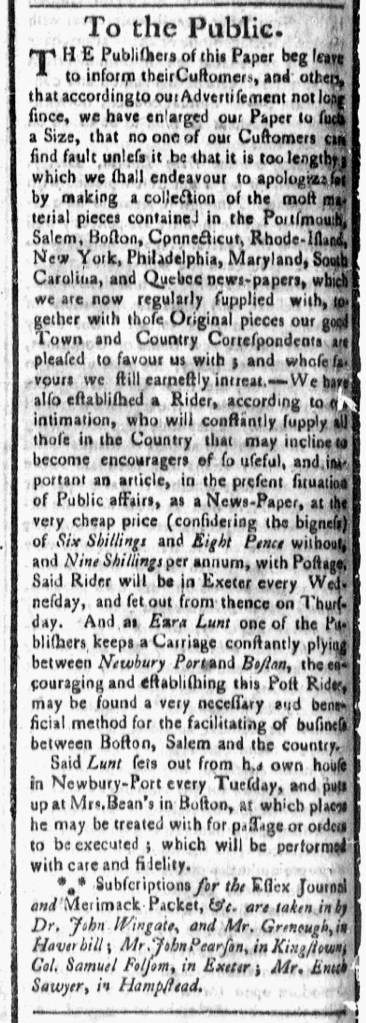
An advertisement in the February 15, 1775, edition of the Essex Journal, printed in Newburyport, Massachusetts, revealed important details about its production and circulation.  Ezra Lunt and Henry-Walter Tinges, the publishers, inserted an address “To the Public” to celebrate that they recently “enlarged our Paper to such a Size, that no one of our Customers can find fault unless it be that it is too lengthy.”  Lunt and Tinges coyly declared that they would “apologize” for the length by “making a collection of the most material pieces contained the Portsmouth, Salem, Boston, Connecticut, Rhode-Island, New York, Philadelphia, Maryland, South Carolina, and Quebec news-papers.”  They asserted that they “are now regularly supplied with” newspapers from all those places.  Like other colonial printers, Lunt and Tinges participated in exchange networks with their counterparts in other cities and towns.  Upon receiving newspapers, they scoured them for content to include in their own publication, usually reprinting articles, editorials, essays, and letters word for word.  One header in the February 15 edition, for instance, stated, “From the Massachusetts Spy.”  They supplemented news from far and wide with “Original pieces our good Town and Country Correspondents are pleased to favour us with.”

Lunt and Tinges’s also gave details about the circulation of the Essex Journal, both where to subscribe and logistics for delivery.  They informed readers that subscriptions “are taken in by Dr. John Wingate, and Mr. Grenough, in Haverhill; Mr. John Pearson, in Kingstown; Col. Samuel Folsom, in Exeter; Mr. Enoch Sawyer, in Hampstead.”  That list of local agents resembled the one that appeared in the colophon of each issue of the Massachusetts Spy, printed by Isaiah Thomas in Boston.  At the bottom of the last page, readers glimpsed an announcement that “J. Larkin, Chairmaker, and Mr. W. Calder, Painter, in Charlestown; Mr. J. Hiller, Watch maker, in Salem; Mr. B. Emerson, Bookseller, in Newbury-Port; Mr. M. Belcher, in Bridgewater; and [] Dr. Elijah Hewins, in Stoughtonham” collected subscriptions for the Massachusetts Spy.  Tinges likely learned about recruiting local agents from Thomas, a founding partner of the Essex Journal.  When it came to delivering the newspaper to subscribers, Lunt and Tinges promoted the services of both a post rider whose route included Exeter, New Hampshire, and the carriage that Lunt operated between Newburyport and Boston.  This network “facilitate[ed] business between Boston, Salem, and the country” in addition to disseminating newspapers.

Intended to increase the number of subscribers (and, in turn, advertisers), this advertisement in the Essex Journal testified to several business practices followed by printers throughout the colonies.  Lunt and Tinges described the various kinds of networks that played a role in gathering subscriptions, collecting news and other content, and delivering newspapers to readers.  Each played a role in making information more widely available to the public during the era of the American Revolution.