December 21

What was advertised in a colonial American newspaper 250 years ago today?

Essex Journal (December 21, 1774).

Intend to enlarge the paper equal to any in the province the year ensuing.”

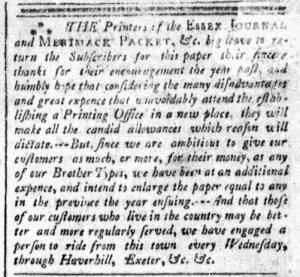
The Essex Journal and Merimack Packet: Or The Massachusetts and New-Hampshire General Advertiser completed its first year of publication with its December 21, 1774, edition.  For the last time, the masthead stated, “VOL. I.”  The compositor updated that to “VOL. II” the following week.  Isaiah Thomas and Henry-Walter Tinges launched the newspaper, published in Newburyport, with a free preview issue on December 4, 1773, then commenced weekly publication on December 29.  Thomas withdrew from the partnership in August 1774, about the same time that he transferred proprietorship of the Royal American Magazine to Joseph Greenleaf.  Ezra Lunt joined Tinges in publishing the Essex Journal without a disruption in distributing the newspaper to subscribers.  Despite those disruptions and the “many disadvantages and great expence that unavoidably attend the establishing a Printing Office in a new place,” the Essex Journal made it through its first year and continued into a second.

In a notice in the final issue of Volume I, Lunt and Tinges announced their plans to improve and expand the newspaper.  They proclaimed that they “are ambitious to give our customers as much, or more, for their money, as any of our Brother Types” who published the Essex Gazette in Salem, the New-Hampshire Gazette in Portsmouth, or any of the five newspapers printed in Boston at the time.  To that end, Lunt and Tinges confided, “we have been at an additional expence, and intend to enlarge the paper equal to any in the province the year ensuing.”  Furthermore, they sought to improve the newspaper for subscribers in other ways.  In order that “those of our customers who live in the country may be better and more regularly served, we have engaged a person to ride from this town every Wednesday, through Haverhill, Exeter,” and other towns.  Lunt and Tinges published the Essex Journal on Wednesdays.  As soon as the ink dried, they gave copies to a postrider to deliver to subscribers throughout the countryside, improving on the services provided throughout the previous year.

Printers often noted when their newspapers completed another year of publication, often marking the occasion with calls for subscribers and others to settle overdue accounts.  Lunt and Tinges did not make any mention of subscribers who were delinquent in making payment.  Instead, they expressed their appreciation and sketched their plans for the next year, hoping to increase support and enthusiasm for the newest newspaper published in Massachusetts.

November 11

What was advertised in a colonial American newspaper 250 years ago today?

Connecticut Journal (November 11, 1774).

“To be sold by the Printers hereof, And by Nathan Hicok, Post-Rider.”

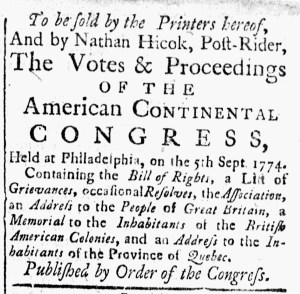
Throughout the colonies, printers provided updates from the First Continental Congress during its meeting in September and October 1774.  After the delegates adjourned and traveled home, printers quickly set about publishing, advertising, distributing, and selling a pamphlet that included an overview of the “Votes & Proceedings” as well as “the Bill of Rights, a List of Grievances, occasional Resolves, the Association, an Address to the People of Great Britain, a Memorial to the Inhabitants of the British American Colonies, and an Address to the Inhabitants of the Province of Quebec.”  William Bradford and Thomas Bradford, printers of the Pennsylvania Journal, first made the pamphlet available in Philadelphia just a week after the meeting ended.  Other printers soon joined them, producing their own local editions.

That included Thomas Green and Samuel Green, the printers of the Connecticut Journal and New-Haven Post-Boy.  On November 4, they alerted readers that the “Proceedings of the Continental Congress will shortly be ready for sale at the Printing Office.”  A week later, they ran a new advertisement, this time announcing that they sold the pamphlet.  Yet customers did not have to visit the printing office or send an order to acquire copies because the Greens enlisted Nathan Hicok, a post rider, in selling as well as delivering the “Votes & Proceedings” to colonizers seeking to keep informed beyond the coverage in newspapers.  It was not the first time that the Greens designated Hicok as one of their agents for disseminating printed items that supported the patriot cause.  On September 30, 1774, they advertised “The celebrated SPEECH, of the Bishop of St. Asaph, on the Bill for altering the Charter of the Colony of Massachusetts-Bay.  To be sold by the Printers, and Nathan Hicok, jun.”  Advertisements in several newspapers demonstrate that several post riders became partners with printers in marketing and selling political pamphlets as the imperial crisis intensified.  Even more post riders, though not named in newspaper advertisements, may have assumed similar responsibilities, actively promoting sales of such items rather than merely delivering them at the behest of printers and their customers.

July 1

What was advertised in a colonial American newspaper 250 years ago today?

Connecticut Gazette (July 1, 1774).

To be sold by … CONSTITUTIONAL Post-Riders.”

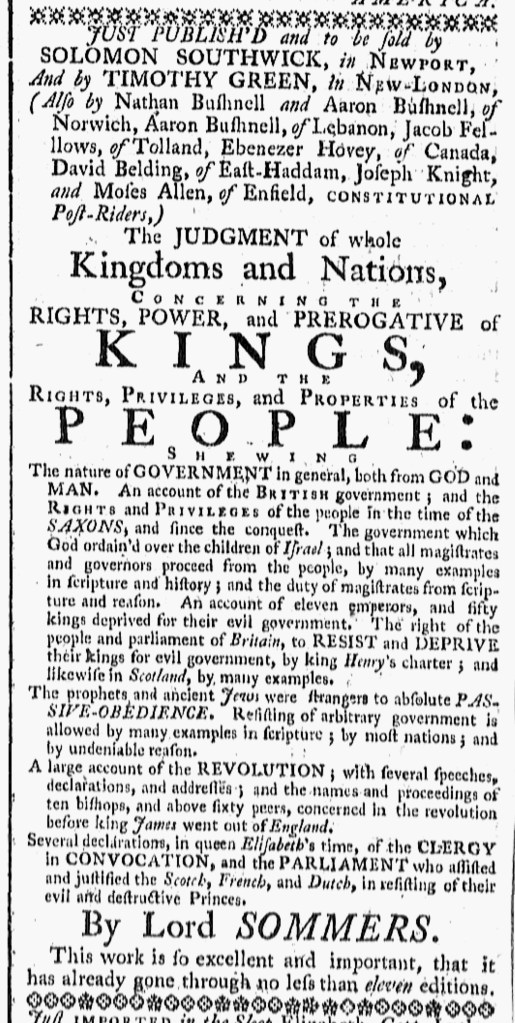
The front page of the July 1, 1774, edition of the Connecticut Gazette featured an open letter “TO THE KING” from “AMERICA” followed immediately by an advertisement for a book, The Judgment of Whole Kingdoms and Nations, Concerning the Rights, Power, and Prerogative of Kings, and the Rights, Privileges, and Properties of the People.  The petition requested a redress of grievances that took into account the “rights and privileges … solemnly given, granted, confirmed, ratified and recognized … by your royal predecessors and their parliaments.”  The book, a constitutional history of Great Britain, echoed that theme in much greater detail, making it hardly a coincidence that advertisement just happened to follow the letter.

American printers in three cities had recently produced American editions of The Judgment of Whole Kingdoms and Nations.  In 1773, John Dunlap printed it in Philadelphia and Isaiah Thomas printed it for John Langdon, a bookseller, in Boston.  The advertisement promoted a 1774 edition “JUST PUBLISH’D and to be sold by SOLOMON SOUTHWICH, in NEWPORT.”  Timothy Green, the printer of the Connecticut Gazette, also sold the book in New London.  In addition, readers could acquire it from “CONSTITUTIONAL Post-Riders” who operated out of Norwich, Lebanon, Tolland, East Haddam, and Enfield.  The National Postal Museum explains that the Constitutional Post was “an alternative to the British run Parliamentary Post.”  William Goddard originally established a “new constitutional Post … between [Philadelphia] and Baltimore” and quickly expanded it.  According to the National Postal Museum, Goddard considered the Parliamentary Post “unacceptable because it was not private – postmasters were allowed to intercept and open letters – and because he saw it as another form of taxation without the colonists’ consent.”  Many shared this view; the number of riders in Connecticut affiliated with the Constitutional Post just a few months after its founding demonstrates that was the case.  In July 1775, the Second Continental Congress assumed responsibility for the Constitutional Post, appointing Benjamin Franklin as postmaster.  Goddard desired the position, but he settled for Riding Surveyor of the Post.  By then, the Constitutional Post had demonstrated its capacity for delivering letters, newspapers, and books.  In the summer of 1774, for instance, the Constitutional Post served as a distribution network for The Judgment of Whole Kingdoms and Nations, consistent with Goddard’s vision for maintaining English rights and liberties in the colonies.

April 29

What was advertised in a colonial American newspaper 250 years ago today?

New-Hampshire Gazette (April 29, 1774).

WATCHES sent … by Post Riders, will be mended, cleaned and sent back with great Care.”

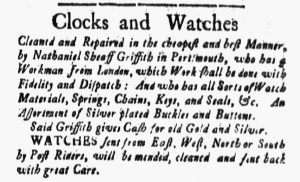
In the spring of 1774, Nathaniel Sheaff Griffith once again advertised that he “Cleaned and Repaired” clocks and watches “in the cheapest and best Manner,” making appeals to both price and skill.  He regularly ran notices in the New-Hampshire Gazette, but this one included an update about an employee who worked in his shop in Portsmouth.  Griffith advised prospective customers that he “has a Workman from London, which Work shall be done with Fidelity and Dispatch.”  In other words, Griffith vouched for his employee.  Other artisans in New England sometimes promoted the work undertaken by their employees.  For instance, Charles Stevens, a goldsmith and silversmith in Providence, informed the public that he “employs an excellent Workman from London” who did “all Kinds of Jewellers Work.”  Similarly, Enos Doolittle advised readers of the Connecticut Courant that he “employed a journeyman who has serv’d a regular Apprenticeship to the Watchmaking business in London.”  Griffith, Stevens, and Doolittle all signaled that they could effectively serve an even more extensive clientele thanks to the workmen from London who labored in their shops.

That may have been a factor in another marketing strategy that Griffith deployed for the first time.  He concluded his advertisement with a note that “WATCHES sent from East, West, North or South by Post Riders, will be mended, cleaned and sent back with great Care.”  While he may have done business that way in the past, he had not previously mentioned this option in his newspaper advertisements.  Perhaps now that he had an assistant Griffith felt more secure in advertising this service widely.  Once again, other artisans in New England also marketed similar arrangements.  Thomas Hilldrup, a watchmaker from London who settled in New London, declared that clients could “forward their Watches to me … by applying to Mr. JOSEPH KNIGHT, Post-Rider.”  He promised the same sort of “Dispatch” or quick service that Griffith did, stating that any watches he received would be “returned regularly the next Week.”  Post riders provided an infrastructure for watchmakers like Griffith and Hilldrup to serve clients who lived at a distance, expanding their business to rural towns rather than working solely for local customers in port cities.

April 18

What was advertised in a colonial American newspaper 250 years ago today?

Massachusetts Gazette and Boston Post-Boy (April 18, 1774).

“He will carry Papers and deliver them to such Gentlemen as are pleased to encourage him.”

When Moses Cleveland set about establishing “a Post to ride weekly between Norwich and Boston” in 1774, he initially advertised in the Norwich Packet.  He pledged that he “will carry this Paper, and deliver it to such Gentlemen as are pleased to encourage it, with the utmost Regularity.”  Soon after, he ran a nearly identical advertisement in the Massachusetts Spy, the newspaper that Isaiah Thomas printed in Boston.  Cleveland realized that the success of the venture depended on attracting as many customers as possible at both ends of his route and places on the way.

His notice in the Massachusetts Spy featured a small, but important, variation.  It stated that he “will carry this and other papers,” acknowledging that five newspapers were published in Boston at the time, “and the Royal American MAGAZINE.”  When I first examined that advertisement, I conjectured that Cleveland had not written that last bit of copy but instead Thomas seized an opportunity to market the new magazine he launched a couple of months earlier.  Cleveland’s advertisement gave the magazine more visibility, while the post rider’s service made the magazine accessible to prospective subscribers in Norwich, “WINDHAM, POMFRET, MENDON,” and other towns in Connecticut and Massachusetts.

Cleveland did not advertise in all the Boston newspapers.  Perhaps that would have been prohibitively expensive as he sought to raise funds for his venture.  Yet he did not confine his advertising to the Massachusetts Spy.  Instead, he placed a notice in the Massachusetts Gazette and Boston Post-Boy, again nearly identical.  In that one, he declared that he “will carry Papers and deliver them to such Gentlemen as are pleased to encourage him,” making no mention of the Royal American Magazine.  This strongly suggests that Thomas did indeed make an editorial intervention in Cleveland’s advertisement, grafting his own marketing efforts onto the newspaper notice purchased by the post rider.

March 31

What was advertised in a colonial American newspaper 250 years ago today?

Norwich Packet (March 31, 1774).

“Set off from the Printing-Office in Norwich every Thursday, immediately after the Publication of the NORWICH PACKET.”

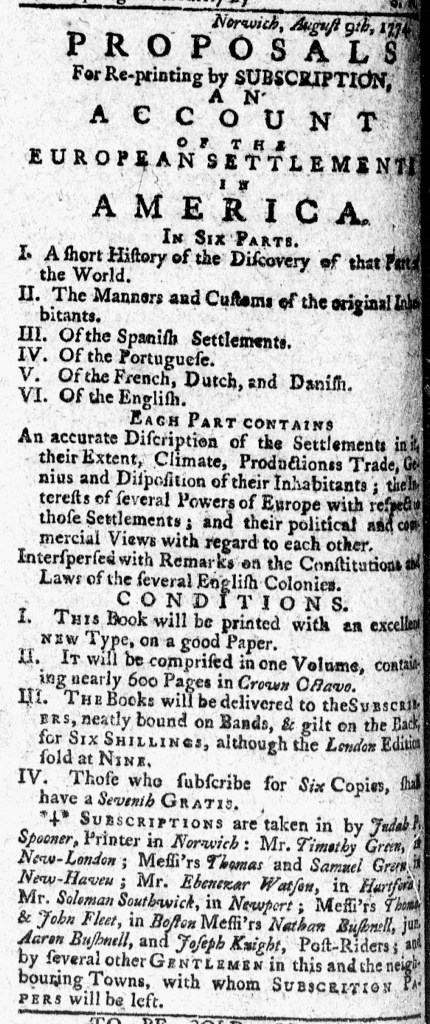
When Moses Cleveland set about establishing a “Post to ride weekly between Norwich and Boston,” he simultaneously advertised in newspapers in both towns.  His advertisements, dated March 23, 1774, first appeared in the March 24 edition of the Norwich Packet and ran a week later in the Massachusetts Spy.  Cleveland covered a route that incorporated stops in both Connecticut and Massachusetts, including Windham, Pomfret, and Mendon.  He advised prospective customers that he would “set out from the Printing-Office in Norwich every Thursday, immediately after the Publication of the NORWICH PACKET.”  Customers in Connecticut received that newspaper hot off the presses, while those in Boston only waited a couple of days.  He arrived there on Saturdays, delivering news from the west that the Boston Evening-Post, Boston-Gazette, and Massachusetts Gazette and Boston Post-Boy might publish the following Monday.  Cleveland remained there until Monday morning before returning to Norwich via the same route.

Massachusetts Spy (March 31, 1774).

His advertisement in the Massachusetts Spy featured almost identical copy, though either the postrider or the printer, Isaiah Thomas, made some updates.  In the Norwich Packet, Cleveland declared that he “will carry this Paper,” while in the Massachusetts Spy he stated that he “will carry this and other papers, and the Royal American MAGAZINE,” the publication that Thomas launched earlier in the year and had been promoting in the public prints from New Hampshire to Maryland for months.  Perhaps Cleveland instructed Thomas to mention the magazine in his advertisement, but a revision to the nota bene that concluded the notice suggests that Thomas did so on his own.  In the Norwich Packet, that postscript indicated that Cleveland “has employed a Post to ride every Week from Norwich to Hartford, [and] serve the Customers with this Paper.”  In the Massachusetts Spy, on the other hand, the nota bene advised that Cleveland “has employed a post to ride every week from NORWICH to HARTFORD, [and] serve the customers with News-Papers [and] Magazines.”  Had delivering the Royal American Magazine, the only magazine published in the colonies at the time, or any other magazines been among the services that Cleveland thought most likely to garner attention from prospective customers, he probably would have mentioned magazines in his advertisement that originated in the Norwich Packet.  More likely, the savvy Thomas seized an opportunity to promote his magazine and assure subscribers beyond Boston that they would receive it in a timely manner.

February 23

What was advertised in a colonial American newspaper 250 years ago today?

Pennsylvania Journal (February 23, 1774).

“A RIDER between Philadelphia and that place.”

William Stenson played a part in establishing and maintaining the communication infrastructure that connected Baltimore and Philadelphia and points in between in the mid 1770s.  Though it had not displaced Annapolis, Baltimore became an increasingly significant urban port on the eve of the American Revolution.  In August 1773, William Goddard launched the Maryland Journal, the city’s first newspaper.  At about the same time, Joseph Rathell attempted to establish a subscription library, but could not manage to generate sufficient interest to compete with William Aikman’s circulating library in Annapolis.  For a small fee, Aikman delivered books to subscribers in Baltimore.

Still, Baltimore was becoming an increasingly important commercial center, a place of interest for merchants and others in Philadelphia.  That created an opportunity for Stenson.  On February 23, 1774, he informed readers of the Pennsylvania Journal that he was “employed by a number of Gentlemen in Baltimore, &c. as a RIDER between Philadelphia and that place” and offered his services during his weekly transit.  He left Philadelphia “early every Thursday morning” and arrived in Baltimore “on Friday evening.”  He stayed until Monday morning and returned to Philadelphia “on Tuesday evenings.”

Stenson attempted to hire his services by the year, suggesting how regularly he believed some prospective clients in Philadelphia wished to contact correspondents in Baltimore and towns on the way.  He offered a “yearly subscription,” pledging that “whatever affairs may be committed to the care of the subscriber, will be performed with all possible fidelity and dispatch.”  For those not ready to pay for his services for an entire year, the rider promised that they “may have their business done at reasonable rates.”  Clients could contact him or leave orders “at Mr. WILLIAM GRAHAM’s, at the sign of the Black Horse” on Market Street.  Alternately, a “subscription paper now lies at the London Coffee-House,” a popular gathering place for Philadelphia’s merchants to conduct business.  Stenson aimed to make procuring his services as convenient as possible for his prospective clients.

December 29

What was advertised in a colonial American newspaper 250 years ago today?

Essex Journal (December 29, 1773).

“The Number of at present, is insufficient to defrey the expence attending the Printing of a News-Paper.”

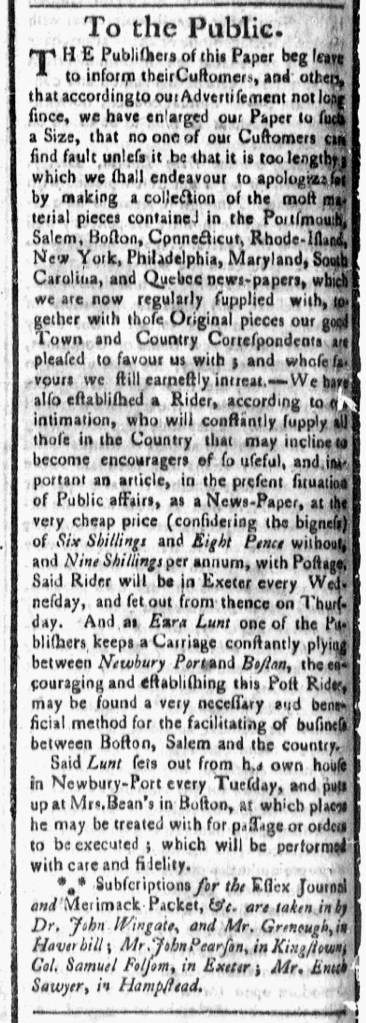
After published an inaugural issue of the Essex Journal and distributing it gratis to incite interest in the first newspaper published in Newburyport, Massachusetts, Isaiah Thomas and Henry-Walter Tinges paused publication to gather the names of subscribers.  More than three weeks after that first issue appeared on December 4, 1773, Thomas and Tinges commenced weekly publication of the Essex Journal.  In a notice on the first page, they confessed to “such Gentlemen and Ladies who wish well to this undertaking and have not yet subscribed that THEIR helping hands are wanted to bear up this Fabrick, … which if not well supported will fall, and lay the Foundation in Ruins.”  In other words, “the Number of Subscribers at present, is insufficient to defrey the expence attending the Printing of a News-Paper.”

Still, Thomas and Hinges took a chance, hoping that publishing a second and subsequent issues would convince prospective customers who intended to subscribe but had not yet done so to submit their names to the printing office.  According to the printers, some had indicated that was their plan: “we were assured that many intended to subscribe on the appearance of a second paper, and others would, at times, drop in.”  The fate of the newspaper depended on the “kindness and generosity” of subscribers.

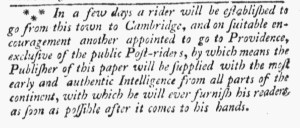
In addition to printing a second issue to demonstrate the usefulness of the venture to readers in Newburyport and other towns in Massachusetts and New Hampshire, Thomas and Hinges adjusted the publication date to suit the needs of the community.  They distributed the inaugural issue on a Saturday, but learned that “meets not the public approbation,” so they “altered the day of publication to WEDNESDAY, which is greatly approved of.”  In turn, that required a new investment on the part of the printers: “we intend establishing a rider from Boston to this place, that we may have the most early and authentic intelligence.”  Thomas also published the Massachusetts Spy in Boston on Thursdays.  He may have originally thought that the Essex Journal could reprint content from that newspaper on Saturdays, but delivering “the most early and authentic intelligence” on Wednesdays likely meant drawing more content from the Boston Evening-Post, the Boston-Gazette, and Massachusetts Gazette and Boston Post-Boy, all of them published on Mondays.  Thomas and Hinges noted the “not very inconsiderable” expense, but also declared their commitment “to spare no pains or cost in our power to tender, in future, THIS paper as useful and entertaining as any News-Paper in America.”

Thomas and Hinges apparently gained more subscribers as well as advertisers.  They published the Essex Journal on every Wednesday in 1774 and Hinges and a new partner continued into 1775.  Then publication became sporadic in May, following the fighting at Lexington and Concord, and moved to Fridays for the remainder of the year, throughout most of 1776, before moving to Thursdays and ceasing in February 1777.

December 10

What was advertised in a colonial American newspaper 250 years ago today?

New-London Gazette (December 10, 1773).

“Forward their Watches to me … by applying to Mr. JOSEPH KNIGHT, Post-Rider.”

Thomas Hilldrup, “WATCK-MAKER from LONDON,” continued his advertising campaign in the fall of 1773.  Having settled in Hartford the previous year, he first set about cultivating a local clientele with advertisements in the Connecticut Courant, that town’s only newspaper.  Over time, he expanded his marketing efforts to include the Connecticut Journal and New-Haven Post-Boy and the New-London Gazette.  That meant that he advertised in every newspaper published in Connecticut at the time.  In an advertisement that ran for several months, Hilldrup declared that he had been “IMbolden’d by the encouragement receiv’d from the indulgent public” to move to a new location “now distinguish’d by the sign of the Dial.”  In other words, business had been good, customers had entrusted their watches to the enterprising newcomer for cleaning and repairs, and that demand for his services meant that others should engage him as well.

To that end, Hilldrup presented instructions for sending watches to his shop.  He appended a nota bene to his advertisement in the New-London Gazette, stating that the “Gentlemen of New-London, or adjacent, that are inclined to forward their Watches to me, may depend on having them done as well and as cheap as in Boston or New-York.”  In addition, Hilldrup offered speedy service, promising to return watches “the next Week.”  Clients could take advantage of these services, including a one-year warranty, “by applying to Mr. JOSEPH KNIGHT, Post-Rider.”  Knight did far more than deliver letters and newspapers from town to town.  He also contracted with various entrepreneurs to facilitate their businesses.  In addition to transporting watches for Hilldrup, Knight also sold “An ORATION, Upon the BEAUTIES of LIBERTY,” a popular political tract, in collaboration with Timothy Green, the printer of the New-London Gazette, and Nathan Bushnell, Jr., another post rider.  In forming a partnership with Knight, Hilldrup established an infrastructure for transporting watches to and from his shop, one that he could promote to prospective clients who might have otherwise been anxious about sending their watches over long distances.  Enlisting an associate already familiar in several towns in Connecticut, Hilldrup marketed an approved and secure method for sending watches to him to restore “to their pristine vigour.”