March 31

What was advertised in a colonial American newspaper 250 years ago today?

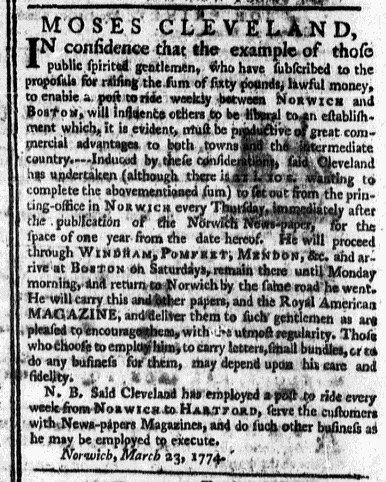
Norwich Packet (March 31, 1774).

“Set off from the Printing-Office in Norwich every Thursday, immediately after the Publication of the NORWICH PACKET.”

When Moses Cleveland set about establishing a “Post to ride weekly between Norwich and Boston,” he simultaneously advertised in newspapers in both towns.  His advertisements, dated March 23, 1774, first appeared in the March 24 edition of the Norwich Packet and ran a week later in the Massachusetts Spy.  Cleveland covered a route that incorporated stops in both Connecticut and Massachusetts, including Windham, Pomfret, and Mendon.  He advised prospective customers that he would “set out from the Printing-Office in Norwich every Thursday, immediately after the Publication of the NORWICH PACKET.”  Customers in Connecticut received that newspaper hot off the presses, while those in Boston only waited a couple of days.  He arrived there on Saturdays, delivering news from the west that the Boston Evening-Post, Boston-Gazette, and Massachusetts Gazette and Boston Post-Boy might publish the following Monday.  Cleveland remained there until Monday morning before returning to Norwich via the same route.
Massachusetts Spy (March 31, 1774).

His advertisement in the Massachusetts Spy featured almost identical copy, though either the postrider or the printer, Isaiah Thomas, made some updates.  In the Norwich Packet, Cleveland declared that he “will carry this Paper,” while in the Massachusetts Spy he stated that he “will carry this and other papers, and the Royal American MAGAZINE,” the publication that Thomas launched earlier in the year and had been promoting in the public prints from New Hampshire to Maryland for months.  Perhaps Cleveland instructed Thomas to mention the magazine in his advertisement, but a revision to the nota bene that concluded the notice suggests that Thomas did so on his own.  In the Norwich Packet, that postscript indicated that Cleveland “has employed a Post to ride every Week from Norwich to Hartford, [and] serve the Customers with this Paper.”  In the Massachusetts Spy, on the other hand, the nota bene advised that Cleveland “has employed a post to ride every week from NORWICH to HARTFORD, [and] serve the customers with News-Papers [and] Magazines.”  Had delivering the Royal American Magazine, the only magazine published in the colonies at the time, or any other magazines been among the services that Cleveland thought most likely to garner attention from prospective customers, he probably would have mentioned magazines in his advertisement that originated in the Norwich Packet.  More likely, the savvy Thomas seized an opportunity to promote his magazine and assure subscribers beyond Boston that they would receive it in a timely manner.

February 23

What was advertised in a colonial American newspaper 250 years ago today?

Pennsylvania Journal (February 23, 1774).

“A RIDER between Philadelphia and that place.”

William Stenson played a part in establishing and maintaining the communication infrastructure that connected Baltimore and Philadelphia and points in between in the mid 1770s.  Though it had not displaced Annapolis, Baltimore became an increasingly significant urban port on the eve of the American Revolution.  In August 1773, William Goddard launched the Maryland Journal, the city’s first newspaper.  At about the same time, Joseph Rathell attempted to establish a subscription library, but could not manage to generate sufficient interest to compete with William Aikman’s circulating library in Annapolis.  For a small fee, Aikman delivered books to subscribers in Baltimore.

Still, Baltimore was becoming an increasingly important commercial center, a place of interest for merchants and others in Philadelphia.  That created an opportunity for Stenson.  On February 23, 1774, he informed readers of the Pennsylvania Journal that he was “employed by a number of Gentlemen in Baltimore, &c. as a RIDER between Philadelphia and that place” and offered his services during his weekly transit.  He left Philadelphia “early every Thursday morning” and arrived in Baltimore “on Friday evening.”  He stayed until Monday morning and returned to Philadelphia “on Tuesday evenings.”

Stenson attempted to hire his services by the year, suggesting how regularly he believed some prospective clients in Philadelphia wished to contact correspondents in Baltimore and towns on the way.  He offered a “yearly subscription,” pledging that “whatever affairs may be committed to the care of the subscriber, will be performed with all possible fidelity and dispatch.”  For those not ready to pay for his services for an entire year, the rider promised that they “may have their business done at reasonable rates.”  Clients could contact him or leave orders “at Mr. WILLIAM GRAHAM’s, at the sign of the Black Horse” on Market Street.  Alternately, a “subscription paper now lies at the London Coffee-House,” a popular gathering place for Philadelphia’s merchants to conduct business.  Stenson aimed to make procuring his services as convenient as possible for his prospective clients.

December 29

What was advertised in a colonial American newspaper 250 years ago today?

Essex Journal (December 29, 1773).

“The Number of at present, is insufficient to defrey the expence attending the Printing of a News-Paper.”

After published an inaugural issue of the Essex Journal and distributing it gratis to incite interest in the first newspaper published in Newburyport, Massachusetts, Isaiah Thomas and Henry-Walter Tinges paused publication to gather the names of subscribers.  More than three weeks after that first issue appeared on December 4, 1773, Thomas and Tinges commenced weekly publication of the Essex Journal.  In a notice on the first page, they confessed to “such Gentlemen and Ladies who wish well to this undertaking and have not yet subscribed that THEIR helping hands are wanted to bear up this Fabrick, … which if not well supported will fall, and lay the Foundation in Ruins.”  In other words, “the Number of Subscribers at present, is insufficient to defrey the expence attending the Printing of a News-Paper.”

Still, Thomas and Hinges took a chance, hoping that publishing a second and subsequent issues would convince prospective customers who intended to subscribe but had not yet done so to submit their names to the printing office.  According to the printers, some had indicated that was their plan: “we were assured that many intended to subscribe on the appearance of a second paper, and others would, at times, drop in.”  The fate of the newspaper depended on the “kindness and generosity” of subscribers.

In addition to printing a second issue to demonstrate the usefulness of the venture to readers in Newburyport and other towns in Massachusetts and New Hampshire, Thomas and Hinges adjusted the publication date to suit the needs of the community.  They distributed the inaugural issue on a Saturday, but learned that “meets not the public approbation,” so they “altered the day of publication to WEDNESDAY, which is greatly approved of.”  In turn, that required a new investment on the part of the printers: “we intend establishing a rider from Boston to this place, that we may have the most early and authentic intelligence.”  Thomas also published the Massachusetts Spy in Boston on Thursdays.  He may have originally thought that the Essex Journal could reprint content from that newspaper on Saturdays, but delivering “the most early and authentic intelligence” on Wednesdays likely meant drawing more content from the Boston Evening-Post, the Boston-Gazette, and Massachusetts Gazette and Boston Post-Boy, all of them published on Mondays.  Thomas and Hinges noted the “not very inconsiderable” expense, but also declared their commitment “to spare no pains or cost in our power to tender, in future, THIS paper as useful and entertaining as any News-Paper in America.”

Thomas and Hinges apparently gained more subscribers as well as advertisers.  They published the Essex Journal on every Wednesday in 1774 and Hinges and a new partner continued into 1775.  Then publication became sporadic in May, following the fighting at Lexington and Concord, and moved to Fridays for the remainder of the year, throughout most of 1776, before moving to Thursdays and ceasing in February 1777.

December 10

What was advertised in a colonial American newspaper 250 years ago today?

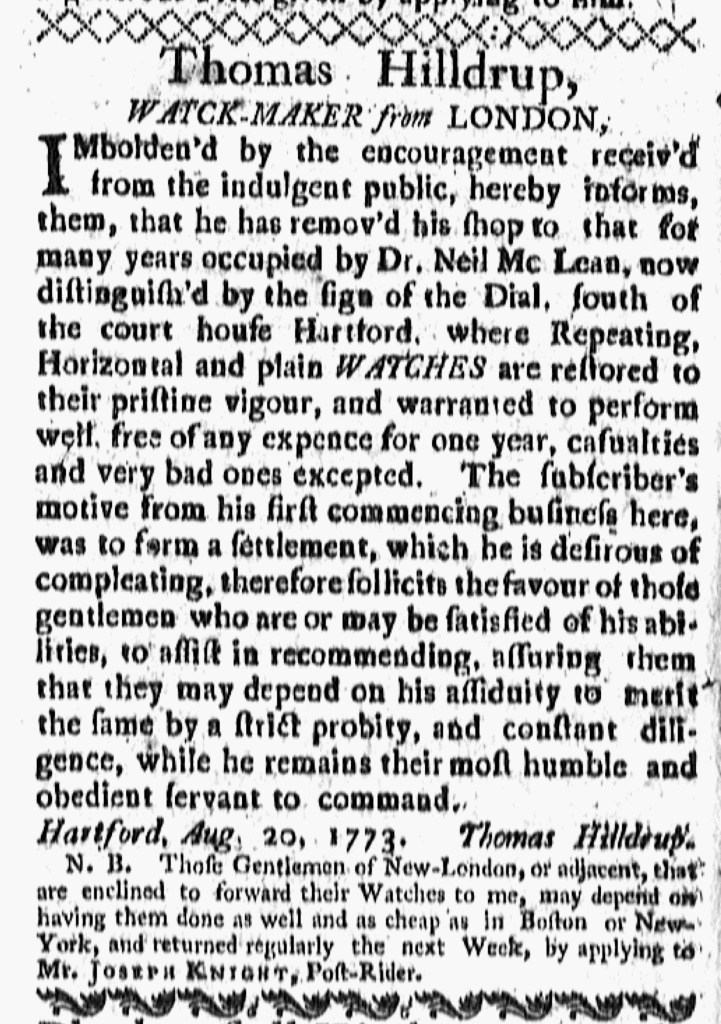
New-London Gazette (December 10, 1773).

“Forward their Watches to me … by applying to Mr. JOSEPH KNIGHT, Post-Rider.”

Thomas Hilldrup, “WATCK-MAKER from LONDON,” continued his advertising campaign in the fall of 1773.  Having settled in Hartford the previous year, he first set about cultivating a local clientele with advertisements in the Connecticut Courant, that town’s only newspaper.  Over time, he expanded his marketing efforts to include the Connecticut Journal and New-Haven Post-Boy and the New-London Gazette.  That meant that he advertised in every newspaper published in Connecticut at the time.  In an advertisement that ran for several months, Hilldrup declared that he had been “IMbolden’d by the encouragement receiv’d from the indulgent public” to move to a new location “now distinguish’d by the sign of the Dial.”  In other words, business had been good, customers had entrusted their watches to the enterprising newcomer for cleaning and repairs, and that demand for his services meant that others should engage him as well.

To that end, Hilldrup presented instructions for sending watches to his shop.  He appended a nota bene to his advertisement in the New-London Gazette, stating that the “Gentlemen of New-London, or adjacent, that are inclined to forward their Watches to me, may depend on having them done as well and as cheap as in Boston or New-York.”  In addition, Hilldrup offered speedy service, promising to return watches “the next Week.”  Clients could take advantage of these services, including a one-year warranty, “by applying to Mr. JOSEPH KNIGHT, Post-Rider.”  Knight did far more than deliver letters and newspapers from town to town.  He also contracted with various entrepreneurs to facilitate their businesses.  In addition to transporting watches for Hilldrup, Knight also sold “An ORATION, Upon the BEAUTIES of LIBERTY,” a popular political tract, in collaboration with Timothy Green, the printer of the New-London Gazette, and Nathan Bushnell, Jr., another post rider.  In forming a partnership with Knight, Hilldrup established an infrastructure for transporting watches to and from his shop, one that he could promote to prospective clients who might have otherwise been anxious about sending their watches over long distances.  Enlisting an associate already familiar in several towns in Connecticut, Hilldrup marketed an approved and secure method for sending watches to him to restore “to their pristine vigour.”

November 14

What was advertised in a colonial American newspaper 250 years ago this week?

Norwich Packet (November 11, 1773).

“NOAH HIDDEN, has undertaken to ride Post between the town of NORWICH and PROVIDENCE.”

Today the Adverts 250 Project features an advertisement from the Norwich Packet and the Connecticut, Massachusetts, New-Hampshire, and Rhode-Island Weekly Advertiser for the first time.  After circulating subscription proposals during the summer of 1773, Alexander Robertson, James Robertson, and John Trumbull established the newspaper on October 7, “judging from the date of the earliest issue located, that of Nov. 4, 1773, vol. 1, no. 5.”[1]  America’s Historical Newspapers does not include that issue, but instead begins with the November 11 edition.  Noah Hidden, a post rider, placed the final advertisement in that issue, though he may have started advertising as early as the inaugural edition.

Hidden advised the public that he “has undertaken to ride Post between the Town of NORWICH and PROVIDENCE,” a distance of about fifty miles.  He departed from the printing office in Norwich on Thursdays and from Knight Dexter’s house in Providence on Saturdays.  Not by accident, this itinerary matched the publication schedule of the newspapers in both towns.  The Robertsons and Trumbull distributed a new edition of the Norwich Packet on Thursdays.  For many years, John Carter published the Providence Gazette on Saturdays.  Hidden carried “Letters, Papers, Memorandoms, or small Bundles left at either of said Places,” pledging to take good care of them and offering receipts “if required.”  In particular, he noted that he would provide “those who choose to employ him, with this PAPER.”

The post rider presented this enterprise as a valuable service “to the Inhabitants of both towns and the intermediate Country.”  He underscored the “great utility” of disseminating the information in the newspapers and letters he delivered along his route.  Furthermore, Hidden asserted that his contributions to the regional information infrastructure merited the “Encouragement which a faithful Discharge of the Business he has undertaken shall entitle him to.”  His endeavors help to explain how the Robertsons and Trumbull could suggest that a newspaper published in Norwich served each of the colonies in New England.  Like other colonial newspapers, the Norwich Packet circulated far beyond its place of publication.

**********

[1] Clarence S. Brigham, History and Bibliography of American Newspapers, 1690-1820 (Worcester: American Antiquarian Society, 1947), 66.

September 11

What was advertised in a colonial American newspaper 250 years ago today?

Providence Gazette (September 11, 1773).

“He now rides Post from Providence to Norwich, and will engage to deliver the Providence Gazette.”

In the early 1770s, the Providence Gazette simultaneously served as both local and regional newspaper.  With only two newspapers printed in Rhode Island, the Newport Mercury and the Providence Gazette, those publications provided news and advertising to towns throughout the colony as well as central and southeastern Massachusetts and western Connecticut.  Advertisements testify to the reach of the Providence Gazette, its dissemination beyond the port where John Carter printed the newspaper.

For instance, Reuben Bishop advertised his services as a post rider from in the fall of 1773.  He covered a route between Providence and Norwich, Connecticut, forty-five miles to the southwest.  Bishop offered to deliver the newspaper to “the present Subscribers on that Road, or to any others that may subscribe.”  Those others would have seen his advertisement when they perused copies of the Providence Gazette that passed from hand to hand, from household to household.  Colonial newspapers rarely had a single reader.  In addition to carrying letters and newspapers, Bishop proposed that he could “other Business, on reasonable Terms,” on behalf of those who engaged his services.  Customers in the Providence area could find him “at the House of Col. Knight Dexter” on Saturday mornings, the same day that Carter published a new weekly edition of the Providence Gazette.  Bishop presumably departed for Norwich once he had the newspapers to deliver to subscribers along his route.

Other advertisements in the September 11 edition also demonstrate that the Providence Gazette kept colonizers near and far informed about current events.  In one notice, Uzal Green of Coventry lamented that his wife, Martha, “hath eloped from me, and refuses to return to my Bed and Board.”  The aggrieved husband, who very likely gave his wife good reason for departing from his household, warned that he would not pay “any Debt of her contracting.”  He cut her off from his credit.  Unlike most husbands who placed such advertisements, he addressed his wife, declaring that he “will receive her kindly” if she “will return home to me.”  He trusted that she would read or hear about that overture thanks to the wide distribution of the Providence Gazette.  In another advertisement, the “Directors of the Congregational Meeting-House Lottery” in East Greenwich provided an update about their endeavor and directed colonizers to purchase tickets from agents in their town, Providence, and Newport.

After the American Revolution, printing offices established newspapers in many more towns, but throughout the colonial period newspaper publication was concentrated in major and minor ports.  Post riders like Reuben Bishop provided a valuable service in disseminating the Providence Gazette and other newspapers far beyond their places of publication.

August 21

What was advertised in a colonial American newspaper 250 years ago this week?

Maryland Journal (August 20, 1773).

“He rides POST from the town of Baltimore to the town of Frederick (once a week).”

The inaugural issue of the Maryland Journal carried twenty advertisements in addition to an address from William Goddard, the printer, news from London, Philadelphia, and Baltimore, an essay “On the SIMPLICITY OF DRESS,” a letter responding to an editorial in the Maryland Gazette, prices current for commodities in Baltimore, a list of letters arrived “by the Frederick-Town POST,” and a poem.  Like other colonial newspapers, the Maryland Journal featured a variety of content.  As Goddard explained in his address, the publication “shall contain not only the Public News, which I shall collect and compile with the greatest Care, but … I will supply the Room with such moral Pieces, from the best Writers, as will conduce most to inculcate good Principles and humane Behaviour, and now and then with Pieces of Wit and Humour, that tend both to amuse and instruct.”

The advertisements included one from the post rider who had delivered the letters from Frederick, a town about forty-five miles west of Baltimore.  Absalom Bonham informed the public that he made the journey between Baltimore and Frederick once a week.  In addition, he continued from Frederick on to Winchester, Virginia, delivering messages, carrying letters, and distributing newspapers.  The post rider also served as a subscription agent for the Maryland Journaland the Pennsylvania Chronicle, the newspaper that Goddard had published in Philadelphia for the past several years.  Bonham set off “from Mr. WILLIAM ADAMS’s, at the sign of the Race Horses, in Baltimore,” every Saturday afternoon, the day after the weekly edition of the Maryland Journal went to press.  He apparently figured that residents of Frederick, Winchester, and other towns along the way were already familiar enough with his comings and goings that he did not need to provide additional information about his route and schedule.

In another notice in the inaugural issue, Goddard offered employment to an “active faithful Man, who can write a tolerable Hand, and keep a fair Account, and is otherwise well qualified to ride as a private POST or CARRIER between this Town and Philadelphia, once a Week.”  The printer needed a trustworthy assistant bow that he oversaw publication of newspapers in two towns.  Both of these advertisements testified to the infrastructure for producing and, especially, disseminating newspapers in eighteenth-century America.  Goddard had already undertaken a campaign for attracting subscribers for the Maryland Journal.  Bonham, the post rider, continued those efforts as part of his duties in the towns he visited each week.

July 2

What was advertised in a colonial American newspaper 250 years ago today?

New-London Gazette (July 2, 1773).

Also at the Printing-Office in Norwich, and by Nathan Bushnell, jun. and Joseph Knight, Post Riders.”

In early July 1773, Timothy Green, the printer of the New-London Gazette, ran an advertisement for a pamphlet that he “Just Publish’d” and sold at the printing office.  He noted that it was the “Third EDITION corrected.”  The Adverts 250 Project has traced the marketing of earlier editions of that pamphlet, John Allen’s “ORATION, Upon the BEAUTIES of LIBERTY, Or the essential Rights of the AMERICANS,” a publication that John M. Bumsted and Charles E. Clark have described as “one of the best-selling pamphlets of the pre-Revolutionary crisis, passing through seven editions in four cities between 1773 and 1775.”[1]

In advertisements in the Massachusetts Gazette and Boston Weekly News-Letter and the Massachusetts Spy on January 14, 1773, Benjamin Kneeland and Nathaniel Davis announced that the pamphlet was “Now in the press, and will be published in a few days.”  A week later, the printers announced “This Day was published” the “SECOND EDITION.”  Newspaper advertisements did not account for the first edition.  It did not take long for Samuel Hall and Ebenezer Hall, the printers of the Essex Gazette, to advertise that they sold the pamphlet at their printing office in Salem.  Copies of the Oration circulated beyond Boston.

Green … or Joseph Knight, a post rider … apparently acquired the pamphlet and determined that the conditions were right to market a third edition in Connecticut.  The imprint on the title page stated, “Printed by T. Green, for Joseph Knight, post-rider.”  The efforts of the printer and the post rider to disseminate Allen’s Oration extended beyond the printing office in New London to include the printing office in Norwich, Knight, and another post rider, Nathan Bushnell, Jr.  Printer-booksellers frequently stocked books and pamphlets published by their fellow printer-booksellers.  They also served as local agents who collected subscriptions for proposed publications.  Newspaper advertisements, however, rarely mentioned post riders as publishers or even as local agents responsible for selling and distributing books and pamphlets.  Green and Knight devised an innovative method for marketing and disseminating this pamphlet, perhaps increasing its circulation and contributing to the popularity that led to four other editions appearing in the next two years.

**********

[1] John M. Bumstred and Charles E. Clark, “New England’s Tom Paine: John Allen and the Spirit of Liberty,” William and Mary Quarterly, 3rd ser., 21, no. 4 (October 1964): 562.

April 17

What was advertised in a colonial American newspaper 250 years ago today?

Providence Gazette (April 17, 1773).

“He informs those Gentlemen whom he has supplied with the PROVIDENCE GAZETTE, that their Year expired.”

It was a common refrain among newspaper printers.  “ALL Persons indebted for this Gazette one Year, or more,” John Carter, printer of the Providence Gazette, declared in the April 17, 1773, edition, “are requested to make immediate Payment.”  Throughout the colonies, subscribers, advertisers, and others fell behind on their bills, prompting printers to regularly insert notices calling on them to settle accounts.  Many were much more elaborate than Carter’s brief notice, underscoring the expenses incurred by printers, extolling the benefits of timely circulation of the news, setting deadlines for payments, or threatening legal action against those who refused to comply.

Yet Carter was not alone in calling on subscribers to make payments in that issue of the Providence Gazette.  Joseph Rickard, Jr., “POST-RIDER from PROVIDENCE to CONNECTICUT,” placed his own notice.  He began by extending “his Thanks to his Employers the Year past” and then moved beyond the pleasantries to inform “those Gentlemen whom he has supplied with the PROVIDENCE GAZETTE, that their Year expired the Third of April,” two weeks earlier.  The being the case, Rickard “requests an immediate Settlement with every one.”  He offered two reasons for customers to abide his request.  First, he owed his own debt to the Carter.  Rickard hoped that customers would feel some sort of obligation to assist him in maintaining his financial standing with the printer who supplied the newspapers.  Suspecting that would not be sufficient motivation for many of his customers, Rickard issued a threat, though he did so in the most pleasant way possible.  He needed customers to pay their bills in order that he “may be enabled to … serve them with Punctuality in future.”  In other words, he would no longer deliver newspapers to customers who did not pay.

Rickard’s advertisement testifies to the role that credit played in printing and disseminating newspapers in eighteenth-century America.  In addition, it also attests to the circulation of newspapers beyond their places of publication.  Rickard served subscribers to the Providence Gazette who not only resided in other towns but also in other colonies.  At the time, printers published three newspapers in Connecticut, the Connecticut Courant in Hartford, the Connecticut Journal and New-Haven Post-Boy, and the New-London Gazette.  For many colonizers in eastern Connecticut (and central Massachusetts), the Providence Gazette served as their local newspaper, despite the distance that Rickard covered to deliver it to them.  Considered together, notices placed by printers and post riders tell a more complete story about the business of producing and disseminating the news in early America.

November 6

What was advertised in a colonial American newspaper 250 years ago today?

New-Hampshire Gazette (November 6, 1772).

“Those Persons are desired to make some Agreement, otherways their Papers must cease.”

Daniel Fowle and Robert Fowle, printers of the New-Hampshire Gazette, frequently inserted notices calling on subscribers and others to settle accounts.  They threatened to sue those who did not pay their bills.  Such notices regularly appeared in newspapers throughout the colonies.  Printers extended credit to subscribers, hoping to increase their circulation numbers in order to generate more revenue by attracting advertisers, and many of those subscribers notoriously became delinquent in paying for their newspapers.

Printers were not the only ones, however, who had a hard time collecting from newspaper subscribers.  The post riders who delivered newspapers to subscribers in other towns also experienced difficulty getting subscribers to pay for their services.  Printers, including the Fowles, sometimes ran notices on behalf of the post riders who facilitated the circulation of their newspapers to subscribers and other readers in towns near and far.

On November 6, 1772, the Fowles ran notices related to both situations.  They advised that “Mr. MILK the Eastern-Post Having now Completed the Year, the Customers are desired to send pay for their Papers by him.”  The printers did not suggest legal action as a consequence of ignoring their notice this time.  Instead, they attempted to reason with subscribers, stating that having enjoyed their subscriptions throughout the year that Milk serviced the route they now had an obligation to pay.  Similarly, the Fowles stated that “Mr. LARRABEE (the Post to Dartmouth College) … also Rode a Year” so “the Customers for this Gazette, on that Road, are desired to send pay and the Entrance for another Year if they expect the Papers sent any longer.”  In this instance, the Fowles expected subscribers to settle accounts for the past year as well as pay in advance for the coming year if they wished to continue receiving the New-Hampshire Gazette.  Perhaps they had an even more difficult time collecting from subscribers at Dartmouth College than those served by the Eastern Post.

The Fowles also instructed subscribers in Hampton and other towns along the route covered by “Mr. NOBLE [and] the Boston Post” that the rider would no longer deliver their newspapers “unless he can by some Means come at the Pay” for his services.  Those subscribers needed “to make some Agreement” with Noble or else “their Papers must cease, or be sent by private Hands.”  Noble apparently no longer found it financially feasible to deliver the New-Hampshire Gazettewithout being paid for his efforts.  Enlisting the aid of the Fowles, he put subscribers on notice that they either had to pay what they owed him or he would discontinue delivery.

Both kinds of notices provide glimpses into the operations of eighteenth-century printing offices and their networks for circulating newspapers to subscribers and other readers.  The Fowles did not directly receive revenues from running these notices, but indirectly such notices may have been as lucrative as paid advertisements if they managed to get some subscribers to settle accounts and kept circulation numbers strong enough to attract advertisers.