August 18

What was advertised in a colonial American newspaper 250 years ago today?
Aug 18 - 8:18:1766 Boston-Gazette
Boston-Gazette (August 18, 1766).

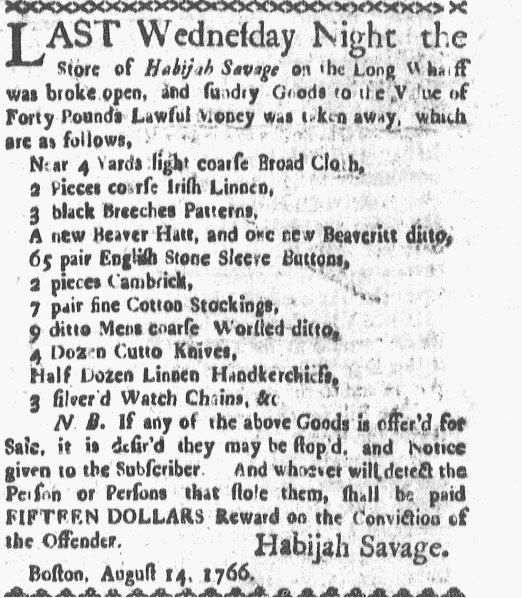
“The Store of Habijah Savage on the Long Wharff was broke open.”

Earlier this week the Adverts 250 Project featured an announcement that Simon Rhodes placed in the New-London Gazette. In late July 1766, a thief or thieves broke into his home in Stonington, Connecticut, and stole two silver watches and a pair of silver buckles. He offered a description of the missing items, warned against anybody purchasing the stolen goods, and offered a reward for their return and the capture of the culprits.

In today’s advertisement, Habijah Savage offered a similar story out of Boston. In this case, however, the thieves “broke open” Savage’s store, rather than his house, and made off with a significant amount of merchandise, amounting to “Forty Pounds Lawful Money.” This was a quite a loss for Savage’s business. Indeed, his list of stolen merchandise was as extensive as those that frequently appeared in advertisements placed by merchants and shopkeepers seeking to sell new goods and auctioneers sponsoring vendue sales.

Despite Savage’s announcement about the theft in the public prints, it seems unlikely that he would have been able to recover all (or any) of the stolen goods. For the most part, they were fairly common items that would have been easily absorbed into an underground economy that paralleled the more legitimate means of acquiring goods. In a fascinating chapter on “The Informal Economy” in Dangerous Economies: Status and Commerce in Imperial New York, Serena R. Zabin has traced how many marginalized colonists – the poor, slaves and free blacks, women – participated in the consumer revolution of the eighteenth century through alternative means that worried authorities and elites. This was an economy that incorporated crime and threatened to disrupt traditional social and economic hierarchies.

The goods stolen from Habijah Savage’s store likely became part of that informal economy. Who might have ended up wearing that “new Beaver Hatt” or making clothes from the “English Stone Sleeve Buttons” and assorted textiles?

August 17

What was advertised in a colonial American newspaper 250 years ago this week?

Aug 17 - 8:15:1766 Virginia Gazette
Virginia Gazette (August 15, 1766).

“Some excellent pieces of sculpture in relieve of Lord CAMDEN and Mr. PITT.”

In the wake of the American Revolution, a variety of artists created and marketed items that commemorated American statesmen and military heroes and depicted significant events. In so doing, they participated in creating a national culture that celebrated the new republic while uniting geographically dispersed citizens in common acts of consumption and veneration. They helped to cultivate a sense of patriotism rooted in a distinct American identity.

Prior to the Revolution, artists also produced and sold items that shaped national identity and allegiance. In the summer of 1766, colonists in Virginia could purchase “some excellent pieces of sculpture in relieve of Lord CAMDEN and Mr. PITT” created by a “Celebrated artist in London.” Camden and Pitt were British politicians who had gained popularity in the colonies due to their opposition to the Stamp Act, arguing that it was not constitutional to impose taxes on the colonies without their consent and that consent was only possible with representation. Camden was one of the few who opposed the Declaratory Act as well. From the perspective of Americans who opposed the Stamp Act, Camden and Pitt truly understood the appropriate and just relationship between Great Britain and the colonies. The advertisement for the sculpture in relieve pieces described them as “names which will be ever dear to AMERICA,” but offered no further explanation. None was needed. Any colonists who read the newspaper or listened to discussions taking place in public places already knew of the accomplishments of Camden and Pitt.

This advertisement and the works it marketed envisioned American political and cultural identity in complicated ways. Americans still thought of themselves as Britons in 1766. At the time, few wanted to sever ties; instead, they sought to benefit from all the protections and advantages that were supposed to be inherent in being part of the British Empire. By purchasing sculpture in relievo pieces of Camden and Pitt and displaying them in their homes, colonists could confirm their allegiance to Britain and the ideals of its political system while simultaneously affirming their particular concerns as Americans. They did not need to prioritize one over the other. The two found themselves in balance rather than opposition to each other, a situation that would change dramatically over the course of the next two decades.

August 16

What was advertised in a colonial American newspaper 250 years ago this week?

Aug 16 - 8:15:1766 New-Hampshire Gazette
New-Hampshire Gazette (August 16, 1766).

“His Stay is intended to be very short.”

George Strange offered “A fresh Assortment of English GOODs” for sale “At a Store on Mr. Allcock’s Wharfe near Spring Hill in Portsmouth.” At first glance, Strange used formulaic language common in many advertisements placed by shopkeepers in the eighteenth-century. However, describing the location as “a Store” rather than “his Store” departed from the usual convention. From the perspective of regular readers of the New-Hampshire Gazette, nothing else would have looked out of the ordinary throughout the remainder of the advertisement (a fairly standard list of wares “Just imported from England) until the final sentence. “His stay is intended to be very short,” Strange warned.

It appears that George Strange did not reside in Portsmouth, unlike other shopkeepers who advertised in the New-Hampshire Gazette. He would not have had his own shop already familiar to locals but instead probably rented a store on the wharf for a brief time. What was Strange’s story? Why did he set up shop in Portsmouth only temporarily? Had he traveled directly from England? Or had he been to other port cities before Portsmouth? Where was he headed next? He offered to “barter Goods for white Pine BOARDS that are fit for the English Markets.” Was a port in Great Britain his next destination? Or would he visit other American ports and attempt to sell any goods not purchased in Portsmouth? This advertisement raises as many questions about commercial culture in a colonial port as it answers.

If George Strange was indeed a stranger in Portsmouth, placing an advertisement in the New-Hampshire Gazette may have been even more imperative for conducting his business than advertising was for local shopkeepers already known to the city’s residents. He needed to attract new customers to his location as quickly and efficiently as possible. His advertisement, more extensive than any other for consumer goods in the same issue of the New-Hampshire Gazette, certainly would have made his presence known to readers and potential customers.

August 15

What was advertised in a colonial American newspaper 250 years ago today?

Aug 15 - 8:15:1766 New-London Gazette
New-London Gazette (August 15, 1766).

“STOLEN out of the Subscriber’s House in the Night … Two silver Watches.”

As a general rule, most advertisements featured on the Adverts 250 Project promoted consumer goods and services. As its primary purpose, the project explores how eighteenth-century advertising incited consumer demand and convinced colonists to purchase an expanding array of goods and services.

Today’s advertisement, however, demonstrates that buying new goods from shopkeepers and merchants was not the only way that colonists could participate in the consumer economy. Some purchased used goods (which were sometimes advertised, but also changed hands in an informal economy that did not rely on public commercial notices), but others resorted to theft to obtain the items they desired or intended to sell for their own gain.

In Simon Rhodes’ case, a thief made off with “Two Silver Watches” and “a pair of Silver wrought Buckles with Steel Chapes and Tongues.”

Rhodes wanted his watches and buckles back, so much so that he paid to insert this advertisement in the New-London Gazette at least three times. (It appeared on August 15, 22, and 29. It may have appeared in earlier issues, but they are no longer extant.) He also offered a reward of five dollars to anybody who captured “the Thief or Thieves, so that the above things may be had, and he or they brought to Justice.” At the very least, Rhodes wanted to make it difficult for the thief or thieves to benefit from the crime. He requested that if any readers noticed his stolen property “offered for Sale” that “they may be stopped.” In addition, his descriptions of the stolen goods, including their flaws and repairs, were designed to make it more difficult to sell them.

August 14

What was advertised in a colonial American newspaper 250 years ago today?

Aug 14 - 8:14:1766 Pennsylvania Gazette
Pennsylvania Gazette (August 14, 1766).

“Mr. Garner, from his approved Conduct in the teaching of Youth, having had many Solicitations to open an Academy …”

Joseph Garner was a well-known teacher who regularly advertised his schools and academies in Philadelphia’s newspapers. Although he addressed the topics students could expect to learn under his tutelage, he also emphasized the environment in which they would study. Students needed to be in surroundings, Garner suggested, that would contribute to their intellectual and moral growth.

Consider his description of the boarding school and its amenities in today’s advertisement. “The House is very extensive,” he proclaimed, so extensive “as to admit of many Boarders, without interrupting each other in their private Studies.” Pupils undertook those studies in “very elegant” rooms. Such surroundings lent themselves well “to the Design of carrying polite Literature into Execution.”

Garner understood that the youth he instructed also needed respite from their studies on occasion. To that end, the “commodious House” had “a large Yard, fit for the Relaxation of Youth after School Hours.” He assured parents of prospective students that this yard was “well inclosed.” Garner safeguarded the children entrusted to his care from the perils of the city, “where Vice is only too often so predominant.” Even when his pupils took a break from reading “polite Literature,” Garner provided an environment that nurtured morality and virtue rather than allowing them “the Liberty of the Streets.” In other words, he kept a close eye on his charges and did not allow them to potentially find trouble as they went gallivanting around the busy port city.

Garner also sought other teachers to assist instructing students. His list of qualifications placed greater emphasis on personal attributes than expertise. In addition to being “well versed in the Languages,” teachers also needed to be “of moral Behaviour, and unexceptionable Character.”

For Garner and the parents who enrolled their children in his academy, the purpose of education was more than the accumulation of knowledge. It was also intended to shape youth into moral men.

August 13

What was advertised in a colonial American newspaper 250 years ago today?

Aug 13 - 8:13:1766 Georgia Gazette
Georgia Gazette (August 13, 1766).

“BLank bonds, bills of sale, mortgages, powers of attorney, bonds of arbitration, indentures, bills of lading …”

Like other colonial newspapers, the Georgia Gazette consistently ended with a colophon that gave the particulars concerning publication: it was printed “by JAMES JOHNSTON, at the Printing-Office in Broughton-Street” in Savannah. Also like other colonial newspapers, the colophon announced a variety of printed goods for sale. Johnston solicited advertisements and subscriptions for the Georgia Gazette, but he supplemented that revenue with job printing: “Hand-Bills, Advertisements, &c. printed at the shortest Notice.”

Regular readers may have grown accustomed to seeing the colophon and largely ignored its contents. It would have been harder to skip over this advertisement, strategically positioned as the final item in the final column on the final page (and immediately above the colophon). Whether reading the advertisements intensively or merely skimming over them, this one would have left a lasting impression among most readers thanks to its placement on the page.

The “&c.” (an eighteenth-century abbreviation for et cetera) in the colophon covered an array of printed items, but Johnston elaborated on them in this advertisement. In total, he listed a dozen kinds of printed blanks, forms intended to streamline a variety of economic transactions and legal interactions. Even this extensive list, however, ended with another “&c.” Blank forms, whether printed or online, are part of everyday life in the twenty-first century, but this advertisement suggests that colonial Americans were not strangers to filling out, handling, and reading forms themselves. It also indicates that the work done by printers facilitated diverse commercial and legal activities as their printed blanks passed from person to person within and beyond their communities.

August 12

What was advertised in a colonial American newspaper 250 years ago this week?

Aug 12 - 8:11:1766 Newport Mercury
Newport Mercury (August 11, 1766).

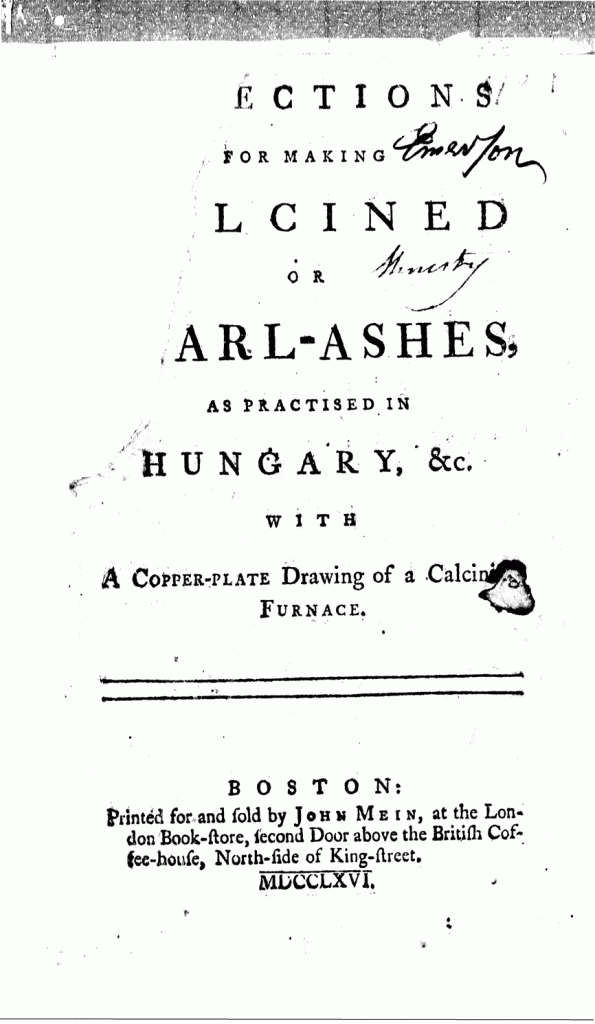
“DIRECTIONS for making calcined or PEARL ASHES.”

Advertisements associated with the potash industry appeared quite regularly in colonial newspapers. Some advertisers wanted to buy it, offering a good price in exchange for potash. Others supplied some of the equipment, such as oversized kettles, necessary for producing potash. Although not necessarily directly involved in potash production, printers also published advertisements that indicated they stood to profit from it all the same. Some sold “Justices Blank Certificates” used in the packing and regulation of potash, while others peddled instruction manuals to those who wanted to participate in the industry or improve on their previous efforts.

Such was the case with a short pamphlet (less than twenty pages) devoted to “DIRECTIONS for making calcined or PEARL ASHES, As practised in Hungary, &c.” Samuel Hall, the printer of the Newport Mercury, sold the pamphlet at his shop “on the North Side of the Parade,” but the imprint on the pamphlet itself indicated that it was “Printed for and sold by JOHN MEIN, at the London Book-store” in Boston. Both printers (and quite likely others throughout New England that exchanged stock with Mein) looked to make a profit from indirect involvement in the potash trade through the sale of ancillary products.

Aug 12 - Potash Pamphlet
Directions for Making Calcined or Pearl Ashes, as Practised in Hungary, &c. with a Copper-plate Drawing of a Calcining Furnace (Boston:  John Mein, 1766).  Boston Public Library.

Both the advertisement and the title page of the pamphlet underscored that it included “a Copper-Plate Drawing of a calcined Furnace.” This would have certainly increased the expense of producing the pamphlet and, ultimately, the cost to the customer, but such an investment could be readily justified. The accompanying image likely offered valuable insight into the text, making it more comprehensible. Art historian Nancy Siegel has argued that engraved images that accompanied eighteenth-century cookbooks were imperative in demonstrating the meaning of the text to readers. The same would have been true for an instruction manual detailing equipment and processes for producing potash, especially for readers not already well versed in the subject. After all, the directions in the pamphlet were “founded on the most extensive Knowledge of Pearl Ashes—a Knowledge acquired by long Practice, Experience and Success. The advertisement warned readers that this was “the only Means to establish Matters of Fact.” It concluded by jeering that “plausible Theories” were “little better than ingenious Amusements.”

In other words, both the text and the engraved copperplate drawing merited attention from anybody serious about potash production. Both were worth the expense.

August 11

What was advertised in a colonial American newspaper 250 years ago today?

Aug 11 - 8:11:1766 New-York Gazette
New-York Gazette (August 11, 1766).

“As soon as the Season will permit, they will brew Spruce again.”

Brewers George Harison and James Leadbetter were savvy marketers. They informed the public “that their ALE is now fit to deliver,” but they also stoked anticipation for another product, spruce beer, that was not yet available but would be brewed again “As soon as the Season will permit.” In a single advertisement they attempted to move their current inventory and create demand for another product that would be in stock in the near future. By drawing attention to their spruce beer even before it had been brewed, they prompted potential customers to associate that product with their brewery rather than settle for similar beverages that competitors might deliver before theirs was ready for market.

Aug 11 - American Cookery
Amelia Simmons, American Cookery (Hartford, Connecticut:  Hudson and Goodwin, 1796).  American Antiquarian Society.

Spruce beer, which came in both alcoholic and non-alcoholic varieties, was quite common in colonial America. Harison and Leadbetter did not address any particular sort of customer in their advertisement, but merchants and captains who provisioned ships that passed through New York’s busy harbor may have counted among their clients. As part of the Columbian Exchange of resources and knowledge, French and British explorers had learned from indigenous Americans that beverages made with spruce could be used to ward off scurvy. Spruce beer became an important component of the rations doled out to European sailors. One correspondent in the September 1764 issue of the London Magazine indicated that when he owned a ship that traded between New England and the West Indies he always instructed the captain to take along spruce beer as a means of safeguarding the health of the crew. Not only did spruce beer ward off scurvy, it was also safer to drink than some of the water.

So common was this drink in eighteenth-century America that in 1796 a recipe “For brewing Spruce Beer” appeared on the final page of Amelia Simmons’ American Cookery, the first cookbook written by an American.

August 10

What was advertised in a colonial American newspaper 250 years ago this week?

Aug 10 - 8:9:1766 Providence Gazette
Providence Gazette (August 9, 1766).

“READY MONEY given for Line Rags of any Sort, old Sail Cloth and Junk.”

Printers regularly inserted calls for rags (intended to be used in making paper) in their newspapers, but this appeal was much more extensive than most that appeared during the eighteenth-century.

The proprietors of the Providence Paper Manufactory accepted “Linen Rags of any Sort, old Sail Cloth and Junk.” Furthermore, they listed the prices they would give for each item, even dividing the rags between those “fine than Oznabrigs” and others “coarser than Oznabrigs.” In the process, they also used terminology that would have been familiar to eighteenth-century readers. Colonists would have readily recognized “Oznabrigs” as a type of coarse and plain fabric and “Junk” as old rope that was beyond its usefulness.

The advertisement listed several locations where readers could exchange “Linen Rags of any Sort, old Sail Cloth and Junk” for “READY MONEY.” They could visit the printers or the proprietors of the “Paper Manufactory” in Providence as well as Jonathan Wilson in Newport or another printer, Benjamin Mecom, in New Haven.

Finally, the advertisement concluded with an interesting proposition for subscribers to the Providence Gazette. The rags, sail cloth, and junk could be exchanged for the newspaper itself, as payment “in lieu of Cash.” This established an interesting relationship between the printer of the Providence Gazette and subscribers who traded in their rags. Eventually those subscribers could expect those rags to be returned to them, transformed into linen paper with news and advertisements printed on it.

When it came to paper, the cycle of advertising and consumption in colonial America had a far reach. A colonist could see an advertisement for textiles and make a purchase. After using and wearing out those textiles, he or she could hand them over to the Providence Paper Manufactory or the printers of the Providence Gazette in exchange for more newspapers with additional advertisements for textiles that could be purchased to replace those that had been reduced to rags. At some point in the cycle, colonists could read advertisements for textiles they would purchase printed on linen paper made from textiles that had previously worn or possessed.

August 9

What was advertised in a colonial American newspaper 250 years ago today?

Aug 9 - 8:9:1766 Providence Gazette
Providence Gazette (August 9, 1766).

“JUST IMPORTED … BY THOMPSON AND ARNOLD, AT THEIR SHOP NEAR THE GREAT BRIDGE.”

The graphic design of Thompson and Arnold’s newspaper advertisement would have certainly caught readers’ attention in the 1760s. Featuring a decorative border and three columns listing “A large and general Assortment of English and India Goods,” it was unlike any other advertisements that appeared in newspapers of the period.

Whenever possible, I highlight innovations in format and graphic design that set particular eighteenth-century advertisements apart from their contemporaries. For the most part, these innovations were fairly conservative as advertisers and printers experimented with new methods yet continued to create advertisements that, to a greater or lesser degree, blended in with other commercial notices.

That was not the case with Thompson and Arnold’s eye-catching advertisement. The border was sufficient to mark this advertisement as different, but a small number of other advertisers (such as Jolley Allen) also used borders to set their advertisements apart from their competitors.

Aug 9 - 8:9:1766 Fourth Page Providence Journal
Fourth Page of Providence Gazette (August 9, 1766).

The number of columns in this advertisement also merited attention. Other advertisers frequently divided their lists of goods into two columns, but Thompson and Arnold managed to squeeze three columns into their advertisement. How did they do that? Their advertisement actually extended across two columns of the Providence Gazette, a mode of setting type not commonly used for either advertisements or new items. Typically only the masthead and the colophon extended across more than one column in any eighteenth-century newspaper.

The printer would have had to set Thompson and Arnold’s advertisement separately. Its design and inclusion required special effort and attention. Visually, it dominated the final page of the Providence Gazette. If a reader were holding open the newspaper to read the second and third pages, this advertisement would have also dominated any observer’s view of the first and fourth pages.

Other newspaper advertisements were certainly set in type specifically for inclusion in newspapers and possessed no other purpose. The size and design of this advertisements, however, suggests that it could have also been printed separately as a trade card or handbill, which would have benefited both the advertisers and the printer who generated revenue for the job.