Happy Birthday, Isaiah Thomas!

Isaiah Thomas, patriot printer and founder of the American Antiquarian Society, was born on January 19 (New Style) in 1749 (or January 8, 1748/49, Old Style).  It’s quite an historical coincidence that the three most significant printers in eighteenth-century America — Benjamin Franklin, Isaiah Thomas, and Mathew Carey — were all born in January.

isaiah_thomas1818
Isaiah Thomas (January 30, 1739 – April 4, 1831). American Antiquarian Society.

The Adverts 250 Project is possible in large part due to Thomas’s efforts to collect as much early American printed material as he could, originally to write his monumental History of Printing in America.  The newspapers, broadsides, books, almanacs, pamphlets, and other items he gathered in the process eventually became the initial collections of the American Antiquarian Society.  That institution’s ongoing mission to acquire at least one copy of every American imprint through 1876 has yielded an impressive collection of eighteenth-century advertising materials, including newspapers, magazine wrappers, trade cards, billheads, watch papers, book catalogs, subscription notices, broadsides, and a variety of other items.  Exploring the history of advertising in early America — indeed, exploring any topic related to the history, culture, and literature of early America at all — has been facilitated for more than two centuries by the vision of Isaiah Thomas and the dedication of the curators and other specialists at the American Antiquarian Society over the years.

Thomas’s connections to early American advertising were not limited to collecting and preserving the items created on American presses during the colonial, Revolutionary, and early national periods.  Like Mathew Carey, he was at the hub of a network he cultivated for distributing newspapers, books, and other printed goods — including advertising to stimulate demand for those items.  Sometimes this advertising was intended for dissemination to the general public (such as book catalogs and subscription notices), but other times it amounted to trade advertising (such as circular letters and exchange catalogs intended only for fellow printers, publishers, and booksellers).

Thomas also experimented with advertising on wrappers that accompanied his Worcester Magazine, though he acknowledged to subscribers that these wrappers were ancillary to the publication:  “The two outer leaves of each number are only a cover to the others, and when the volume is bound may be thrown aside, as not being a part of the Work.”[1]
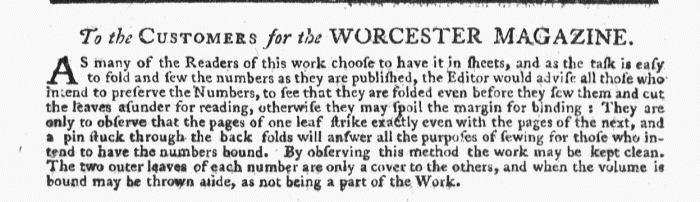
jan-30-worcerster-magazine-april-1786
Detail of Advertising Wrapper, Worcester Magazine (Second Week of April, 1786).

Thomas’s patriotic commitment to freedom of the press played a significant role in his decision to develop advertising wrappers.  As Thomas relays in his History of Printing in America, he discontinued printing his newspaper, the Massachusetts Spy, after the state legislature passed a law that “laid a duty of two-thirds of a penny on newspapers, and a penny on almanacs, which were to be stamped.”  Such a move met with strong protest since it was too reminiscent of the Stamp Act imposed by the British two decades earlier, prompting the legislature to repeal it before it went into effect.  On its heels, however, “another act was passed, which imposed a duty on all advertisements inserted in the newspapers” printed in Massachusetts.  Thomas vehemently rejected this law as “an improper restraint on the press. He, therefore, discontinued the Spy during the period that this act was in force, which was two years. But he published as a substitute a periodical work, entitled ‘The Worcester Weekly Magazine,’ in octavo.”[2] This weekly magazine lasted for two years; Thomas discontinued it and once again began printing the Spy after the legislature repealed the objectionable act.

jan-30-advertising-wrapper-worcester-magazine-4th-week-may-1786
Third Page of Advertising Wrapper, Worcester Magazine (Fourth Week of May, 1786).

Isaiah Thomas was not interested in advertising for its own sake to the same extent as Mathew Carey, but his political concerns did help to shape the landscape of early American advertising.  Furthermore, his vision for collecting American printed material preserved a variety of advertising media for later generations to admire, analyze, ponder, and enjoy.  Happy 272nd birthday, Isaiah Thomas!

**********

[1] Isaiah Thomas, “To the CUSTOMERS for the WORCESTER MAGAZINE,” Worcester Magazine, wrapper, second week of April, 1786.

[2] Isaiah Thomas, The History of Printing in America: With a Biography of Printers, and an Account of Newspapers, vol. 2 (Worcester, MA: Isaac Sturtevant, 1810), 267-268.

Slavery Advertisements Published January 19, 1771

GUEST CURATOR:  Chloe Amour

The Slavery Adverts 250 Project chronicles the role of newspaper advertising in perpetuating slavery in the era of the American Revolution. The project seeks to reveal the ubiquity of slavery in eighteenth-century life from New England to Georgia by republishing advertisements for slaves – for sale, wanted to purchase, runaways, captured fugitives – in daily digests on this site as well as in real time via the @SlaveAdverts250 Twitter feed, utilizing twenty-first-century media to stand in for the print media of the eighteenth century.

The project aims to provide modern audiences with a sense of just how often colonists encountered these advertisements in their daily lives. Enslaved men, women, and children appeared in print somewhere in the colonies almost every single day. Those advertisements served as a constant backdrop for social, cultural, economic, and political life in colonial and revolutionary America. Colonists who did not own slaves were still confronted with slavery as well as invited to maintain the system by purchasing slaves or assisting in the capture of runaways. The frequency of these newspaper advertisements suggests just how embedded slavery was in colonial and revolutionary American culture in everyday interactions beyond the printed page.

These advertisements also testify to the experiences of enslaved men, women, and children, though readers must consider that those experiences have been remediated through descriptions offered by slaveholders rather than the slaves themselves. Often unnamed in the advertisements, enslaved men, women, and children were not invisible or unimportant in early America.

From compiling an archive of digitized eighteenth-century newspapers to identifying advertisements about enslaved men, women, and children in those newspapers to preparing images of each advertisement to posting this daily digest, Chloe Amour served as guest curator for this entry.  She completed this work while enrolled in an independent study for HIS 366 – Introduction to Public History at Assumption University in Worcester, Massachusetts, in Fall 2020.

These advertisements appeared in colonial American newspapers 250 years ago today.

Providence Gazette (January 19, 1771).

January 18

What was advertised in a colonial American newspaper 250 years ago today?

New-Hampshire Gazette (January 18, 1771).

“A few Almanacks, and several Pieces on the late renowned WHITEFIELD, &c. may be had at the Printing Office.”

When George Whitefield, one of the most prominent ministers associated with the eighteenth-century religious revivals now known as the Great Awakening, died on September 30, 1770, it did not take long for printers, booksellers, and others to market commemorative items that celebrated the life of the minister and mourned his passing.  Within a week, advertisements for merchandise ranging from poems to hymns to funeral sermons began appearing in colonial newspapers.  While the commodification of Whitefield’s death was concentrated in New England, consumers in other regions also had opportunities to purchase memorabilia.

Those advertisements ran regularly for several months, but then tapered off at the end of the year.  As part of that process, printers and booksellers incorporated Whitefield commemorative items into advertisements promoting other items for sale.  For instance, printers Thomas Fleet and John Fleet inserted an advertisement for four pamphlets in the January 7, 1771, edition of their newspaper, the Boston Evening-Post.  “Dr. Whitaker’s Sermon on the Death of Mr. WHITEFIELD” was the third of those four items.  Previously, Whitefield commemorative items merited advertisements of their own in the Boston Evening-Post.

Such was the case in a brief advertisement in the January 18 edition of the New-Hampshire Gazette.  Daniel Fowle and Robert Fowle advised prospective customers that “A few Almanacks, and several Pieces on the late renowned WHITEFIELD, &c. may be had at the Printing Office.”  Whitefield’s death and the ensuing commemorations and mourning rituals were no longer breaking news, so the Fowles, like the Fleets, devoted less advertising space to marketing memorabilia.  Yet they still had inventory available, surplus copies that diminished any potential profits gained from the commodification of the minister’s death.  Advertising excess copies of almanacs in January was an annual custom for printers throughout the colonies.  The Fowles folded their Whitefield commemorative items into that practice, attempting to draw on remaining demand without giving over a significant amount of space to their advertisements.

Happy Birthday, Benjamin Franklin!

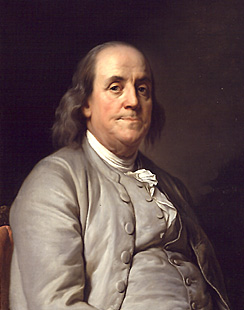
Today is an important day for specialists in early American print culture, for Benjamin Franklin was born on January 17, 1706 (January 6, 1705, Old Style), in Boston. Among his many other accomplishments, Franklin is known as the “Father of American Advertising.” Although I have argued elsewhere that this title should more accurately be bestowed upon Mathew Carey (in my view more prolific and innovative in the realm of advertising as a printer, publisher, and advocate of marketing), I recognize that Franklin deserves credit as well. Franklin is often known as “The First American,” so it not surprising that others should rank him first among the founders of advertising in America.

benjamin-franklin
Benjamin Franklin (Joseph Siffred Duplessis, ca. 1785).  National Portrait Gallery.

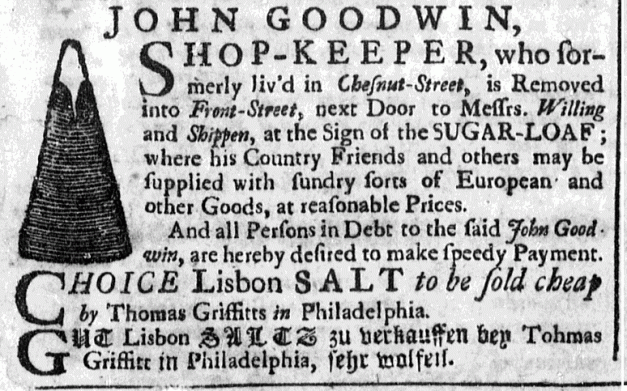
Franklin purchased the Pennsylvania Gazette in 1729. In the wake of becoming printer, he experimented with the visual layout of advertisements that appeared in the weekly newspaper, incorporating significantly more white space and varying font sizes in order to better attract readers’ and potential customers’ attention. Advertising flourished in the Pennsylvania Gazette, which expanded from two to four pages in part to accommodate the greater number of commercial notices.

jan-17-pennsylvania-gazette-19-161736
Advertisements with white space, varying sizes of font, capitals and italics, and a woodcut from Benjamin Franklin’s Pennsylvania Gazette (December 9-16, 1736).

Many historians of the press and print culture in early America have noted that Franklin became wealthy and retired as a printer in favor of a multitude of other pursuits in part because of the revenue he collected from advertising. Others, especially David Waldstreicher, have underscored that this wealth was amassed through participation in the colonial slave trade. The advertisements for goods and services featured in the Pennsylvania Gazette included announcements about buying and selling enslaved men, women, and children as well as notices offering rewards for those who escaped from bondage.

jan-17-pennsylvania-gazette-slave-19-161736
Advertisement for an enslaved woman and an enslaved child from Benjamin Franklin’s Pennsylvania Gazette (December 9-16, 1736).

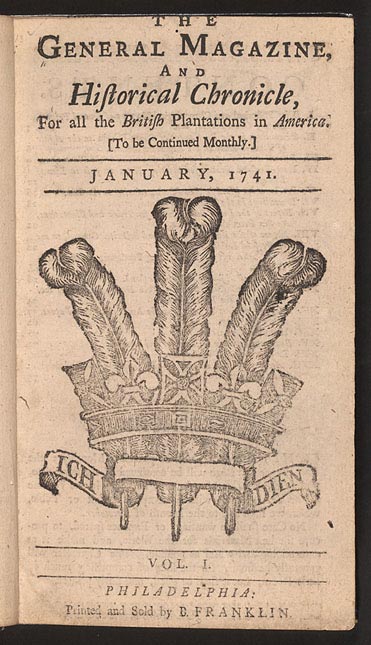
In 1741 Franklin published one of colonial America’s first magazines, The General Magazine and Historical Chronicle, for all the British Plantations in America (which barely missed out on being the first American magazine, a distinction earned by Franklin’s competitor, Andrew Bradford, with The American Magazine or Monthly View of the Political State of the British Colonies). The magazine lasted only a handful of issues, but that was sufficient for Franklin to become the first American printer to include an advertisement in a magazine (though advertising did not become a standard part of magazine publication until special advertising wrappers were developed later in the century — and Mathew Carey was unarguably the master of that medium).

general-magazine
General Magazine and Historical Chronicle, For all the British Plantations in America (January 1741).  Library of Congress.

In 1744 Franklin published an octavo-sized Catalogue of Choice and Valuable Books, including 445 entries. This is the first known American book catalogue aimed at consumers (though the Library Company of Philadelphia previously published catalogs listing their holdings in 1733, 1735, and 1741). Later that same year, Franklin printed a Catalogue of Books to Be Sold at Auction.

Franklin pursued advertising through many media in eighteenth-century America, earning recognition as one of the founders of American advertising. Happy 315th birthday, Benjamin Franklin!

January 17

What was advertised in a colonial American newspaper 250 years ago today?

Pennsylvania Journal (January 17, 1771).

“Each articles will be put up singly, and in the order of the inventory annexed.”

Both the size and format of Richard Tidmarsh’s advertisement on the final page of the January 17, 1771, edition of the Pennsylvania Journal likely attracted attention.  Rather than appearing in a single column, it ran across two columns.  It also extended half a column, creating a large rectangle of text that seemed to dominate the page even though it accounted for about one-third of the content.

Tidmarsh, a druggist, announced an upcoming auction of “DRUGS, MEDICINES, and SHOP FURNITURE” in advance of his departure from the colony “by the first spring vessels.”  He listed the items up for sale, in effect publishing an auction catalog as a newspaper advertisement.  That list made the format of his advertisement even more distinctive.  The introductory material extended across two columns, but the list of items for sale ran in three narrow columns that also did not correspond to the width of any columns that appeared elsewhere in the newspaper.  To help prospective buyers navigate the list, Tidmarsh arranged entries for medicines in alphabetical order.  In the final column, he inserted headers in capital letters for sections enumerating “PERFUMERY,” “PATENT MEDICINES,” and “SPARE UTENSILS and FURNITURE.”  In the introduction, the apothecary explained his rationale for selling items separately rather than as a whole.  He envisioned that “practitioners, as well as Gentlemen of the trade, will have an opportunity of being supplied with such articles as they may be out of.”  Tidmarsh apparently did not anticipate any buyers for his entire inventory, but did anticipate demand for the various drugs and medicines on their own.  He offered credit to buyers who purchased a sufficient quantity and promised that the “whole of the stock of MEDICINES and DRUGS are of the first quality.”  To guide prospective buyers through the auction, he asserted that each article would be sold “in the order of the inventory annexed.”

Tidmarsh advertised an eighteenth-century version of a “going out of business” sale.  In an effort to liquidate his inventory before leaving Philadelphia, he organized an auction that would allow buyers to acquire medicines “of the first quality” at bargain prices compared to retail and perhaps even wholesale transactions.  He published an auction catalog in the public prints, its organized columns guiding prospective bidders through both the items for sale and the order.  He also encouraged participation by offering credit to those who purchased in sufficient quantities.  The unusual format of the apothecary’s advertisement also drew attention to the upcoming auction, helping to generate interest and incite bidders to attend.

Slavery Advertisements Published January 17, 1771

GUEST CURATOR:  Chloe Amour

The Slavery Adverts 250 Project chronicles the role of newspaper advertising in perpetuating slavery in the era of the American Revolution. The project seeks to reveal the ubiquity of slavery in eighteenth-century life from New England to Georgia by republishing advertisements for slaves – for sale, wanted to purchase, runaways, captured fugitives – in daily digests on this site as well as in real time via the @SlaveAdverts250 Twitter feed, utilizing twenty-first-century media to stand in for the print media of the eighteenth century.

The project aims to provide modern audiences with a sense of just how often colonists encountered these advertisements in their daily lives. Enslaved men, women, and children appeared in print somewhere in the colonies almost every single day. Those advertisements served as a constant backdrop for social, cultural, economic, and political life in colonial and revolutionary America. Colonists who did not own slaves were still confronted with slavery as well as invited to maintain the system by purchasing slaves or assisting in the capture of runaways. The frequency of these newspaper advertisements suggests just how embedded slavery was in colonial and revolutionary American culture in everyday interactions beyond the printed page.

These advertisements also testify to the experiences of enslaved men, women, and children, though readers must consider that those experiences have been remediated through descriptions offered by slaveholders rather than the slaves themselves. Often unnamed in the advertisements, enslaved men, women, and children were not invisible or unimportant in early America.

From compiling an archive of digitized eighteenth-century newspapers to identifying advertisements about enslaved men, women, and children in those newspapers to preparing images of each advertisement to posting this daily digest, Chloe Amour served as guest curator for this entry.  She completed this work while enrolled in an independent study for HIS 366 – Introduction to Public History at Assumption University in Worcester, Massachusetts, in Fall 2020.

These advertisements appeared in colonial American newspapers 250 years ago today.

Maryland Gazette (January 17, 1771).

**********

Maryland Gazette (January 17, 1771).

**********

Maryland Gazette (January 17, 1771).

**********

Massachusetts Gazette and Boston Weekly News-Letter (January 17, 1771).

**********

Massachusetts Spy (January 17, 1771).

**********

New-York Journal (January 17, 1771).

**********

Pennsylvania Journal (January 17, 1771).

**********

Pennsylvania Journal (January 17, 1771).

**********

South-Carolina Gazette (January 17, 1771).

**********

South-Carolina Gazette (January 17, 1771).

**********

South-Carolina Gazette (January 17, 1771).

**********

South-Carolina Gazette (January 17, 1771).

**********

South-Carolina Gazette (January 17, 1771).

**********

Virginia Gazette [Purdie and Dixon] (January 17, 1771).

**********

Virginia Gazette [Purdie and Dixon] (January 17, 1771).

**********

Virginia Gazette [Purdie and Dixon] (January 17, 1771).

**********

Virginia Gazette [Purdie and Dixon] (January 17, 1771).

**********

Virginia Gazette [Purdie and Dixon] (January 17, 1771).

**********

Virginia Gazette [Purdie and Dixon] (January 17, 1771).

**********

Virginia Gazette [Purdie and Dixon] (January 17, 1771).

**********

Virginia Gazette [Purdie and Dixon] (January 17, 1771).

**********

Virginia Gazette [Purdie and Dixon] (January 17, 1771).

**********

Virginia Gazette [Purdie and Dixon] (January 17, 1771).

**********

Virginia Gazette [Purdie and Dixon] (January 17, 1771).

**********

Virginia Gazette [Purdie and Dixon] (January 17, 1771).

**********

Virginia Gazette [Purdie and Dixon] (January 17, 1771).

**********

Virginia Gazette [Purdie and Dixon] (January 17, 1771).

**********

Virginia Gazette [Rind] (January 17, 1771).

**********

Virginia Gazette [Rind] (January 17, 1771).

**********

Virginia Gazette [Rind] (January 17, 1771).

**********

Virginia Gazette [Rind] (January 17, 1771).

**********

Virginia Gazette [Rind] (January 17, 1771).

**********

Virginia Gazette [Rind] (January 17, 1771).

**********

Virginia Gazette [Rind] (January 17, 1771).

**********

Virginia Gazette [Rind] (January 17, 1771).

**********

Virginia Gazette [Rind] (January 17, 1771).

**********

Virginia Gazette [Rind] (January 17, 1771).

**********

Virginia Gazette [Rind] (January 17, 1771).

**********

Virginia Gazette [Rind] (January 17, 1771).

**********

Virginia Gazette [Rind] (January 17, 1771).

**********

Virginia Gazette [Rind] (January 17, 1771).

**********

Virginia Gazette [Rind] (January 17, 1771).

January 16

What was advertised in a colonial American newspaper 250 years ago this week?

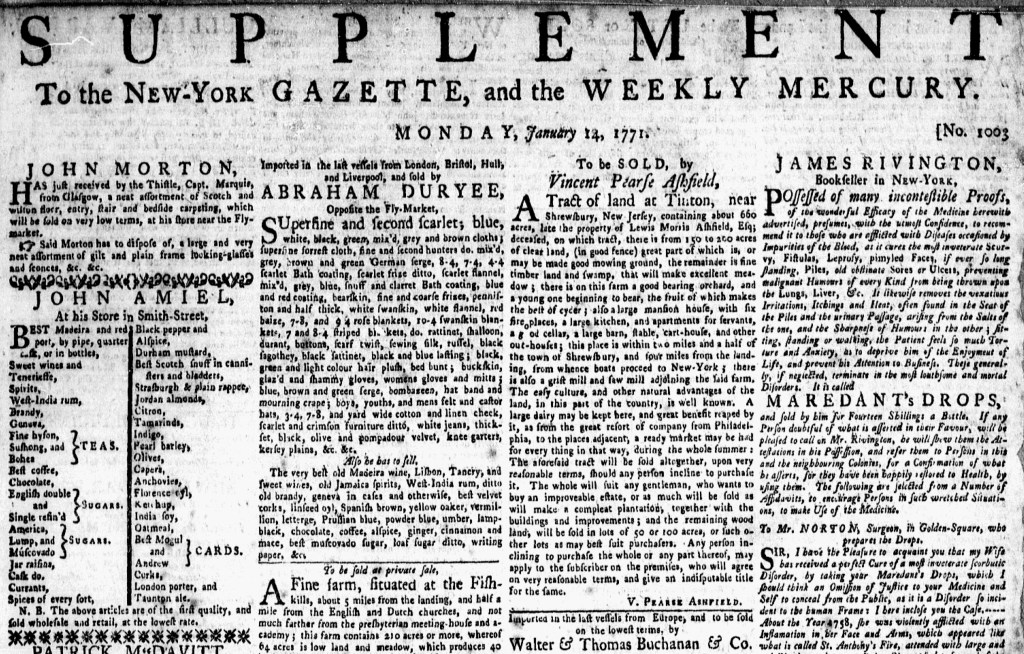
Supplement to the New-York Gazette and Weekly Mercury (January 14, 1771).

“Said Morton has to dispose of, a large and very neat assortment of gilt and plain frame looking-glasses and sconces.”

Hugh Gaine, “Printer, Bookseller, and Stationer, at the Bible and Crown, in Hanover-Square,” printed the New-York Gazette and Weekly Mercury, one of several newspapers published in the city in the early 1770s.  On many occasions, Gaine devoted more space to disseminating advertising than news articles, letters and editorials, prices current, and shipping news from the customs house.  Such was the case for the January 14, 1771, edition.

Like other eighteenth-century newspapers, that issue consisted of four pages created by printing two on each side of a broadsheet and folding it in half.  Some printers reserved advertising for the final pages, but Gaine distributed paid notices throughout his newspaper.  The first two columns on the first page of the January 14 edition contained advertising.  News accounted for most of the third and fourth columns, but five short advertisements concluded the fourth column.  News filled the first three columns of the second page before giving way to advertising in the final column.  On the third page, readers encountered news in the first two columns and advertising in the last two.  The final page consisted entirely of paid notices.  Overall, nine of the sixteen columns, more than half of the issue, delivered advertising to readers.

Yet that was not all.  Gaine had so many advertisements that did not fit in the standard issue that he also published a two-page supplement to accompany it.  With the exception of the masthead, that supplement contained nothing but paid notices, another eight columns of advertising.  Considered together, this amounted to seventeen of the twenty-four columns in the standard issue and supplement.  More than two-thirds of the content that Gaine delivered to subscribers and other readers that week consisted of advertising.

For many newspaper printers in eighteenth-century America, advertising generated revenues that rivaled or surpassed subscription fees.  For Gaine, that was almost certainly the case, thought the volume of advertising also suggests impressive circulation numbers.  Advertisers would not have chosen to insert their notices in his newspaper if they were not confident that they would reach the general public.

January 15

What was advertised in a colonial American newspaper 250 years ago today?

Essex Gazette (January 15, 1771).

“A POEM on the Execution of William Shaw.”

True crime!  News of the murder of Edward East circulated widely in New England.  The Massachusetts Gazette and Boston Weekly News-Letter was among the first publications that presented the news to the public.  A short article in its September 27, 1770, edition reported, “We hear from Springfield, that one Edward East, was murthered in the Gaol at that Place, by William Shaw and George French, who wounded him in several Parts, on the 17th of this [month], of which Wounds he died the next Day.”  As was common practice at the time, several newspapers reprinted this news over the course of several weeks.

On October 12, the Connecticut Journal provided updates in a longer story, reporting that a “jury by their verdict declared” Shaw “to be guilty” of murder, “whereupon the sentence of death was passed upon him.”  The execution was scheduled for November 8.  At the same time, the jury did not find enough evidence to convict French as an accomplice but instead “returned a verdict in his favour.”  On November 19, the Boston Evening-Post noted that Shaw’s execution was delayed until December 13, but did not provide an explanation.  The Connecticut Journal reported on Shaw’s execution in its December 18 edition.  “On which solemn occasion,” the editor declared, “an affecting sermon was delivered by the Rev. MOSES BALDWIN … to an audience of many thousands collected from all the adjacent towns as spectators of the awful scene.”  Newspapers in Connecticut, Massachusetts, New Hampshire, New York, and Rhode Island all reported on the execution.

Advertisements for commemorative items soon appeared as well, including one for “A POEM on the Execution of William Shaw” in the January 7, 1771, edition of the Boston Evening-Post.  On January 10, an advertisement in the Massachusetts Gazette and Boston Weekly News-Letter promoted another commemorative item, “A SERMON intitled, The Ungodly condemned in Judgment; Preached at Springfield, December 13th 1770.  On Occasion of the Execution of WILLIAM SHAW, for Murder, By MOSES BALDWIN.”  Printers and booksellers in other places also advertised and sold the poem and the sermon.  Samuel Hall, printer of the Essex Gazette in Salem, for instance, advertised the poem on January 15.  These advertisements helped to deliver news of current events while offering consumers opportunities to learn more.  For those who were not among the “many thousands” who heard the sermon and witnessed the execution, the commemorative items served as a proxy in addition to as supplement for coverage in newspapers.

Slavery Advertisements Published January 15, 1771

GUEST CURATOR:  Chloe Amour

The Slavery Adverts 250 Project chronicles the role of newspaper advertising in perpetuating slavery in the era of the American Revolution. The project seeks to reveal the ubiquity of slavery in eighteenth-century life from New England to Georgia by republishing advertisements for slaves – for sale, wanted to purchase, runaways, captured fugitives – in daily digests on this site as well as in real time via the @SlaveAdverts250 Twitter feed, utilizing twenty-first-century media to stand in for the print media of the eighteenth century.

The project aims to provide modern audiences with a sense of just how often colonists encountered these advertisements in their daily lives. Enslaved men, women, and children appeared in print somewhere in the colonies almost every single day. Those advertisements served as a constant backdrop for social, cultural, economic, and political life in colonial and revolutionary America. Colonists who did not own slaves were still confronted with slavery as well as invited to maintain the system by purchasing slaves or assisting in the capture of runaways. The frequency of these newspaper advertisements suggests just how embedded slavery was in colonial and revolutionary American culture in everyday interactions beyond the printed page.

These advertisements also testify to the experiences of enslaved men, women, and children, though readers must consider that those experiences have been remediated through descriptions offered by slaveholders rather than the slaves themselves. Often unnamed in the advertisements, enslaved men, women, and children were not invisible or unimportant in early America.

From compiling an archive of digitized eighteenth-century newspapers to identifying advertisements about enslaved men, women, and children in those newspapers to preparing images of each advertisement to posting this daily digest, Chloe Amour served as guest curator for this entry.  She completed this work while enrolled in an independent study for HIS 366 – Introduction to Public History at Assumption University in Worcester, Massachusetts, in Fall 2020.

These advertisements appeared in colonial American newspapers 250 years ago today.

South-Carolina Gazette and Country Journal (January 15, 1771).

**********

South-Carolina Gazette and Country Journal (January 15, 1771).

**********

South-Carolina Gazette and Country Journal (January 15, 1771).

**********

South-Carolina Gazette and Country Journal (January 15, 1771).

**********

South-Carolina Gazette and Country Journal (January 15, 1771).

**********

South-Carolina Gazette and Country Journal (January 15, 1771).

**********

South-Carolina Gazette and Country Journal (January 15, 1771).

**********

South-Carolina Gazette and Country Journal (January 15, 1771).

**********

South-Carolina Gazette and Country Journal (January 15, 1771).

**********

South-Carolina Gazette and Country Journal (January 15, 1771).

**********

South-Carolina Gazette and Country Journal (January 15, 1771).

**********

South-Carolina Gazette and Country Journal (January 15, 1771).

**********

South-Carolina Gazette and Country Journal (January 15, 1771).

**********

South-Carolina Gazette and Country Journal (January 15, 1771).

**********

South-Carolina Gazette and Country Journal (January 15, 1771).

**********

South-Carolina Gazette and Country Journal (January 15, 1771).

**********

South-Carolina Gazette and Country Journal (January 15, 1771).

**********

South-Carolina Gazette and Country Journal (January 15, 1771).

**********

South-Carolina Gazette and Country Journal (January 15, 1771).

**********

South-Carolina Gazette and Country Journal (January 15, 1771).

**********

South-Carolina Gazette and Country Journal (January 15, 1771).

**********

South-Carolina Gazette and Country Journal (January 15, 1771).

**********

South-Carolina Gazette and Country Journal (January 15, 1771).

**********

South-Carolina Gazette and Country Journal (January 15, 1771).

**********

South-Carolina Gazette and Country Journal (January 15, 1771).

**********

South-Carolina Gazette and Country Journal (January 15, 1771).

**********

Supplement to the South-Carolina Gazette and Country Journal (January 15, 1771).

**********

Supplement to the South-Carolina Gazette and Country Journal (January 15, 1771).

**********

Supplement to the South-Carolina Gazette and Country Journal (January 15, 1771).

**********

Supplement to the South-Carolina Gazette and Country Journal (January 15, 1771).

**********

Supplement to the South-Carolina Gazette and Country Journal (January 15, 1771).

**********

Supplement to the South-Carolina Gazette and Country Journal (January 15, 1771).

**********

Supplement to the South-Carolina Gazette and Country Journal (January 15, 1771).

**********

Supplement to the South-Carolina Gazette and Country Journal (January 15, 1771).

**********

Supplement to the South-Carolina Gazette and Country Journal (January 15, 1771).

**********

Supplement to the South-Carolina Gazette and Country Journal (January 15, 1771).

January 14

What was advertised in a colonial American newspaper 250 years ago today?

Boston Evening-Post (January 14, 1771).

“A short Narrative of the horrid MASSACRE in BOSTON.”

Commemoration and commodification of the American Revolution occurred simultaneously, the process beginning years before the first shots were fired at Concord and Lexington on April 19, 1775.  The Boston Massacre took place on March 5, 1770.  A week later, the town meeting appointed James Bowdoin, Samuel Pemberton, and Samuel Warren to a committee charged with preparing an account of that infamous event.  The committee quickly prepared A Short Narrative of the Horrid Massacre in Boston and presented it to the town meeting on March 19.  The town meeting accepted the account and ordered it printed immediately.  The Short Narrative quickly became available to consumers, its imprint declaring that it was “Printed by Order of the Town of Boston, and Sold by Edes and Gill, in Queen-Street, and T. & J. Fleet, in Cornhill.”  Other commemorative items quickly hit the market as well.  On March 26, Paul Revere advertised his “PRINT containing a Representation of the late horrid Massacre in King-Street.”  A week later, Henry Pelham announced a similar print, “The Fruits of Arbitrary Power,” available for purchase at local printing offices.

Months later, Thomas Fleet and John Fleet, printers of the Boston Evening-Post, occasionally advertised the Short Narrative of the Horrid Massacre.  On January 14, 1771, they reminded readers of one of the most significant events of the previous year when they once again ran advertisement for the Short Narrative.  An advertisement for another book likely prompted them to market the Short Narrative approved by the town meeting once again.  They inserted their advertisement immediately below John Fleeming’s notice that he would soon publish “The Trial of William Wemmes, James Hartegan, William McCauley, Hugh White, Matthew Killroy, William Warren, John Carrol, and Hugh Montgomery, for the Murder of Crispus Attucks, Samuel Gray, Samuel Maverick, James Caldwell, & Patrick Carr, on the Evening of the 5th March 1770.”  Following a vigorous defense by John Adams, a jury acquitted six of those soldiers and found the other two guilty of manslaughter.  The latter managed to reduce their sentences from death to having their thumbs branded by pleading benefit of clergy.  Fleeming, the printer who offered an account of the trial to the public, had formerly published the Boston Chronicle, noted for its Tory sympathies, in partnership with John Mein.  That newspaper ceased publication in 1770, shortly after angry colonists chased Mein out of town.

The account of the trial and its outcome ran counter to the version of events depicted in the Short Narrative and the prints produced by Pelham and Revere.  It became another entry in the propaganda battle of competing stories presented in newspapers, prints, and pamphlets, published in both Boston and London, following the Boston Massacre.  It could hardly be considered a coincidence that the Fleets just happened to advertise the Short Narrative once again just as Fleeming announced publication of a pamphlet about the trial of the soldiers, especially since their advertisement appeared immediately after Fleeming’s notice.  The Fleets did not censor Fleeming from advertising in their newspaper, but they did insist on having the last word in hopes of shaping the narrative for the public.