Slavery Advertisements Published October 26, 1772

The Slavery Adverts 250 Project chronicles the role of newspaper advertising in perpetuating slavery in the era of the American Revolution. The project seeks to reveal the ubiquity of slavery in eighteenth-century life from New England to Georgia by republishing advertisements about enslaved people – for sale as individuals or in groups, wanted to purchase or for hire for short periods, runaways who liberated themselves, and those who were subsequently captured and confined in jails and workhouses – in daily digests on this site as well as in real time via the @SlaveAdverts250 Twitter feed, utilizing twenty-first-century media to stand in for the print media of the eighteenth century.

The project aims to provide modern audiences with a sense of just how often colonizers encountered these advertisements in their daily lives. Enslaved men, women, and children appeared in print somewhere in the colonies almost every single day. Those advertisements served as a constant backdrop for social, cultural, economic, and political life in colonial and revolutionary America. Colonizers who did not purport to own enslaved people were still confronted with slavery as well as invited to maintain the system by purchasing enslaved men, women, and children or assisting in the capture of so-called “runaways” who sought to free themselves from bondage. The frequency of these newspaper advertisements suggests just how embedded slavery was in colonial and revolutionary American culture in everyday interactions beyond the printed page.

These advertisements also testify to the experiences of enslaved men, women, and children, though readers must consider that those experiences have been remediated through descriptions offered by enslavers rather than enslaved people themselves. Often unnamed in the advertisements, enslaved men, women, and children were not invisible or unimportant in early America.

These advertisements appeared in colonial American newspapers 250 years ago today.

Boston Evening-Post (October 26, 1772).

**********

Boston Evening-Post (October 26, 1772).

**********

Supplement to the Boston-Gazette (October 26, 1772).

**********

New-York Gazette and Weekly Mercury (October 26, 1772).

**********

New-York Gazette and Weekly Mercury (October 26, 1772).

**********

New-York Gazette and Weekly Mercury (October 26, 1772).

**********

Pennsylvania Packet (October 26, 1772).

October 25

What was advertised in a colonial American newspaper 250 years this week?

Supplement to the Massachusetts Gazette and Boston Weekly News-Letter (October 22, 1772).

“PROPOSALS For Re-Printing by Subscription … Baron de MONTESQUIEU’s celebrated Spirit of Laws”

On October 22, 1772, Richard Draper distributed a two-page supplement to accompany the standard issue of the Massachusetts Gazette and Boston Weekly News-Letter.  That supplement consisted almost entirely of advertising, though it did include brief news items from London and Quebec.  A subscription proposal for an “American Edition of … Baron de MONTESQUIEU’s celebrated Spirit of Laws” filled most of the second page of the supplement.  That subscription proposal would have looked familiar to colonizers who also read the Massachusetts Gazette and Boston Post-Boy since it appeared in that newspaper three days earlier.  It may have also looked familiar to those who had not perused the other publication.  As I argued when examining the first appearance of the subscription proposal in Boston’s newspapers, it likely circulated separately as a handbill or broadside.

Draper adopted the same method of making the subscription proposal fit on the page that John Green and Joseph Russell used in their newspaper.  Since it was wider than two standard columns, he created a narrower third column by rotating the type to run perpendicular to the rest of the page.  Draper also added a colophon, centered at the bottom of the subscription proposal.  This method of making the broadside fit on a newspaper page was not the only similarity between its appearance in two newspapers.  It looks as though the printing offices shared the type.  If that was the case, who produced the broadside?  Draper or Green and Russell?  Even if the subscription proposal did not circulate separately as a broadside or handbill, the printers almost certainly shared type between their offices.  That was not the first time in 1772 that Draper collaborated with other printers in that manner.  In May, Jolley Allen’s advertisements in the Boston-Gazette and the Massachusetts Gazette and Boston Weekly News-Letter had identical copy and format.  At the same time, Andrew Dexter’s advertisements in the Boston Evening-Post and the Massachusetts Gazette and Boston Weekly News-Letter also featured identical copy and format.  At various times, Draper apparently shared type already set with three other printing offices.  Yet he was not always involved in instances of sharing type.  Advertisements for a “Variety of Goods” that ran in the Boston Evening-Post and the Boston-Gazette on October 12, for instance, appear identical, with the exception of the last two lines either added to the notice in the Boston-Gazette or removed from the one in the Boston Evening-Post to make it fit the page.  Examining advertisements reveals several other examples of printers in Boston seemingly sharing type in the early 1770s.

As I have noted on other occasions that I have identified what appears to be type transferred from one printing office to another, these observations are drawn from digitized copies of eighteenth-century newspapers.  Examining the original editions, including taking measurements, may yield additional details that either demonstrate that Boston’s printers did not share type for newspaper advertisements or that further suggest that they did indeed do so.  This question merits further investigation to learn more about business practices in printing offices that competed for both newspaper subscribers and advertisers.

Supplement to the Massachusetts Gazette and Boston Weekly News-Letter (October 22, 1772).

October 24

What was advertised in a colonial American newspaper 250 years ago today?

Providence Gazette (October 24, 1772).

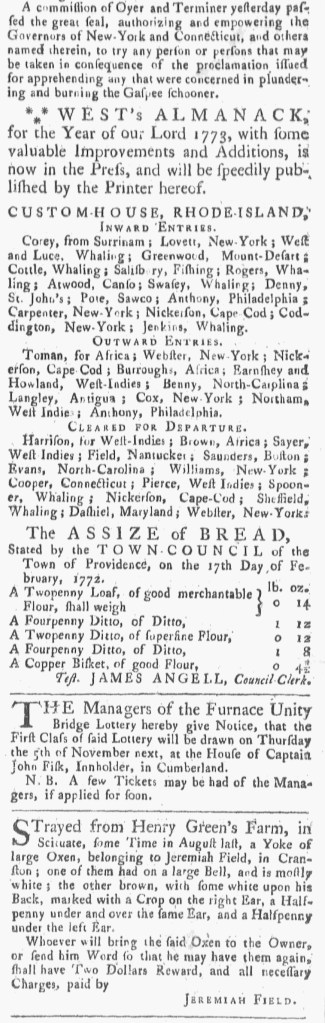
“WEST’s ALMANACK … is now in the Press.”

Where advertisements appeared in colonial newspapers varied from publication.  Some printers reserved advertising for the final pages, placing news items on the front and interior pages.  Others placed advertisements on the first and last pages since those were the first pages printed when producing a standard four-page edition.  Advertisements, which often repeated for multiple weeks, could be set in type and printed first, saving the second and third pages for the latest news that arrived in the printing office.  In some instances, printers distributed advertising throughout the newspaper, placing paid notices in the rightmost column on each page.

John Carter, printer of the Providence Gazette, consistently placed advertising at the end of the newspaper.  Paid notices usually filled the final page, though sometimes news items ran in the upper left corner.  The third page often had advertising that appeared to the right of the news.  In general, Carter printed news and editorials in the first two pages.

That made the placement of an announcement about “WEST’s ALMANACK, for the Year of our Lord 1773, with some valuable Improvements and Additions” all the more noteworthy for its placement in the October 24, 1772, edition of the Providence Gazette.  Rather than appearing among the advertisements or even as the first of the advertisements, the notice ran on the third page, immediately below local news from Providence and above shipping news from the customs house, a regular news feature.  The first advertisements in the issue appeared lower in the column.  The notice about the almanac, authored by Benjamin West in an annual collaboration with the printer of the Providence Gazette, declared that it was “now in the Press, and will be speedily published by the Printer hereof.”  The notice appeared in larger type than the news above and below it, helping to draw attention to it.

Given his interest in the success of the almanac, Carter treated the notice about its publication as a news item.  In so doing, he exercised his prerogative as the printer of the newspaper to give the notice a privileged place, separate from other advertisements.  The following week, Carter inserted an advertisement to inform prospective customers that he “Just PUBLISHED” the almanac, placing it first among the advertisement in that issue.  In both his initial effort to incite interest and his subsequent attempt to market the almanac, Carter took advantage of his access to the press to increase the likelihood that consumers saw his notices.

Slavery Advertisements Published October 24, 1772

The Slavery Adverts 250 Project chronicles the role of newspaper advertising in perpetuating slavery in the era of the American Revolution. The project seeks to reveal the ubiquity of slavery in eighteenth-century life from New England to Georgia by republishing advertisements about enslaved people – for sale as individuals or in groups, wanted to purchase or for hire for short periods, runaways who liberated themselves, and those who were subsequently captured and confined in jails and workhouses – in daily digests on this site as well as in real time via the @SlaveAdverts250 Twitter feed, utilizing twenty-first-century media to stand in for the print media of the eighteenth century.

The project aims to provide modern audiences with a sense of just how often colonizers encountered these advertisements in their daily lives. Enslaved men, women, and children appeared in print somewhere in the colonies almost every single day. Those advertisements served as a constant backdrop for social, cultural, economic, and political life in colonial and revolutionary America. Colonizers who did not purport to own enslaved people were still confronted with slavery as well as invited to maintain the system by purchasing enslaved men, women, and children or assisting in the capture of so-called “runaways” who sought to free themselves from bondage. The frequency of these newspaper advertisements suggests just how embedded slavery was in colonial and revolutionary American culture in everyday interactions beyond the printed page.

These advertisements also testify to the experiences of enslaved men, women, and children, though readers must consider that those experiences have been remediated through descriptions offered by enslavers rather than enslaved people themselves. Often unnamed in the advertisements, enslaved men, women, and children were not invisible or unimportant in early America.

These advertisements appeared in colonial American newspapers 250 years ago today.

Pennsylvania Chronicle (October 24, 1772).

**********

Pennsylvania Chronicle (October 24, 1772).

October 23

What was advertised in a colonial American newspaper 250 years ago today?

New-Hampshire Gazette (October 23, 1772).

“He has been oblig’d to take away the upper Gallery intirely.”

As audiences in Philadelphia enjoyed “FEATS in HORSEMANSHIP” performed by Mr. Bates and illusions performed by Hyman Saunders and Abraham Benjamin in the fall of 1772, patrons in Portsmouth, New Hampshire, attended performances “at the ACADEMY ROOM in Pitt-Street.”  A brief advertisement in the October 16 edition of the New-Hampshire Gazette reminded prospective members of the audience that the “Exhibitions will be perform’d as usual” that evening, though with some alterations or variation in the program.  A week later, a new advertisement provided a list of acts for an upcoming performance, demonstrating even to those who had recently attended that the theater offered something new for their amusement and entertainment.  The acts included “THE DEVIL and the DOCTOR, … A DRAMATIC SATIRE,” “A PANTOMINICAL ENTERTINMENT in Grotesque Characters, call’d WIN HER, and WEAR HER; or, HARLOQUIN SKELETON,” and an “Interlude of SINGING & DANCING, call’d NAVAL GLORY; or, the BRITISH TARS TRIUMPH.”

The advertisement advised that the doors would open at five o’clock and the performance would begin “Punctually” at six o’clock.  Patrons might wish to arrive early to claim their spots for viewing the various acts, especially following a reconfiguration of the Academy Room.  The notice acknowledged complaints “that the first Gallery was very In-commodious.”  To make the experience more comfortable and, in turn, more enjoyable for the audience, “Mr. MORGAN takes this opportunity of informing the TOWN, that has alter’d [the Academy Room}as much for the better as the House will allow.”  In order to do so, “he has been oblig’d to take away the upper Gallery intirely.”  That may explain why the advertisement gave the prices for tickets at “3, & 2 Pistereens each” compared to the “3, 2, and 1 Pistereen” in the previous notice.  Admission to the upper gallery, no longer available, had apparently cost one pistareen.  That portion of the advertisement demonstrates that performers promoted more than just the spectacles on the stage when they marketed their shows.  In this advertisement, the space in which the performances took place was just as important as the program of satires, pantomimes, and songs.  Those acts could have been performed in any tavern, but utilizing a space specifically adapted for the comfort and convenience of audiences enhanced the experience of attending the shows.

Slavery Advertisements Published October 23, 1772

The Slavery Adverts 250 Project chronicles the role of newspaper advertising in perpetuating slavery in the era of the American Revolution. The project seeks to reveal the ubiquity of slavery in eighteenth-century life from New England to Georgia by republishing advertisements about enslaved people – for sale as individuals or in groups, wanted to purchase or for hire for short periods, runaways who liberated themselves, and those who were subsequently captured and confined in jails and workhouses – in daily digests on this site as well as in real time via the @SlaveAdverts250 Twitter feed, utilizing twenty-first-century media to stand in for the print media of the eighteenth century.

The project aims to provide modern audiences with a sense of just how often colonizers encountered these advertisements in their daily lives. Enslaved men, women, and children appeared in print somewhere in the colonies almost every single day. Those advertisements served as a constant backdrop for social, cultural, economic, and political life in colonial and revolutionary America. Colonizers who did not purport to own enslaved people were still confronted with slavery as well as invited to maintain the system by purchasing enslaved men, women, and children or assisting in the capture of so-called “runaways” who sought to free themselves from bondage. The frequency of these newspaper advertisements suggests just how embedded slavery was in colonial and revolutionary American culture in everyday interactions beyond the printed page.

These advertisements also testify to the experiences of enslaved men, women, and children, though readers must consider that those experiences have been remediated through descriptions offered by enslavers rather than enslaved people themselves. Often unnamed in the advertisements, enslaved men, women, and children were not invisible or unimportant in early America.

These advertisements appeared in colonial American newspapers 250 years ago today.

Connecticut Journal (October 23, 1772).

October 22

What was advertised in a colonial American newspaper 250 years ago today?

Massachusetts Gazette and Boston Weekly News-Letter (October 22, 1772).

“CHEAP GOODS.”

In the fall of 1772, David Sears joined other advertisers in Boston who used borders composed of decorative type to enclose either the headline or their entire newspaper notice.  Sears proclaimed that he sold “CHEAP GOODS,” that headline surrounded by printing ornaments that called attention to his advertisement and prompted subscribers of the Massachusetts Gazette and Boston Weekly News-Letter to read more about the “fresh Assortment of Gall and Winter Goods” he recently imported from London.  His advertisement in the October 26 edition of the Boston-Gazette included the same headline within a decorative border.  In with instances, the headline and its border directed prospective customers to his bold claim that he set “such Prices that is not possible to be conceived of without Trial.”  In other words, it would take some effort to even imagine such low prices.

Sears certainly was not the first advertiser in Boston to incorporate a border into a newspaper advertisement.  As early as 1766, Jolley Allen made borders around his entire notices a signature element of his marketing.  Occasionally other advertisers deployed borders as well, but greater numbers did so simultaneously in the summer and fall of 1772.  Jolley Allen and Andrew Dexter both published advertisements with borders in May, though the Massachusetts Spy seemingly rejected any requests or instructions to include a border around Allen’s advertisement.  Martin Bicker ran an advertisement surrounded by a border in August.  Jonathan Williams, Jr., also did so in September.  Other merchants and shopkeepers opted for borders around just the headlines.  The week before Sears ran his advertisement on October 22, William Jackson introduced his notice with a border around the headline, “Variety Store.”  A few days later, Herman Brimmer and Andrew Brimmer had a border enclosing “Variety of Goods” at the top of their advertisement in Supplement to the Boston-Gazette.  The printers of that newspaper had recently used a decorative border for their own notice calling on subscribers with overdue accounts “to make immediate Payment.”

These examples may seem scattered, but considering how infrequently borders adorned advertisements in Boston’s newspapers (or newspapers printed elsewhere in the colonies) they suggest a trend among advertisers in 1772.  Sears may have observed that others included borders in their notices and determined that he desired the same for his advertisement, combining a pithy headline and graphic design to demand the attention of readers.

Slavery Advertisements Published October 22, 1772

GUEST CURATOR: Julia Tardugno

The Slavery Adverts 250 Project chronicles the role of newspaper advertising in perpetuating slavery in the era of the American Revolution. The project seeks to reveal the ubiquity of slavery in eighteenth-century life from New England to Georgia by republishing advertisements about enslaved people – for sale as individuals or in groups, wanted to purchase or for hire for short periods, runaways who liberated themselves, and those who were subsequently captured and confined in jails and workhouses – in daily digests on this site as well as in real time via the @SlaveAdverts250 Twitter feed, utilizing twenty-first-century media to stand in for the print media of the eighteenth century.

The project aims to provide modern audiences with a sense of just how often colonizers encountered these advertisements in their daily lives. Enslaved men, women, and children appeared in print somewhere in the colonies almost every single day. Those advertisements served as a constant backdrop for social, cultural, economic, and political life in colonial and revolutionary America. Colonizers who did not purport to own enslaved people were still confronted with slavery as well as invited to maintain the system by purchasing enslaved men, women, and children or assisting in the capture of so-called “runaways” who sought to free themselves from bondage. The frequency of these newspaper advertisements suggests just how embedded slavery was in colonial and revolutionary American culture in everyday interactions beyond the printed page.

These advertisements also testify to the experiences of enslaved men, women, and children, though readers must consider that those experiences have been remediated through descriptions offered by enslavers rather than enslaved people themselves. Often unnamed in the advertisements, enslaved men, women, and children were not invisible or unimportant in early America.

From compiling an archive of digitized eighteenth-century newspapers to identifying advertisements about enslaved men, women, and children in those newspapers to preparing images of each advertisement to posting this daily digest, Julia Tardugno served as guest curator for this entry. She completed this work as part of the Summer Scholars Program, funded by a fellowship from the D’Amour College of Liberal Arts and Sciences at Assumption University in Worcester, Massachusetts, in Summer 2022. 

These advertisements appeared in colonial American newspapers 250 years ago today.

Maryland Gazette (October 22, 1772).

**********

Maryland Gazette (October 22, 1772).

**********

Maryland Gazette (October 22, 1772).

**********

Maryland Gazette (October 22, 1772).

**********

Massachusetts Gazette and Boston Weekly News-Letter (October 22, 1772).

**********

New-York Journal (October 22, 1772).

**********

New-York Journal (October 22, 1772).

**********

New-York Journal (October 22, 1772).

**********

New-York Journal (October 22, 1772).

**********

South-Carolina Gazette (October 22, 1772).

**********

South-Carolina Gazette (October 22, 1772).

**********

South-Carolina Gazette (October 22, 1772).

**********

South-Carolina Gazette (October 22, 1772).

**********

Supplement to the South-Carolina Gazette (October 22, 1772).

**********

Supplement to the South-Carolina Gazette (October 22, 1772).

**********

Supplement to the South-Carolina Gazette (October 22, 1772).

**********

Supplement to the South-Carolina Gazette (October 22, 1772).

**********

Supplement to the South-Carolina Gazette (October 22, 1772).

**********

Virginia Gazette [Purdie and Dixon] (October 22, 1772).

**********

Virginia Gazette [Purdie and Dixon] (October 22, 1772).

**********

Virginia Gazette [Purdie and Dixon] (October 22, 1772).

**********

Virginia Gazette [Purdie and Dixon] (October 22, 1772).

**********

Virginia Gazette [Purdie and Dixon] (October 22, 1772).

**********

Virginia Gazette [Purdie and Dixon] (October 22, 1772).

**********

Virginia Gazette [Purdie and Dixon] (October 22, 1772).

**********

Virginia Gazette [Purdie and Dixon] (October 22, 1772).

**********

Virginia Gazette [Purdie and Dixon] (October 22, 1772).

**********

Virginia Gazette [Purdie and Dixon] (October 22, 1772).

**********

Virginia Gazette [Purdie and Dixon] (October 22, 1772).

**********

Virginia Gazette [Rind] (October 22, 1772).

**********

Virginia Gazette [Rind] (October 22, 1772).

**********

Virginia Gazette [Rind] (October 22, 1772).

**********

Virginia Gazette [Rind] (October 22, 1772).

**********

Virginia Gazette [Rind] (October 22, 1772).

October 21

What was advertised in a colonial American newspaper 250 years ago today?

Pennsylvania Journal (October 21, 1772).

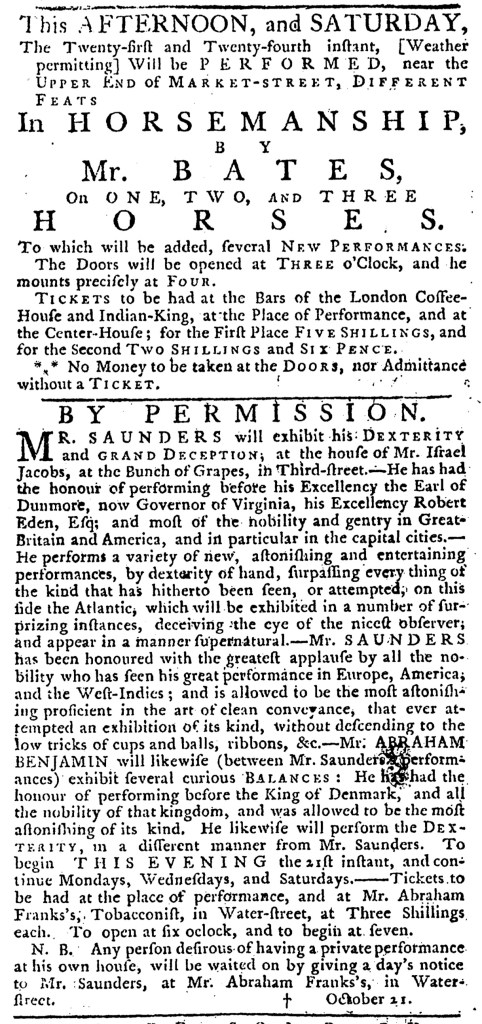
“MR. SAUNDERS will exhibit his DEXTERITY and GRAND DECEPTION.”

Newspaper advertisements help in revealing some of the entertainments enjoyed by colonizers in the eighteenth century.  For instance, two advertisements in the October 21, 1772, edition of the Pennsylvania Journal promoted upcoming performances and encouraged residents of Philadelphia to purchase tickets.  The first offered feats of “HORSEMANSHIP, BY Mr. BATES,” promising that he did tricks “On ONE, TWO, AND THREE HORSES.”  Bates and his act would have been familiar to regular readers at the time this advertisement appeared, so to entice anyone who had already seen the show to come again he proclaimed that he added “several NEW PERFORMANCES.”  Patrons needed to purchase tickets in advance since “No Money [would] be taken at the DOORS, nor Admittance without a TICKET,” yet they also received a discount for purchasing more than one.  The first ticket cost five shillings and the second only two shillings and six pence.  In other words, Bates advertised a “buy one, get one half off” promotion.

The other advertisement announced that “MR. SAUNDERS will exhibit his DEXTERITY and GRAND DECEPTION … at the Bunch of Grapes.”  Most likely, Hyman Saunders, the illusionist and itinerant performer who previously advertised in newspapers in both New York and Philadelphia, placed this notice.  He boasted that he “had the honour of performing before his Excellency the Earl of Dunmore, now Governor of Virginia … and most of the nobility and gentry in Great-Britain and America, and in particular in the capital cities.”  Saunders described his act as “dexterity by hand, surpassing everything of the kind that has hitherto been seen, or attempted, on this side of the Atlantic,” intending that such hyperbole would motivate readers to come to the show.  As a bonus, they would also see “Mr. ABRAHAM BENJAMIN … exhibit several curious BALANCES,” feats of “DEXTERITY, in a different manner from Mr. Saunders.”  Benjamin previously “had the honour of performing before the King of Denmark, and all the nobility of that kingdom.”  The pedigrees of both performers likely resonated with residents of Philadelphia who aspired to be as cosmopolitan as their counterparts in European cities.  Patrons could purchase tickets in advance at the Bunch of Grapes or “at Mr. Abraham Franks’s, Tobacconist.”  Saunders advised that performances would “continue [on] Mondays, Wednesdays, and Saturdays.”  Colonizers could also hire him for private performances in their own homes, entertaining themselves and guests fortunate enough to receive invitations.

Performers used newspaper advertisements to drum up interest in their performances in early America.  They likely resorted to handbills and broadsides as well, though those kinds of advertisements were more ephemeral.  Itinerant performers depended on publicity to draw audiences to their shows.  Even those who spent some time in town had to resort to promoting their acts to keep audiences coming or coming back for more.

Slavery Advertisements Published October 21, 1772

GUEST CURATOR: Julia Tardugno

The Slavery Adverts 250 Project chronicles the role of newspaper advertising in perpetuating slavery in the era of the American Revolution. The project seeks to reveal the ubiquity of slavery in eighteenth-century life from New England to Georgia by republishing advertisements about enslaved people – for sale as individuals or in groups, wanted to purchase or for hire for short periods, runaways who liberated themselves, and those who were subsequently captured and confined in jails and workhouses – in daily digests on this site as well as in real time via the @SlaveAdverts250 Twitter feed, utilizing twenty-first-century media to stand in for the print media of the eighteenth century.

The project aims to provide modern audiences with a sense of just how often colonizers encountered these advertisements in their daily lives. Enslaved men, women, and children appeared in print somewhere in the colonies almost every single day. Those advertisements served as a constant backdrop for social, cultural, economic, and political life in colonial and revolutionary America. Colonizers who did not purport to own enslaved people were still confronted with slavery as well as invited to maintain the system by purchasing enslaved men, women, and children or assisting in the capture of so-called “runaways” who sought to free themselves from bondage. The frequency of these newspaper advertisements suggests just how embedded slavery was in colonial and revolutionary American culture in everyday interactions beyond the printed page.

These advertisements also testify to the experiences of enslaved men, women, and children, though readers must consider that those experiences have been remediated through descriptions offered by enslavers rather than enslaved people themselves. Often unnamed in the advertisements, enslaved men, women, and children were not invisible or unimportant in early America.

From compiling an archive of digitized eighteenth-century newspapers to identifying advertisements about enslaved men, women, and children in those newspapers to preparing images of each advertisement to posting this daily digest, Julia Tardugno served as guest curator for this entry. She completed this work as part of the Summer Scholars Program, funded by a fellowship from the D’Amour College of Liberal Arts and Sciences at Assumption University in Worcester, Massachusetts, in Summer 2022. 

These advertisements appeared in colonial American newspapers 250 years ago today.

Pennsylvania Gazette (October 21, 1772).

**********

Pennsylvania Gazette (October 21, 1772).

**********

Pennsylvania Gazette (October 21, 1772).

**********

Pennsylvania Gazette (October 21, 1772).

**********

Pennsylvania Gazette (October 21, 1772).

**********

Supplement to the Pennsylvania Journal (October 21, 1772).

**********

Supplement to the Pennsylvania Journal (October 21, 1772).

**********

Supplement to the Pennsylvania Journal (October 21, 1772).

**********

Supplement to the Pennsylvania Journal (October 21, 1772).