April 19

What was advertised in a revolutionary American newspaper 250 years ago today?
Pennsylvania Journal (April 19, 1775).

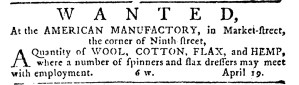
“WANTED, at the AMERICAN MANUFACTORY … A Quantity of WOOL, COTTON, FLAX, and HEMP.”

In the middle of March 1775, supporters of a “FUND for establishing and carrying on an AMERICAN MANUFACTORY, of LINEN, WOOLLEN,” and textiles made of other items met at Carpenters’ Hall in Philadelphia to learn more about the undertaking.  They pledged their support by signing their names to “Subscription Papers” or “general Proposals,” either at the meeting or at the London Coffee House in advance.  The organizers and the “Subscribers” sought to encourage “domestic manufactures” (products made in the colonies) as alternatives to imported goods.  Entrepreneurs had been pursuing that goal for more than a decade during the imperial crisis, though many devoted more effort during the times that colonizers adopted nonimportation agreements as political leverage.  In the spring of 1775, those involved with the “AMERICAN MANUFACTORY” did so as part of the Continental Association.  Its eighth article called for “encourage[ing] Frugality, Economy, and Industry; and promot[ing] Agriculture, Arts, and the Manufacturers of this Country.”

A month later, advertisements concerning the venture simultaneously appeared in the Pennsylvania Gazette and the Pennsylvania Journal on April 19.  “WANTED, At the AMERICAN MANUFACTORY,” the notices advised, “A Quantity of WOOL, COTTON, FLAX, and HEMP.”  Readers could demonstrate their commitment to the cause by supplying the resources necessary to produce textiles in the colony.  The advertisement also noted that “a number of spinners and flax dressers may meet with employment” at the manufactory, contributing to the success of the Continental Association while earning their livelihoods.

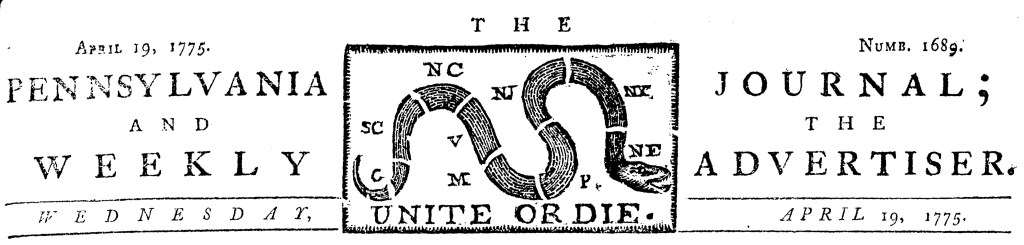
When the printers of the Pennsylvania Gazette and the Pennsylvania Journal distributed the weekly issue of their newspapers on April 19, they were not yet aware of the momentous events that happened at Lexington and Concord in Massachusetts that morning, though it would not take long for word to spread to Philadelphia and throughout the colonies.  Historians have long debated when the American Revolution began, echoing the question that John Adams posed to Thomas Jefferson in 1815: “What do We mean by the Revolution?  The War?  That was no part of the Revolution.  It was only an Effect and Consequence of it.  The Revolution was in the Minds of the People, and this was effected, from 1760 to 1775, in the course of fifteen Years before a drop of blood was drawn at Lexington.”  Establishing the “AMERICAN MANUFACTORY” in Philadelphia before the war, according to Adams, was part of the revolution.  Today, however, the 250th anniversary of the battles at Lexington and Concord offers a convenient moment for commemorating the American Revolution by aligning it with the Revolutionary War that secured independence for a new nation composed of thirteen former colonies.  For readers of the Pennsylvania Journal in 1775, the political cartoon depicting a severed snake with the motto “UNITE OR DIE” had already been spreading its message for many months.  The masthead, the articles and letters, and many of the advertisements had been part of a revolution that was already occurring “in the Minds of the People.”
Pennsylvania Journal (April 19, 1775).

Slavery Advertisements Published April 19, 1775

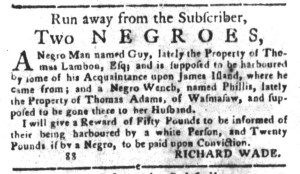
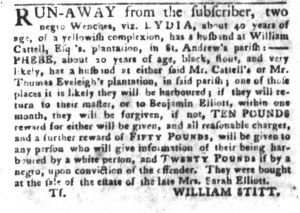
The Slavery Adverts 250 Project chronicles the role of newspaper advertising in perpetuating slavery in the era of the American Revolution. The project seeks to reveal the ubiquity of slavery in eighteenth-century life from New England to Georgia by republishing advertisements about enslaved people – for sale as individuals or in groups, wanted to purchase or for hire for short periods, runaways who liberated themselves, and those who were subsequently captured and confined in jails and workhouses – in daily digests on this site as well as in real time via the @SlaveAdverts250 Twitter feed, utilizing twenty-first-century media to stand in for the print media of the eighteenth century.

The project aims to provide modern audiences with a sense of just how often colonizers encountered these advertisements in their daily lives. Enslaved men, women, and children appeared in print somewhere in the colonies almost every single day. Those advertisements served as a constant backdrop for social, cultural, economic, and political life in colonial and revolutionary America. Colonizers who did not purport to own enslaved people were still confronted with slavery as well as invited to maintain the system by purchasing enslaved men, women, and children or assisting in the capture of so-called “runaways” who sought to free themselves from bondage. The frequency of these newspaper advertisements suggests just how embedded slavery was in colonial and revolutionary American culture in everyday interactions beyond the printed page.

These advertisements also testify to the experiences of enslaved men, women, and children, though readers must consider that those experiences have been remediated through descriptions offered by enslavers rather than enslaved people themselves. Often unnamed in the advertisements, enslaved men, women, and children were not invisible or unimportant in early America.

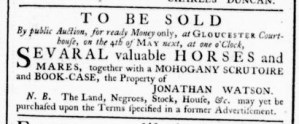
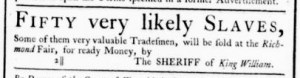
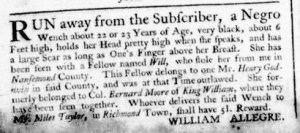
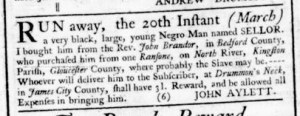
These advertisements appeared in colonial American newspapers 250 years ago today.

Maryland Journal (April 19, 1775).

**********

Maryland Journal (April 19, 1775).

**********

Maryland Journal (April 19, 1775).

**********

Pennsylvania Journal (April 19, 1775).

April 18

What was advertised in a colonial American newspaper 250 years ago today?

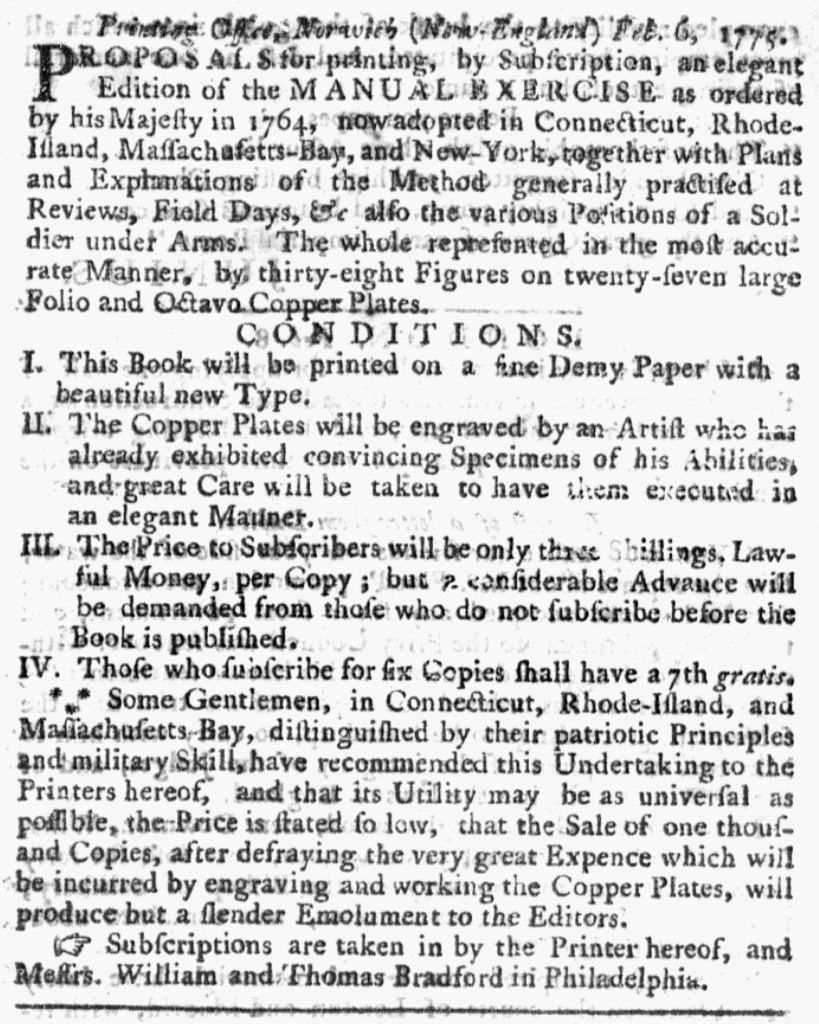
“An elegant Edition of the MANUAL EXERCISE [with] the various Positions of a Soldier under Arms.”

Pennsylvania Evening Post (April 18, 1775).

Advertisements for The Manual Exercise as Ordered by His Majesty in 1764: Together with Plans an Explanations of the Method Generally Practised at Reviews and Field-Days appeared in several newspapers printed in New England in 1774, one indication of how colonizers reacted to the trouble brewing with Great Britain.  Printers in five towns produced their own editions, including Ezra Lunt and Henry-Walter Tinges in Newburyport, Massachusetts, John Carter in Providence, Rhode Island, Judah Paddock Spooner in Norwich, and Thomas Green and Samuel Green in New Haven, Connecticut.  In Boston, Isaiah Thomas printed the book and Thomas Fleet and John Fleet issued three variant editions.  They may have also published a previous edition in 1773, based on an inscription that appears in one surviving copy.

In 1775, printers beyond New England produced other editions after the skirmishes at Lexington and Concord and the ensuing military actions.  In New York, Hugh Gaine published one edition; another printed by J. Anderson has been dated to that year.  William Bradford and Thomas Bradford issued the book in Philadelphia.  So did Robert Aitken, meeting with sufficient demand to issue a second edition.  Francis Bailey in Lancaster, Pennsylvania, James Adams in Wilmington, Delaware, and John Dixon and William Hunter in Williamsburg, Virginia, each published local editions in 1775.

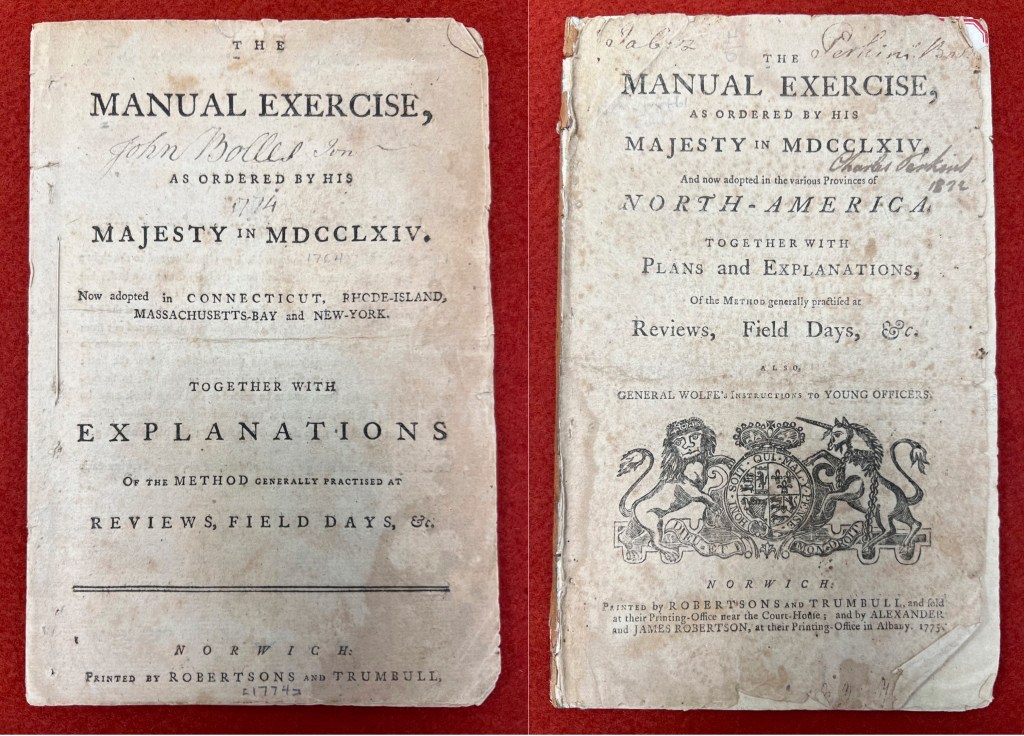
Alexander Robertson, James Robertson, and John Trumbull in Norwich, Connecticut, were among the printers who published an edition in 1774.  In the October 13 edition of the Norwich Packet, they advertised that they had “Just published … THE MANUAL EXERCISE, AS ORDERED BY HIS MAJESTY, And now adopted in the Colonies of CONNECTICUT, RHODE-ISLAND, and Province of MASSACHUSETTS-BAY.”  On February 23, 1775, they ran much more elaborate subscription proposals for another edition, an “ELEGANT EDITION” that would include “38 Figures on 27 large Folioand Octavo Copper Plates” that depicted the “various POSITIONS of a SOLDIER UNDER ARMS.”  They explained that “Some Gentlemen, distinguished by their patriotic Principles and military Skill, have recommended this Undertaking to the Printers” as a service to the public.  In the interest of disseminating the book widely so “its Utility may be as universal as possible,” the printers set a low price, “only three Shillings … per Copy” for subscribers who ordered theirs in advance.  Those “who do not subscribe before the Book is published,” on the other hand, could expect to pay “a considerable Advance” (or higher price).  The Robertsons and Trumbull set the price such that “the Sale of 500 Copies” would defray “the very great Expence which will be incurred by the engraving and working the Copper Plates” and yield “but a slender Emolument to the Editors.”

In those proposals, the printers listed local agents who collected subscriptions in Boston, Chelsea, Newburyport, and Salem in Massachusetts, Portsmouth in New Hampshire, and Providence in Rhode Island.  In addition, three post riders also took orders from subscribers.  Eventually, a version of the proposals ran in the Pennsylvania Evening Post.  It did not include the lengthy list of local agents in New England, but instead specified that Benjamin Towne, the printer of the Pennsylvania Evening Post, and William Bradford and Thomas Bradford, the printers of the Pennsylvania Journal, collected subscriptions in Philadelphia.  Perhaps the Bradfords had not yet determined to publish their own edition.  Those proposals also doubled the number of subscribers necessary for “defraying the great Expence” of the engravings to one thousand.

Even though the Robertsons and Trumbull promoted the copper plates, asserting that they “will be engraved by an Artists who has already exhibited convincing Specimens of his Abilities, and great Care will be taken to have them executed in an elegant Manner,” they did not include those illustrations with the new edition they published in 1775.  That edition closely paralleled their previous edition, though it did have a new title page and “Instructions for young OFFICERS.  By GENERAL WOLFE” on the final page, which had been blank in the 1774 edition.  While it is possible that the engravings were removed from the copy in the collections of the American Antiquarian Society at some point over the past 250 years, it seems more likely that events overtook the printers.  Once the imperial crisis became a war, they may have been less concerned about commissioning copperplate engravings and more interested in issuing a new edition of the Manual Exercise to meet the demand of colonizers who believed more than ever that they needed the instructions in that volume.

Copies of The Manual Exercise printed by Robertsons and Trumbull in the collections of the American Antiquarian Society. Left: 1774 edition. Right: 1775 edition.

Slavery Advertisements Published April 18, 1775

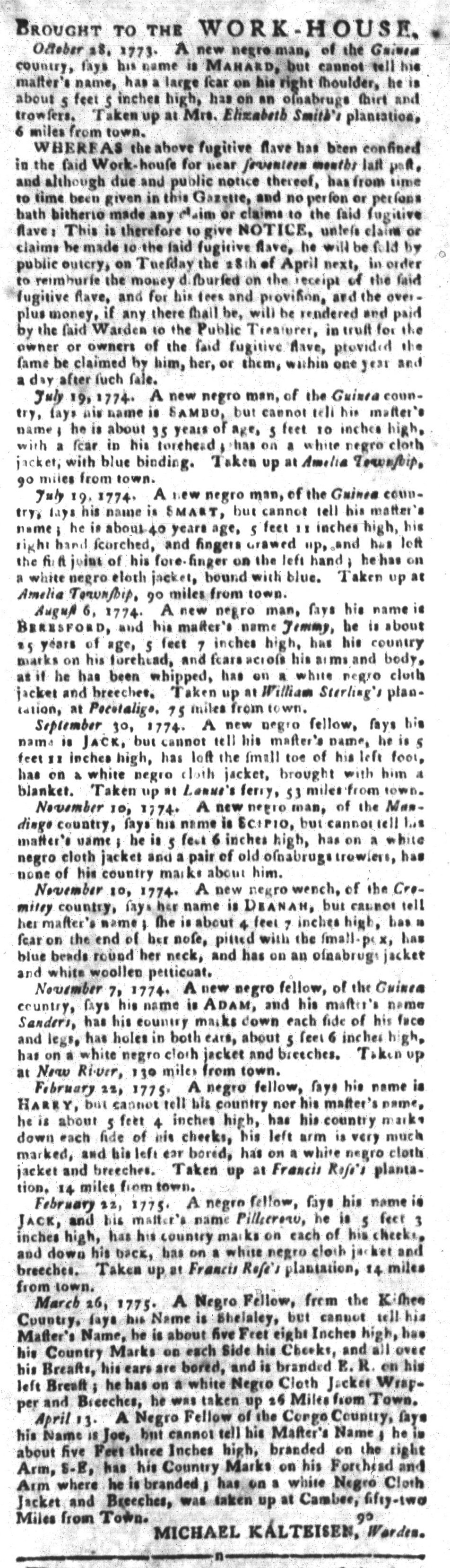
The Slavery Adverts 250 Project chronicles the role of newspaper advertising in perpetuating slavery in the era of the American Revolution. The project seeks to reveal the ubiquity of slavery in eighteenth-century life from New England to Georgia by republishing advertisements about enslaved people – for sale as individuals or in groups, wanted to purchase or for hire for short periods, runaways who liberated themselves, and those who were subsequently captured and confined in jails and workhouses – in daily digests on this site as well as in real time via the @SlaveAdverts250 Twitter feed, utilizing twenty-first-century media to stand in for the print media of the eighteenth century.

The project aims to provide modern audiences with a sense of just how often colonizers encountered these advertisements in their daily lives. Enslaved men, women, and children appeared in print somewhere in the colonies almost every single day. Those advertisements served as a constant backdrop for social, cultural, economic, and political life in colonial and revolutionary America. Colonizers who did not purport to own enslaved people were still confronted with slavery as well as invited to maintain the system by purchasing enslaved men, women, and children or assisting in the capture of so-called “runaways” who sought to free themselves from bondage. The frequency of these newspaper advertisements suggests just how embedded slavery was in colonial and revolutionary American culture in everyday interactions beyond the printed page.

These advertisements also testify to the experiences of enslaved men, women, and children, though readers must consider that those experiences have been remediated through descriptions offered by enslavers rather than enslaved people themselves. Often unnamed in the advertisements, enslaved men, women, and children were not invisible or unimportant in early America.

These advertisements appeared in colonial American newspapers 250 years ago today.

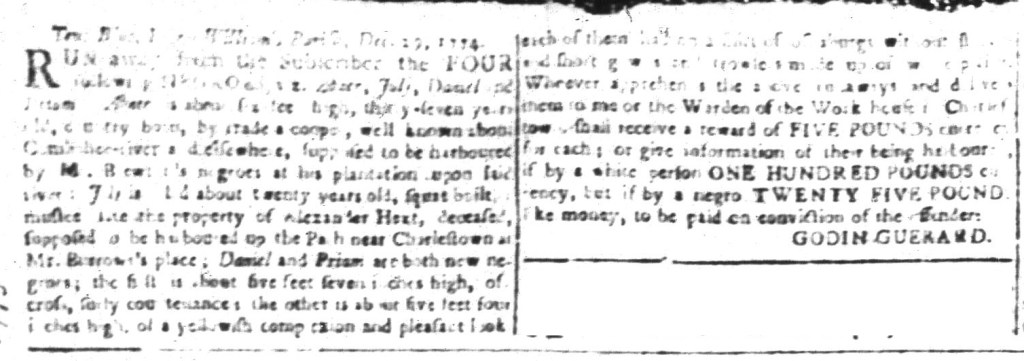
South-Carolina and American General Gazette (April 18, 1775).

**********

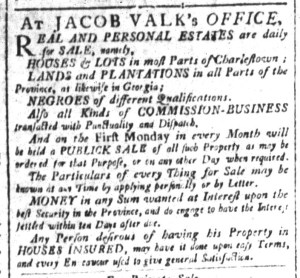
South-Carolina and American General Gazette (April 18, 1775).

**********

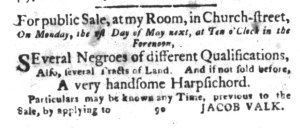
South-Carolina and American General Gazette (April 18, 1775).

**********

South-Carolina and American General Gazette (April 18, 1775).

**********

South-Carolina and American General Gazette (April 18, 1775).

**********

South-Carolina and American General Gazette (April 18, 1775).

**********

South-Carolina Gazette and Country Journal (April 18, 1775).

**********

South-Carolina Gazette and Country Journal (April 18, 1775).

**********

South-Carolina Gazette and Country Journal (April 18, 1775).

**********

South-Carolina Gazette and Country Journal (April 18, 1775).

**********

South-Carolina Gazette and Country Journal (April 18, 1775).

**********

South-Carolina Gazette and Country Journal (April 18, 1775).

**********

South-Carolina Gazette and Country Journal (April 18, 1775).

**********

South-Carolina Gazette and Country Journal (April 18, 1775).

**********

South-Carolina Gazette and Country Journal (April 18, 1775).

**********

South-Carolina Gazette and Country Journal (April 18, 1775).

**********

South-Carolina Gazette and Country Journal (April 18, 1775).

**********

South-Carolina Gazette and Country Journal (April 18, 1775).

April 17

What was advertised in a colonial American newspaper 250 years ago today?

Boston Evening-Post (April 17, 1775).

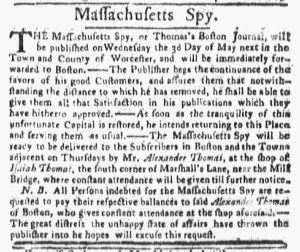
“THE Massachusetts Spy … will be published … in the Town and County of Worcester.”

Isaiah Thomas published the last issue of the Massachusetts Spy in Boston on April 6, 1775.  Eleven days later, advertisements in the Boston Evening-Post and the Massachusetts Gazette and Boston Post-Boy informed readers that the “Massachusetts Spy, or Thomas’s Boston Journal, will be published on Wednesday the 3d Day of May next in the Town and County of Worcester, and will be immediately forwarded to Boston.”  Why did Thomas suddenly suspend publishing the Massachusetts Spy, founded in 1770, and relocate to Worcester with plans to revive the newspaper there?

In his History of Printing in America, published in 1810, Thomas declared, “It became at length apparent to all reflecting men that hostilities must soon take place between Great Britain and her American colonies.”  Through the editorial stance he took in the Massachusetts Spy, the patriot printer “had rendered himself very obnoxious to the friends of the British administration; and, in consequence, the tories, and some of the British soldiery in the town, openly threatened him with the effects of their resentment.”  Along with other residents of Boston, Thomas had endured all sorts of “Distresses,” as he called them, following the closure of the harbor in retaliation for the destruction of the tea, but now his own safety was at stake.  “For these and other reasons, he was induced to pack up, privately, a press and types, and to send them in the night over the Charles river to Charlestown, whence they were conveyed to Worcester.”  Thomas was smart with his timing for getting out of Boston: “This was only a few days before the affair at Lexington.”[1]  The printer smuggled a press out of Boston just before the Revolutionary War began with the skirmishes at Lexington and Concord followed by the siege of Boston.

Near the end of February, the Massachusetts Spy carried subscription proposals for a “New Weekly NEWS-PAPER … To be entitled, The WORCESTER GAZETTE.”  Thomas had made arrangements with “a number of gentlemen in the county of Worcester, zealously engaged in the cause of the country … to open a printing house, and to publish a newspaper there, in the course of the ensuing spring.”  It would be the town’s first printing office and first newspaper.  Thomas planned “to send a press, with a suitable person to manage the concerns of it,” having previously gained experience setting up Henry-Walter Tinges as a junior partner who oversaw their printing office in Newburyport and printed the Essex Journal.  “The war commencing sooner than expected,” however, Thomas “was obliged to leave Boston, and came himself to Worcester, opened a printing house, and on the 3d of May, 1775, executed the first printing done in the town.”[2]

As he prepared to open that printing office, his advertisement in newspapers still published in Boston advised the public that the “Publisher [of the Massachusetts Spy] begs the continuance of the favors of his good Customers, and assures then that notwithstanding the distance to which he has removed, he shall be able to give them all that Satisfaction in his publications which they have hitherto approved.”  Furthermore, he planned to return to Boston “[a]s soon as the tranquility of this unfortunate Capital is restored,” not knowing at the time that he would remain in Worcester after the war ended.  For the moment, he designated a local agent, Alexander Thomas, who oversaw his shop in Boston and saw to the delivery of new issues of the Massachusetts Spy on Thursdays, the day after the printer published them in Worcester.  He also requested that “All Persons indebted for the Massachusetts Spy … pay their respective balances.” Like other printers, Thomas extended credit to his customers, but the “great distress [of] the unhappy state of affairs” made it necessary to call on them to make payment.”  Thomas faced a new chapter, one that the Adverts 250 Projectwill chronicle as it examines advertisements placed in revolutionary American newspapers.

**********

[1] Isaiah Thomas, The History of Printing in America: With a Biography of Printers and an Account of Newspapers (1810; New York: Weathervane Press, 1970), 168.

[2] Thomas, History of Printing, 180-181.

Slavery Advertisements Published April 17, 1775

The Slavery Adverts 250 Project chronicles the role of newspaper advertising in perpetuating slavery in the era of the American Revolution. The project seeks to reveal the ubiquity of slavery in eighteenth-century life from New England to Georgia by republishing advertisements about enslaved people – for sale as individuals or in groups, wanted to purchase or for hire for short periods, runaways who liberated themselves, and those who were subsequently captured and confined in jails and workhouses – in daily digests on this site as well as in real time via the @SlaveAdverts250 Twitter feed, utilizing twenty-first-century media to stand in for the print media of the eighteenth century.

The project aims to provide modern audiences with a sense of just how often colonizers encountered these advertisements in their daily lives. Enslaved men, women, and children appeared in print somewhere in the colonies almost every single day. Those advertisements served as a constant backdrop for social, cultural, economic, and political life in colonial and revolutionary America. Colonizers who did not purport to own enslaved people were still confronted with slavery as well as invited to maintain the system by purchasing enslaved men, women, and children or assisting in the capture of so-called “runaways” who sought to free themselves from bondage. The frequency of these newspaper advertisements suggests just how embedded slavery was in colonial and revolutionary American culture in everyday interactions beyond the printed page.

These advertisements also testify to the experiences of enslaved men, women, and children, though readers must consider that those experiences have been remediated through descriptions offered by enslavers rather than enslaved people themselves. Often unnamed in the advertisements, enslaved men, women, and children were not invisible or unimportant in early America.

These advertisements appeared in colonial American newspapers 250 years ago today.

Boston Evening-Post (April 17, 1775).

**********

Boston Evening-Post (April 17, 1775).

**********

Boston Evening-Post (April 17, 1775).

**********

Boston-Gazette (April 17, 1775).

**********

Newport Mercury (April 17, 1775).

**********

New-York Gazette and Weekly Mercury (April 17, 1775).

**********

New-York Gazette and Weekly Mercury (April 17, 1775).

**********

Supplement to the New-York Gazette and Weekly Mercury (April 17, 1775).

**********

Supplement to the New-York Gazette and Weekly Mercury (April 17, 1775).

**********

Supplement to the New-York Gazette and Weekly Mercury (April 17, 1775).

**********

Supplement to the New-York Gazette and Weekly Mercury (April 17, 1775).

**********

Supplement to the New-York Gazette and Weekly Mercury (April 17, 1775).

April 16

What was advertised in a colonial American newspaper 250 years ago this week?

Rivington’s New-York Gazetteer (April 13, 1775).

“Being fully determined not to be undersold by any person whatever.”

A “NEW ADVERTISEMENT BY RICHARD DEANE, Distiller,” ran in the April 13, 1775, edition of Rivington’s New-York Gazetteer.  Even though it had a dateline from two months earlier, “Feb. 10, 1775,” and had been running for several weeks, it still merited being called a “NEW ADVERTISEMENT” because it displaced another advertisement that Deane regularly placed in New York’s newspapers for many months.

The distiller took to the pages of the newspaper with some fanfare to inform “the public, my friends and customers” that he would not be undersold by any of his competitors who marketed their own “brandy, Geneva, and cordials.”  He believed that he had lost some customers to other distillers, prompting him to proclaim that he “can afford to sell said liquors on as cheap terms as any others can theirs, of an equal quality.”  Moreover, he deserved special consideration because “it cannot be denied, that I was the first distiller that ever made brandy and geneva, for sale in this province, … introducing a business, whereby the country saves annually large sums of money, that must otherwise have gone to foreign parts.”  Consumers should purchase his liquor, he asserted, to support local industry and, especially, the entrepreneur who took the risk of establishing the trade in the colony.  In turn, they could depend on what they spent supporting the local economy.

At the same time, Deane made appeals to quality.  He declared that even though he lowered his prices considerably, he still made “brandy and geneva of a full quality, and a high proof, as usual.”  He also pledged that he would not “diminish the goodness of my cordials, in any respect whatever.”  Furthermore, the “great demand for my liquors in most parts of North-America … is sufficient proof of their excellence.”  Consumers should trust existing customers, the distiller reasoned.  To encourage them to do so, he offered a price match guarantee.  He listed the prices the prices per gallon of brandy, gin, and several cordials, but also declared “that if any other person sells liquors of an equal quality with mine, cheaper than the rates underneath, I will immediately sell at the same price, being fully determined not to be undersold by any person whatever.”  Deane recognized that he lost customers because other set lower prices, but he aimed to win them back and gain new ones in the process.
April 15

What was advertised in a colonial American newspaper 250 years ago today?

Pennsylvania Ledger (April 15, 1775).

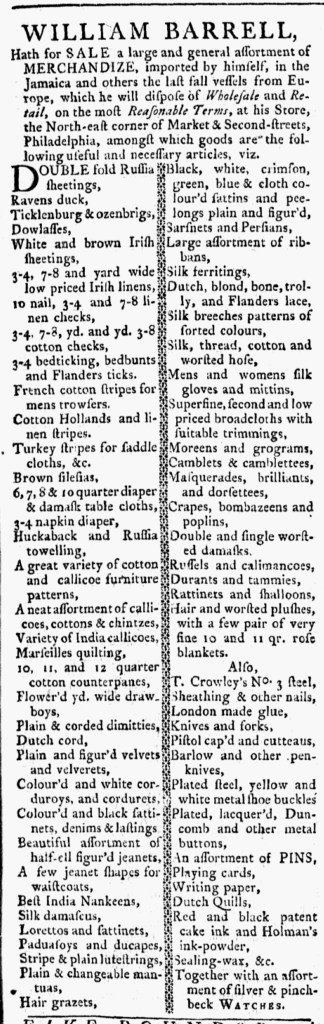
“MERCHANDIZE, imported [in] the last fall vessels from Europe.”

William Barrell’s advertisement in the April 15, 1775, edition of the Pennsylvania Ledger looked much like many of the advertisements that merchants and shopkeepers had been placing in American newspapers for the past couple of decades.  That was even though the Continental Association, a nonimportation agreement devised by the First Continental Congress, had been in effect since December 1, 1774.  Colonizers sought to use economic leverage to convince Parliament to repeal the Coercive Acts.

The notice filled most of the first column on the first page, making it difficult for readers to miss.  Barrell promoted a “large and general assortment of MERCHANDIZE.”  To demonstrate the choices available to consumers, he included an extensive catalog that accounted for most of the space occupied by the advertisement.  He did not opt for dense paragraphs of text, instead arranging with the compositor to divide the list of his inventory into two columns with a line comprised of printing ornaments running down the center.  One, two or three related items appeared on each line.  Barrell stocked all sorts of textiles, everything from “Ticklenburg & ozenbrigs” to “Colour’d and white corduroys, and cordurets” to Crapes, bombazeens and poplins.”  He also carried “Mens and womens silk gloves and mittins,” “Playing cards,” and “Plated, lacquer’d Duncomb and other metal buttons.”  Prospective customers had access to the same variety of goods as they did before the nonimportation agreement.

In his introduction to his list of “useful and necessary articles,” Barrell made a standard appeal to price, stating that he sold his wares “on the most Reasonable Terms.”  He also noted that he imported them via the “last fall vessels from Europe.”  The savvy merchant carefully alerted the public that he was not breaking the Continental Association by selling goods imported since December 1.  Instead, he continued to stock and sell only items that arrived in Philadelphia before the Continental Association went into effect.  In that regard, his advertisement did differ from those published at other times.  Merchants and shopkeepers often emphasized that they peddled new inventory that just arrived.  Customers could select from among the latest styles.  In this instance, however, Barrell realized that consumers would accept, even embrace, goods that had been on the shelves for a few months, especially if he emphasized that they had not been there for too long, just since the arrival of the “last fall vessels.”

Slavery Advertisements Published April 15, 1775

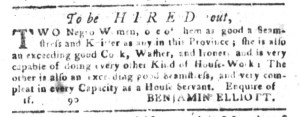
The Slavery Adverts 250 Project chronicles the role of newspaper advertising in perpetuating slavery in the era of the American Revolution. The project seeks to reveal the ubiquity of slavery in eighteenth-century life from New England to Georgia by republishing advertisements about enslaved people – for sale as individuals or in groups, wanted to purchase or for hire for short periods, runaways who liberated themselves, and those who were subsequently captured and confined in jails and workhouses – in daily digests on this site as well as in real time via the @SlaveAdverts250 Twitter feed, utilizing twenty-first-century media to stand in for the print media of the eighteenth century.

The project aims to provide modern audiences with a sense of just how often colonizers encountered these advertisements in their daily lives. Enslaved men, women, and children appeared in print somewhere in the colonies almost every single day. Those advertisements served as a constant backdrop for social, cultural, economic, and political life in colonial and revolutionary America. Colonizers who did not purport to own enslaved people were still confronted with slavery as well as invited to maintain the system by purchasing enslaved men, women, and children or assisting in the capture of so-called “runaways” who sought to free themselves from bondage. The frequency of these newspaper advertisements suggests just how embedded slavery was in colonial and revolutionary American culture in everyday interactions beyond the printed page.

These advertisements also testify to the experiences of enslaved men, women, and children, though readers must consider that those experiences have been remediated through descriptions offered by enslavers rather than enslaved people themselves. Often unnamed in the advertisements, enslaved men, women, and children were not invisible or unimportant in early America.

These advertisements appeared in colonial American newspapers 250 years ago today.

Pennsylvania Ledger (April 15, 1775).

**********

Pennsylvania Ledger (April 15, 1775).

**********

Virginia Gazette [Dixon and Hunter] (April 15, 1775).

**********

Virginia Gazette [Dixon and Hunter] (April 15, 1775).

**********

Virginia Gazette [Dixon and Hunter] (April 15, 1775).

**********

Virginia Gazette [Dixon and Hunter] (April 15, 1775).

**********

Virginia Gazette [Dixon and Hunter] (April 15, 1775).

**********

Virginia Gazette [Dixon and Hunter] (April 15, 1775).

**********

Virginia Gazette [Dixon and Hunter] (April 15, 1775).

**********

Virginia Gazette [Dixon and Hunter] (April 15, 1775).

**********

Virginia Gazette [Dixon and Hunter] (April 15, 1775).

April 14

Who was the subject of an advertisement in a colonial American newspaper 250 years ago today?

Story and Humphreys’s Pennsylvania Mercury (April 14, 1775).

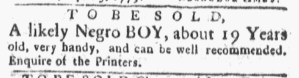
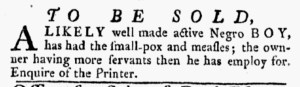
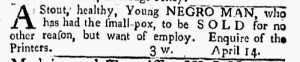
“A Stout, healthy, Young NEGRO MAN … to be SOLD … Enquire of the Printers.”

On April 14, 1775, Enoch Story and Daniel Humphreys published “VOL. I.  NUMB. 2,” the second issue of their new newspaper.  They updated the title in the masthead from The Pennsylvania Mercury; and the Universal Advertiser to Story and Humphreys’s Pennsylvania Mercury, and Universal Advertiser.  The colophon running across the bottom of the final page remained the same, advising readers that they “gratefully received” subscriptions, advertisements, articles, and “Letters of Intelligence” at their printing office in Norris’s Alley in Philadelphia.  Their first issue featured a significant number of advertisements.  The second issue contained even more.  Advertisers were willing to take a chance with this new newspaper, apparently believing that its circulation justified the investment in purchasing space to disseminate their notices.

Among the advertisements that ran for the first time in the second issue of Story and Humphreys’s Pennsylvania Mercury, one offered “A Stout, healthy, Young NEGRO MAN, who has had the small-pox, to be SOLD for no other reason, but want of employ.”  It advised interested parties to “Enquire of the Printers” to learn more.  The notice was dated “April 14” and had a notation, “3 w,” that let the compositor know to include it in three issues.  Last week, Story and Humphreys’s Pennsylvania Mercury made its first appearance in the Adverts 250 Project to examine the advertisements in it (or its second appearance when counting subscription proposals that ran in another newspaper).  Today, the Adverts 250 Project features that newspaper once again because it is making its first appearance in the Slavery Adverts 250 Project.

Yet Story and Humphreys did not merely publish an advertisement that offered an enslaved man for sale.  They published an “Enquire of the Printers” advertisement that made them active participants in the sale.  They may have facilitated an introduction, or they may have negotiated on behalf of the advertiser.  The notice does not reveal the extent of their involvement, but it does indicate that they were involved beyond publishing the advertisement and earning revenue for doing so.  As Jordan E. Taylor documents, American printers acted as slave brokers in thousands of advertisements in newspapers published throughout the colonies and, later, states in the eighteenth century.[1]  Participating in the slave trade was part of the business model for operating a viable newspaper.  Taylor could not identify any printers who refused to run advertisements that offered enslaved people for sale as a matter of principle; the financial incentives were too strong to ignore.  Story and Humphreys very quickly incorporated perpetuating slavery into the practices for their press, both as printers who disseminated advertisements offering enslaved people for sale and as printers who served as slave brokers via “Enquire of the Printers” advertisements.

**********

[1] Jordan E. Taylor, “Enquire of the Printer: Newspaper Advertising and the Moral Economy of the North American Slave Trade, 1704-1807,” Early American Studies: An Interdisciplinary Journal 18, no. 3 (Summer 2020): 287-323.