February 25

Who was the subject of an advertisement in a colonial American newspaper 250 years ago today?
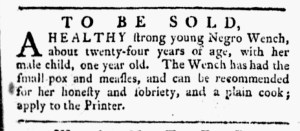
Pennsylvania Ledger (February 25, 1775).

“A HEALTHY strong young Negro [Woman] … with her male child, one year old.”

Five issues.  It took only five issues for an advertisement offering enslaved people for sale to appear in the Pennsylvania Ledger.  James Humphreys, Jr., launched the newspaper on January 28, 1775.  Four weeks later, he printed an advertisement about a “HEALTHY strong young Negro [Woman], about twenty-four years of age,” to be sold “with her male child, one year old.”  The Pennsylvania Ledger was still such a new publication when it carried this advertisement that the proposals and conditions for subscribing appeared as the first item in the first column on the first page.  An advertisement for a political pamphlet ran immediately below the proposals, followed by the advertisement for the enslaved young woman and her child.  Readers encountered them before news reprinted from the Maryland Gazette or any of the other content in that issue.

Humphreys did not merely print and disseminate the advertisement.  He also acted as a broker in the sale.  The notice instructed interested parties to “apply to the Printer.”  What role Humphreys would play when someone did “apply” to him was not apparent in the advertisement.  He may have referred prospective buyers to the advertiser, he may have provided more details about the sale, including price and credit, or he may have been empowered to agree to a sale should a buyer meet the terms specified by the enslaver who offered the woman and child for sale.  Whatever role he played, Humphreys was actively involved in the sale beyond printing the advertisement in his newspaper.

He may have even consulted with the advertiser in composing the advertisement, though it was formulaic enough that an enslaver looking to sell human property likely did not need such assistance.  After all, such “enquire of the printer” advertisements appeared regularly in newspapers published during the era of the American Revolution.  The anonymous advertiser noted that the enslaved woman “has had the small-pox and measles,” a guarantee of her health in the future since she would not contract those diseases again, and “can be well recommended fort her honesty and sobriety.”  In addition, she was a “plain cook.”  Such language was just as common in advertisements for enslaved people as directions to “apply to the Printer” who would act as a broker in the sale.

For more on such advertisements, see Jordan Taylor’s “Enquire of the Printer: The Slave Trade and Early American Newspaper Advertising.”

February 24

What was advertised in a colonial American newspaper 250 years ago today?

New-Hampshire Gazette (February 24, 1775).

“All which were imported before the 1st Day of December.”

As February 1775 came to a close, Richard Wibirt Penhallow took to the pages of the New-Hampshire Gazette to advertise a variety of items he offered for sale “at the Warehouse on Long-Wharfe, (lately occupied by Mr. Jacob Sheafe jun.)” in Portsmouth.  He had nails, sugar, frying pans, blankets, twine, and fishing hooks, “together with many other Articles.”  Penhallow concluded his notice by informing readers that all his wares “were imported before the 1st Day of December.”

Why would prospective customers, readers of the New-Hampshire Gazette, or the public care when Penhallow imported the goods that he sold in February 1775?  In clarifying when he received his merchandise, Penhallow acknowledged current events, including the Continental Association that went into effect on December 1 and the imperial crisis that intensified as Parliament passed and enforced the Coercive Acts in response to the Boston Tea Party.  The Continental Association, a nonimportation, nonconsumption, and nonexportation agreement devised by the First Continental Congress and adopted throughout the colonies, called for boycotting imported goods until Parliament repealed the Coercive Acts.  Colonizers attempted to use economic means to achieve political ends.

Not wishing to run afoul of the local Committee of Inspection, Penhallow emphasized when he received the goods that he advertised.  He also indicated that he sold then “cheap for CASH only.”  In addition to alerting prospective customers that he would not extend credit in those troubling times, he also signaled that he abided by the provision of the Continental Association that prohibited merchants, shopkeepers, and others from engaging in price gouging.  “Venders of Goods or Merchandise,” the ninth article specified, “will not take Advantage of the Scarcity of Goods that may be occasioned by this Association, but will sell the same at the Rates we have been respectively accustomed to do for twelve Months last past.”  Those who did jack up their prices could expect consequences.  Supporters of the Association would not “deal with any such Person … at any Time thereafter, for any Commodity whatever.”

With a few carefully selected words in his advertisement, Penhallow communicated that he understood and abided by the Continental Association.  In turn, prospective customers could acquire merchandise from him without worrying that they violated the pact.  Similarly, he could remain in good standing in his community.

February 23

What was advertised in a colonial American newspaper 250 years ago today?

Massachusetts Spy (February 23, 1775).

“A New Weekly NEWS-PAPER … The WORCESTER GAZETTE; OR, AMERICAN ORACLE of LIBERTY.”

Among the advertisements in the February 23, 1775, edition of the Massachusetts Spy appeared “PROPOSALS For … A New Weekly NEWS-PAPER … To be entitled, The WORCESTER GAZETTE; OR, AMERICAN ORACLE of LIBERTY.”  That newspaper would commence publication in Worcester, about forty miles west of Boston, “as soon as Seven Hundred Subscribers have entered their names.”  It would be the first newspaper published in that town, giving residents greater access to “the most early and authentic Intelligence, and such Political Essays, as are worthy of Public notice, with other matters interesting and entertaining.”

In his History of Printing in America (1810), Isaiah Thomas explained, “In 1774, a number of gentlemen in the county of Worcester, zealously engaged in the cause of the country, were from the then appearance of public affairs, desirous to have a press established in Worcester.”  In other words, supporters of the patriot cause wanted a local newspaper instead of relying on newspapers published in Boston, Salem, Newburyport, Providence, Portsmouth, Norwich, and Hartford.  Although newspapers from each of those towns served readers in larger, overlapping regions, Patriots in Worcester believed that a local newspaper would both serve their community and strengthen their position.  By the time they “applied to a printer in Boston” in December 1774, the “Worcester Revolution” had already closed the courts and removed British authority from that town.  Thomas, that printer in Boston, “engaged to open a printing house, and to publish a newspaper there, in the course of the ensuing spring.”  He initially intended to follow a model like the one for establishing the Essex Journal in partnership with Henry-Walter Tinges in Newburyport.  Tinges, the junior partner, managed the printing office there while Thomas remained in Boston.  As part of his preparations, Thomas published the proposals for the Worcester Gazette as he worked on recruiting “a suitable person to manage the concerns of it.” However, when the Revolutionary War began with the Battles of Lexington and Concord on April 19, Thomas “was obliged to leave Boston, and came himself to Worcester” and became the city’s first printer.[1]

When Thomas disseminated the first issue on May3, he combined the name of the newspaper he published in Boston for several years, the Massachusetts Spy, and the intended name for the new newspaper, calling it the Massachusetts Spy or American Oracle of Liberty.  As outlined in the proposals from February, he published the newspaper “every WEDNESDAY Morning, as early as possible” so it could be “delivered to the Subscribers in Worcester at their houses, and sent by the first opportunity to such as are at a greater distance.”  The annual subscription fee in the colophon matched the proposals, “Six Shillings and Eight Pence per annum, the same as the Boston news-papers.”  The colophon did not list rates for advertising, though the proposals stated that they would be “inserted in a neat and conspicuous [manner], at the same rates as they are in Boston.”  Little did Thomas know when he published the “PROPOSALS [for] The WORCESTER GAZETTE” in February 1775 that he would soon relocate to that town and become one of its most prominent residents, establishing the first printing office and, eventually, founding the American Antiquarian Society in 1812.

**********

[1] Isaiah Thomas, The History of Printing in America: With a Biography of Printers and an Account of Newspapers (1810; New York: Weathervane Books, 1970), 180-181.

February 21

What was advertised in a colonial American newspaper 250 years ago today?

Essex Gazette (February 21, 1775).

“GARDEN SEEDS.  Just imported … from LONDON.”

Each year the Adverts 250 Project chronicles the marketing efforts of women who sold garden seeds in Boston.  The appearance of their advertisements in the several newspapers published in that city heralded the changing of the seasons from winter to spring.  They participated in an annual ritual, not unlike printers who began advertising almanacs for the coming year each fall.  Their advertisements in the public prints signaled to readers that spring was indeed on its way.

Those advertisements sometimes appeared as early as the middle of February in years before the Continental Association went into effect on December 1, 1774.  The First Continental Congress devised that nonimportation agreement in response to the Coercive Acts.  By the end of the third week of February 1775, neither Susanna Renken, who was often the first to advertise garden seeds in the Boston press, nor any of her sister seed sellers published any advertisements.  In addition to the Continental Association constraining trade, the harbor had been closed to commerce because of the Boston Port Act since June 1, 1774.  In Salem, however, W.P. Bartlett advertised a “fresh Assortment of GARDEN SEEDS” in the February 21 edition of the Essex Gazette.

Bartlett reported that the seeds were “JUST IMPORTED, in the Venus, from LONDON.”  The “INWARD ENTRIES” from the custom house in the January 24 edition document the arrival of the Venus, establishing Bartlett received the shipment of seeds in the period between December 1, 1774, and February 1, 1775.  The tenth article of the Continental Association made provision for goods that arrived during that period, specifying that importers could refuse them, surrender them to the local Committee of Inspection to store while the nonimportation agreement remained in force, or transfer them to the committee to sell to recover the costs with any profits donated for the relief of Boston.

Some advertisements in the Essex Gazette and other newspapers indicated that importers opted for the third option, but other advertisements suggest that some disregarded the Continental Association.  In the same issue that carried Bartlett’s advertisement for garden seeds, Stephen Higginson hawked “English and India GOODS” that he “Just IMPORTED in the Venus … from London.”  That certainly defied the Continental Association.  What about the garden seeds that Bartlett peddled?  Did they deserve special consideration since they contributed to the “Frugality, Economy, and Industry” and promotion of “Agriculture, Arts, and the Manufactures of this Country” called for by the eighth article of the Continental Association?

February 20

GUEST CURATOR:  Gabriela Vargas

What was advertised in a colonial American newspaper 250 years ago today?

Dunlap’s Pennsylvania Packet (February 20, 1775).

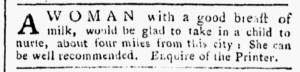
“A WOMAN with a good breast of milk, would be glad to take in a child to nurse.”

On February 20, 1775, an anonymous woman placed an advertisement offering her services as a wet nurse in Dunlap’s Pennsylvania Packet. In colonial and revolutionary America, women advertised their services as wet nurses while families often placed advertisements seeking wet nurses. Mothers who could not supply their own breast milk due to health issues acquired wet nurses. Families who lost mothers during childbirth also needed wet nurses. This was a common practice in the eighteenth century.

According to Janet Golden, some English physicians advised against wet nurses because they might be “sick or ill-tempered.”[1]  William Buchan, for instance, advised looking for a “healthy woman, … one with an abundant supply of milk, healthy children, clean habits and a sound temperament.”[2] Those physicians looked down on women not breastfeeding their own children but doing it for others. In general, wet nursing caused an increase in infant mortality rate. Golden states, “Nearly every European commentator knew that wet nursing increased infant mortality. Wet-nursed infants were more likely to die than were infants suckled by their mothers, and the wet nursing system itself contributed to infant mortality by inducing poor women to abandon their own offspring in order to find employment suckling the children of others.”[3]

For women who were hired as wet nurses in colonial America, their earnings belonged to their husbands by law.[4] Wet nursing was not always a paid arrangement. Instead, neighbors sometimes helped their communities by nursing the babies of mothers who could not breastfeed due to postpartum ailments.[5] Some families felt more comfortable with a neighbor rather than a stranger. Mothers or their families would often look for neighbors or friends to breastfeed their babies, but that was not always possible. That created a market for other women to offer their services, which they would advertise in early American newspapers.

**********

ADDITIONAL COMMENTARY:  Carl Robert Keyes

Even though the prescriptive literature authored by English physicians sometimes cautioned against entrusting infants to wet nurses, colonizers sometimes heeded those concerns and other times developed their own practices embedded in local circumstances in the eighteenth century.  As Gabriela indicates, neighbors participated in communal wet nursing as one way of contributing to their communities.

Some also went against the prescriptive literature that condemned wealthy women for hiring wet nurses instead of fulfilling what the physicians considered their maternal obligations.  Sending infants to foster with wet nurses in the countryside became a popular practice among many affluent families in Boston and other cities.  “Some urban families,” Golden explains,” assumed that the city was an unhealthy environment, rife with both epidemic and endemic diseases.  The countryside, many believed, provided a more salubrious setting, especially in the early months of life.”[6]  Note that the anonymous “WOMAN with a good breast of milk” in the advertisement Gabriela selected emphasized that she resided about four miles from Philadelphia, near the busy port yet removed from the largest city in the colonies.  Other women took a similar approach.  According to Golden, “advertisements placed by women looking for babies to wet nurse reported their distance from the city.”[7]

In four short lines, the woman who placed today’s featured advertisement addressed several common concerns.  She commented on her own health and the nourishment she could provide for an infant, asserting that she had a “good breast of milk.”  Yet she did not ask prospective clients to take her word for it.  Instead, she stated that she “can be well recommended,” presumably both for her character and for her health.  At the same time, she testified to the healthiness of the environment where she provided her services, highlighting that she resided outside the city.  The anonymous woman intended for each of those appeals to resonate with mothers and their families.

**********

[1] Janet Golden, A Social History of Wet Nursing in America: From Breast to Bottle (New York: Cambridge University Press, 1996), 15.

[2] Golden, Social History of Wet Nursing, 16.

[3] Golden, Social History of Wet Nursing, 14.

[4] Golden, Social History of Wet Nursing, 17.

[5] Golden, Social History of Wet Nursing, 20.

[6] Golden, Social History of Wet Nursing, 22.

[7] Golden, Social History of Wet Nursing, 22.

February 19

What was advertised in a colonial American newspaper 250 years ago this week?

Massachusetts Spy (February 16, 1775).

“THE PETITION of the American Continental Congress, to the KING.”

In February 1775, Isaiah Thomas, printer of the Massachusetts Spy, published and advertised “THE PETITION of the American Continental Congress, to the KING.”  During its meetings in Philadelphia in September and October 1774, the delegates to the First Continental Congress drafted several documents.  Almost as soon as they adjourned, William Bradford and Thomas Bradford, printers of the Pennsylvania Journal, advertised “EXTRACTS FROM THE VOTES AND PROCEEDINGS OF THE AMERICAN CONTINENTAL CONGRESS.”  Over the next several weeks, printers in towns throughout the colonies published local editions to supplement coverage in their newspapers.  By the end of November, the Bradfords published a more complete “JOURNAL OF THE PROCEEDINGS OF THE CONGRESS Held at PHILADELPHIA,” though not as many printers issued local editions of that pamphlet.  After all, the Extracts already contained “The BILL of RIGHTS; a List of GRIEVANCES; occasional RESOLVES; the ASSOCIATION; and ADDRESS to the people of Great-Britain; and a MEMORIAL to the Inhabitants of the British American Colonies.”

Yet neither the Extracts nor the Proceedings included all the work undertaken by the First Continental Congress.  In his advertisement, Thomas asserted that he published the Petition “For the benefit of those who have purchased the Votes and Proceedings of the Continental Congress, or the Extracts therefrom, as it is inserted in neither of said Pamphlets.”  He encouraged colonizers to complete their collections of these important documents.  As part of that marketing strategy, he noted that he printed the Petition “in a Pamphlet that it may be either bound of stitched up with the Votes and Proceedings.”  Buyers had the option to collect the several pamphlets together under a single cover, though few seem to have done so.  In a description of the copy now in the collections of the Princeton University Library, the William Reese Company declared, “We can locate only three copies of this rarity, those at the Library of Congress, Massachusetts Historical and American Antiquarian Society.”  That colonizers did not bind the Petition with other pamphlets, however, does not necessarily mean that they did not purchase or read it.  Thomas described the Petition as “Worthy the perusal of his Majesty and every subject in his dominions.”  As the imperial crisis intensified in the winter and spring of 1775, readers may have been eager to consume as much as they could about the positions taken by the First Continental Congress, including this eight-page pamphlet for “two coppers.”  In an advertisement for another political pamphlet claimed that such a “small price” made it affordable to “every person who is desirous” of reading about “our political Controversy.”

February 18

What was advertised in a colonial American newspaper 250 years ago today?

Pennsylvania Ledger (February 18, 1775).

“The Fountain and Three Tuns, … [an] old accustomed and commodious tavern.”

When William Dibley, an experienced tavernkeeper, became the proprietor of the Fountain and Three Tuns in Philadelphia in February 1775, he placed an advertisement in the Pennsylvania Ledger to promote some of the amenities available at his new location.  He hoped that a variety of conveniences would encourage prospective patrons to visit the Fountain and Three Tuns.

Dibley made some of the most common appeals that appeared in advertisements for inns and taverns during the era of the American Revolution.  He highlighted the hospitality that he offered to guests, pledging that they would receive “the most civil treatment.”  He served “the best of liquors and provisions” in a “commodious tavern” that he had “considerably improved” or renovated for the comfort of his patrons.

Those improvements included updating the stables to accommodate sixty horses.  Travelers who visited Philadelphia could expect to find space for their horses in Dibley’s stables while they enjoyed their time at the Fountain and Three Tuns.  Those stables had easy access to the streets of Philadelphia via a “convenient passage either from Market or Chesnut streets.”  For affluent patrons, the tavernkeeper also had a “house for carriages.”

The tavernkeeper provided other services to entice merchants and others to visit the Fountain and Three Tuns, including messengers dispatched to other towns every Wednesday.  One “goes through Newark [in Delaware] to Nottingham [in Maryland],” carrying “packages and orders” to colonies to the south.  The other headed to the west, going “through Goshen to Strasburg, in Lancaster County.”  In addition, the “Virginia and Baltimore posts also call at the said inn every week.”  Dibley positioned the Fountain and Three Tuns at the center of networks for conducting commerce.

Dibley certainly hoped that his reputation would attract former customers and “his Friends in particular” who knew him from the Cross Keys on Chestnut Street.  His advertisement advised them that they could expect the same level of service at his new location.  Yet the tavernkeeper did not merely wish to transfer his current clientele from one establishment to another.  His extensive advertisement notified both locals and travelers of the many reasons they should choose the Fountain and Three Tuns over other inns and taverns in Philadelphia.

February 17

What was advertised in a colonial American newspaper 250 years ago today?

Virginia Gazette [Purdie] (February 17, 1775).

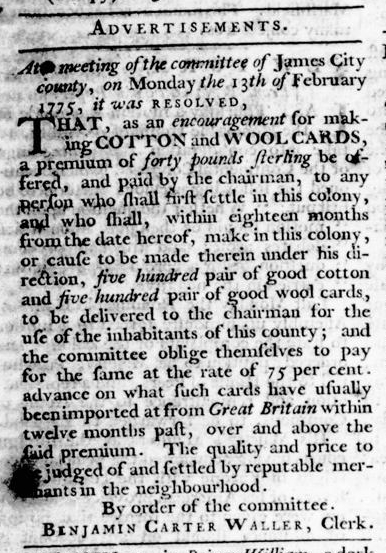
“An encouragement for making COTTON and WOOL CARDS … in this colony.”

Residents of James City County took the Continental Association seriously, especially the eighth article.  When the First Continental Congress devised that nonimportation, nonconsumption, and nonexportation agreement in response to the Coercive Acts, they included an article that called for colonizers “in our several Stations, [to] encourage Frugality, Economy, and Industry; and promote Agriculture, Arts, and the Manufactures of this Country, especially that of Wool.”  In turn, the “committee of James City county” passed a resolution for the “encouragement for making COTTON and WOOL CARDS” at its meeting in February 1775.

Within days an advertisement appeared in Alexander Purdie’s Virginia Gazette and John Dixon and William Hunter’s Virginia Gazette to inform enterprising entrepreneurs that the committee offered “a premium of forty pounds sterling … to any person who shall first settle in this colony, and who shall, within eighteen months from the date hereof, make in this colony, or cause to be made therein under his direction, five hundred pair of good cotton and five hundred pair of good wool cards … for the use of the inhabitants of this county.”

Preparing wool and cotton for spinning involved separating and straightening the fibers using two cards or paddles with fine wire teeth.  That process made wool and cotton easier to spin; it also made the cards an essential tool for producing textiles as alternatives to imported fabrics.  While the committee assumed that men would make the cards, it would be women who used them.  That gave political meaning to the activities they undertook in carding, spinning, and weaving, just as women participated in politics when they refused to purchase imported cards, imported textiles, or any other imported goods.

Making cotton and wool cards in Virginia had the potential to be a profitable venture.  In addition to the premium, the committee offered a “75 per cent. advance on what such cards have usually been imported at from Great Britain within the twelve months past.”  In other words, the committee agreed to pay nearly twice what importers had recently paid for this important tool, another incentive for producing cards in the colony.

Supporters of the American cause had already mobilized in boycotting imported goods and producing alternatives.  This advertisement suggested one more means of contributing to those efforts, making cotton and wool cards in Virginia.  A successful venture would have ripple effects as women purchased those cards and used them in processing cotton and wool to produce homespun cloth rather than buying imported textiles.  The premium offered for making cotton and wool cards was part of a larger project with significant political implications.

February 16

What was advertised in a colonial American newspaper 250 years ago today?

Massachusetts Spy (February 16, 1775).

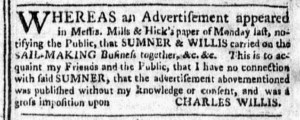
“I have no connection with said SUMNER.”

Charles Willis needed to correct an error.  An advertisement in the February 13, 1775, edition of the Massachusetts Gazette and Boston Post-Boy proclaimed that “SUMNER and WILLIS … CARRY on the Sail-Making Business in all its Branches.”  It gave their location and listed prices.  Yet Willis had no knowledge of this partnership.  Rather than wait for the next issue of the Massachusetts Gazette and Boston Post-Boy on February 20, he submitted his own advertisement to the Massachusetts Spy for inclusion in its February 16 edition.

“WHEREAS an Advertisement appeared in Messrs. Mills & Hick’s paper of Monday last, notifying the Public, that SUMNER & WILLIS carried on the SAIL-MAKING business together,” the aggrieved Willis asserted, “This is to acquaint my Friends and the Public, that I have no connection with said SUMNER, that the advertisement abovementioned was published without my knowledge or consent, and was a gross imposition upon CHARLES WILLIS.”  The sailmaker was angry as he set the record straight.  Readers of the Massachusetts Spy, on the other hand, may have been mildly amused by the drama that unfolded in the public prints.  After all, a dispute between sailmakers could have been a welcome distraction from the hardships they encountered while the harbor remained closed to commerce because of the Boston Port Act.

Willis likely visited or contacted Mills and Hicks’s printing office about the offensive advertisement.  It did not appear a second time, though the standard fee for advertisements provided for inserting them in three consecutive issues.  Willis’s advertisement, for instance, ran in the Massachusetts Spy twice more before it was discontinued.  Willis opted not to run a similar notice in the Massachusetts Gazette and Boston Post-Boy, the newspaper that carried the original “SUMNER and WILLIS” advertisement.  That could have been because he did not wish to invest any more money on such notices in the public prints, yet it also suggests his confidence in the circulation of the Massachusetts Spy and ensuing conversations inspired by its contents, both news and advertisements.  Advertising in just one newspaper sufficiently clarified that “SUMNER and WILLIS” were not indeed partners in the “Sail-Making Business.”

February 15

What was advertised in a colonial American newspaper 250 years ago today?

Essex Journal (February 15, 1775).

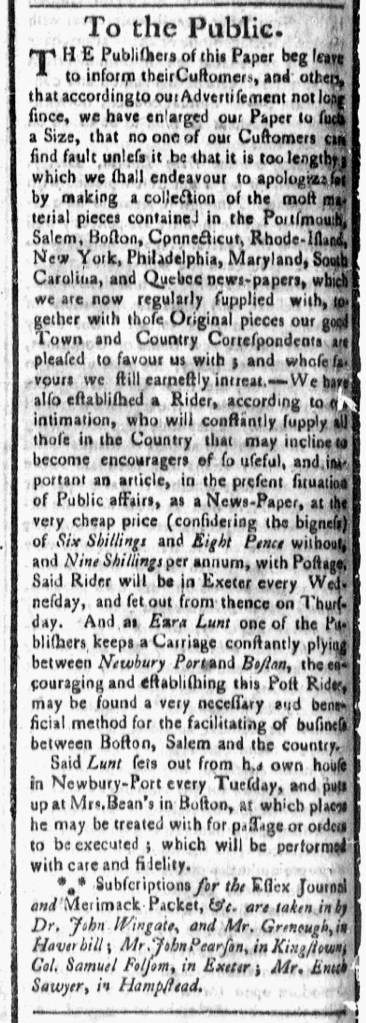
“We have enlarged our Paper to such a Size, that no one of our Customers can find fault.”

An advertisement in the February 15, 1775, edition of the Essex Journal, printed in Newburyport, Massachusetts, revealed important details about its production and circulation.  Ezra Lunt and Henry-Walter Tinges, the publishers, inserted an address “To the Public” to celebrate that they recently “enlarged our Paper to such a Size, that no one of our Customers can find fault unless it be that it is too lengthy.”  Lunt and Tinges coyly declared that they would “apologize” for the length by “making a collection of the most material pieces contained the Portsmouth, Salem, Boston, Connecticut, Rhode-Island, New York, Philadelphia, Maryland, South Carolina, and Quebec news-papers.”  They asserted that they “are now regularly supplied with” newspapers from all those places.  Like other colonial printers, Lunt and Tinges participated in exchange networks with their counterparts in other cities and towns.  Upon receiving newspapers, they scoured them for content to include in their own publication, usually reprinting articles, editorials, essays, and letters word for word.  One header in the February 15 edition, for instance, stated, “From the Massachusetts Spy.”  They supplemented news from far and wide with “Original pieces our good Town and Country Correspondents are pleased to favour us with.”

Lunt and Tinges’s also gave details about the circulation of the Essex Journal, both where to subscribe and logistics for delivery.  They informed readers that subscriptions “are taken in by Dr. John Wingate, and Mr. Grenough, in Haverhill; Mr. John Pearson, in Kingstown; Col. Samuel Folsom, in Exeter; Mr. Enoch Sawyer, in Hampstead.”  That list of local agents resembled the one that appeared in the colophon of each issue of the Massachusetts Spy, printed by Isaiah Thomas in Boston.  At the bottom of the last page, readers glimpsed an announcement that “J. Larkin, Chairmaker, and Mr. W. Calder, Painter, in Charlestown; Mr. J. Hiller, Watch maker, in Salem; Mr. B. Emerson, Bookseller, in Newbury-Port; Mr. M. Belcher, in Bridgewater; and [] Dr. Elijah Hewins, in Stoughtonham” collected subscriptions for the Massachusetts Spy.  Tinges likely learned about recruiting local agents from Thomas, a founding partner of the Essex Journal.  When it came to delivering the newspaper to subscribers, Lunt and Tinges promoted the services of both a post rider whose route included Exeter, New Hampshire, and the carriage that Lunt operated between Newburyport and Boston.  This network “facilitate[ed] business between Boston, Salem, and the country” in addition to disseminating newspapers.

Intended to increase the number of subscribers (and, in turn, advertisers), this advertisement in the Essex Journal testified to several business practices followed by printers throughout the colonies.  Lunt and Tinges described the various kinds of networks that played a role in gathering subscriptions, collecting news and other content, and delivering newspapers to readers.  Each played a role in making information more widely available to the public during the era of the American Revolution.