March 4

What was advertised in a colonial American newspaper 250 years ago this week?

Boston-Gazette (March 2, 1772).

“THE FRUGAL HOUSEWIFE … By SUSANNAH CARTER.”

In 1772, Benjamin Edes and John Gill, printers of the Boston-Gazette, published an American edition of The Frugal Housewife, or Complete Woman Cook by Susannah Carter of London.  The book included “Five Hundred approved Receipts” for everything from roasting and frying to sauces and soups to tarts and puddings to jellies and custards as well as instructions for preserving, pickling, and candying various foods.  In addition, Carter provided “Various BILLS of FARE, For DINNERS and SUPPERS in every Month of the Year” to guide readers in consulting the many recipes and choosing which items to prepare together.  The book also featured “a copious Index of the whole” to help readers find the recipes.  Edes and Gill promised that “Any Person, by attending to the Instructions given in this Book, may soon attain to a compleat Knowledge in the Art of Cookery.”

The printers marketed The Frugal Housewife in their own newspaper, but they also turned to other publications in their effort to create a larger market for what they believed had the potential to be a popular American edition of a cookbook first published in London in the 1760s.  On March 2, 1772, they ran advertisements in both the Boston Evening-Post and the Boston-Gazette.  Three days later, they placed an advertisement in the Massachusetts Spy.  The notices in the other newspapers were not as elaborate as the one that appeared in their own.  The version in the Boston-Evening Post, for instance, did not include the price nor the nota bene assuring prospective customers that they would acquire “a complete Knowledge” of cooking.  The version in the Massachusetts Spy, on the other hand, included both of those items as well as a note that the book “contains more in Quantity than most other Books of a much higher Price.”  It did not, however, feature the distinctive typography with only two items on each line that made the notices in the other newspapers occupy significantly more space.  Instead, a dense list of the contents comprised most of the content of the advertisement in the Massachusetts Spy.

Edes and Gill sought to expand their marketing and sales by placing advertisements in multiple newspapers.  Though they exercised control over the copy, they did not exert as much influence when it came to the format.  Compositors who labored in other printing offices made decisions about the appearance of Edes and Gill’s advertisements for The Frugal Housewife.

February 26

What was advertised in a colonial American newspaper 250 years ago this week?

Boston-Gazette (February 24, 1772).

“A fresh Assortment of Garden Seeds.”

It was a sign that spring was approaching.  The first advertisement for a “fresh Assortment of Garden Seeds” than ran in the Boston newspapers in 1772 appeared in the February 24 edition of the Boston-Gazette.  Lydia Dyar informed the public that she stocked seeds for “Collyflower, Cucumber, Onion, Carrot, Turnip, Raddish, and Lettice of all sorts,” an “assortment of Flower Seeds,” and “a Variety of other Seeds not mentioned.”  She pledged that her inventory, obtained “from the Seeds men in LONDON,” consisted of seeds “warranted to be fresh and good, and of the last Year’s Produce.”

Dyar was one of several “Seeds women” in Boston who placed newspaper advertisements in the late 1760s and early 1770s.  More than half a dozen female entrepreneurs annually took the pages of newspapers published in the busy port city to draw attention to the imported seeds they offered for sale.  Most did not advertise at any time of the year except spring, nor did most advertise other sorts of goods.  That does not mean that they did not keep shop throughout the rest of the year, only that they exclusively advertised seeds in the spring.

Although Dyar was the first to insert an advertisement in the public prints in 1772, readers likely expected other “Seeds women” would soon join her.  In past years, compositors tended to cluster advertisements from Dyar and her competitors together, one after another in the lengthy columns in standard issues or occupying an entire page on smaller sheets distributed as supplements.  Compositors rarely resorted to placing advertisements with similar purposes together in eighteenth-century newspapers, making it all the more notable when they seemed to recognize a distinct classification for advertisements for seeds.  The “Seeds women” of Boston comprised a unique cohort of advertisers.  In no other American city or town did so many female entrepreneurs place so many advertisements promoting seeds.  It was indeed a sign that spring was approaching, but one witnessed solely by readers of Boston’s newspapers.

January 20

GUEST CURATOR:  Kelly Blecker

What was advertised in a colonial American newspaper 250 years ago today?

Supplement to the Boston-Gazette (January 20, 1772).

“Snake Root Waters.”

This advertisement features a wide variety of items for sale by Joseph Hall, including “Snake Root Waters,” an item I found particularly interesting. I had never heard of this before, so I was curious to see what it was and how colonists used it. The snakeroot plant is native to North America. According to George E. Gifford, Jr., in “Botanic Remedies in Colonial Massachusetts, 1620-1820,” snakeroot “had long been used by the Seneca … as a specific in cases of poisoning by the bite of a rattlesnake.” They boiled the plant in water and made a paste, or poultice, which they used to heal rattlesnake bite. “They had inferred this from a supposed resemblance between the root of the plant and the rattle of the snake.” Other uses for snakeroot included treating headache, stomachache, and respiratory problems such as pneumonia and bronchitis. English physicians found using the plant to treat their patients to be highly effective.

The increase in the use of snakeroot waters and other natural remedies showcases how the colonists did not trust European medicine exclusively. Gifford states, “The settlers benefited from the skill of native healers who understood the medicinal value of many indigenous animal and vegetable products.”  As a result, they “establish[ed] an independent tradition of prescribing a specific remedy for a specific ailment. It also caused them to gradually shift from relying on the European schoolmen to depending on the simples and specifics of the old wives, Indians, and ministers.” Colonists adopted knowledge and guidance from Native Americans to create remedies right in North America instead of relying only on patent medicines imported from England.

**********

ADDITIONAL COMMENTARY:  Carl Robert Keyes

Readers of the Boston-Gazette and other newspapers published throughout the colonies regularly encountered advertisements for a vast array of patent medicines produced in England and exported to America.  Apothecaries stocked patent medicines (as we will see in some of the advertisements selected by Kelly’s classmates), but so did merchants and shopkeepers … and even printers!  Patent medicines were the over-the-counter drugs of the eighteenth century, the brands and their uses so familiar that they did not require specialized expertise on the part of purveyors who provided them to colonial consumers.  The producers of many of those patent medicines claimed that their elixirs cured all sorts of maladies rather than targeting specific symptoms and illnesses.

Yet medical knowledge and remedies did not flow in just one direction across the Atlantic, as Kelly demonstrates in her examination of snakeroot.  On both sides of the Atlantic, Europeans embraced knowledge and products derived from the experiences of indigenous peoples.  As Gifford explains, “simple remedies,” like snakeroot, “were quite unlike the complicated nostrums and electuaries of Europe,” those patent medicines, “which sometimes contained up to eighty ingredients.”  Identifying a specific purpose for snakeroot and other flora contributed to a “tradition of prescribing a specific remedy for a specific ailment” instead of relying as extensively on patent medicines that supposedly cured just about any disorder or disease.

Gifford indicates that the “collection, cultivation, and exportation of plant drugs such as ipecac, Virginia snakeroot, and ginseng were of considerable economic significance in the colonies.”  In 1770, for instance, England imported seventy-seven tons of sassafras, used for treating syphilis.  Gifford describes this as part of a “favorable exchange” of ideas as European practitioners incorporated indigenous knowledge into their treatment of patients.  That does not mean that doctors and apothecaries recognized indigenous healers as equal partners in the enterprise, but Europeans on both sides of the Atlantic did benefit from knowledge, experience, and guidance from indigenous Americans.

January 15

What was advertised in a colonial American newspaper 250 years ago this week?

Boston-Gazette (January 13, 1772).

“Any Person, by attending to the Instructions given in this Book, may soon attain to a competent Knowledge in the Art of Cookery.”

Cox and Berry sold “Modern Books of all Kinds” as well as “School Books” and “Prayer Books of various Sizes” at their store on King Street in Boston, but they targeted women and children (or parents and others who bought books to give to children) as prospective customers in an advertisement that ran in the January 13, 1772, edition of the Boston-Gazette.  That notice listed several “Little Books for the Instruction and Amusement of all good Boys and Girls,” including “Brother Gift, or the Naughty Girl Reformed” and “Sister Gift, or the Naughty Boy Reformed.”  They also stocked abridged versions of popular novels by Henry Fielding and Samuel Richardson.

The partners devoted half of their advertisement to promoting “THE FRUGAL HOUSE-WIFE, OR COMPLETE WOMAN COOK … by SUSANNAH CARTER, of London” to female consumers (or others who believed that women they knew would benefit from the guidance offered in that volume).  Quoting from the extensive title, Cox and Berry explained that the book provided instruction in “the Art of Dressing all Sorts of Viands [or Foods] with Cleanliness, Decency and Elegance.”  It contained five hundred “approved Receipts” or recipes as well as the “best Methods” for “Preserving, Drying, Candying, [and] Pickling” various foods.  In addition to the recipes, readers would encounter menus or “various Bills of Fare, for Dinners and Suppers in every Month of the Year” as well as a “copious Index to the Whole” to help them navigate so much content.  To further entice prospective customers, Cox and Berry declared that The Frugal House-Wife “contains more in Quantity than most other Books of a much higher Price.”  Such a bargain!

The booksellers promised that “Any Person, by attending to the Instructions given in this Book, may soon attain to a competent Knowledge in the Art of Cookery.”  That theme ran throughout Cox and Berry’s advertisement.  They targeted women and children as consumers out of a belief that they merited special instruction in performing their household duties or behaving appropriately.  They deployed consumer culture, especially choices about which books to purchase, as a means of promoting good order within households, though they suggested that the readers of these books would experience “Amusement” as well as “Instruction” in the process of learning their proper roles.

January 13

What was advertised in a colonial American newspaper 250 years ago today?

Massachusetts Gazette and Boston Post-Boy (January 13, 1772).

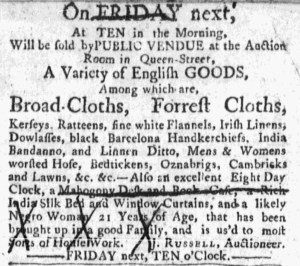
“A Mahogony Desk and Book-Case.”

This advertisement presents a conundrum.  It attracted my attention because someone made manuscript notations on the copy of the Massachusetts Gazette and Boston Post-Boy that has been preserved in an archive and digitized for greater accessibility.  They crossed out “FRIDAY” in the portion of the headline that gave the date of an auction, crossed out “a Mahagony Desk and Book-Case” midway through the advertisement, and placed three large “X” over most of the rest of the content.  I suspected that either Joseph Russell or John Green, the partners who published the Massachusetts Gazette and Boston Post-Boy, made those notations to guide the compositor in setting type for a revised version of the advertisement to appear in a subsequent issue.  Russell, the auctioneer who placed the advertisement, focused primarily on operating the “Auction Room in Queen-Street” while Green oversaw the newspaper and the printing office.

A revised version did not appear in a subsequent edition of the Massachusetts Gazette and Boston Post-Boy.  The same advertisement did run in the Boston Evening-Post and the Boston Gazette on Monday, January 13, 1772, the same day it appeared in the Massachusetts Gazette and Boston Post-Boy.  Those newspapers ran the same copy, but with variations in line breaks because the compositors made their own decisions about format.  I also looked for revised versions of the advertisement in other newspapers published in Boston between January 13 and the day of the sale.  The Massachusetts Spy published on Thursday, January 16, the day before the say, did not carry the advertisement, but the Massachusetts Gazette and Boston Weekly News-Letter distributed on the same day did feature a slightly revised version.  Only the first line differed from the original version, stating that the auction would take place “TO-MORROW” rather than “On FRIDAY next.”

Massachusetts Gazette and Boston Weekly News-Letter (January 16, 1772).

The rest of the advertisement was identical to the one that ran in the Massachusetts Gazette and Boston Post-Boy earlier in the week.  The copy was identical and the format (including line breaks, spelling, and capitals) was identical.  Even the lines on either side of “FRIDAY next, TEN o’Clock” on the final line were identical.  Both advertisements lacked a space between “by” and “PUBLIC VENDUE” on the third line.  The manuscript notations on the original advertisement may have directed someone in revising the first line, but not the remainder of the notice.  Even more puzzling, it looks as though Green and Russell shared type already set at their printing office with Richard Draper, the printer of the Massachusetts Gazette and Boston Weekly News-Letter.  This is not the first time that I have detected such an instance in newspapers published by these printers in the late 1760s and early 1770s.  It raises questions about both the logistics and the business practices of those involved, questions that merit greater attention and closer examination of the contents, both news and advertising, in the two newspapers.

December 2

GUEST CURATOR:  Elizabeth Peterson

What was advertised in a colonial American newspaper 250 years ago today?

Boston-Gazette (December 2, 1771).

“POTASH Kettles.”

Smith and Atkinson advertised “POTASH KETTLES” and “EUROPEAN and INDIA GOODS” in the Boston Gazetteon December 2, 1771. The combination of potash kettles and imported goods in their advertisement give insight about life during this time. Potash, a chemical compound made from burning trees, was an important commodity produced in colonial America. As William I. Roberts III explains, “Potash, or pot-ashes, as contemporaries called it, was the principal industrial chemical of the eighteenth century, being essential in the production of crown or flint glass, soft soap, various drugs and dyes, and saltpetre.”[1] As Roberts suggests, potash was a very important chemical during this era, one used in many different everyday items.  Colonists produced and exported this commodity. Potash helped colonists make money.  In turn, producing potash helped them participate in the consumer revolution. Colonists used the money they earned from selling a material used to make other goods, like glass and soap, to purchase the imported goods that Smith and Atkinson advertised.

**********

ADDITIONAL COMMENTARY:  Carl Robert Keyes

When selecting an advertisement about potash kettles, Lizzie had several options.  She ultimately chose the advertisement that best illuminated themes from readings and discussions about commerce and consumption in early America in our Research Methods class at Assumption University in Spring 2021.  Smith and Atkinson’s advertisement does indeed demonstrate both production and consumption in eighteenth-century America, distinguishing it from other advertisements about potash kettles that ran in the same issue of the Boston-Gazette.

Note that Smith and Atkinson’s advertisement was nestled between and advertisement for “Pot-Ash Kettles” placed by Benjamin Andrews, Jr., and another for “POT-ASH KETTLES” by Joseph Webb.  Those three notices accounted for most of the middle column on the front page of the December 2, 1771, edition of the Boston-Gazette, prominently placed where readers would likely notice them.  Each advertisement encouraged American industry, noting that the kettles had been cast at forges in several towns in New England.  In turn, buyers would use the kettles to produce potash to export.  As Lizzie notes, they could use the proceeds to participate in the consumer revolution, purchasing the “EUROPEAN and INDIA GOODS” that Smith and Atkinson so prominently promoted in their advertisement.  Andrews also mentioned “a small assortment of English Goods” on hand at his shop, but Smith and Atkinson’s advertisement most visibly establishes the relationship between production and consumption in early America.

Colonists encountered the same advertisement in the Boston Evening-Post and the Massachusetts Gazette and Boston Post-Boy on the same day it ran in the Boston-Gazette.  All three newspapers ran other advertisements by merchants and shopkeepers who listed an array of merchandise – textiles, housewares, hardware – that they imported and sold.  Colonists who acquired their potash kettles from Smith and Atkinson had many other options beyond the “large and general assortment of EUROPEAN and INDIA GOODS” stocked by Smith and Atkinson.  The widespread encouragement to consume imported goods that appeared in advertisements in all three newspapers buttressed Smith and Atkinson’s notice that balanced production and consumption.

**********

[1] William I. Roberts III, “American Potash Manufacture before the American Revolution,” Proceedings of the American Philosophical Society 116, no. 5 (October 1972): 383.


November 18

GUEST CURATOR:  Kaden McSheffrey

Who was the subject of an advertisement in a colonial American newspaper 250 years ago today?

Boston-Gazette (November 18, 1771).

“Ran-away … a Negro Man Servant named CROMARTE.”

This advertisement from the Boston-Gazette in November 1771 offers a reward for “Negro Man Servant named CROMARTE, commonly called CRUM” who “Ran-away” from Samuel Fitch.  At first, Fitch calls Cromarte a “Negro Man Servant” and does not mention the word “slave.” At the end of the advertisement, however, he calls Cromarte a “Slave for Life” when he warns “Masters of Vessels and others” not to help him. This is interesting because many people are not aware that slavery was present in the northern colonies in the eighteenth century; most people assume that slavery happened only in the southern colonies. It is clear that this is an advertisement about an enslaved man in Boston in 1771. Cromarte’s experience was part of a longer story. According to the Massachusetts Historical Society, “John Winthrop (the founder of Boston) … recorded on 26 February 1638 that the Massachusetts ship Desire had returned from the West Indies carrying ‘some cotton, and tobacco, and negroes, etc.’”  Slavery was part of Massachusetts history from the earliest days of English settlement.

**********

ADDITIONAL COMMENTARY:  Carl Robert Keyes

In Slavery and American History: The Tough Stuff of Memory (2006), James Oliver Horton tells a story of a tourist in Boston shocked to learn about slavery and the slave trade in New England.  “I thought we were better than that,” the tourist lamented.  Reflecting on this encounter, Horton notes that “confronting the contradiction between the American ideal and the reality of American history can be disturbing.”  He continues with an assertion: “The first task for the public historian is to attempt to address popular ignorance of slavery’s diversity, longevity, complexity, and centrality.”[1]  Fifteen years later, historians and others continue to work toward that goal.  They have made some progress, especially in the wake of the 1619 Project, though that work has also met with backlash.

I teach at a regional university.  Most of my students grew up in New England.  They arrive in my classes assuming, as many Americans do, that slavery was limited to southern colonies and states.  When they serve as guest curators for the Adverts 250 Project and the Slavery Adverts 250 Project, they see for themselves the extent that slavery thrived throughout the colonies, including in New England, during the era of the American Revolution.  They do not merely read an article or listen to a lecture about slavery in the region; instead, they encounter accounts of enslaved people repeatedly as they examine newspapers from the period.  My students must grapple with the diversity, complexity, and centrality of slavery in the era of the Revolution, intensively examining a relatively short period does not necessarily address the longevity of slavery in New England.  In doing independent research to identify primary and secondary sources to help him analyze his selected advertisement, however, Kaden incorporated the longevity of slavery in Massachusetts into his work as guest curator, identifying the first documented reference to the sale of enslaved people in the colony more than 130 years before Cromarte, a “Slave for Life,” liberated himself from Samuel Fitch in Boston in the fall of 1771.

**********

[1] James Oliver Horton, “Slavery in American History: An Uncomfortable National Dialogue,” in Slavery and Public History: The Tough Stuff of American Memory, eds. James Oliver Horton and Lois E. Horton (New York: New Press, 2006): 37-38.

October 2

What was advertised in a colonial American newspaper 250 years ago this week?

Supplement to the Boston-Gazette (September 30, 1771).

“Choice Bohea, Souchon, and Hyson Tea.”

In the fall of 1771, Gilbert Deblois deployed graphic design to distinguish his newspaper advertisements from those placed by his competitors.  On September 30, he ran an advertisement with a unique format in the Boston Evening-Post.  The text ran upward at forty-five degree angles, creating an irregular diamond that filled the entire block of space he purchased in that issue.  That same day, he ran an advertisement featuring the same copy arranged in another distinctive format in the Supplement to the Boston-Gazette.  The text once again formed a diamond, that one created by centering lines of text of progressively longer and then shorter lengths.  In contrast to the advertisement in the Boston Evening-Post, this one incorporated a significant amount of white space into Deblois’s notice.

That these advertisements appeared simultaneously in two newspapers published in Boston demonstrated that Deblois carefully coordinated an advertising campaign intended to attract attention with its unusual typography.  The compositors at the Boston Evening-Post and Boston-Gazette would not have independently decided to experiment with the format of Deblois’s advertisements.  Instead, the shopkeeper must have worked with the compositors or at least sent instructions to the printing offices to express his wishes for innovative graphic design.

In most instances, advertisers submitted copy and left it to compositors to produce an appropriate format.  Advertisements that ran in multiple newspapers often had variations in font size, capitalization, and italics according to the preference of the compositors, even as the copy remained consistent.  On occasion, however, advertisers assumed greater control over the design of their notices, creating spectacles on the page.  Both of Deblois’s notices demanded attention from readers because they deviated visually so significantly from anything else in the newspaper.  Deblois did not have to commission a woodcut or include a variety of ornamental type in his notices in order for them to stand out from others.  He achieved that by working with the compositors to determine what they could accomplish solely by arranging the text in unexpected ways.

September 23

What was advertised in a colonial American newspaper 250 years ago today?

Supplement to the Boston-Gazette (September 23, 1771).

“A large and compleat Assortment of ENGLISH, INDIA, and SCOTCH GOODS.”

Benjamin Edes and John Gill, printers of the Boston-Gazette, had more content than would fit in the standard issue on September 23, 1771.  Like other newspapers published during the colonial era, an issue of the Boston-Gazette consisted of four pages.  Edes and Gill printed two pages on each side of a broadsheet and then folded it in half.  On occasion, however, they had sufficient content to merit publishing a supplement to accompany the standard issue.  They did so on September 23.  Hugh Gaine, printer of the New-York Gazette and Weekly Mercury, did so as well.

Both supplements consisted of two pages.  Both contained advertisements exclusively.  Despite these differences, Gaine adopted a slightly different strategy in producing the supplement for his newspaper than Edes and Gill did.  The standard issue of the New-York Gazette and Weekly Mercury featured four columns per page.  The supplement did as well.  Gaine used a half sheet that matched the size of the standard issue; all six pages were the same size.  Edes and Gill, on the other hand, did not.  A standard issue of the Boston-Gazette had three columns, but only two columns for the supplement.  The printers chose a smaller sheet to match the amount of content and conserve paper.  They generated revenue from the advertisements in the supplement, but kept costs down in producing it.

The relative sizes of the supplements compared to the standard issues would be readily apparent when consulting originals, but not when working with digitized images.  As a result of remediation, digital images become the size of the screen and change as readers zoom in and zoom out.  The size of the page of a digital image is not permanent, unlike the size of the page of the original newspaper.  In the process of remediation, information about originals gets lost if those creating new images do not record and make metadata accessible.  In this case, modern readers consulting digitized images can deduce that Edes and Gill used a different size sheet for the supplement, but have a much more difficult time imagining the experience of eighteenth-century subscribers who received sheets of two different sizes.

September 16

What was advertised in a colonial American newspaper 250 years ago today?

Boston-Gazette (September 16, 1771).

“George Spriggs, Gardner to John Hancock, Esq.”

In the early 1770s, George Spriggs supplied colonists with fruit trees.  In September 1771, he placed advertisements in the Boston-Gazette to promote “ABOUT four or five Thousand Mulberry Trees of different Sizes,” “a large Assortment of English Fruit Trees,” and “an Assortment of flowering Shrubs.”  Those were not just any mulberry trees, Spriggs asserted.  They grew from seeds from “the first ripe Fruit of Mulberries, from a Tree of Mr. David Colson’s, which is the largest and finest Fruit that is in America.”  He expected consumers to be familiar with Colson and his trees or at least trust his expertise about the significance.  He carefully timed his marketing, advising prospective customers that “the best Time of transplanting” the fruit trees “is about the Middle of October.”  Anyone interested in purchasing trees or shrubs from Spriggs could plan accordingly.

In addition to establishing a connection to Colson, Spriggs leveraged his connection to a colonist so prominent that readers of the Boston-Gazette almost certainly knew who he was.  Before he even described the trees and shrubs he offered for sale, Spriggs described himself as “Gardner to John Hancock, Esq.”  It was not the first time he deployed that strategy, seeking to benefit from the celebrity of one of his clients.  In February 1770, for instance, he opened another advertisement in the same manner.  Nor was he the only advertiser who named a famous client as a means of establishing his credentials.  Elsewhere in the Boston-Gazette, Jacob Hemet introduced himself as “DENTIST to her Majesty, and the Princess Amelia.”  Doctors and dentists who migrated to the colonies frequently claimed they previously provided their services to nobles and the gentry in Europe, expecting prospective clients to take their word for it.  Spriggs, on the other hand, knew that customers could much more easily confirm whether he actually was a “Gardner to John Hancock, Esq.”  He did not publish a testimonial from the prominent merchant, but encouraged customers to believe that his association with Hancock was recommendation enough.