October 16

What was advertised in a revolutionary American newspaper 250 years ago today?

New-York Journal (October 16, 1775).

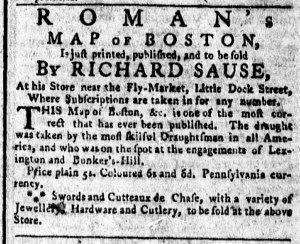
“THIS Map of Boston, &c. is one of the most correct that has ever been published.”

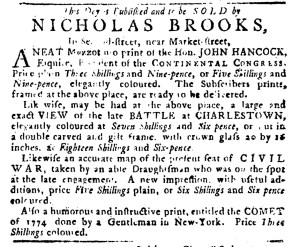
Richard Sause, a cutler in New York, became a local agent in that city when Nicholas Brooks and Bernard Romans collaborated on a map of Boston.  Brooks, a shopkeeper in Philadelphia, described himself as “the printer of said Maps” in newspaper advertisements, though he likely meant that he was the publisher who collaborated with Romans, a noted cartographer.  Sause had not been among the original list of local agents in an advertisement that appeared in Rivington’s New-York Gazetteer in August 1775, nor had he been on the list on a broadside subscription proposal that circulated in the summer and fall.  When Brooks and Romans launched a second project, “An Exact VIEW of the late BATTLE at CHARLESTOWN,” the subscription proposal in the Pennsylvania Ledger included “Mr. Richard Sause in New-York” among the local agents.  Brooks and Romans apparently supplied him with copies of the map as well as the print depicting what is now known as the Battle of Bunker Hill.

Sause, a frequent advertiser, was already familiar to consumers in New York.  A woodcut depicting various kinds of cutlery available at his “Jewlery, Hardware, and Cutlery Store” often adorned his advertisements in newspapers printed in that city.  In the summer and fall of 1775, he emphasized “SMALL SWORDS” in his advertisements.  Following the outbreak of hostilities at Lexington and Concord in April, residents of New York and other towns did not know what to expect.  Many prepared to defend their liberties should the British turn their attention to them.  Sause made sure that Patriots in New York knew that he could supply them with various kinds of small swords.  He even made a pitch for those items at the end of his advertisement for Romans’s map of Boston: “Swords and Cutteaux de Chase [a short sword], with a variety of Jewellery, Hardware and Cutlery, to be sold at the above Store.”

Yet the “MAP OF BOSTON” was the main attraction in that advertisement.  In addition to the headline in capital letters, Sause’s notice billed the map as “one of the most correct that has ever been published.”  To help make sales, he emphasized that the “draught [draft] was taken by the most skilful Draughtsman in all America.”  Buyers could depend on its accuracy because Romans “was on the spot at the engagements of Lexington and Bunker’s-Hill.”  Current events certainly played a role in Sause expanding his business to incorporate a new revenue stream, yet marketing and selling both Brooks and Romans’s map of Boston and prints depicting the Battle of Bunker Hill also gave him an opportunity to participate in politics via the marketplace.

September 25

What was advertised in a revolutionary American newspaper 250 years ago today?

New-York Gazette and Weekly Mercury (September 25, 1775).

“Illustrated with a beautiful Plan of Boston, and the Provincial Camp.”

When fall arrived, it was time to market almanacs for the coming year.  It was an annual ritual in American newspapers from New England to Georgia.  Hugh Gaine, the printer of the New-York Gazette and Weekly Mercury, began advertising “HUTCHIN’s Improv’d: BEING AN ALMANACK … For the Year of our LORD 1776” on September 18, 1775, and then inserted his extensive notice in subsequent issues.  The almanac’s contents included the usual astronomical data, such as “Length of Days and Nights” as well as a schedule of the courts, a description of roads to other cities and towns, and “useful Tables, chronological Observations and entertaining Remarks.”  Gaine enumerated thirty-one of those items, such as a “Very comical, humorous, and entertaining Adventure of a young LADY that used to walk in her sleep,” an essay on the “evil Consequences of Sloth and Idleness,” and a “Method for destroying Caterpillars on Trees.”

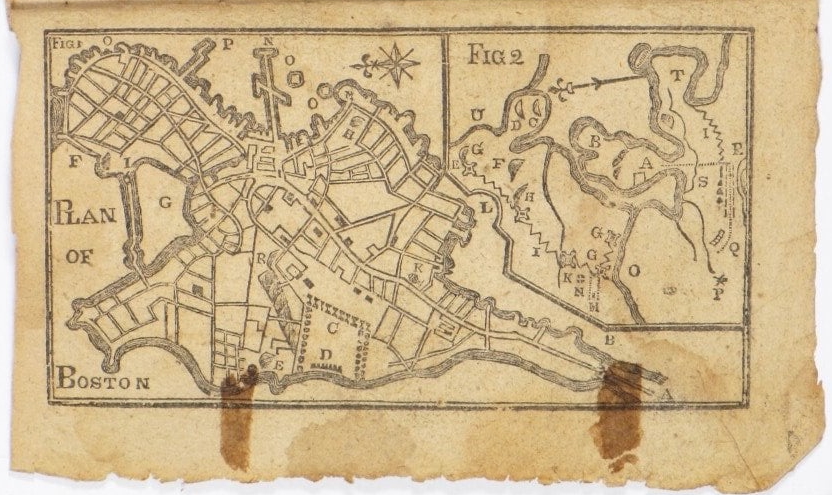
If all of that was not enough to entice customers, Gaine made sure that they knew that the almanac was “Illustrated with a beautiful Plan of Boston, and the Provincial Camp.”  That proclamation led the advertisement, appearing immediately above the title of the almanac.  Gaine then devoted the greatest amount of space to describing the map: “13. A very neat Plan of the Town of Boston, shewing at one View, the Provincial Camp, Boston Neck, Fortification, Commons, Battery, Magazines, Charlestown Ferry, Mill Pond, Fort Hill, Corps Hill, Liberty Tree, Windmill Point, South Battery, Long Wharf, Island Wharf, Hancock’s [Wharf], Charlestown, Bunker’s Hill, Winter Hill, Cobble Hill, Forts, Prospect Hill, Provincial Lines, Lower Fort, Upper [Fort], Main Guard, Cambridge College, Charles River, Pierpont’s Mill, Fascine Battery, Roxbury Hill Lines, General Gage’s Lines, Dorchester Hill and Point, and Mystick River.”  As the siege of Boston continued, Daine realized that colonizers in Boston would be interested in supplementing what they read in newspapers and heard from others with a map that would help them envision and better understand recent events.

What was the source for the map?  According to the catalog description for the almanac by PBA Galleries, Auctioneers and Appraisers, the map, “titled a ‘Plan of Boston,’ details Boston’s Shawmut Peninsula and with a smaller inset of the greater Boston area.  Both maps appear to be based on the ‘New and Correct Plan of the Town of Boston and Provincial Camp,’ which appeared in the Pennsylvania Magazine for July, 1775.”  The image that Aitken marketed to spur magazine sales found its way into another periodical publication.  Another printer used it to generate demand for an item produced on his press.

Gaine also listed “11. The whole Process of making SALT PETRE, recommended by the Hon. The Continental Congress, for the making of which there is a Bounty now given both in this and the neighbouring Provinces” and “12. The Method of making Gun-Powder, which at this Juncture may be carried into Execution in a small Way, by almost every Framer in his own Habitation.”  The auction catalog further clarifies that the almanac contains “the Resolution of Congress, July 28, 1775 on the necessity of making gunpowder in the colonies, signed in print by John Hancock, with a recipe for gunpowder on the reverse of the map.”  More than ever, current events played a part in compiling the contents and then marketing almanacs.

“Plan of Boston,” in Hutchins Improved: Being an Almanack and Ephemeris … For the Year of Our Lord 1776 (New York: Hugh Gaine, 1775). Courtesy PBA Galleries, Auctioneers and Appraisers.

August 21

What was advertised in a revolutionary American newspaper 250 years ago today?

New-York Gazette and Weekly Mercury (August 21, 1775).

“To the last Number for July, is affix’d a new and correct Plan of the TOWN of BOSTON, and PROVINCIAL CAMP.”

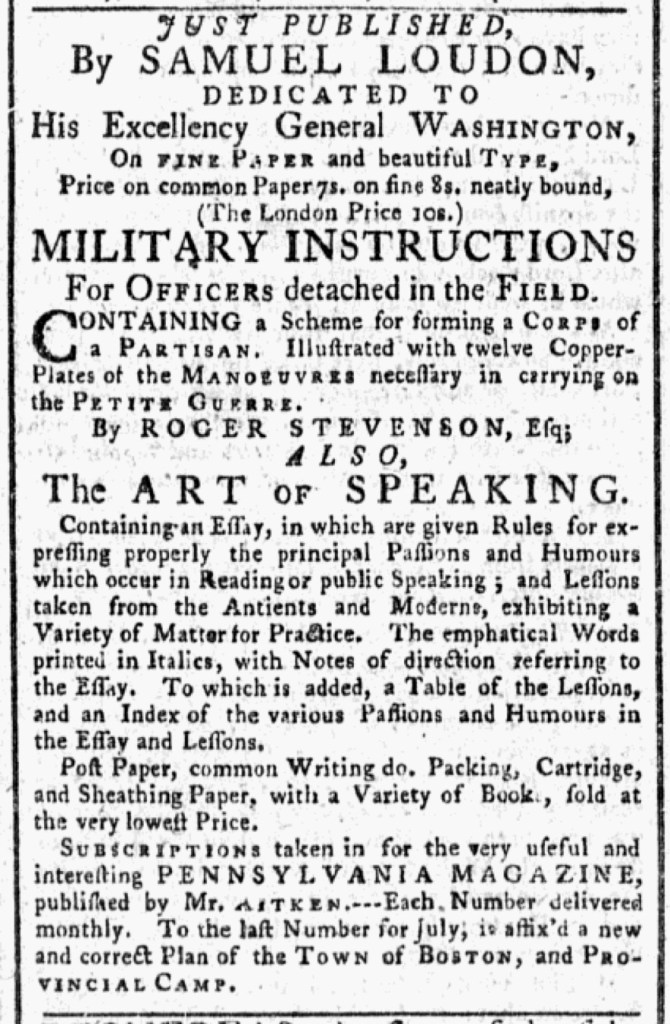
In the summer of 1775, Samuel Loudon, a bookseller in New York, stocked books printed by Robert Aitken in Philadelphia.  He advertised Military Instructions for Officers Detached in the Field, “DEDICATED TO His Excellency General Washington,” and The Art of Speaking in the August 21, 1775, edition of the New-York Gazette and Weekly Mercury.  He also noted that he stocked an assortment of paper and a “Variety of Books” that he “sold at the very lowest Price.”

Loudon concluded his advertisement by promoting another of Aitken’s projects.  The bookseller advised the public that he collected subscriptions “for that very useful and interesting “PENNSYLVANIA MAGAZINE, published by Mr. AITKEN.”  The Pennsylvania Magazine, or, American Monthly Museum commenced publication with its January 1775 issue, briefly overlapping with the Royal American Magazine.  Upon the demise of the latter, it became the only magazine published in the colonies.

To incite interest, Loudon noted that “the last Number for July” featured a “new and correct Plan of the TOWN of BOSTON, and PROVINCIAL CAMP.”  According to the Norman B. Leventhal Map and Education Center at the Boston Public Library, this map “was the earliest printed depiction of Boston after the battle of Bunker Hill, June 17, 1775.”  It includes an inset that “shows the location of the location of the battle, as well as provincial (American) lines in the communities surrounding Boston.”  This demonstrated “the commanding position enjoyed by the Continental Army.”

Getting a free map of Boston following the Battle of Bunker Hill was certainly an incentive to subscribe to the Pennsylvania Magazine!  But was it the first map of Boston created after that battle?  Perhaps, but it might better be described as one of the first depictions of Boston after the Battle of Bunker Hill.  A note in the Leventhal Center’s online catalog states, “This date is inferred,” likely because the map was “Engrav’d for the Pennsylva. Magazine” for July 1775.  Yet the assertion that it was the earliest printed depiction of Boston after the Battle of Bunker Hill may rely on an assumption that colonial printers published magazines at the beginning of the month when they instead issued monthly issues at the end of the month or early in the following month.  Thus, Aitken distributed the July 1775 issue of the Pennsylvania Magazine at the same time that he, Nicholas Brooks, and others advertised Bernard Romans’s map of Boston, a map that also featured an inset showing the “Provincial Lines” during the siege of the city and the site of the Battle of Bunker Hill.  Aitken may have consulted with Romans when preparing a map to accompany the magazine.  For prospective subscribers, it may not have mattered whether they acquired the first map of Boston published after the Battle of Bunker Hill, only that they had access to the map … and at a bargain price since it came as a premium with their subscription to the Pennsylvania Magazine rather than purchasing Romans’s map separately.

“A New and Correct Plan of the Town of Boston, and Provincial Camp” (1775). Courtesy Norman B. Leventhal Map and Education Center at the Boston Public Library.

August 19

What was advertised in a revolutionary American newspaper 250 years ago today?

Pennsylvania Ledger (August 19, 1775).

“Map of Boston … the engagements of Lexington and Bunker’s Hill.”

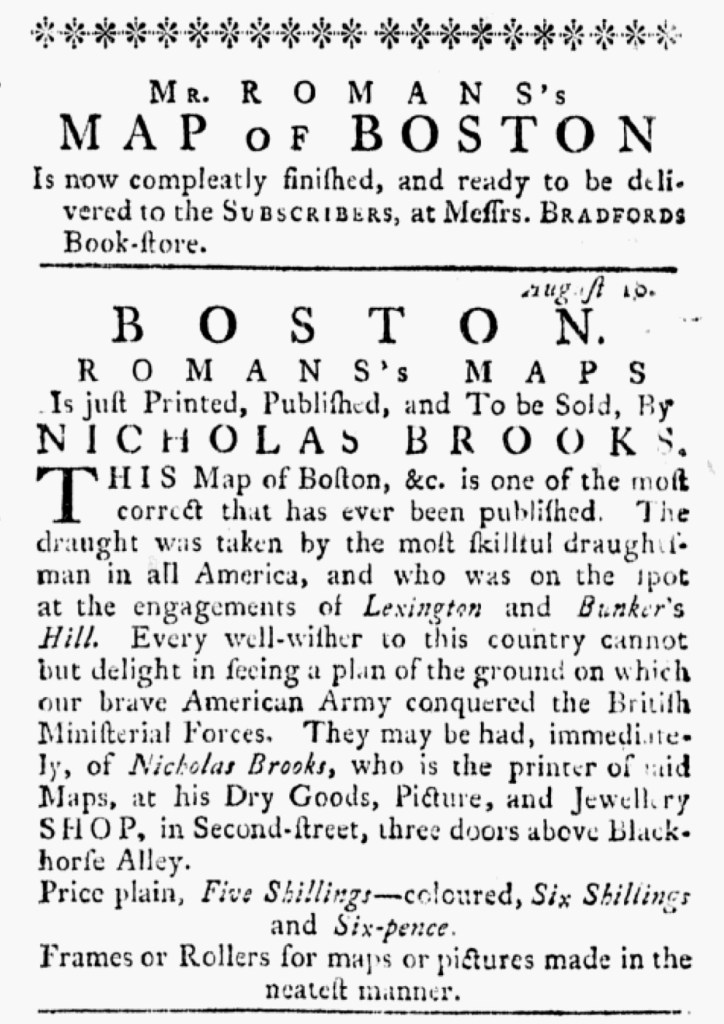
More advertisements for “MR. ROMANS’s MAP OF BOSTON” appeared in the August 19, 1774, edition of the Pennsylvania Ledger.  Bernard Romans, the cartographer who created a “MAP, FROM BOSTON TO WORCESTER, PROVIDENCE AND SALEM. Shewing the SEAT of the present unhappy CIVIL WAR in NORTH-AMERICA,” and Nicholas Brooks, the publisher, previously promoted the project with a broadside subscription proposal that began circulating in the middle of July and scattered references to the map at the end of advertisements in the Pennsylvania Ledger.  Two weeks earlier, for instance, Brooks ran an advertisement that featured an extensive list of merchandise available at his shop and added a nota bene of a single line: “Romans’s map of the seat of war near Boston, &c.”  Robert Aitken mentioned the map in a slightly longer nota bene when he advertised Military Instructions for Officers Detached in the Field.  An advertisement in Rivington’s New-York Gazetteer replicated the copy from the broadside.

Once the map was “completely finished, and ready to be delivered to the SUBSCRIBERS,” as William Bradford and Thomas Bradford put it in their advertisement, or “just Printed, Published, and To be Sold,” as Brooks proclaimed in his own notice, it received greater attention in newspaper notices.  Although many similar projects utilized subscription proposals in newspapers to generate demand attract orders in advance of publication, Romans and Brooks relied on their broadside subscription proposal during their first round of marketing and later added newspaper advertisements once the map was available for sale.

Just four months after the battles at Lexington and Concord, a remarkably short interval for such an endeavor, Brooks advertised copies of Romans’s map of Boston for sale at his “Dry Goods, Picture, and Jewellery SHOP” in Philadelphia.  He touted the quality of the map, declaring it “one of the most correct that has ever been published” and emphasiziong that the “draught was taken by the most skillful draughtsman in all America.”  As if that was not enough to sell it, Romans “was on the spot at the engagements of Lexington and Bunker’s Hill.”  Brooks marketed an eyewitness account of those important battles.  Furthermore, he asserted that consumers had a patriotic duty to examine the map, which they could do by purchasing it.  “Every well-wisher to this country,” Brooks trumpeted, “cannot but delight in seeing a plan of the ground on which our brave American Army conquered the British Ministerial Forces.”  Commemoration and commodification of the American Revolution occurred before the Continental Congress declared independence.

April 9

What was advertised in a colonial American newspaper 250 years ago this week?

North Carolina Gazette (April 7, 1775).

“EXTRACTS from the Votes and Proceedings of the AMERICAN CONTINENTAL CONGRESS.”

The North-Carolina Gazette, published by James Davis in New Bern from May 1768 through November 1778, with some interruptions, only made its first appearance in the Adverts 250 Project a couple of weeks ago because extant copies are so rare that few have been digitized and made more broadly accessible to scholars.  America’s Historical Newspapers, the most comprehensive database of digitized eighteenth-century newspapers, includes only seven issues of the North-Carolina Gazette, all of them from 1775.  Other databases do not include any.

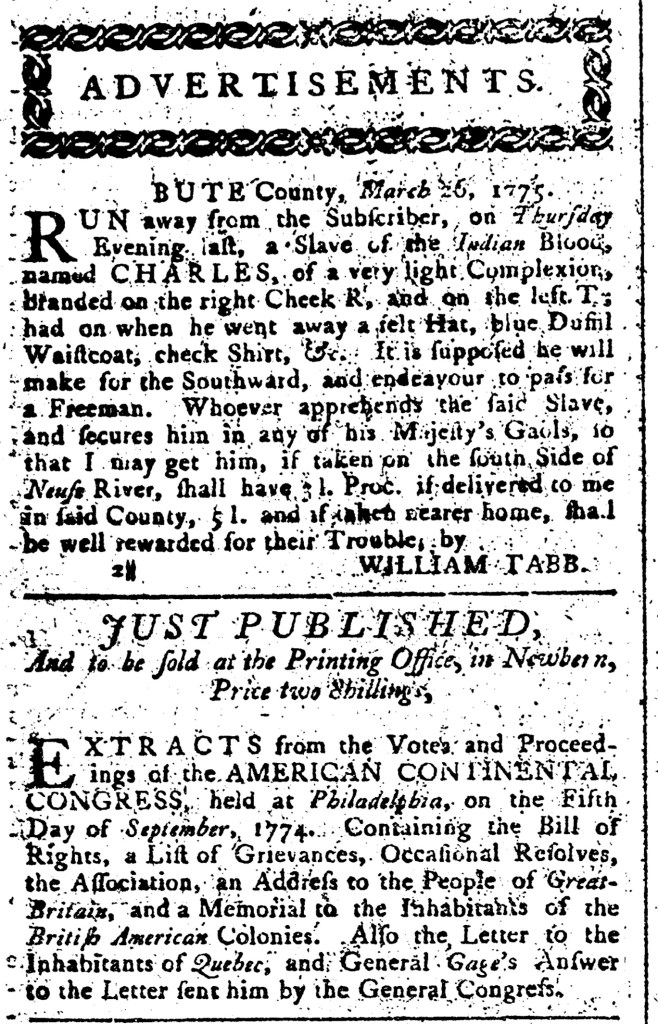
As a result, the April 7 edition is the second issue of the North-Carolina Gazette available for inclusion in the Adverts 250 Project and the Slavery Adverts 250 Project.  The first two advertisements in that issue drew my attention.  The first described and offered a reward for “a Slave of the Indian Blood, named CHARLES” who liberated himself by running away from his enslaver.  Charles’s story of resistance has been compiled with other advertisements about enslaved men, women, and children published in American newspapers on April 7, 1775, as part of the Slavery Adverts 250 Project.

The second promoted “EXTRACTS from the Votes and Proceedings of the AMERICAN CONTINENTAL CONGRESS, held at Philadelphia” in September and October 1774.  The Adverts 250 Project has traced the publication and marketing of the Extracts, starting with William Bradford and Thomas Bradford’s edition in Philadelphia and continuing with local editions published in many other towns.  This advertisement confirms that Davis sold the Extracts.

Did he print a local edition?  Or did he sell copies that he received from another printer?  The formulaic language in the advertisement — “JUST PUBLISHED, And to be sold at the Printing Office, in Newbern” — does not definitively answer those questions.  The phrase “JUST PUBLISHED,” for instance, merely meant that a book, pamphlet, or almanac was available.  When an advertisement first ran, “JUST PUBLISHED” meant that it had been published recently, but printers and booksellers sometimes ran advertisements for weeks or months without updating them.  They did not consider setting type once again worth investing their time or attention.  Eighteenth-century readers understood that “JUST PUBLISHED” did not always mean that the item was hot off the presses.  Similarly, they separated “JUST PUBLISHED” and “to be sold at the Printing Office,” realizing that printers often peddled books, pamphlets, and almanacs “JUST PUBLISHED” by other printers.

This language suggests that Davis may or may not have printed the edition of the Extracts that he advertised.  Some bibliographers, however, have trusted advertisements in the North-Carolina Gazette as sufficient proof that he did publish a local edition.  In “James Davis: North Carolina’s First Printer,” a thesis submitted to the School of Information and Library Science of the University of North Carolina at Chapel Hill, Scott Aaron Reavis includes the Extracts among works printed on Davis’s press.  He notes, “No copies are known to exist, however, it was advertised for sale in the North Carolina Gazette, 24 February 1775.”[1]  By the time the subsequent advertisement ran in the April 7 edition, the Extracts were “JUST PUBLISHED” indeed!  Charles Evans did not list Davis’s New Bern edition in American Bibliography: A Chronological Dictionary of All Books, Pamphlets, and Periodical Publications Printed in the United States of America from the Genesis of Printing in 1639 Down to and Including the Year 1820, but, according to Reavis, Douglas C. McMurtie included the Extracts in his “Bibliography of North Carolina Imprints.”[2]  Given how many printers published local editions of the Extracts, I am inclined to agree with McMurtie and Reavis that Davis did as well.  I disagree, however, with the date assigned to the work.  Davis’s edition has been dated to 1775 based on an advertisement in one of the few extant issues of the North-Carolina Gazette.  More likely, if Davis published the Extracts then he did so in November or December 1774, the same time that printers in other towns produced local editions, and occasionally inserted his advertisement that he had “JUST PUBLISHED” and sold the volume at his printing office several times over the next several months.

**********

[1] Scott Aaron Reavis, “James Davis: North Carolina’s First Printer” (master’s thesis, University of North Carolina at Chapel Hill, 2000), 44.

[2] Reavis, “James Davis,” 28.

April 8

What was advertised in a colonial American newspaper 250 years ago today?

Virginia Gazette [Dixon and Hunter] (April 8, 1775).

“JOURNAL of the PROCEEDINGS OF THE CONVENTION held at RICHMOND.”

John Carter once again advertised that “A few Copies of The Proceedings of the late Continental CONGRESS May be had at the Printing-Office” in the April 8, 1775, edition of the Providence Gazette.  That same day, John Dixon and William Hunter advertised that they “have for SALE … the Journal of the Proceedings of the Congress held at Philadelphia” in the Virginia Gazette.  When the First Continental Congress concluded its meetings near the end of October 1774, printers in many towns rushed to publish local editions of the Extracts from the Votes and Proceedings of the American Continental Congress.  Dixon and his partner at the time, Alexander Purdie, printed the Extracts.  So did Carter.  Advertisements for the Extracts quickly appeared in newspapers.  Not nearly as many printers published the Journal.  William and Thomas Bradford produced a Philadelphia edition about a month after they published the Extracts.  In New York, Hugh Gaine published the only other edition.  In contrast to marketing for the Extracts, advertisements for the Journal did not immediately pepper newspapers throughout the colonies.

Yet over time printers and booksellers acquired copies of the Journal from the Bradfords or from Gaine and informed prospective customers that they stocked that volume.  Dixon and Hunter did so when they advertised a publication that came off their own press, “A JOURNAL of the PROCEEDINGS OF THE CONVENTION held at RICHMOND ON THE 20th OF MARCH, 1775.”  Although listed first in the advertisement, the Journal for the First Continental Congress received secondary attention.  Dixon and Hunter used larger type for the title of their new publication and created greater visual interest by breaking the title into several lines and centering each line.  Dixon and Hunter did not diminish the significance of the Journal for the First Continental Congress; instead, they treated the Journal for the convention at Richmond as breaking news, an important local update, and a continuation of coverage of proceedings that commenced with delegates in Philadelphia and then moved to meetings held throughout the colonies.  They also had an interest in selling the volume that they produced, yet they recognized an opportunity to package it with the Journal for the First Continental Congress and increase revenue.  Both publications kept the public informed while simultaneously commodifying American responses to the imperial crisis that ultimately became a revolution.

March 29

What was advertised in a colonial American newspaper 250 years ago today?

Essex Journal (March 29, 1775).

“A DISCOURSE … Preached … In Cammemoration of the MASSACRE at BOSTON.”

In March 1775, residents of Boston once again participated in an annual commemoration of the Boston Massacre, marking its fifth anniversary.  Joseph Warren delivered the oration, just as he had done three years earlier.  As had been the case in years past, local printers published and marketed copies of the address.  Printers in other towns also produced and advertised their own editions of Warren’s oration, helping to keep its memory alive as colonizers dealt with the effects of the Coercive Acts that Parliament imposed in retaliation for the Boston Tea Party.

Colonizers in other towns joined in commemorating the Boston Massacre and critiquing Parliament.  Oliver Noble, “Pastor of a Church in NEWBURY,” delivered a sermon that did so, “PREACH[ING] AT THE REQUEST of a Number of Respectable Gentlemen of said Town.”  In turn, Noble partnered with Ezra Lunt and Henry-Walter Tinges, the printers of the Essex Journal, to publish the sermon “at the General Desire of the Hearers.”  The extensive title, which doubled as the advertising copy, gave an overview of its contents and purpose: “SOME STRICTURES upon the sacred Story recorded in the Book of ESTHER, shewing the Power and Oppression of State Ministers, tending to the Ruin and Destruction of GOD’s People:– And the remarkable Interpositions of Divine Providence in Favour of the Oppressed; IN A Discourse … In Cammemoration of the MASSACRE at BOSTON.”  An advertisement ran in the March 29 edition of the Essex Journal, encouraging colonizers to acquire their own copies.  Those who had heard Noble preach could experience the sermon again every time they read it, remembering how the minister delivered each “STRICTURE” and how other “Hearers” reacted.  Others who had not been fortunate to be present for the commemoration did not have to miss it entirely if they purchased and read Noble’s Discourse.

Relations between the colonies and Britain had deteriorated to the worst point yet during the imperial crisis.  Although they did not know it, a war would start within weeks of Noble preaching his sermon in commemoration of the Boston Massacre and advertising it in the Essex Journal, a war that began because colonizers wanted redress of their grievances and eventually became a war for independence.  Commemoration and commodification of the events that were part of that conflict began before the fighting started.

March 27

What was advertised in a colonial American newspaper 250 years ago today?

Newport Mercury (March 27, 1775).

“Worth the Perusal of each TRUE SON OF LIBERTY.”

In the years after British soldiers fired into a crowd of protestors and killed several colonizers on March 5, 1770, the residents of Boston staged an annual commemoration of the “horrid MASSACRE.”  They called on a prominent patriot to give an “ORATION” about what occurred and the dangers of having British soldiers quartered in urban ports during times of peace.  Colonizers did not need to be present for the oration to experience it for themselves.  Each year, printers published and marketed the oration, commodifying an event that played an important role in the imperial crisis becoming a revolution.

New-York Gazette and Weekly Mercury (March 27, 1775).

In the first several years, printers in Boston published the oration and newspapers in Massachusetts carried advertisements for it.  In 1775, however, printers in other colonies produced their own editions of Joseph Warren’s oration commemorating the fifth anniversary of the Boston Massacre.  Benjamin Edes and John Gill, the printers of the Boston-Gazette, and Joseph Greenleaf, the publisher of the Royal American Magazine, partnered in printing and advertising a Boston edition.  Not long after, Solomon Southwick, the printer of the Newport Mercury, advertised his own edition, giving the notice a privileged place as the first item in the first column on the first page of the March 27 edition of his newspaper.  On that same day, John Anderson inserted a notice in the New-York Gazette and Weekly Mercury to alert readers of the imminent publication of a local edition undertaken “At the particular Desire of a Number of respectable GENTLEMEN.”  Patriots expressed intertest in obtaining their own copies of Warren’s oration; in turn, printers believed they could generate even greater demand.  To that end, Anderson declared, “The genuine Spirit of Freedom which breathes in every Line of this inimitable Performance, renders it worth the Perusal of each TRUE SON OF LIBERTY.”

The political climate had shifted since printers in Boston disseminated John Hancock’s oration commemorating the fourth anniversary of the Boston Massacre.  Since then, colonizers experienced how Parliament reacted to the destruction of tea during what has become known as the Boston Tea Party.  The Coercive Acts, including the Boston Port Act that closed the harbor until residents paid restitution, prompted delegates from throughout the colonies to gather in Philadelphia for the First Continental Congress in the fall of 1774.  They adopted a nonimportation agreement, the Continental Association, that remained in effect in the spring of 1775.  Given the events that transpired in 1774 and early 1775, it made sense that the anniversary of the “BLOODY TRAGEDY of the 5th of MARCH, 1770” garnered greater attention beyond Massachusetts.

March 18

What was advertised in a colonial American newspaper 250 years ago today?

Providence Gazette (March 18, 1775).

“The Proceedings of the late Continental CONGRESS.”

It was a brief yet important notice: “A few Copies of the Proceedings of the late Continental CONGRESS May be had at the Printing-Office.”  It was the first advertisement that appeared in the March 18, 1775, edition of the Providence Gazette, immediately following the local news.  During the era of the American Revolution, printers often gave advertisements they considered significant, often advertisements for political pamphlets and other publications, that privileged place.  Such notices marked a transition between news selected by the printer and other content submitted by advertisers.  Printers may have expected that readers were more likely to give their attention to notices that followed (or even appeared to continue) the news than if they had been interspersed among other advertisements.

John Carter, the printer of the Providence Gazette, stocked a variety of political publications at his printing office “at Shakespear’s Head, in Meeting-Street, near the Court-House.”  He previously advertised “EXTRACTS From the VOTES and PROCEEDINGS of the AMERICAN CONTINENTAL CONGRESS.”  Once the First Continental Congress concluded its meetings in Philadelphia at the end of October 1774, printers in many towns, including Carter, published and advertised local editions of the Extracts to supplement coverage provided in their newspapers.  Not nearly as many printers, however, published the “JOURNAL OF THE PROCEEDINGS OF THE CONGRESS.”  William Bradford and Thomas Bradford, the printers of the Pennsylvania Journal, published a Philadelphia edition.  Hugh Gaine, the printer of the New-York Gazette and Weekly Mercury, published another edition.  Printers and booksellers in other cities and towns apparently acquired copies of the Journal from the Bradfords or from Gaine rather than devoting resources to producing local editions.  They believed that a market existed for that publication, even if local customers demanded only “A few Copies” to read along with the Extracts that provided so much information about the work of the First Continental Congress.  As the imperial crisis intensified in the first months of 1775, Carter suspected that readers of the Providence Gazette might desire their own copies of the Journal.

March 17

What was advertised in a colonial American newspaper 250 years ago today?

Massachusetts Gazette and Boston Weekly News-Letter (March 17, 1775).

“AN ORATION … to commemorate the bloody Tragedy of March 5th 1770.”

In the spring of 1771, patriots marked the first anniversary of the “BLOODY TRAGEDY” now known as the Boston Massacre with “AN ORATION Delivered … at the Request of the Inhabitants of the Town of Boston … By JAMES LOVELL.”  That started an annual tradition, with Joseph Warren giving the oration in 1772, Benjamin Church in 1773, and John Hancock in 1774.  Gathering for the oration became an annual ritual.  So did publishing and marketing it.

For the fifth anniversary, the “ORATION … to commemorate the bloody Tragedy of March 5th 1770” was once again “delivered by JOSEPH WARREN.”  Less than two weeks later, advertisements in the March 17 edition of the Massachusetts Gazette and Boston Weekly News-Letter informed readers where they could acquire copies.  One indicated that Benjamin Edes and John Gill, the printers of the Boston-Gazette, sold the oration, implying that they also published it.  According to the imprint, Edes and Gill printed the address in partnership with Joseph Greenleaf, the proprietor of the Royal American Magazine.

Another advertisement gave readers another option: “In the MASSACHUSETTS SPY, of this Day is published, the WHOLE of the ORATION, delivered by JOSEPH WARREN, Esq; on March 6th , 1775, to commemorate the bloody Tragedy of March 5th, 1770.”  Isaiah Thomas, the printer of the Massachusetts Spy, did indeed devote three of the four columns of the third page of his newspaper to Warren’s oration.  In an introduction, he reported that it was “this day published, in a pamphlet” and available for sale in addition to appearing in the newspaper.  The printer offered multiple ways for readers to engage with the oration.  He (and Edes and Gill and Greenleaf) also offered consumers an opportunity to purchase a commemorative item.  Readers who previously purchased the orations by Lovell, Warren, Church, and Hancock on previous anniversaries may have been motivated to add to their collections.

The printer of the Massachusetts Gazette and Boston Weekly News-Letter gave the advertisements a privileged place, likely intended to increase the chances that readers took note of them.  They appeared one after the other immediately after the weekly account of local marriages and deaths.  That meant that the advertisements served as a transition between news items and paid notices.  Readers who perused the news yet merely glanced through the advertisements may have been more likely to take note of these first notices as they realized that the remainder of the page featured advertising.  A manicule also helped call attention to them, signaling their importance in a town experiencing the distresses of the Boston Port Act and the other Coercive Acts.