March 18

What was advertised in a colonial American newspaper 250 years ago today?

Connecticut Gazette (March 18, 1774).

Make Way! A Probationer for NEW GATE!

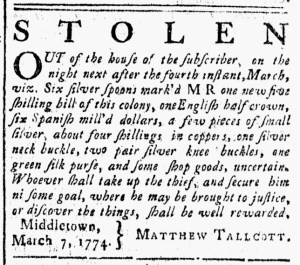
For Matthew Talcott, all was fine on the evening of March 4, 1774, but he woke up to discover a calamity the next morning.  Sometime during the night six silver spoons “marked M R,” “one silver neck buckle, two pair silver knee buckels,” quite a bit of cash, and “some shop goods, uncertain,” had been stolen from his shop in Middletown, Connecticut.  In response, Talcott turned to the public prints, running advertisements in hopes that someone “shall take up the thief, and secure him in some [jail], where he may be brought to justice.”  He also sought to recover the stolen items and money.  In addition to giving a reward, he invested in advertisements in three newspapers published in the colony.
Connecticut Journal (March 18, 1774).

Talcott’s advertisement first appeared in the Connecticut Gazette, published in New London, and the Connecticut Journal and New-Haven Post-Boy on March 11.  In each instance, a headline alerted readers to the contents of the rest of the advertisement.  The Connecticut Journal used “STOLEN” as the headline, while the Connecticut Gazette featured a more playful one that may have attracted even more attention: “Make Way! A Probationer for NEW GATE!”  The colony had recently opened a prison in a copper mine converted for that purpose in East Granby.  Someone in the printing office, rather than Talcott, may have devised the headline.

What suggests that was the case?  The two advertisements featured some variations.  The one in the Connecticut Gazette indicated that the theft took place “out of the Shop” while the Connecticut Journal stated it occurred “OUT of the house” of the unfortunate Talcott.  He likely worked where he resided.  Some of the stolen goods also appeared in slightly different order.  Talcott likely wrote the copy once for one newspaper and then copied it for the other, but was not exact in the process.  The compositor for the Connecticut Journal then used the first word as the headline, a common practice.  The editor or the compositor for the Connecticut Gazette, on the other hand, may have spotted an opportunity for creativity.
Connecticut Courant (March 15, 1774).

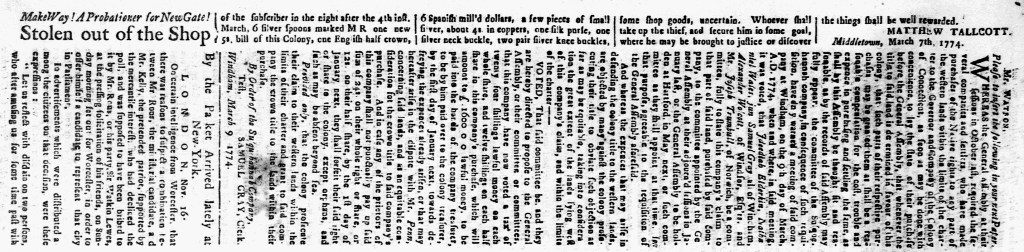
Consider that Talcott’s advertisement next ran in the Connecticut Courant, published in Hartford, on March 15.  It featured the same copy, including the snappy headline, that appeared in the Connecticut Gazette.  It also appeared in the margin on the final page, suggesting that the printing office received the advertisement at the last moment.  Type had already been set for the rest of the issue, but the compositor found a way to include Talcott’s notice.  Rather than Talcott submitting his advertisement directly to the Connecticut Courant, he may have made arrangements with the printer of the Connecticut Gazette to instruct his counterpart in Hartford to publish it, marking it in the copy sent as part of an exchange network of printers throughout the colony and the region.

While not conclusive, the circumstances collectively suggest that Talcott wrote the original copy, the Connecticut Gazetteembellished it with a provocative headline, and the Connecticut Courant reprinted it.  Several people played a role in creating the advertisement ultimately distributed to readers throughout the colony.

February 25

What was advertised in a colonial American newspaper 250 years ago today?

Norwich Packet (February 24, 1774).

“CLOCKS and WATCHES, if left with Mr. JOHN CHAMPLIN, in New-London, will be carefully forwarded to the said HARLAND, and returned with all Expedition.”

In February 1774, Thomas Harland, “WATCH & CLOCK MAKER, From LONDON,” ran an advertisement in the Norwich Packet “to acquaint the public, that he has opened a Shop … in Norwich.”  In it, he incorporated some of the appeals commonly advanced by artisans who migrated across the Atlantic.  In particular, Harland emphasized the quality of his work, declaring that he “makes, in the neatest manner, and on the most improved principles, horizontal, repeating, and plain watches.”  Like others in his trade, he also “cleans and repairs watches and clocks with the greatest care and dispatch.”  Harland devoted a nota bene to engraving and finishing clock faces and cutting and finishing parts, such as watch wheels and fusees, as “neat as in LONDON and at the same price.”  Harland suggested that he offered the sort of superior workmanship available in the largest and most cosmopolitan city in the empire.

Connecticut Gazette (February 25, 1774).

Residents of Norwich and surrounding towns were not the only prospective customers that Harland sought to attract.  He simultaneously ran the same advertisement, with a few modifications, in the Connecticut Gazette, published in New London.  His notice appeared on the front page of the February 25, 1774, edition, supplemented with a short paragraph that informed readers, “CLOCKS and WATCHES, if left with Mr. JOHN CHAMPLIN, in New-London, will be carefully forwarded to the said HARLAND, and returned with all Expedition.”  In his own advertisement on the fourth page of that issue, Champlin, a “GOLDSMITH and JEWELLER,” promoted the work he undertook in his shop and “likewise informs his Customers and others that they may have Clocks and Watches repaired at his Shop as usual.”  Harland’s advertisement suggests that those repairs did not take place in Champlin’s shop, that he instead sent them to Norwich.  Champlin had a history of partnering with associates to provide ancillary services to attract customers to his shop.  The previous fall, Champlin and Daniel Jennings jointly advertised in the New-London Gazette.  In April 1772, Champlin placed a notice in which he stated that he “employed a Person well acquainted” with “Clock and Watch making, mending, cleaning and repairing.”  In December 1769, James Watson advertised that he moved from one silversmith’s shop to Champlin’s shop “where he makes, mends and repairs all kinds of clocks and watches.”  Harland and Champlin mutually benefited from their partnership.  Harland, a newcomer, had an established artisan generating business for him, while Champlin continued providing the same array of services to current and prospective customers.

Champlin may have also played a role in Harland’s marketing efforts.  The watch- and clockmaker in Norwich may have sent his advertising copy to Champlin as part of their regular correspondence rather than directly to the printing office in New London.  An advertisement that had a rather plain appearance in the Norwich Packet featured a variety of embellishments in the Connecticut Gazette.  That version had greater variation in fonts as well as a decorative border.  Champlin’s advertisement also had a decorative border, while most paid notices in the Connecticut Gazette did not.  The compositor could have been responsible for sprucing up Harland’s advertisement, but the connection between Champlin and Harland suggests that the changes may have resulted from specific instructions from one of the advertisers.

February 18

What was advertised in a colonial American newspaper 250 years ago today?

Connecticut Gazette (February 18, 1774).

“HATS … both Bever and Castor.”

Ellie Chaclas, a student in my Revolutionary America class, and I worked together in selecting today’s advertisement.  Ellie has an interest in the history of fashion, completing her capstone research project on the politics of fashion during the era of the American Revolution.  She was drawn to this advertisement for “HATS, Manufactured by … DAVID NEVINS” that ran on the front page of the February 18, 1774, edition of the Connecticut Gazette.  Ellie noted that Nevins marketed the hats that he made as “warranted to be of the best Quality” as well as “as cheap and as fashionable as can be purchased in Boston and New-York.”  Nevins “Manufactured” hats in Norwich and marketed them to readers of a newspaper published in New London, reaching prospective customers in towns throughout Connecticut.  Colonizers did not have to live in urban ports like Boston and New York to participate in the consumer revolution of the eighteenth century.

Ellie also noted that Nevins made “Bever” or beaver hats but did not immediately recognize what he meant by “Castor.”  That gave us an opportunity to consult a resource that we frequently used in our class, the Oxford English Dictionary.  That yielded this definition: “a hat, originally either of beaver’s fur, or intended to be taken as such; in the end of the 17th and beginning of 18th cent. distinguished from ‘beaver’, and said to be of rabbit’s fur.”  We also discovered that “Bever” did not refer only to the material for “Manufactur[ing]” hats but in the eighteenth century was the name commonly used for a style of hat: “a hat made of beaver’s fur, or some imitation of it; formerly worn by both sexes, but chiefly by men.”  This underscored our conversations in class about eighteenth-century consumers speaking a language that they shared across the colonies yet much of their vocabulary no longer resonates with modern consumers.  To understand their experiences, we had to learn how to “translate” eighteenth-century English.

In addition, Ellie noted that even though the advertisement mentioned Boston and New York, Nevins likely had connections, even if indirect ones, with Detroit and the Great Lakes region and the trade in beaver fur.  As a class, we read and discussed Tiya Miles’s Dawn of Detroit: A Chronicle of Slavery and Freedom in the City of the Straits, shifting our examination of the era of the Revolution from the thirteen colonies on the Atlantic coast to the interior of the continent.  Miles’s book helped Ellie and her classmates (and their professor!) achieve a more complete understanding of the scope of Indigenous and African slavery in the Great Lakes region.  While not visible in Nevins’s advertisement, enslaved people likely played a part of in processing and transporting the fur he used in making his hats.

February 11

What was advertised in a colonial American newspaper 250 years ago today?

Connecticut Gazette (February 11, 1774).

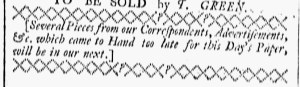
Several Pieces from our Correspondents, Advertisements, &c. which came to Hand too late for this Day’s Paper, will be in out next.”

Timothy Green, the printer of the Connecticut Gazette, inserted a brief notice in the February 11, 1774, edition to advise that “Several Pieces from our Correspondents, Advertisements, &c. which came to Hand too late for this Day’s Paper, will be in out next.”  In a few short lines, the printer aimed to manage his relationships with subscribers, advertisers, and anyone who submitted news, editorials, essays, or any other content for the newspaper.  He suggested to readers that he worked until the last possible moment to include the latest news.  He assured advertisers that their notices would indeed appear in print in the next issue.  He let those who provided content know that practical matters, not a lack of appreciation for their efforts, played the deciding role in why their submissions did not appear alongside a proclamation from the governor, resolutions from a “Town-Meeting of the Town of Providence” concerning a “Duty upon Tea” enacted by Parliament, and an account of events that resulted in the tarring and feathering of John Malcom, a customs officer, in Boston.

Green’s notice appeared at the bottom of the final column on the third page.  While that may seem like a curious place to modern readers, it made absolute sense to eighteenth-century readers, especially anyone familiar with the process for printing newspapers.  The Connecticut Gazette, like other newspapers of the era, consisted of four pages, created by printing two pages on each side of a broadside and folding it in half.  Workers in a printing office set the type for the first and fourth pages, printed the side of the broadsheet that featured those pages, and let the ink dry before printing the second and third pages on the other side.  That meant that type for the interior pages was set last, so news received most recently, regardless of its magnitude, appeared there rather than on the front page.  Whatever appeared at the end of the last column on the third page was the final bit of content that printers managed to fit in that issue.  That Green’s notice appeared there testified to his efforts to publish everything received in his printing office in New London up to the moment he had to take that issue to press and distribute the February 11 edition on schedule.

January 21

What was advertised in a colonial American newspaper 250 years ago today?

Connecticut Gazette (January 21, 1774).

“Greatly contribute towards the elevation and enlivening of Literary Manufactures.”

Both before and after the American Revolution, Robert Bell, one of the most influential publishers and booksellers of the eighteenth century, set about creating an American market for books.  That did not always mean publications by American authors but rather editions printed in America for American readers.  More than any other printer, publisher, or bookseller, Bell devised advertising campaigns that spanned the colonies in the early 1770s, distributing subscription proposals and inserting notices in newspapers from New England to South Carolina.  His advertisement addressing “SAGES and STUDENTS of the LAW, in AMERICA,” for instance, appeared in newspapers in several colonies, promoting “American editions” of “celebrated works” undertaken by “ROBERT BELL, Printer and Bookseller, of Philadelphia.”

Readers of the Connecticut Gazette, published in New London, encountered Bell’s “SAGES and STUDENTS” advertisement in the January 21, 1774, edition.  By then, the advertisement had been in circulation in various newspapers for several months as Bell attempted to cultivate a community of readers and consumers not bounded by local geography but instead defined by their common interest in “the elevation and enlivening of Literary Manufactures in America.”  To that end, readers in New London and other places near and far had “had an opportunity of seeing at most of the booksellers shops in the capital towns and cities on the Continent, printed proposals with conditions and specimens” for “American editions” of several books, including “BACON’s new abridgment of the law,” “FERGUSON’s essay on the history of Civil Society,” and “A second American edition of Judge BLACKSTONE’s Commentaries on the laws of England.”  For some of those books, Bell asserted that they matched “page for page with the last London edition,” yet he charged only half the price for the American edition.  The savvy publisher wedded bargain prices and supporting American industry at a time when relations with Parliament deteriorated in the wake of the Tea Act.

To learn more about subscribing to these various American editions, prospective customers could view the conditions in the printed proposals as well as examine specimens (or samples) to confirm that the quality of the type, paper, and printing was not inferior to imported editions.  Bell’s marketing efforts thus incorporated several media, not newspaper advertisements alone.  Bell cultivated a network of printers and booksellers to disseminate his various forms of advertising in the public prints and in their printing offices and bookshops, enlisting distant associates in the project of encouraging a market for American editions of important and popular books.

January 14

What was advertised in a colonial American newspaper 250 years ago today?

Connecticut Gazette (January 14, 1774).

“ALL Persons indebted to me / are desired to pay, / Or they will sued be, / and that without delay.”

Advertisements calling on colonizers to pay their debts frequently appeared in newspapers from New England to Georgia, including the Connecticut Gazette.  On January 14, 1774, for instance, that newspaper carried an estate notice directed to “All Persons indebted to the Estate of the Hon. JONATHAN HUNTINGTON,” asking them “to make speedy Payment, to EBENEZER DEVOTION, Executor.”  In addition to that advertisement, another instructed “All Persons indebted toRussell Hubbard, by BOOK or NOTE, whose Debts are of more than one Year’s standing … to settle their respective Accounts and pay off their Notes, without delay, or they may depend on being sued to the next Court.”  Given the circulation of the newspaper in New London and beyond, he asserted that he “expects that this will be as sufficient a Warning as if he wrote to each Person separately.”

Seth Wymund Holmes also took to the pages of the public prints in his efforts to encourage his debtors to make good on what they owed.  He resorted to a different format than Devotion and Hubbard, making his request (and delivering his threats of legal action) in verse.  Holmes composed four stanzas of four lines each.  “ALL Persons indebted to me / are desired for to pay,” his poem began, “Or they will sued by, and that without delay.”  He appealed to the conscience: “So will the Sum amount: / How can you it abide / To add to your Account / Trouble and Cost beside?”  He also lamented how long he carried those debts, incorporating a strategy that appeared in many other advertisements that did not resort to poetry.  “As many Debts now standing be, / for seven Years, to croud my Books,” Holmes declared, “I do protest I hate to see / such dull and heavy looks.”  In case neither asking debtors to do the right thing nor stating how long he had extended credit without receiving payment worked, Holmes circled back to threatening to sue in the final stanza.  “I therefore warn Debtors to come, / and Payment make with speed, / Or they will shortly hear their Doom / in Letters plain to read.”

Holmes certainly did not produce a great work of literature, but that was not his goal.  Instead, he sought to draw the attention of those who owed him money.  He also aimed to make his message memorable.  The format of his advertisement, the amount of white space that remained after setting type for each line, distinguished it from the dense text in so many other notices.  Once that aspect of Holmes’s advertisement prompted readers to take a closer look, they may have considered the poem such a novelty that they read each stilted stanza instead of skimming through the notice like they might have done with the advertisements placed by Devotion and Hubbard.  Holmes presented something different to readers of the Connecticut Gazette.  Whether or not that convinced his debtors to settle accounts, this strategy likely increased the chances that they knew he intended to sue them if they did not.

December 31

What was advertised in a colonial American newspaper 250 years ago today?

Connecticut Gazette (December 31, 1773).

“Clocks and Watches repaired … as well and cheap as in New-York or Boston.”

John Champlin, a goldsmith and jeweler, ran a shop in New London in the early 1770s.  He occasionally placed advertisements in the Connecticut Gazette to promote the goods and services that he provided.  For instance, as 1773 came to a close, he advised the public that he stocked a “good Assortment of cypher’d and brilliant Ear-ring & Button Stones, Locket Stones, Ring Stones of all Kinds,” “Wires of all Kinds, a neat Assortment of Files,” “Materials for repairing Clocks and Watches,” “best plated Shoe and Knee Buckles,” and “many other Articles.”  Like others advertisers, he intended that a list demonstrating the many choices he offered would entice consumers to visit his shop.

Champlin deployed other marketing strategies as well.  He made an appeal to price, asserting that he sold “All Sorts of Gold-smith, Silver-smith, and Jeweller’s Work as cheap” as anywhere else in the colony.  In so doing, he acknowledged that he operated within a regional rather than a local marketplace.  Prospective customers in New London and nearby towns had the option to send away to smiths and jewelers in New Haven, Hartford, and other towns if they thought they might get better deals, but Champlin assured them that was not necessary.  The market also extended beyond the colony.  Champlin declared that his customers “may have Clocks and Watches repaired at his Shop … as well and cheap as in New-York or Boston.”  In recent months, Thomas Hilldrup, a watchmaker in Hartford, advertised widely in newspapers in Hartford, New Haven, and New London, encouraging colonizers to send their watches to him via post riders.  Champlin may have deliberately avoided alluding to Hartford, not wishing to amplify Hillrup’s marketing efforts, and instead focused on low prices often associated with major ports.  All the same, the message was clear that customers should bring or send their clocks and watches to him rather than sending them for repairs in any other city or town.

The goldsmith and jeweler advanced and adapted some of the most common marketing appeals that appeared in eighteenth-century newspaper advertisements.  He emphasized consumer choice, low prices, and quality.  In so doing, he sought to make himself competitive not only in the town where he kept his shop but anywhere in the colony and throughout New England where readers perused the Connecticut Gazette.

December 17

What was advertised in a colonial American newspaper 250 years ago today?

Connecticut Gazette (December 17, 1773).

WANTED, A HUSBAND.”

Was it an advertisement or an editorial?  The December 17, 1773, edition of the Connecticut Gazette included an item that purported to be a “WANTED” advertisement.  The anonymous woman who placed it sought a husband who “can be warranted to possess the following agreeable Qualifications” and listed a “good Education,” “good Morals,” a mind “richly furnish’d with all useful Knowledge,” and “genteel, easy, and graceful” behavior.  That husband should be “free from Pride and Arrogance.”  Overall, he needed to demonstrate “the most distinguish’d Character.”  A nota bene indicated the circumstances that likely prompted this particular “Advertisement.”  The anonymous advertiser insisted that her prospective husband “should treat the Ladies with the Respect that their Merits require, considering that their Sex alone intitles them to his Esteem.”  To behave otherwise would not be “consistent with the Character of a Gentleman.”  Patriarchal structures defined and confined women’s status in colonial America, but the system was also supposed to bestow certain privileges and protections upon them, especially middling and elite white women.

This item included a salutation, unlike most paid notices that appeared in the Connecticut Gazette and other colonial newspapers.  “Mr. GREEN,” it addressed the printer, “Please to give the following Advertisement a Place in your Paper, and oblige one of your constant Readers.”  The anonymous advertiser likely did not intend to pay for this “Advertisement,” but rather used the word according to another common meaning in both England and America in the eighteenth century.  The Oxford English Dictionary provides this “now chiefly historical” definition: “a (written) statement calling attention to anything; a notification; esp. a notice to readers in a book (typically, a preface).”  Printers and authors also used “advertisement” in that manner in newspapers.  In this instance, the “Advertisement” appeared in a curious place in the Connecticut Gazette, on the final page immediately below the “POET’S CORNER,” a weekly feature, and above advertisements that were indeed paid notices.  The printer chose to place the “Advertisement” with paid notices rather than among the news and editorials on other pages, perhaps suggesting that even though he did not collect payment he still considered the piece artful, like that week’s poem, rather than a serious editorial.  The anonymous advertiser could demand “the Respect that [Ladies’] Merits require,” but that did not mean that the printer was obliged to respond in that manner.  Just as John Adams would mock Abigail’s admonitions to “Remember the Ladies” in their correspondence in the spring of 1776, the printer of the Connecticut Gazette gave this “Advertisement” a place in his newspaper that suggested he did not take it as seriously as the anonymous advertiser intended.

May 24

What was advertised in a colonial American newspaper 250 years ago today?

Connecticut Journal (May 24, 1771).

“RUN away … a Negro Man named GLASGOW.”

Near the end of April 1770, Dover, an enslaved man, liberated himself from Nathaniel Sperry of New Haven.  As the anniversary of Dover making his escape approached, Sperry turned to the public prints to seek assistance in capturing Dover and returning him to bondage.  To that end, he placed an advertisement in which he described Dover and offered a reward in the Connecticut Journal.  On the night of May 7, 1771, another enslaved man, Glasgow, liberated himself from John Treat of Milford.  On the same night, “a Negro Man named ABEL” liberated himself from Gideon Platt, Jr., also of Milford.  Abel and Glasgow may have worked together to outsmart their enslavers and increase their chances of successfully escaping from their enslavers.  Platt and Treat placed separate advertisements in the Connecticut Journal, perhaps unaware of any possible connection until their notices appeared one after the other in the May 10, 1771, edition of the Connecticut Journal.

All three advertisements ran for three consecutive weeks, but their format shifted during that time.  On May 10, all three appeared in a single column on the final page.  The following week, however, the printers had more content than space, so they improvised by placing the advertisement about Abel in the left column on the second page and the advertisements about Dover and Glasgow in the right margin on the third page.  Since the type had already been set for these advertisements, the printers simply divided them into several columns that ran perpendicular to the other text on the page. Doing so conserved time and effort while also making using of available space since the printers had to make only one small revision, placing the town and date on the same line as John Treat’s name.  For the final appearance in the May 24 edition, all three advertisements returned to the regular columns, each of them reconstituted to their original format (save for the minor change to Treat’s advertisement about Glasgow).

Thomas Green and Samuel Green, the printers of the Connecticut Gazette, minimized the amount of effort required to run the advertisements about Abel, Dover, and Glasgow for three consecutive weeks.  They adopted a common strategy of printing in the margins, a practice that tended to their own interests as entrepreneurs seeking to maximize revenues while reducing expenses.  In the process, they demonstrated their commitment to serving their customers by publishing notices submitted to their printing office, including notices about enslaved people who liberated themselves.  The Greens could have delayed publication of the advertisements about Abel, Dover, and Glasgow by a week, as other printers sometimes did when they had more content than space.  Instead, the Greens invested additional effort in publishing descriptions of the men, even as they conserved their own resources.  Reconfiguring the advertisements twice, even if not starting over on setting type each time, testified to their willingness to give customers access to the power of the press as a means of encouraging surveillance of Black people with the intention of capturing of enslaved people who liberated themselves.

September 6

What was advertised in a colonial American newspaper 250 years ago today?

Sep 6 - 9:6:1766 Connecticut Gazette
Connecticut Gazette (September 6, 1766).

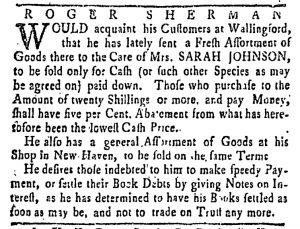
“ROGER SHERMAN … has lately sent a Fresh Assortment of Goods there to the Care of Mrs. SARAH JOHNSON.”

Relative to the number of women who worked as shopkeepers or otherwise operated businesses of various sorts in eighteenth-century America, very few women placed advertisements to promote their endeavors and attract customers. As a matter of principle, I do not wish to further obscure women’s participation in the marketplace as producers and retailers on the supply side of the equation; all too often they are depicted merely as consumers on the demand side. Accordingly, I select advertisements placed by women as frequently as practical.

Today’s advertisement caught my attention because it promotes a business run by a woman, yet it was not placed by the woman herself. Sarah Johnson sold “a Fresh Assortment of Goods” in Wallingford, a town about a dozen miles outside of New Haven. Roger Sherman, however, placed an advertisement in the Connecticut Gazette to “acquaint his Customers at Wallingford” that Johnson sold those goods and provided discounts for customers who bought in volume. He also wanted potential customers in New Haven to know that he sold a similar “Assortment of Goods” on the same terms.

This advertisement raises questions about the arrangements Johnson and Sherman made. It appears that Johnson oversaw the day-to-day operations of the shop in Wallingford, including the necessary accounting and negotiating (as indicated when Sherman allowed for payment in “such other Species as may be agreed on” instead of cash). Yet she seems to have been an employee of some sort rather than a partner. What kind of stake did she have in the enterprise? Did she own any of the inventory she stocked? Did she earn commissions on the goods she sold? How much risk had she assumed compared to Sherman? How much autonomy did she exercise in selecting goods and setting prices? Did she participate in the decisions to offer discounts or to call in debts? Note that Sherman referred to customers Johnson served in Wallingford as “his Customers,” suggesting how he envisioned his relationship to both Johnson and their (his?) clients.

This advertisement acknowledges Sarah Johnson’s presence in the operation of a shop in Wallingford, Connecticut, but it does not fully elaborate on her position relative to Roger Sherman beyond suggesting that even though she participated in the marketplace she did so as a subordinate to Sherman. The advertisement, intended for public consumption, maintained the gender hierarchy of the period, regardless of whatever practices Johnson and Sherman devised outside the public eye.