July 31

What was advertised in a revolutionary American newspaper 250 years ago today?

Dunlap’s Pennsylvania Packet (July 31, 1775).

“… that we may not now, nor hereafter, have any occasion to import from our ministerial enemies in Great-Britain.”

Charles Maise, a “MUSTARD and CHOCOLATE MAKER” in Philadelphia, took to the pages of Dunlap’s Pennsylvania Packet to promote his business at the end of July 1775.  First, he needed supplies, offering “Forty shillings per bushel for any quantity of good clean Mustard-seed.”  Yet Maise wanted readers to think bigger about his business and their role as both suppliers and consumers given the imperial crisis experienced in the colonies over the last decade.  He expressed his hope that “farmers and others will use their best endeavours to encourage this valuable manufactory, by cultivating and improving the growth of so valuable an article, that we may not now, nor hereafter, have any occasion to import from our ministerial enemies in Great-Britain.”  Such sentiments certainly resonated with the Continental Association, a nonimportant agreement devised by the First Continental Congress in the fall of 1774 in response to the Coercive Acts. The eight article called on colonizers “in our several Stations,” including mustard and chocolate makers, to “encourage Frugality, Economy, and Industry; and promote Agriculture, Arts, and the Manufactures of this Country.”

Producers had a part to play in making available alternatives to imported goods, but the Continental Association did not depend on their efforts alone.  Consumers also had to make choices aligned with their political principles.  That meant purchasing “domestic manufactures,” goods produced in the colonies.  Maise stood ready to partner with consumers in pursuing their common cause.  In a nota bene, he announced that he “stands in the market on market days, opposite the London Coffee-house.”  Customers could find him there.  He extended “thanks to his former customers,” stating that he “hopes for a continuance of their favours, and doubts not but to merit their esteem.”  Of course, Maise also intended for his advertisement to reach new customers and wanted them to join existing customers in supporting both his business and the American cause by purchasing mustard produced locally from mustard seeds grown in the colonies.  Mustard gained political significance when taking into consideration “our ministerial enemies in Great-Britain,” especially in the wake of recent news of hostilities commencing at Lexington and Concord, the siege of Boston, and the Battle of Bunker Hill.

July 28

What was advertised in a revolutionary American newspaper 250 years ago today?

Essex Journal (July 28, 1775).

“Encourage their children and servants to save the old Rags … and send them to the Printing-office.”

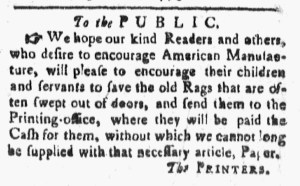
John Mycall and Henry-Walter Tinges, the printers of the Essex Journal in Newburyport, Massachusetts, concluded the July 28, 1775, edition of their newspaper with an advertisement that presented colonizers an opportunity to aid the American cause.  “We hope our kind Readers and others, who desire to encourage American Manufacture,” Mycall and Tinges declared, “will please to encourage their children and servants to save the old Rags that are often swept out of doors, and send them to the Printing-office.”  The printers offered cash for the rags, explaining that without them “we cannot long be supplied with that necessary article, Paper.”  Mycall and Tinges oversaw a recycling venture imperative in producing an essential article for continuing to publish their newspaper and anything else.  They were not the only printers in the region who experienced a disruption in acquiring paper in the months after the battles at Lexington and Concord.  Daniel Fowle, the printer of the New-Hampshire Gazette, had a similar experience.

Throughout the imperial crisis, collecting rags to recycle into paper had been imbued with political significance.  Producing paper in the colonies meant that printers did not need to import as much paper from England.  As nonimportation agreements went into effect in 1768, Christopher Leffingwell of Norwich, Connecticut, described collecting rags as “an entire Saving to the COUNTRY” and encouraged “every Friend and lover thereof [to] save every Scrap” of discarded linen.  For years, John Keating regularly promoted his “Paper Manufactory” in New York’s newspapers, arguing that economic resistance during the “present alarming situation of the colonies” was the “safest and most efficacious method of convincing the Ministry of Great-Britain of their error.”  He suggested that each household designate a “certain place” for collecting rags and cultivate a habit that would “establish this valuable manufactory upon a permanent foundation.”  Who undertook such work?  John Dunlap, the printer of the Pennsylvania Packet, hoped “to prevail upon our LADIES to grant us a little of their industry and assistance,” believing that “the welfare of their country will influence them” to do their part in collecting rags to recycle into paper.  Mycall and Tinges extended the call to include “children and servants.”  As men mustered to defend their liberties, women, children, and servants had their own role to play.  They could contribute to the American cause by supporting “American Manufacture,” including collecting rags to transform into the newspapers and pamphlets that disseminated the rhetoric of the Revolution.

July 21

What was advertised in a revolutionary American newspaper 250 years ago today?

Pennsylvania Evening Post (July 21, 1775).

“He hopes to meet with due encouragement, especially as it is the first of its kind attempted in America.”

John Melchior Naff, a “MANUFACTORER of WIRE,” used an advertisement in the July 21, 1775, edition of the Pennsylvania Evening Post to inform “the public in general, and his friends in particular,” about the business he planned to establish in Philadelphia.  He declared that he “proposes to manufacture and sell all kinds of WIRE, BRASS and IRON, and draw it to any size, fit for any use whatsoever.”  He also stated that he “can make all kinds of COMMON PINS, HAIR PINS, COTTON CARDS, and HOOKS and EYES, as good and as cheap as can be imported from Europe.”

Although Naff did not invoke the Continental Association, a nonimportation agreement in protest of the Coercive Acts that had been in effect since the previous December, he almost certainly expected that readers would take it into consideration when they perused his advertisement.  In addition to boycotting goods imported from Britain, the Continental Association called for consumers and producers alike to encourage “domestic manufactures.”  Naff answered that call with pins and other items of the same quality and low prices as imported ones.  He made an investment in the enterprise, reporting that he “hath, at his own expence, already furnished himself with the proper tools and implements to carry on the said business.”  The entrepreneur felt he deserved “due encouragement” from consumers, “especially as it is the first of its kind attempted in America.”  That claim echoed the one that Richard Lightfoot recently made about his “PIN MANUFACTORY” in New York, asserting that “he is the first that ever attempted” to produce several kinds of wirework “on this continent.”  Similarly, Ryves and Fletcher, paper stainers in Philadelphia, advertised that “they are the first who have ever attempted” to make paper hangings (or wallpaper) “on this continent.”

A few months before Naff, Lightfoot, and Ryes and Fletcher ran their advertisements, the imperial crisis boiled over.  Word about the battles at Lexington and Concord and the siege of Boston spread quickly.  More recently, colonizers learned about the Battle of Bunker Hill.  As they prepared for the possibility of more military encounters, perhaps even in or near their own towns, they also continued to use the marketplace as a venue to engage in resistance.  When Naff requested “due encouragement” for establishing a new industry in America, he reminded prospective customers of their duty to fight against Parliament in the decisions they made about the goods they purchased.

July 18

What was advertised in a revolutionary American newspaper 250 years ago today?

Pennsylvania Evening Post (July 18, 1775).

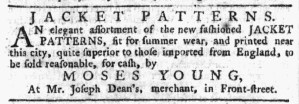
“JACKET PATTERNS … printed near this city, quite superior to those imported from England.”

Public discourse about the American Revolution resonated not only in the news and editorials that appeared in newspapers but also in the advertisements that ran in them.  In the July 18, 1775, edition of the Pennsylvania Journal, for instance, John Dean, a bookbinder, once again advertised the Philadelphia edition of A Self Defensive War Lawful, a sermon recently “preached at Lancaster, before Captain Ross’s company of militia” by John Carmichael.  The updated version of this advertisement indicated that four local printers and booksellers now stocked the sermon.  It also listed prices for single copies, a dozen, or a hundred, suggesting that Dean anticipated that retailers would purchase copies to sell or other customers would buy the sermon to distribute in their communities.

The advertisement immediately above the one for the sermon was also tied to the events of the American Revolution.  Moses Young announced that he sold “JACKET PATTERNS.”  He had an “elegant assortment of the new fashioned JACKET PATTERNS, fit for summer wear, and printed near this city.”  Young did not have to invoke the Continental Association, a nonimportation agreement devised by the First Continental Congress in response to the Coercive Acts, for readers to understand the implications of his assertion that the patterns were produced near Philadelphia.  In addition to prohibiting imported goods, the Continental Association called on colonizers to “encourage Frugality, Economy, and Industry; and promote Agriculture, Arts, and the Manufactures of this Country.”  Moses Young did just that … and he gave consumers a chance to do their part.  They could keep up with current trends and they could do so without sacrificing quality.  After all, Young described the patterns as both “new fashioned” and “quite superior to those imported from England.”  In addition, he sold them for a “reasonable” price.  As the siege of Boston continued in Massachusetts and the Second Continental Congress continued meeting in Philadelphia, Young’s marketing presented an opportunity for consumers to offer their support for the American cause through one of the decisions they made in the marketplace.

July 16

What was advertised in a revolutionary American newspaper 250 years ago this week?
New-York Gazette and Weekly Mercury (July 10, 1775).

“He therefore hopes for the countenance of those who wish to encourage their own manufactures.”

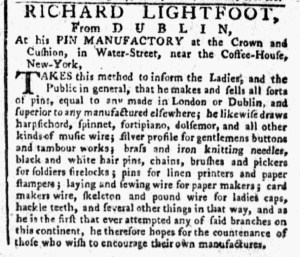
In the summer of 1775, Richard Lightfoot placed a newspaper advertisement to promote his “PIN MANUFACTORY at the Crown and Cushion” in New York.  In addition to “all sorts of pins,” he also produced a variety of other wirework, including “harpsichord, spinnet, fortepiano, dolsemor, and all other kinds of music wire,” “brass and iron knitting needles,” “pins for linen printers and paper stampers,” and “laying and sewing wire for paper makers.”

Lightfoot addressed “the Ladies,” who presumably constituted a significant portion of his customers, yet also directed his advertisement to “the Public in general.”  After all, he had an interest in the entire community knowing about the work undertaken at his “PIN MANUFACTORY” and his contributions to the American cause through his participation in the marketplace.  Lightfoot proclaimed that “he is the first that ever attempted any of said branches,” the production of the various kinds of wirework, “on this continent.”  He did so at a time that colonizers observed the Continental Association, a nonimportation agreement devised by the First Continental Congress in response to the Coercive Acts.  That pact called for encouraging “Industry” and “the Manufactures of this Country” as alternatives to imported goods.  Under those circumstances, Lightfoot hoped “for the countenance of those who wish to encourage their own manufactures.”  That meant that “the Public in general” should support his enterprise by recommending it to “the Ladies” who purchased and used the pins and other items he made.

When they did so, they could depend on the quality of those products.  Lightfoot asserted that his pins were “equal to any made in London or Dublin, and superior to any manufactured elsewhere.”  He was qualified to make that claim, indicating that he was “From DUBLIN” and likely learned and practiced his trade there before migrating to New York.  Claiming that authority, Lightfoot assured prospective customers that they did not sacrifice quality when they applied their political principles to their decisions about which pins to purchase.  It did not matter that the Continental Association prohibited buying imported pins because Lightfoot made and sold pins that were just as good as (or even better than) pins produced elsewhere!

June 29

What was advertised in a revolutionary American newspaper 250 years ago today?

Maryland Gazette (June 29, 1775).

“THE manufactory of snuff of various sorts is now carried on by me at this place.”

On the eve of the American Revolution, Richard Thompson attempted to establish a market for snuff produced in Virginia.  In “The Beginnings of Tobacco Manufacture in Virginia,” Jacob M. Price argues that “there is not even a hint of a local manufacture” of snuff in Virginia from the middle of the 1730s through the late 1760s.  Most of the snuff came from Great Britain with  occasional “bottles, boxes, and kegs of snuff … appear from time to time in notices of arriving cargoes from Antigua, Boston, New York, and Salem.”  According to Price, Thompson “moved his business from Bladensburg [Maryland] to the falls of the Potomac and tried to crash the Virginia market in 1772,” placing a lengthy advertisements in the October 8 edition of William Rind’s Virginia Gazette.  “Little more is known,” Price continues, “of this early Maryland industrial pioneer and of his seemingly premature efforts to introduce a ‘patriotic’ tobacco and snuff manufacture into the Chesapeake.”[1]

An advertisement in the June 29, 1775, edition of the Maryland Gazette, published in Annapolis, reveals that Thompson continued to produce snuff at “George-town, on the Potowmack” at that time.  The “manufactory of snuff of various sorts is now carried on by me at this place,” Thompson proclaimed, “where I can furnish it either in wholesale or retail, at reasonable rates.”  In addition, Thompson had “manufactured tobacco for sale, viz. shag and saffron, and shall shortly begin and continue to manufacture it in all the different forms, if I receive proper encouragement.”  According to the date on the advertisement, Thompson first asked for that encouragement on December 27, 1774, no doubt hoping that the Continental Association, a nonimportation agreement devised by the First Continental Congress in response to the Coercive Acts, created favorable conditions for snuff produced in the colonies.  Patriotic colonizers had an obligation to support his enterprise, to give him that “proper encouragement,” but they did not have to settle for a product inferior to snuff produced elsewhere in the colonies.  In a nota bene, Thompson declared, “I will now say, and with some degree of confidence, that at present I have by me, (and shall continue to make) as good snuff as is manufactured on this continent.”  Even if his business got off to a rocky start, as Price suggests, Thompson asserted that he made improvements over time.  He composed his advertisement less than a month after the Continental Association went into effect (and a notation, “3m,” indicated that it would appear in the Maryland Gazette for three months), yet apparently decided that the time was right to revive it more than six months later after learning of the battles at Lexington and Concord.  Those battles and the events that followed meant that friends of the American cause, after all, had even more reason to support his endeavor.

**********

[1] Jacob M. Price, “The Beginnings of Tobacco Manufacture in Virginia,” Virginia Magazine of History and Biography 64, no. 1 (January 1956): 9, 12, 14.

June 19

What was advertised in a revolutionary American newspaper 250 years ago today?

Postscript to Dunlap’s Pennsylvania Packet (June 19, 1775).

“A NEW AMERICAN MANUFACTORY.”

As summer arrived in 1775, Ryves and Fletcher took to the pages of Dunlap’s Pennsylvania Packet to inform the public that they established a “NEW AMERICAN MANUFACTORY” where they made and sold “all kinds of PAPER HANGINGS” (better known as wallpaper today).  The eighth article of the Continental Association, the nonimportation pact devised by the First Continental Congress in the fall of 1774, called for “promot[ing] Agriculture, Arts, and the Manufactures of this Country” as alternatives to imported goods.  That charge had even greater urgency following once colonizers heard about the battles at Lexington and Concord and the ensuing siege of Boston.  When Ryves and Fletcher ran their advertisement two days after the Battle of Bunker Hill, word of that engagement had not yet arrived in Philadelphia.  When it appeared again in July, readers had even more information about momentous events in Massachusetts that likely shaped how they reacted to Ryes and Fletcher marketing paper hangings made in America.

The “PAPER STAINERS,” as Ryves and Fletcher described themselves, asserted that they “are the first who have attempted that manufacture on this continent.”  Perhaps they were not aware that Plunket Fleeson made, advertised, and sold “AMERICAN PAPER HANGINGS” in Philadelphia in 1769, though they may have conveniently overlooked that enterprise in their efforts to promote their own.  Ryves and Fletcher made significant investment in procuring both workers and materials, noting in particular that their undertaking “consumes a large quantity of the paper of this country.”  In return for their dedication to the patriot cause, they “are therefore induced to hope for the countenance and protection of all well wishers to the infant manufacturers of America.”  They did their duty as producers, but that was not enough; consumers now had an obligation to purchase the paper hangings that Ryves and Fletcher made.  The paper stainers launched a “Buy American” campaign at the beginning of the Revolutionary War.  As part of their marketing efforts, they emphasized quality, extolling the “neatness of patterns and elegance of colour,” and price, pledging that “they will sell on much more reasonable terms than any paper can be disposed of which is imported into America.”  Ryves and Fletcher were among the first to produce and market paper hangings made in America, helping establish a new industry during the era of the American Revolution.

**********

I provide a brief case study of patriotic advertisements for paper hangings in Carl Robert Keyes, “A Revolution in Advertising: ‘Buy American’ Campaigns in the Late Eighteenth Century,” in Creating Advertising Culture:  Beginnings to the 1930s, vol. 1, We Are What We Sell:  How Advertising Shapes American Life … And Always Has, eds. Danielle Coombs and Bob Batchelor (New York:  Praeger, 2013), 1-25.

March 20

What was advertised in a colonial American newspaper 250 years ago today?

Dunlap’s Pennsylvania Packet (March 20, 1775).

“The Proprietors being unwilling to deprive such as are desirous of seeing the factory, from the gratification of their curiosity.”

John Elliott and Company advertised items made at the “AMERICAN GLASS WARE-HOUSE” in Kensington, Philadelphia, as soon as the Continental Association went into effect in December 1774.  Nearly four months later, the company ran another advertisement that listed a variety of glassware – including “wine glasses of various sorts,” “tumblers of all sizes,” “hour glasses,” “tubes for thermometers,” “mustard pots,” and “lamps for halls, streets, chambers, shops, [and] weavers” – that “shop keepers and others in town or country” could purchase “as cheap [as] those imported.”  Some items were “much cheaper.”  Colonizers who abided by the nonimportation agreement did not have to pay more to acquire glassware made in the colonies; instead, they got a bargain!  Elliott and Company also informed apothecaries and others that they accepted orders and would follow patterns “left at the aforesaid Ware-house.”

Yet this enterprise did more than manufacture glassware.  Elliott and Company’s operation became a destination for the curious who wanted to witness the production of “AMERICAN GLASS” for themselves.  That had the potential to become disruptive, so the proprietors devoted the final paragraph of their advertisement to instructions for visiting.  They explained that they struck a compromise, “being unwilling to deprive such as are desirous of seeing the factory, from the gratification of their curiosity, but at the same time finding it necessary to endeavour, in some measure, to save the works from the disadvantage which must and does actually arise from the great resort of spectators.”  Accordingly, Elliott and Company charged “two shillings for each person’s admittance, expected at the gate.”  Even that fee, they claimed, “is very inadequate to the hinderance occasioned thereby,” yet, once again, the company offered a bargain.  In the process, Elliott and Company monetized visits to their production facility.  Perhaps it had not been as popular a destination as they implied.  Perhaps they exaggerated in hopes of drumming up interest in such a novelty, especially as the imperial crisis intensified and the Continental Association became even more meaningful to many colonizers.  An advertisement with instructions for visiting the factory, no matter how many people had previously been there, gave readers ideas about an outing they could make themselves.  Attracting visitors to see the works, after all, would likely translate into additional sales.

March 5

What was advertised in a colonial American newspaper 250 years ago this week?

Supplement to the New-York Journal (March 2, 1775).

“PARCHMENT … Made and sold … [in] Philadelphia.”

In the early 1770s, Robert Wood made and sold parchment in Philadelphia, yet he did not confine his marketing or distribution of his product to that city and its hinterland.  As spring approached in 1775, he ran an advertisement in the supplement that accompanied the March 2 edition of the New-York Journal, advising prospective customers that they could acquire his parchment from local agents.  John Holt, the printer of the New-York Journal, and Hugh Gaine, the printer of the New-York Gazette and Weekly Mercury, each stocked Wood’s parchment along with books, stationery, and writing supplies at their printing offices.  In addition, Joseph Dunkley, a painter and glazier, also supplied Wood’s parchment at his workshop “opposite the Methodist Meeting House.”  The New-York Journal circulated beyond the city, so some prospective customers would have found it more convenient to acquire Wood’s parchment from Isaac Collins, a printer in Burlington, New Jersey.  According to previous advertisements, Collins had been peddling Wood’s parchment to “friends to American Manufactures” for several years.

Wood asserted that the “Demand for this Parchment [was] much increased of late,” though he left it to readers to imagine why that was the case.  Most would assume that the Continental Association, a nonimportation agreement that went into effect on December 1, 1774, played a role in increased demand for parchment produced in the colonies.  Wood likely intended for prospective customers to draw the conclusion that the quality of his product, not merely its availability, contributed to the demand.  He declared that “those who have tried it … esteemed [it] superior to most imported from England.”  He was bold enough to resort to superlatives, claiming that customers considered his parchment better than any imported to the colonies, yet he offered firm assurances about it quality.  Wood had recently met with so much demand for his parchment that he “extend[ed] his Works … to be able to supply his Customers in a manner more satisfactory than heretofore, without Fear of a Disappointment.”  In other words, he stepped up production to expand his inventory so every customer who wished to purchase his parchment could do so.  Wood answered the call of the eighth article of the Continental Association with his own “Industry” in producing “Manufactures of this Country” as alternatives to imported goods.

February 17

What was advertised in a colonial American newspaper 250 years ago today?

Virginia Gazette [Purdie] (February 17, 1775).

“An encouragement for making COTTON and WOOL CARDS … in this colony.”

Residents of James City County took the Continental Association seriously, especially the eighth article.  When the First Continental Congress devised that nonimportation, nonconsumption, and nonexportation agreement in response to the Coercive Acts, they included an article that called for colonizers “in our several Stations, [to] encourage Frugality, Economy, and Industry; and promote Agriculture, Arts, and the Manufactures of this Country, especially that of Wool.”  In turn, the “committee of James City county” passed a resolution for the “encouragement for making COTTON and WOOL CARDS” at its meeting in February 1775.

Within days an advertisement appeared in Alexander Purdie’s Virginia Gazette and John Dixon and William Hunter’s Virginia Gazette to inform enterprising entrepreneurs that the committee offered “a premium of forty pounds sterling … to any person who shall first settle in this colony, and who shall, within eighteen months from the date hereof, make in this colony, or cause to be made therein under his direction, five hundred pair of good cotton and five hundred pair of good wool cards … for the use of the inhabitants of this county.”

Preparing wool and cotton for spinning involved separating and straightening the fibers using two cards or paddles with fine wire teeth.  That process made wool and cotton easier to spin; it also made the cards an essential tool for producing textiles as alternatives to imported fabrics.  While the committee assumed that men would make the cards, it would be women who used them.  That gave political meaning to the activities they undertook in carding, spinning, and weaving, just as women participated in politics when they refused to purchase imported cards, imported textiles, or any other imported goods.

Making cotton and wool cards in Virginia had the potential to be a profitable venture.  In addition to the premium, the committee offered a “75 per cent. advance on what such cards have usually been imported at from Great Britain within the twelve months past.”  In other words, the committee agreed to pay nearly twice what importers had recently paid for this important tool, another incentive for producing cards in the colony.

Supporters of the American cause had already mobilized in boycotting imported goods and producing alternatives.  This advertisement suggested one more means of contributing to those efforts, making cotton and wool cards in Virginia.  A successful venture would have ripple effects as women purchased those cards and used them in processing cotton and wool to produce homespun cloth rather than buying imported textiles.  The premium offered for making cotton and wool cards was part of a larger project with significant political implications.