July 2

What was advertised in a colonial American newspaper 250 years ago today?

Essex Gazette (July 2, 1771).

“To be sold by the Printer hereof.”

Samuel Hall, printer of the Essex Gazette, frequently supplemented the news accounts, letters, and paid notices in his newspaper with advertisements of his own.  In doing so, he simultaneously promoted various enterprises undertaken at his printing office in Salem and generated content to fill otherwise empty space.  Throughout the colonies, printers adopted similar strategies in their newspapers.

Consider the July 2, 1771, edition of the Essex Gazette.  Hall interspersed three of his own notices among the paid advertisements.  The first announced, “A good Assortment of PAPER, by the Ream or Quire, as cheap as at any Shop or Store in Boston; together with most other Sorts of Stationary, to be sold by the Printer hereof.”  Extending only four lines, this notice appeared near the bottom of the second column on the third page.  Another of Hall’s notice ran at the top of the final column on that page.  That one advised prospective customers that Hall sold copies of “the Rev. Dr. Pemberton’s Sermon in the Ordination of the Rev. Mr. Story of Marblehead.”  It also listed related items “annexed” to the sermon in the pamphlet.  Like many other printers, Hall pursued multiple revenue streams at his printing office, selling books and stationery to supplement the proceeds from newspaper subscriptions, advertisements, and job printing.

Essex Gazette (July 2, 1771).

In his third notice, Hall declared, “CASH given for RAGS, at the Printing Office in Salem.”  Printers frequently collected rags, a necessary resource for the production of the paper they needed to pursue their occupation.  Even more than his other notices in the July 2 issue, the placement of Hall’s call for rags suggests that it also served as filler to complete the page.  It appeared at the bottom of the final column.  The compositor also inserted decorative type to fill the remaining space, furthering testifying to the utility of running that particular notice.  Access to the press meant that printers could run advertisements promoting their own endeavors whenever they wished, but that was not the only reason they inserted notices into their publications.  Sometimes they sought to quickly and efficiently fill remaining space with short notices already on hand.  The type remained set for easy insertion whenever necessary, a strategy for streamlining the production of newspapers in eighteenth-century America.

June 22

What was advertised in a colonial American newspaper 250 years ago today?

Providence Gazette (June 22, 1771).

“ADVERTISEMENTS of a moderate Length (accompanied with the Pay) are inserted in this Paper three Weeks for Four Shillings Lawful Money.”

Today marks two thousand days of production for the Adverts 250 Project.  Every day for two thousand consecutive days, I have examined an advertisement originally published in an eighteenth-century newspaper.  Students enrolled in my Colonial America, Revolutionary America, Public History, and Research Methods classes at Assumption University have also contributed to the Adverts 250 Project as guest curators.

This milestone seems like a good opportunity to address two of the questions I most commonly encounter.  How much did a subscription to an eighteenth-century newspaper cost?  How much did an advertisement cost?  Most printers did not regularly publish subscription rates or advertising rates in their newspapers, but some did include that information in the colophon at the bottom of the final page.  Of the twenty-two newspapers published during the week of Sunday, June 16 through Saturday, June 22, 1771, that have been digitized and made available for scholars and other readers, seven listed subscription rates and six indicated advertising rates.  Four of those, the Essex Gazette, the Maryland Gazette, Purdie and Dixon’s Virginia Gazette, and Rind’s Virginia Gazette, included both subscription rates and advertising rates in the colophon. That nearly as many identified advertising rates as the cost of subscriptions testifies to the importance of advertising for generating revenue.

Here is an overview of subscription rates and advertising rates inserted in the colophons of colonial newspapers during the last week of spring in 1771.

SUBSCRIPTION RATES:

  • Essex Gazette (June 18): “THIS GAZETTE may be had for Six Shillings and Eight Pence per Annum, (exclusive of Postage) 3s. 4d. (or 3s. 6d. if sent by Post) to be paid at Entrance.”
  • Maryland Gazette (June 20): “Persons may be supplied with this GAZETTE, at 12s. 6d. a Year.”
  • Massachusetts Spy (June 20): “Persons may be supplied with this paper at Six Shillings and Eight Pence, Lawful Money, per Annum.”
  • Pennsylvania Chronicle (June 17): “Subscriptions, (at TEN SHILLINGS per Annum) Advertisements, Articles and Letters of Intelligence are gratefully received for this Paper.”
  • Pennsylvania Journal (June 20): “Persons may be supplied with this Paper at Ten Shillings a Year.”
  • Virginia Gazette [Purdie and Dixon] (June 20): “ALL Persons may be supplied with this PAPER at 12s. 6d. a Year.”
  • Virginia Gazette [Rind] (June 20): “All Persons may be supplied with this GAZETTE at 12s6 per Year.”

ADVERTISING RATES:

  • Essex Gazette (June 18): “ADVERTISEMENTS not exceeding eight or ten Lines are inserted for Three Shillings.”
  • Maryland Gazette (June 20): “ADVERTISEMENTS, of a moderate Length, are inserted for the First Time, for 5s. and 1s. for each Week’s Continuance.  Long Ones in Proportion to their Number of Lines.”
  • New-York Journal (June 20): “Advertisements of no more Length than Breadth are inserted for Five Shillings, four Weeks, and One Shilling for each Week after, and larger Advertisements in the same Proportion.”
  • Providence Gazette (June 22): “ADVERTISEMENTS of a moderate Length (accompanied with the Pay) are inserted in this Paper three Weeks for Four Shillings Lawful Money.”
  • Virginia Gazette [Purdie and Dixon] (June 20): “ALL Persons may … have ADVERTISEMENTS (of a moderate Length) inserted in it for 3s. the first Week, and 2s. each Week after.”
  • Virginia Gazette [Rind] (June 20): “ADVERTISEMENTS of a moderate Length are inserted for 3s. the First Week, and 2s. each Time after; and long ones in Proportion.”

Those newspapers that specified both subscription rates and advertising rates demonstrate the potential for generating significant revenue by publishing advertisements.  The competing newspapers in Williamsburg, Virginia, each charged twelve shillings and six pence per year for a subscription and collected three shillings for the first insertion of an advertisement and two shillings for every subsequent insertion.  William Rind declared that he set rates “in Proportion” for longer advertisements.  An advertisement that ran for six weeks cost more than an annual subscription.  Anne Catherine Green set the same price, twelve shillings and six pence, for a subscription to the Maryland Gazette, but charged five shillings the first time an advertisement ran.  Samuel Hall charged six shillings and eight pence for a subscription to the Essex Gazette and three shillings for each appearance of an advertisement of “eight or ten Lines.”  Some significantly exceeded that length, costing as much as a subscription for a single insertion.  Other printers presumable set similar rates, a pricing structure that meant that advertising played a substantial role in funding the dissemination of the news even in the colonial era.

June 18

What was advertised in a colonial American newspaper 250 years ago today?

Essex Gazette (June 18, 1771).

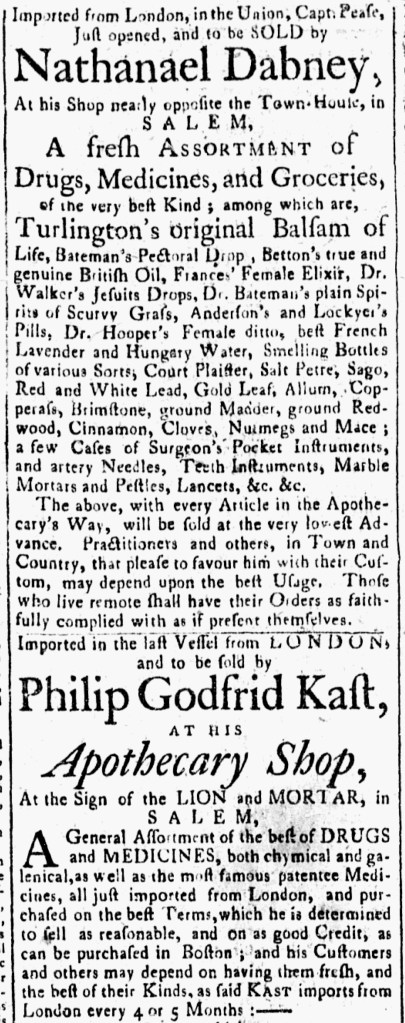
“Those who live remote shall have their Orders as faithfully complied with as if present themselves.”

Apothecaries Nathanael Dabney and Philip Godfrid Kast competed for customers.  Each placed an advertisement in the June 18, 1771, edition of the Essex Gazette, inviting prospective customers to their shops in Salem.  Making the choice between the two apothecaries even more visible to readers, their advertisements appeared one after the other.  Kast, the more experienced advertiser, placed the longer notice.  It extended more than a column, extensively listing the items in stock at the Sign of the Lion and Mortar.  Kast also included blurbs about patent medicines, some of them more familiar to consumers than others, such as “Dr. Hill’s Pectoral Balsam of Honey,” “Dr. Robert James’s Powder for Fevers,” “Dr Stoughton’s great Cordial Elixir for the Stomach,” and “Dr. Scott’s Powder for the Teeth.”  Dabney, on the other hand, provided a shorter list of his inventory, but also promising “every Article in the Apothecary’s Way.”  He aimed to make himself competitive with Kast.

Both apothecaries sought clients in Salem and beyond, inviting readers unable to visit their shops to submit orders.  Dabney and Kast each pledged not to favor customers who visited their shops over those who did not.  “Those who live remote,” Dabney proclaimed, “shall have their Orders as faithfully complied with as if present themselves.”  Kast deployed similar language in a nota bene that concluded his advertisement: “Those who will send their Orders shall be as well used as if present themselves.”  That included both consumers and “Practitioners … in Town and Country.”  The apothecaries described an eighteenth-century version of mail order for “DRUGS and MEDICINES,” an effort to enhance their sales and increase their revenues by offering a convenience to their customers.  Some prospective clients may have found Kast’s advertisement the more alluring of the two.  In addition to a longer list of merchandise, the blurbs about various patent medicines served as suggestions for distant customers unable to consult with the apothecary in person.  Furthermore, Kast trumpeted that he sold his wares “as reasonable, and on as good Credit, as can be purchased in Boston.”  The apothecary no doubt sought to engage every reader, but especially prospective customers outside of Salem who might have been likely to look to Boston, the larger port, for better bargains when resorting to sending orders from a distance.

Dabney and Kast promoted the assortment of medicines they carried and pledged good customer service, but Kast further embellished his marketing efforts by comparing his prices to those in Boston and by providing descriptions of certain patent medicines to help prospective customers make their choices.  For instance, Kast declared that Stoughton’s Cordial “is as necessary for all Seamen or Travellers, and others, to take with them as their daily Food.”  That level of detail required purchasing additional space in the Essex Gazette, but Kast may have determined it was well worth the expense if it drummed up additional business.

June 4

What was advertised in a colonial American newspaper 250 years ago today?

Essex Gazette (June 4, 1771).

An additional Supply of English GOODS.”

Wholesalers and retailers rarely placed multiple advertisements in a single issue of a newspaper prior to the American Revolution, but on occasion some did so.  Such was the case for George Deblois of Salem in the spring of 1771.  He originally published one advertisement in the Essex Gazette in April and then supplemented it with another advertisement in May.  The timing of the advertisements as well as the contents corresponded with the arrival of ships in port.

In an advertisement in the April 23 edition, Deblois “acquaint[ed] his Customers and others” that he stocked “A good Assortment of English Piece Goods” that he “just imported, in the last Ships from LONDON.”  To entice consumers, he enumerated some of the merchandise available at his shop, including textiles, stationery, and hardware.  That advertisement filled two-thirds of a column.  A month later, he placed another advertisement promoting “An additional Supply of English GOODS” and listing dozens of items not mentioned in the first advertisement.  These goods, Deblois explained, arrived “in the Captains Lyde, Hall, and Hood, from LONDON, and in Capt. Gough from BRISTOL.”  Like many other advertisers, he named the captains rather than the vessels that transported the goods.  The merchant also proclaimed that he received “in Captain SMITH from BRISTOL, a large Assortment of HARD WARES.”  Not as lengthy as the first advertisements, this one filled one-third of a column.

Both advertisements ran in the May 21 edition of the Essex Gazette and then appeared in the same issue again on June 4.  In each instance, they accounted for a considerable portion of the content.  Between them, they extended an entire column in a newspaper that consisted of only twelve columns.  For his marketing efforts, Deblois purchased a significant amount of space in the local newspaper.  Running two advertisements simultaneously, though briefly, enhanced the visibility of his enterprise.  Nathaniel Sparhawk, one of Deblois’s competitors, ran an advertisement that extended nearly an entire column, but readers encountered his notice only once when they perused the Essex Gazette.  That Deblois published multiple advertisements, each documenting a variety of items, suggested an even greater array of choices for consumers who visited his shop.

May 28

What was advertised in a colonial American newspaper 250 years ago today?

Essex Gazette (May 28, 1771).

“Any that will favour him with their Custom my depend upon being used as well as they can be at any Store upon the Continent.”

In an advertisement that extended nearly an entire column in the May 28, 1771, edition of the Essex Gazette, Nathaniel Sparhawk, Jr., listed dozens of items available “at his Store next to the Rev. Doctor Whitaker’s Meeting-House.”  Other advertisers also provided lengthy lists of their merchandise, but none of them as long as the description of the “general Assortment of English and India GOODS” that Sparhawk carried.  To further underscore the multitude of choices, he concluded the list with “&c. &c. &c. &c. &c.”  Advertisers frequently inserted the eighteenth-century abbreviation for et cetera once, twice, or even three times to suggest that the amount of space in their advertisements was not sufficient for cataloging all of their wares.  Sparhawk was even more intent on making that point.

He also enhanced his notice with a nota bene directed to wholesalers.  Like many other advertisers, he sold his goods “by Wholesale or Retail.”  Most who did so did not make special overtures to customers who wished to buy in volume.  Sparhawk, on the other hand, advised “all those that deal in the Wholesale Way, that they may be assured that his Goods come from one of the best Houses in LONDON.”  The merchant sought to assure shopkeepers, tailors and milliners who purchased textiles and accessories, and other retailers that he carried goods of the highest quality and most current fashions.  Sparhawk’s customers did not need to fear that their own customers and clients would reject this merchandise.  Furthermore, the merchant aimed to cultivate good relationships with retailers.  He expressed a desire “to sell chiefly by Wholesale,” pledging that “any that will favour him with their Custom my depend upon being used as well as they can be at any Store upon the Continent.”  Sparhawk had many competitors, not only in Salem, but also in nearby Boston.  For the right prices, retailers might have even looked to Portsmouth, New Hampshire, and beyond.  The merchant proclaimed that doing so was not necessary, that he provided service that equaled any in the colonies.  In return for their custom, “their Favours shall ever be gratefully acknowledged.”

Sparhawk deployed several strategies to attract customers, especially those who wished to make wholesale purchases with the intention of retailing those items.  He underscored the extensive choices available among his merchandise, both through a lengthy catalog of goods and a hyperbolic expression of just how many items did not fit in his advertisement.  He also made a point of describing his own supplier as “one of the best Houses in LONDON,” bestowing even greater cachet on his merchandise.  In addition to promoting his goods, Sparhawk also promised superior customer service in his efforts to attract retailers as customers.

May 21

What was advertised in a colonial American newspaper 250 years ago today?

Essex Gazette (May 21, 1771).

“All as cheap as they can be bought in Boston.”

From New Hampshire to Georgia, purveyors of consumer goods frequently made appeals to price in their newspaper advertisements.  They often made general statements, like Francis Grant did in an advertisement in the May 21, 1771, edition of the Essex Gazette.  He described his prices for a “good Assortment of English and West-India GOODS” as “cheap.”  Similarly, John Appleton declared that he sold his merchandise “on the most reasonable Terms.”  John Appleton made a stronger case for his prices, asserting that he sold imported foods “At the very lowest Rates.”  Even so, he deployed rather generic language.

Other advertisers, however, attempted to attract customers by making bolder and more specific promises about their prices.  William Vans advertised a “Beautiful Assortment of Paper Hangings” (or wallpaper) as well as a “great Variety of English, West-India and Grocery GOODS.”  He pledged that he set prices “as cheap as any Store in Town.”  Yet merchants and shopkeepers in Salem did not compete for customers only among themselves but also with their counterparts in nearby Boston.  That being the case, Jonathan Nutting sold “Painters Colours” and window glass “as cheap as they can be bought in Boston.”  Nathaniel Sparhawk stocked all sorts of merchandise, listing dozens of items in his advertisement.  Like Nutting, he proclaimed that he was “determined to sell as low as can be bought in Boston.”  George Deblois expressed a similar sentiment in an advertisement enumerating just as many goods.  He trumpeted that his prices were “as cheap … as can be bought in this town, or any other town in the province.”  Consumers did not need to look to Boston or anywhere else for better bargains than they could find in Salem.

Making an appeal to price became a standard part of newspaper advertisements for consumer goods in the eighteenth century.  Almost every advertisement in the May 21, 1771, edition of the Essex Gazette included some mention of low prices, suggesting that both advertisers and prospective customers expected such appeals incorporated into marketing efforts.  Yet many advertisers did not merely declare low prices by rote.  Instead, they devised more sophisticated appeals, such as comparing their prices to their competitors in town and beyond.  Those merchants and shopkeepers acknowledged that consumers looked for the best deals.  In turn, they promised their customers would find those deals at their shops, stores, and warehouses.

May 15

What was advertised in a colonial American newspaper 250 years ago this week?

Essex Gazette (May 14, 1771).

“[The following was paid for as an Advertisement.]”

Newspaper editors selected which articles and letters to print or reprint in their publications, but that did not exclude others, especially advertisers, from shaping the contents and messages disseminated to readers.  In the era of the American Revolution, for instance, many advertisers enhanced their notices with political commentary, encouraging consumers to graft politics onto their decisions in the marketplace.  Aggrieved husbands regularly published advertisements warning others not to extend credit to wives who had the audacity to resist the patriarchal authority husbands were supposed to exercise in their households.  In the process, husbands gave details about marital discord and the misbehavior of their wives.  On occasion, some of those wives responded with advertisements of their own, painting less than flattering portraits of abusive or negligent husbands.  Other advertisers disputed land titles or pursued personal grudges.  Editors temporarily transferred editorial authority to advertisers who paid for space in their newspapers.

That seems to have been the case concerning a poem that ran in the May 15, 1771, edition of the Essex Gazette.  Many eighteenth-century newspapers featured a poetry corner, often positioned in the upper left corner of the final page, but that was not the case with this poem.  Instead, it appeared at the bottom of the last column on the third page.  Given the production process for a standard four-page issue, that meant that the poem was the last item the compositor inserted into that issue.  Perhaps Samuel Hall, the printer of the Essex Gazette, had second thoughts about including it at all.  An editorial note preceded the poem, suggesting that Hall decided that its appearance in his newspaper required some sort of explanation: “[The following was paid for as an Advertisement.]”  In other words, Hall did not select it for the edification or amusement of his readers.  He might not have even fully understood its purpose or meaning, but a customer paid for the space.  The poem very well may have bewildered Hall and most readers.  A preamble declared, “The folloing lines were Presented to A lat skull mistres in this town by 4 of her skolers the morning after her mareg.”  The misspellings continued throughout the poem, suggesting that the “skull mistres” (school mistress) achieved only partial success with these “skolers” (scholars) who sent tidings following her “mareg” (marriage).  The poem was an inside joke not intended for all readers of the Essex Gazette.

Hall could have refused to publish the poem, exercising his prerogative as editor and proprietor of the Essex Gazette.  He was not obligated to publish anything submitted to the printing office, even if accompanied by payment to appear as an advertisement.  Yet that payment justified temporarily surrendering editorial control to an advertiser.  Indeed, Hall abbreviated an advertisement from Nathaniel Sparhawk, Jr., explaining that “[Want of Room obliges us to defer the Particulars till next Week.]”  Hall could have given Sparhawk the space devoted to the poem, but instead opted to collect payment and insert the poem with a disclaimer.  The four “skolers” then found their ode to their “skull mistres” in the public prints.

May 14

What was advertised in a colonial American newspaper 250 years ago today?

Essex Gazette (May 14, 1771).

“Medals of the Rev. G. Whitefield.”

George Whitefield, one of the most prominent ministers associated with the eighteenth-century religious revivals now known as the Great Awakening, died in Newburyport, Massachusetts, on September 30, 1770.  Newspapers in Boston published the news the following day.  Newspapers in other colonies reprinted those accounts as soon as they came to hand.  Almost as quickly, printers, booksellers, and others inserted advertisements for various commemorative items, including funeral sermons, poems in memory of the minister, and works written by Whitefield.  Once vessels crossing the Atlantic delivered the news to England and returned to the colonies, printers advertised even more Whitefield memorabilia, including his last will and testament and the sermon John Wesley preached in his memory.  As broadsides, pamphlets, and books, the simultaneous commemoration and commodification of Whitefield took place via print.

Yet that commemoration and commodification was not confined to print.  Advertisers also marketed “Medals of the Rev. G. Whitefield.”  Samuel Hall, printer of the Essex Gazette, was the first to do so, inserting a brief notice in the May 14, 1771, edition of his newspaper.  Hall did not elaborate on the medals, stating only that they “may be had at the Printing-Office next Thursday or Friday.”  He did not mention the images or inscriptions that appeared on either side, nor did he specify the artist or place of production.  Artists produced several medals on the occasion of Whitefield’s death, many of them dated to 1770, but Hall did not indicate which medals consumers could purchase at his printing office.  Given his experience marketing other commemorative items, he may not have considered it necessary to provide elaborate descriptions of the medals in newspaper advertisements, especially if those other items met brisk demand among consumers who wished to mourn the famous minister through acquiring goods associated with him.  Many months after Whitefield’s death attracted notice throughout the colonies, new commemorative items continued to hit the market.  One of the most significant news events of 1770 continued to receive attention in the public prints as advertisers hawked a variety of Whitefield memorabilia.

April 23

What was advertised in a colonial American newspaper 250 years ago today?

Essex Gazette (April 23, 1771).

“A few of Mr. Lovell’s ORATIONS on the Massacre in Boston.”

In the spring of 1771 colonial printers advertised a variety of items commemorating the death of George Whitefield the previous fall.  At the same time that John Dunlap in Philadelphia, John Fleeming in Boston, Daniel Fowle and Robert Fowle in New Hampshire, and John Holt in New York advertised Whitefield memorabilia, Samuel Hall informed residents of Salem that he carried an item that commemorated the other major news story of the previous year.  “A few of Mr. Lovell’s ORATIONS on the Massacre in Boston, to be sold by the Printer hereof,” Hall noted in an advertisement in the April 23 edition of the Essex Gazette.

Hall referred to “An Oration Delivered April 2d, 1771. At the Request of the Inhabitants of the Town of Boston; To Commemorate the Bloody Tragedy of the Fifth of March, 1770.”  James Lovell delivered this oration on the occasion of the first anniversary of the Boston Massacre.  As the Massachusetts Historical Society explains, “From 1771 until 1783, when the commemoration of the Massacre was superseded by the celebration of independence on the Fourth of July, a leader of the patriot movement gave an address each year on or near the date of the anniversary.”  On the first anniversary of the Boston Massacre, local leaders determined that “there needed to be a public oration to remember the event.”  Lovell gave the first official oration sanctioned by the town, but, as Samuel A. Forman notes, Thomas Young “delivered a speech … on the same theme a few weeks prior and closer to the first anniversary of the Boston Massacre.”  No copy of Young’s address survives, but Lovell’s oration was “Printed by Edes and Gill, By Order of the Town of Boston.”

Benjamin Edes and John Gill, printers of the Boston-Gazette and vocal supporters of the patriot cause, quickly took Lovell’s oration to press.  They made it available to consumers in Boston and beyond, disseminating copies to fellow printers and booksellers in other towns.  Hall, Edes and Gill, and patriot leaders in Boston all encouraged a culture of commemoration around the Boston Massacre, participating in rituals of remembrance and the commodification of those rituals in order to make a lasting impression well before the skirmishes at Lexington and Concord.  They cultivated reverence for this significant event considered one of the causes of the American Revolution in the years prior to the colonies declaring independence.  Marketing items like Lovell’s “Oration” and prints of the “Bloody Massacre” likely contributed to the cultivation of patriotic sentiment as many colonists shifted their attitudes from resistance to revolution.

**********

The Massachusetts Historical Society provides access to a digitized copy of Lovell’s “Oration.”

April 17

What was advertised in a colonial American newspaper 250 years ago today?

South-Carolina and American General Gazette (April 17, 1771).

“Grand Feast of Historical Entertainment … XENOPHONTICK BANQUET.”

Robert Bell advertised widely when he published an American edition of William Robertson’s History of the Reign of Charles the Fifth in 1771.  Though he printed the three-volume set in Philadelphia, he placed advertisements in newspapers from New England to South Carolina.  In seeking subscribers in advance of publication and buyers after the books went to press, Bell did not rely on the usual means of marketing books to consumers.  Instead, he adopted a more flamboyant style, an approach that became a trademark of his efforts to promote the American book trade in the late eighteenth century.

For instance, Bell announced “the Completion of the grand Feast of Historical Entertainment” with the imminent “Publication of the third Volume of Robertson’s celebrated History of Charles the Fifth” in an advertisement in the April 17, 1771, edition of the South-Carolina and American General Gazette.  He invited “all Gentlemen that possess a sentimental Taste” to participate in “this elegant XENOPONTICK BANQUET” by adding their names to the subscription list.  In continuing the metaphor of the feast, Bell invoked Xenophon of Athens, an historian and philosopher considered one of the greatest writers of the ancient world.  The phrase “XENOPHONTICK BANQUET” appeared in all capitals and a slightly larger font, as did “HISTORY,” the headline intended to draw attention to the advertisement.

Essex Gazette (April 16, 1771).

The previous day, a very similar advertisement ran in the Essex Gazette.  It featured “HISTORY” and “XENOPHONTIC BANQUET” in capital letters and larger font.  Most of the text was identical as well, though local printers adjusted the instructions for acquiring copies of the book.  The version in the South-Carolina and American General Gazette directed subscribers to “any of the Booksellers in Boston, New-York, Philadelphia, or to ROBERT WELLS,” bookseller and printer of the newspaper, “in Charlestown.”  The variant in the Essex Gazette also mentioned “Booksellers in Boston, New-York, [and] Philadelphia,” but also listed local agents in seven other towns, including Samuel Orne in Salem.  Wells also inserted a note that he sold writing paper and trunks in addition to the first and second volumes of Robertson’s History.

Published just a day apart in Charleston, South Carolina, and Salem, Massachusetts, these advertisements with such similar copy and format created a near simultaneous reading experience in towns located hundreds of miles distant.  Reprinting news accounts from one newspaper to another to another had a similar effect, though it took time to disseminate news in that manner.  Bell engineered an advertising campaign without the same time lapse as coverage of the “freshest Advices” among the news accounts.  Among the imagined community of readers and consumers in South Carolina and Massachusetts, the simultaneity of being encouraged to purchase an American edition of Robertson’s famed work was much less imagined than the simultaneity of keeping up with current events by reading the news.