January 8

What was advertised in a colonial American newspaper 250 years ago today?

jan-8-181767-massachusetts-gazette
Massachusetts Gazette (January 8, 1767).

“Books for Children, very proper for Christmas and New Year’s Gifts.”

John Mein made a fairly unique appeal to potential customers when he advertised “A Large Assortment of entertaining and instructive Books for Children, very proper for Christmas and New Year’s Gifts.” The bookseller tied consumerism to the holidays in a way that few other advertisers did in late 1766 and early 1767, which differs significantly from marketing practices in the twentieth and twenty-first centuries. Very few advertisers acknowledged Christmas as a holiday, much less used it to promote purchases from their shops. Recognition of the new year manifested itself in advertising mostly through calls for those who previously bought on credit to settle accounts. Indeed, only a handful of advertisers linked the holidays to making purchases and giving gifts.

As with many other aspects of marketing, members of the book trade seemed to be at the forefront of this innovation. Throughout all of the advertisements placed in newspapers during December 1766 and early January 1767, booksellers alone encouraged customers to think of their wares as gifts for others. In an advertisement in the January 8, 1767, issue of the New-York Journal bookseller Garrat Noel listed “A very large Parcel of Mr. Newberry’s beautiful gilt Picture Books, for the Entertainment of his old Friends the pretty Masters and Misses of New-York, at Christmas and New-York.” The appropriately named Noel was a veteran of promoting holiday gifts, having noted in his advertisements a year earlier that it was “his annual Custom … to offer to the Public, the following List of Books, as proper for Christmas Presents and New-Year’s Gifts.”

John Mein further advanced this innovation, anticipating marketing strategies of the late nineteenth century and beyond. He announced that potential customers could pick up free “Printed Catalogues” listing the books he considered especially suited to be given as gifts. Retailers of all sorts eventually resorted to catalogs, especially Christmas catalogs, to drive sales during a season increasingly associated with consumerism.

In the 1760s, however, the media – both printers and advertisers – took little notice of the Christmas season. On the same day that Mein’s advertisement appeared in Boston and Noel’s in New York, the first page of the Virginia Gazette featured “An ODE upon CHRISTMAS” on the front page. It was dated December 4, 1766, but the printers did not consider it pressing enough to make room for it in their newspaper until five weeks later. The Christmas holiday did not dominate December in the 1760s to the extent it does in modern America.

January 1

What was advertised in a colonial American newspaper 250 years ago today?

jan-1-111767-massachusetts-gazette
Massachusetts Gazette (January 1, 1767.)

“The VERY LOW Price at which he sells will not afford a lengthy Advertisement.”

Joshua Blanchard did not have much patience for the sort of list advertisement that frequently appeared in colonial American newspapers. Retailers commonly made appeals to consumer choice, inserting lengthy lists of merchandise to underscore the extent of the choices they offered prospective customers. Accordingly, such advertisements took up significant space in many newspapers. Blanchard’s advertisement, for instance, appeared to the left of an advertisement placed by competitor Frederick William Geyer, an advertisement that extended most of the column and listed more than one-hundred items. Samuel Eliot inserted a similar advertisement on the previous page. Both retailers used extensive lists of goods to entice potential customers into their shops.

Blanchard took a different approach. Although he stated that he carried “a large and general Assortment of Goods,” he specified very few of them. Instead, in a separate paragraph, headed by a manicule, he proclaimed that “The VERY LOW Price at which he sells will not afford a lengthy Advertisement enumerating every Particular, even to Pins and Needles.” Blanchard considered the advertisements published by his competitors preposterous. He mocked their marketing strategies, but also cleverly dismissed extensive lists of merchandise by claiming that more modest advertising allowed him to offer lower prices to his customers. Eliot and Geyer promised “the very lowest Rates” and “the very lowest Advance,” but Blanchard called those claims into question when he suggested that listing their entire inventory, down to the smallest “Pins and Needles,” incurred significant advertising costs to be passed along to consumers.

Lest potential customers suspect that Blanchard did not provide a list of his merchandise because he could not offer the same array of choices as his competitors, he stressed that “his Friends and the Publick may be assured, that his Assortment consists perhaps of as many Articles, that are as good Goods, and will be sold as cheap for CASH, as at any Shop or Store in TOWN.” He folded together appeals to choice, quality, and price in his argument that a longer advertisement did not necessarily mean more merchandise on hand.

Joshua Blanchard made a virtue out of his shorter, more modest advertisement when he implied that his competitors could not compete with his prices because they purchased significant amounts of advertising space in the local newspapers. He needed to publish an advertisement to make this claim, an advertisement designed to shape the attitudes and actions of potential customers even as it critiqued other marketing practices.

December 25

Who was the subject of an advertisement in a colonial American newspaper 250 years ago today?

dec-25-12251766-massachusetts-gazette
Massachusetts Gazette (December 25, 1766).

“Slaves, as may be absent from their master’s Houses and walking the Streets.”

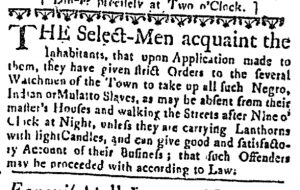
Only one advertisement concerning slaves appeared in the December 25, 1766, issue of the Massachusetts Gazette. Rather than seeking to buy or sell slaves or offering rewards for runaway slaves, it aimed to regulate the activities and movements of “Negro, Indian or Mulatto Slaves” in Boston.

Apparently the selectmen of the town received complaints about slaves “absent from their master’s Houses and walking the streets” in the evenings and into the night. In response, they issued “strict Orders to the Watchmen of the Town” to detain any slaves they encountered on the street “after Nine o’Clock at Night.” The watchmen were permitted to make exceptions, provided slaves made “good and satisfactory Account of their Business.” In order to demonstrate that they were not up to some sort of skullduggery, slaves traversing the streets at that hour needed to carry lanterns with lit candles, making it easier to spot them and preventing them from seeming to sneak from place to place. The advertisement concluded with a threat against masters and slaves: “such Offenders may be proceeded with according to Law.” Advertisements for runaway slaves were intended to regulate the movements of enslaved men and women, to return them to the authority and oversight of their masters. This advertisement, on the other hand, regulated both slaves and masters, instructing slaveholders who had been lax in supervising their slaves to become more vigilant and strict.

**********

As an aside, it might seem especially appropriate today to examine the marketing aspects of an advertisement for consumer goods and services that appeared 250 years ago. After all, Christmas has increasingly become a celebration of consumerism in modern America. Isn’t this advertisement regulating the movement of slaves a missed opportunity considering all of the advertisements more explicitly linked to consumer culture?!

The Christmas holiday, however, did not garner the same attention in colonial America, especially not in New England among the descendants of Puritans. (Observing Christmas had been banned in New England in the seventeenth century.) Colonists certainly did not indulge in rampant exchanges of gifts and all of the buying and selling associated with giving presents. Accordingly, in choosing an advertisement for today I have refrained from hyping consumerism and imagining Christmas celebrations that did not exist in colonial New England. Instead, I have selected an advertisement that reveals one of the more pressing concerns in Boston on December 25, 1766.

November 20

GUEST CURATOR: Patrick Keane

What was advertised in a colonial newspaper 250 years ago today?

nov-20-11201766-massachusetts-gazette
Massachusetts Gazette (November 20, 1766).

“A general Assortment of Goods.”

I chose this advertisement because Bartholomew Kneeland ran a store that sold a wide variety of products that almost everyone during colonial times used. These products were “imported from London” to be sold at his store in Boston. Kneeland did not sell just one category of products; he sold items such as fabrics to make clothing, tea and spices, “Writing Paper,” “English and Poland Starch,” and “many other articles not mentioned.”

Many of these are everyday products were very much needed in colonial America; many continue to be important even today. I noticed a lot of materials that colonists used to make their own clothing and other necessities. According to Virginia Johnson, “Every colonial family except for the very rich had to be able to make their own soap, candles, furniture, cloth, baskets, toys, and musical instrument.” Families in colonial Boston needed the products Kneeland sold. This made me think of today and how most people do not need to make their own clothing and other household items.

**********

ADDITIONAL COMMENTARY: Carl Robert Keyes

When Patrick and I met to review his advertisements together, I asked him to explain why he selected this particular advertisement for his first day as guest curator of the Adverts 250 Project. Of all the possible advertisements he could have chosen, what was it about this advertisement that attracted his attention. Patrick indicated that he noticed this advertisement because of its length and the number of consumer goods listed separately in its two columns. We then had a discussion in which we compared Bartholomew Kneeland’s advertisement to others that appeared in the same issue of the Massachusetts Gazette.

Kneeland’s advertisement appeared at the top of the first column on the second page of that issue. It extended approximately three-quarters of the way down the column. Readers would have noticed it not only because it was the first advertisement in that issue but also because it occupied so much space on the page. Immediately below it, another advertisement announced “West-India Goods” for sale but did not list any specific items. To the right, similar list-style advertisements by Thomas Hickling and Samuel Eliot extended the entire second and third columns, respectively. Other lengthy list-style advertisements appeared on the third and fourth pages of the issue.

Many other advertisements, however, were markedly shorter. Richard Salter and Joshua Blanchard, for instance, each inserted short advertisements that announced goods imported for London available at low prices, but they did not deploy a list of merchandise as an appeal to attract customers to their shop. One advertisement briefly stated, “Nathaniel Appleton, At his Shop in CORNHILL, has just opened: A General Assortment of English and India Goods, which he will sell cheaper than ever for Cash only.”

nov-20-11201766-appleton-massachusetts-gazette
Massachusetts Gazette (November 20, 1766).

Each advertiser attempted to incite demand and encourage potential customers to visit their shops, but they used different strategies. Bartholomew Kneeland and some of his competitors invested in lengthy list-style advertisements to demonstrate the variety of their merchandise and to make it more likely that readers noticed their advertisements. A quarter of a millennium later this method continued to succeed: Kneeland’s advertisement caught Patrick’s attention and prompted him to read through it to see what the shopkeeper offered for sale.

November 9

GUEST CURATOR: Carolyn Crawford

What was advertised in a colonial American newspaper 250 years ago this week?

nov-9-1161766-massachusetts-gazette
Massachusetts Gazette (November 6, 1766).

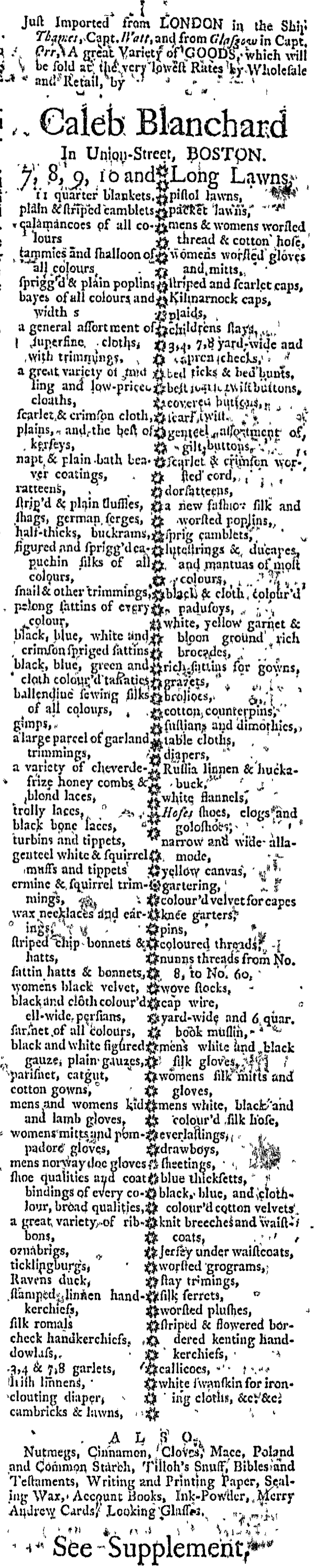
“A great Variety of GOODS … cotton gowns … womens mitts and pompadore gloves.”

When I first glanced at this advertisement, I was overwhelmed by the number of products and clothing accessories that Caleb Blanchard listed and sold to the public in Boston. After I examined this advertisement, I concluded that there was some differentiation between the social classes, especially for the women.

For instance, affluent women could afford to purchase the necessary materials for seamstresses to make clothes. In particular, gowns, designed in cotton or rich satin and silk, were a favorite for elite women. A gown “consisted of the bodice and skirt joined together, with the skirt opened in the front to reveal the separate petticoat, which was an essential part of the dress and not an undergarment.” Elite women presented themselves in clothes that were displayed in various colors and fabrics. Additionally, affluent women presented themselves in the latest fashionable necklaces, earrings, gloves, and satin bonnets and hats.

On the other hand, some colonial women purchased materials that they needed from shopkeepers like Caleb Blanchard in order to make their own clothing themselves. Many of them had to consciously ration out their money. Since the goods were sold “at the very lowest Rates,” colonial women strategically made purchases.

Throughout the colonial era, fashion was represented status. With that being said, individuals were given the opportunity to purchase any products of their choosing. However, finances played an essential role. Some could afford to purchase anything they wanted, while others had to be more selective.

**********

ADDITIONAL COMMENTARY: Carl Robert Keyes

This advertisement attracted Carolyn’s attention thanks to the number of imported goods it listed, divided into two columns within the advertisement. It would have been hard to miss because it comprised the entire third and final column of the second page of the Massachusetts Gazette. Its impressive length, however, lent itself to the graphic design element that drew my eye: the printing ornaments deployed to divide the advertisement into two columns of goods. They were all the more visible because they extended down the entire page.

Dividing a lost of goods within in advertisement into two columns was fairly common in the 1760s. Two other advertisements that appeared in the same issue used this method, one full-column advertisement by Frederick William Geyer on the third page and one shorter advertisement by John Head on the fourth page. Both of the other two advertisements, however, featured a narrow line dividing the two columns of merchandise. Caleb Blanchard’s advertisement was unique in its use of printing ornaments to separate the columns.

I have argued on other occasions that advertisers assumed responsibility for writing copy while printers oversaw layout and other design elements of most newspaper advertisements. On occasion, it appears that advertisers made requests or gave specific directives concerning the appearance of their advertisements. This seems to have been just such a case. While it’s possible that Richard Draper may have played with the design elements within the Massachusetts Gazette, it seems highly unlikely that Edes and Gill would have independently made the same decision when they printed Blanchard’s advertisement in the November 10, 1766, issue of the Boston-Gazette – or that T. and J. Fleet would also use the same printing ornaments to create columns in Blanchard’s advertisement in the November 10, 1766, Supplement to the Boston Evening-Post. (The November 6, 1766, issue of the Massachusetts Gazette also included Jolley Allen’s advertisement with its distinctive border created with printing ornaments.)

Blanchard was a savvy marketer who aimed for maximum exposure by advertising in multiple newspapers, but that was not where his entrepreneurial spirit ended. He adroitly used distinctive graphic design to make sure that readers of those newspapers noticed his advertisements, increasing the chances the chances that they would become customers.

November 8

GUEST CURATOR: Carolyn Crawford

What was advertised in a colonial American newspaper 250 years ago this week?

nov-8-1161766-massachusetts-gazette
Massachusetts Gazette (November 6, 1766).

“Robert Jenkins … has just imported … Fur Trimmings.”

Robert Jenkins carried a variety of materials for making clothing, like various textiles (including satins and silks), leather, and fur. These extravagant products came in various colors, including black, white, and crimson.

Marge Bruchac explains that during the colonial era “fur and leather garments in New England exemplified the intersection of Native American Indian and Euro-American material culture and fashion, in ways that crossed and blurred categories of class, wealth and ethnicity.” Before that, Bruchac continues, fur garments, such as coats and gloves, were primarily worn by affluent individuals in Europe. Fur indicated wealth or an association with nobility. In contrast, Native Americans of North America did not associate their furs with status. Instead, fur was often passed down through the generations and contributed to survival.

By the late eighteenth century, Europeans were actively involved in the fur trade with Native Americans. In the process, Europeans acquired and “adopted Native items like fur hats, leggings, mittens and moccasins, for warmth and comfort.” They were interested in practical attire. Many clothing items were designed from the soft fur of many animals, including muskrat, rabbit, fox, bear, otter and seal. In particular, fur hats became widely popular. They were even worn by runaway servants, such as John Cannon (according to an advertisement in the Pennsylvania Gazette in 1763), and colonial troops.

**********

ADDITIONAL COMMENTARY: Carl Robert Keyes

Despite his pledge to sell imported fabrics “at the very lowest Rates,” Robert Jenkins appeared to cater to customers of some means. The “large and fresh Assortment of Goods, suitable for the Season” that he had just imported from London may have included general merchandise of interest to colonists from diverse backgrounds, but among those goods he mentioned by name in his advertisement he opted to list several items that would have denoted the refinement and wealth of genteel customers.

Depending on how they were incorporated into garments, the “Fur Trimmings” may have been intended for customers of a certain social standing. On the other hand, Carolyn’s examination of how Anglo-Americans used fur in making clothing during the colonial era demonstrates that fur was not exclusively reserved for the better sorts. She points to an interesting case of historical contingency in determining the social value and meanings of certain garments.

Consider how fur garments have been interpreted during various periods of European and American history. In modern times fur garments have often been associated with wealth, power, and, especially, refinement. In modern America, many people reserve their fur coats and other garments for special occasions. Similarly, as Carolyn notes, wearing fur garments was associated with the nobility in medieval Europe. It might be tempting, therefore, to assume that fur clothing has always been an indicator of status. However, that was not the case in colonial America. Instead, many settlers adopted fur garments because they were practical, not to signal their status.

October 30

GUEST CURATOR: Ceara Morse

What was advertised in a colonial American newspaper 250 years ago today?

oct-30-10301766-massachusetts-gazette
Massachusetts Gazette (October 30, 1766).

“Madeira Fish.”

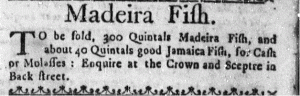
In this advertisement certain types of fish were being sold: “Madeira Fish” and “Jamaica Fish.”

What drove me to pick this advertisement? I was interested in where these fish came from and how they show the vast networks of trade the colonies are involved in. At the time Jamaica was under British rule; however, Madeira was (and continues to be) an archipelago in the eastern Atlantic that belongs to Portugal. I found this quite interesting since before this I had never heard of Madeira and found it intriguing that the island traded with the New England colonies.

T.H. Breen notes that economic growth of colonial America was not just due to the exporting of goods from the colonies but also consumption thanks to the importation of new goods.[1] These fish are prime examples of this. Breen argued that colonists were not as self-sufficient as later historians claimed. They imported food, like “Madeira Fish” and “Jamaica Fish,” to supplement what they produced themselves. This also showed a taste or craving for goods rather than the common fish from the area.

**********

ADDITIONAL COMMENTARY: Carl Robert Keyes

Ceara rightly notes that this relatively plain advertisement reveals transatlantic networks of commerce. Despite the rich fishing grounds of the North Atlantic, colonists imported and consumed fish from Madeira and the Caribbean, diversifying their diets.

Even as this advertisement conjured an imaginative map of trade throughout the Atlantic, it also oriented colonists toward London, the center of the British Empire. The anonymous purveyor of “Madeira Fish” and “Jamaica Fish” gave few directions to the shop where customers could acquire these fish: “Enquire at the Crown and Sceptre in Back street.” This shop sign invoked two symbols of royal authority. The proprietor could have selected from among countless other devices to mark the location of this shop but chose a sign that asserted allegiance to the king and the British nation. Furthermore, the proprietor continued to display this particular shop sign even after the Stamp Act controversy and the Declaratory Act. Three days earlier, William Murray published an advertisement in the supplement to the Boston Evening-Post, an advertisement that listed his location as “at the Sign of General Wolfe.” Murray associated his shop with the English hero killed at the Battle of Quebec during the Seven Years War. Both Murray and the anonymous proprietor at the “Crown and Sceptre” promoted British identity as integral to their own commercial identities. They also expected this would resonate with potential customers. Elsewhere in the same issue of the Massachusetts Gazette, however, John Gore, Jr., stated that he sold goods imported from London “Opposite LIBERTY-TREE, BOSTON.”

These advertisements reveal a tension that began to emerge in advertisements and elsewhere during the 1760s as colonists contemplated how to organize the spatial geography of urban ports in light of their evolving relationship with Britain. Many continued to put great stock in their British identity and membership in the empire, despite new regulations passed by Parliament, but others used new symbols to define their businesses and their relationship to England.

**********

[1] T.H. Breen, “An Empire of Goods: The Anglicization of Colonial America, 1690-1776,” Journal of British Studies 25, no. 4 (October 1986): 478-485.

October 23

GUEST CURATOR: Megan Watts

What was advertised in a colonial American newspaper 250 years ago today?

oct-23-10231766-massachusetts-gazette
Massachusetts Gazette (October 23, 1766).

“West-India rum, Muscovado Sugars by the Hogshead, Spices of all sorts.”

One thing that has not changed in advertisements for hundreds of years is the purpose of gaining the attention of consumers. This advertisement for the Broker’s Store at the “Corner of Kilby-Street” strove to catch readers’ eyes with the myriad items listed, a tactic used by colonial advertisers. The long account of available items was supposed to intrigue readers and make them curious about the sundry different goods. There was something at the Broker’s Store for everyone. The items included varied from “Lisbon Wines” to “Carolina Sole-Leather” to “best refined Iron.”

Another element of this advertisement that would have warranted attention in 1766 was the incorporation of goods imported from faraway places, not just other North American colonies or England. The advertisement mentioned “a small Invoice of English Goods” as well as “West-India Rum.”

These products were noted because there was a demand for them in the colonies and that would have motivated some consumers to visit the store. These few lines are important because they speak to the demand and the availability of imported goods. The inclusion of these goods demonstrates that the North American colonies were not isolated from the motherland or other British colonies (like the West Indies); they were, in fact, engaged in political, social, and, especially, commercial exchanges within and beyond the British Empire.

T.H Breen, when analyzing the effects of peddlers in eighteenth-century America, recognizes the large network which was the colonial economy. Breen specifically comments on the extensive trade relations, in a section describing the activities of an unlicensed peddler who was prosecuted for selling goods in Maine in 1721. “This unfortunate peddler brought the settlers into contact with a vast market economy that linked them to the merchants of Boston and London, to the manufacturers of England, to the exploding Atlantic economy.”[1]

**********

ADDITIONAL COMMENTARY: Carl Robert Keyes

In his monumental study of the merchant community in Philadelphia during the decades on either side of the American Revolution, Thomas M. Doerflinger made a distinction between those that specialized in the dry goods trade and their counterparts who specialized in the provisions trade. The inventory at the “BROKER’S STORE” in Boston suggests that it operated primarily as part of the provisions trade. The items that received first billing and constituted the bulk of the advertisement included “Lisbon Wines,” “Florence Oil,” “Hyson and Bohea Teas,” and a variety of other imported spices and grocery items. A limited number of dry goods appeared near the end of the advertisement: “Men’s ready-made Camblet Cloaks lin’d with Baize” and “a small Invoice of English Goods.”

The proprietors of the “BROKER’S STORE” facilitated the distribution of these goods to colonial retailers and, ultimately, consumers. Doerflinger notes that “certain firms specialized in the collection and distribution of groceries imported by other firms from overseas.” They sometimes handled dry goods, but never extensively. The name of the establishment, the “BROKER’S STORE,” suggests that was the case for this advertisement. By breaking up large shipments into smaller lots, the merchants who operated the store provided a clearinghouse for others to move their goods off of incoming ships, through the busy port of Boston, and on to retailers and consumers. Doerflinger asserts that merchants from Philadelphia who pursued such ventures did not become “long-term specialists in this activity, but instead used it as a relatively low-risk entry into the mercantile world.”[2] They then invested their profits into other activities likely to generate even more significant returns.

Many eighteenth-century advertisements invited readers to visit shops that would cater to them as potential customers. Advertisements like this one, however, focused instead on moving inventory through warehouses, leaving it to the retailers who purchased these goods to nurture relationships with consumers.

**********

[1] T.H. Breen, “An Empire of Goods: The Anglicization of Colonial America, 1690-1776,” Journal of British Studies 25, no. 4 (October 1986): 468.

[2] Thomas F. Doerflinger, A Vigorous Spirit of Enterprise: Merchants and Economic Development in Revolutionary Philadelphia (Chapel Hill: University of North Carolina Press for the Omohundro Institute of Early American History and Culture, 1986). See Chapter 2. Both quotations appear on 125.

October 6

GUEST CURATOR: Elizabeth Curley

What was advertised in a colonial American newspaper 250 years ago today?

oct-6-1061766-boston-evening-post
Boston Evening-Post (October 6, 1766).

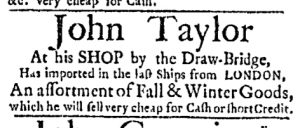
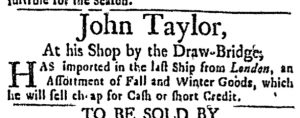
“John Taylor At his SHOP by the Draw-Bridge.”

I originally picked this advertisement from the Boston Evening-Post because John Taylor’s shop was in close proximity to a drawbridge that I researched for an entry last semester. Then this particular advertisement became more interesting when I found it in a second newspaper, the Boston-Gazette, printed on the same day by a rival publisher. As I did more research on the people and places in Boston, I learned about the printers of the Boston Evening-Post and the Boston-Gazette.

oct-6-1061766-boston-gazette
Boston-Gazette (October 6, 1766).

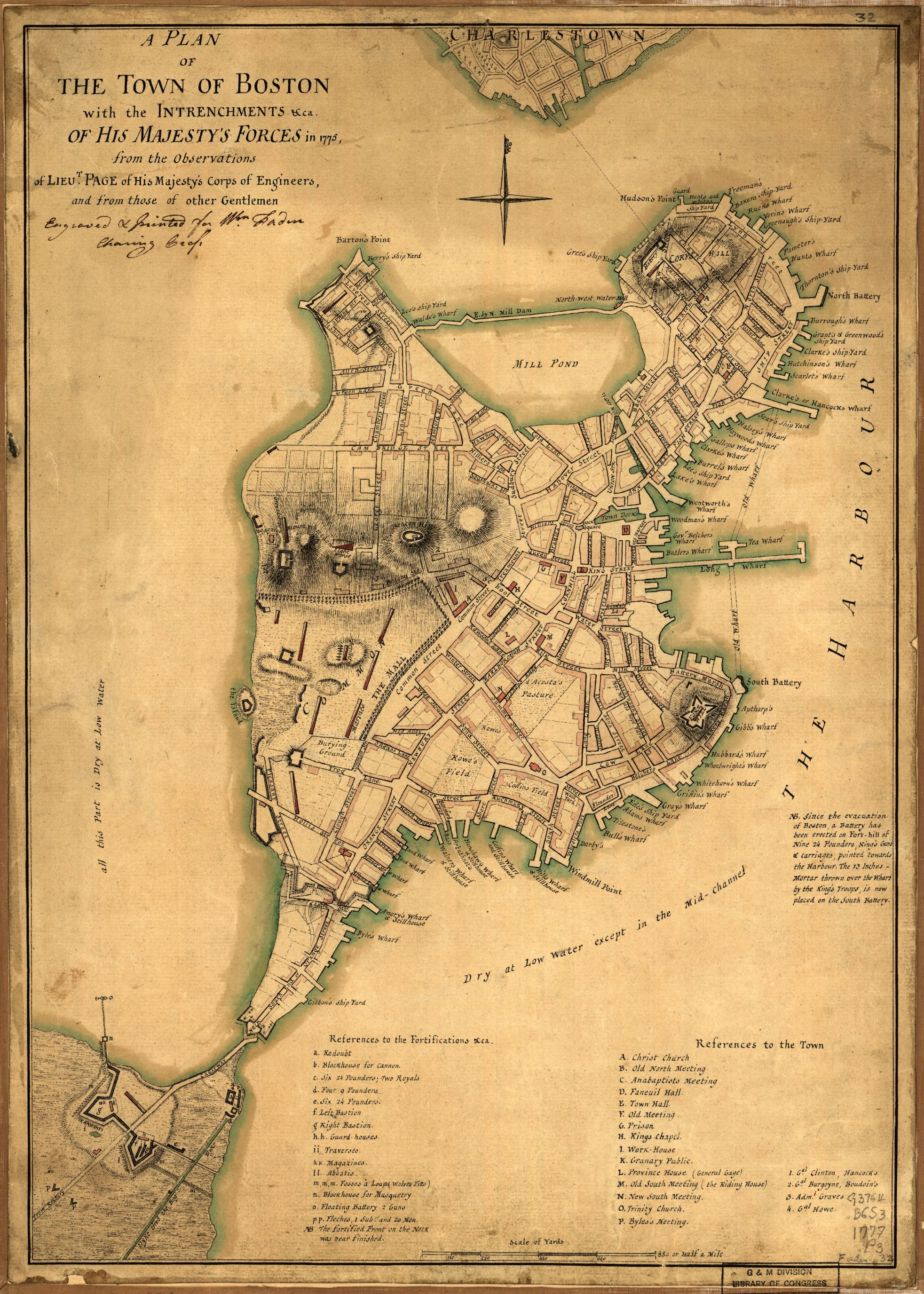
Printers have an interesting role in early American history, especially in colonial Boston. They were the ones who provided various types of entertainment and, more importantly, news and communication to the populace. Printers T. and J. Fleet at the Heart and Crown printed many items other than newspapers. They operated their shop on Cornhill Street, which was laid out in 1708 and ran from Water Street to Dock Square. (In 1789 it was renamed Washington Street.) Even from its earliest days Cornhill Street was full of intellectuals and publishers and printers. The Fleet family lived on Cornhill and ran their print shop beneath their residence.

oct-6-detail-of-map-of-boston
Detail of A Plan of the Town of Boston.
oct-6-map-of-boston
A Plan of the Town of Boston with the Intrenchments &ca. of His Majesty’s Forces in 1775, from the Observations of Lieut. Page of His Majesty’s Corps of Engineers, and from Those of Other Gentlemen (1777?). Library of Congress.

Thomas and John Fleet were prominent printers during the 1760s. In addition to newspapers, they sold broadsides and other important printed items that spread news and information. According to the Massachusetts Historical Society, their father started the newspaper that became the Boston Evening-Post, which they continued to print until 1776.

Benjamin Edes and John Gill printed the Boston-Gazette. These partners would over time get themselves in trouble with British authorities because of what they printed.  J. L. Bell has written about many examples of the printers of the Boston-Gazette closely walking the line of legal and illegal; for an example, see “Henry Bass Spills the Beans on a Political Protest.” Edes and Gill had a large circulation and may have been the Boston Evening-Post’s biggest competition. One reason that they may have had such a large circulation and got in to trouble often was Benjamin Edes was a member of the Loyal Nine, which was a secret group of patriots, nine “young business men” who planned a protest of the Stamp Act in 1765.

**********

ADDITIONAL COMMENTARY: Carl Robert Keyes

Elizabeth brings a sense of excitement to the research she does for the Adverts 250 Project. I’m continuously impressed with the primary and secondary sources she consults and incorporates into her analysis of the advertisements she has selected. As we work through revising and refining her first drafts, often we determine that some material should be eliminated in the interest of producing a concise entry that addresses one major theme. I know from experience how difficult and disappointing it can be to jettison portions of my own research and writing when certain parts of it just don’t work out. Unfortunately, that’s one of the hard lessons that Elizabeth and the other guest curators learn as we work collaboratively through the writing, revision, and publication process.

I appreciate the way that Elizabeth has used today’s advertisement as a jumping off point for examining the printers who produced newspapers and the advertisements they contained. However, she contemplated an alternate analysis of John Taylor’s advertisement that appeared in the October 6, 1766, issue of the Boston Evening-Post. Elizabeth located the same advertisement in the Boston-Gazette, prompting her to think about how “marketing and exposure were key to drawing in consumers, even in colonial America.” This is the third week that Elizabeth has been a guest curator for the Adverts 250 Project. With that statement from her first draft, she demonstrated that she really understands some of the questions that I find most interesting about the ongoing project.

Since this is a collaborative effort, I picked up Elizabeth’s research by consulting the other two newspapers printed in Boston in 1766. John Taylor’s advertisement also appeared later in the week in the October 9, 1766, issue of the Massachusetts Gazette, furthering strengthening Elizabeth’s suspicion that Taylor was being savvy by marketing his wares in multiple newspapers, increasing his shop’s exposure to as many readers as possible. The October 6, 1766, issue of the Boston Post-Boy did not carry Taylor’s advertisement. That does not mean that he did not attempt to place it in that publication. News items and other advertisements may have squeezed out Taylor’s advertisement in that particular issue.

oct-6-1091766-massachusetts-gazette
Massachusetts Gazette (October 9, 1766).

At the very least, Elizabeth and I have identified three newspapers that carried Taylor’s advertisement 250 years ago this week, demonstrating that the shopkeeper did calculate the benefits of increased exposure from multiple publications. As we saw in June, Jolley Allen pursued a similar strategy, placing the same advertisement in all four newspapers printed in Boston. Were these two advertisers outliers? Answering that question will require a lot more roll-up-the-sleeves research.

October 2

GUEST CURATOR: Elizabeth Curley

What was advertised in a colonial American newspaper 250 years ago today?

oct-2-1021766-massachusetts-gazette
Massachusetts Gazette (October 2, 1766).

“Just Published … The Examination of Doctor BENJAMIN FRANKLIN, before an AUGUST ASSEMBLY.”

In the eighteenth century and today, most people agree that Benjamin Franklin significantly influenced colonial American politics and commerce. Some count him as an honored founding father, but if you ask my seven-year-old nephew he’ll declare that Franklin was his favorite president (despite my repeated attempts to tell him that, no, Mr. (or Dr.) Franklin was in fact not a president). Franklin made many contributions to early America history and life.

One of his most significant contributions was his delegation to England on behalf of Pennsylvania and other colonies. On February 13, 1766, he testified before Parliament about repealing the Stamp Act. On March 18, 1766, Parliament did in fact repeal the Stamp Act, although on that same day they voted in the Declaratory Act. News of the repeal reached the colonies around six weeks later, around the start of May.

As I was reading this advertisement I wondered, “Why would this be an August Assembly?” I found myself needing to know more, and went to J.L. Bell’s blog, Boston 1775. There I learned that Parliament’s proceedings were very secretive. Actions that Parliament took were made public, but the debates and arguments were private. Speaking about conversations held within either of the two houses was considered a breach of privilege and punishable by both houses.

To protect Franklin, his previous printing partner (and now owner of the Pennsylvania Gazette), David Hall changed the story. By saying that Franklin simply had spoken at an “August Assembly,” Franklin and Hall were attempting to get around the legality of publishing Franklin’s “Examination,” which discussed the flow of the questions and testimony and even recalled some speakers in Parliament by name. Publishing the testimony was a big deal, not only because many times colonists heard news months later, but also because this kept them better informed about Parliament, which met very far away from them.

**********

ADDITIONAL COMMENTARY: Carl Robert Keyes

Elizabeth introduces the curious history of “The Examination of Doctor BENJAMIN FRANKLIN, before an AUGUST ASSEMBLY, relating to the Repeal of the Stamp-Act.” The colonists were certainly hungry for information, which meant that advertisements for this pamphlet did not have to offer much in the way of marketing other than announcing that it was “Just Published … And Sold” by local printers and booksellers.

Indeed, members of the book trades in multiple cities produced, distributed, and sold pamphlets about Franklin’s testimony before “an AUGUST ASSEMBLY.” The American Antiquarian Society’s catalog indicates that at least five editions were printed in British mainland North America in 1766. As Elizabeth indicates, the original edition came off the presses of Hall and Sellers in Philadelphia, but that did not prevent other printers from producing their own editions. In each instance, politics and profit overlapped as printers and booksellers simultaneously sought to keep colonists informed about what was taking place in Parliament and generate revenues for themselves in the process.

Still, even with the subterfuge involved in allusions to “an AUGUST ASSEMBLY,” printers took on some risk when they decided to reprint their own copies of this pamphlet. The edition printed in New York did not list a printer, though bibliographers have associated James Parker with this imprint. An edition from New England listed neither printer nor city, but book historians believe Edes and Gill, printers of the Boston-Gazette, produced it. The title page of an edition from Virginia stated that it had been “Printed and sold by William Rind, opposite the Capitol” in Williamsburg. Back in Philadelphia, Heinrich Miller printed a German translation, which should come as little surprise considering the large population of German settlers in Pennsylvania. Timothy Green did not bother with printing another separate edition in Connecticut; instead, he reprinted the pamphlet in the New-London Gazette, beginning with the October 10, 1766, issue. In addition to being a treat for his readers and keeping them better informed, this stunt may have attracted new subscribers.

Today’s advertisement suggests that politics and a desire to keep colonists informed of Parliament’s machinations sometimes trumped competition among colonial printers. Note that the pamphlet was sold by “T. and J. Fleet, at the Heart & Crown in Cornhill,” yet the advertisement appeared in a newspaper “PUBLISHED by RICHARD DRAPERS, Printer to the Governor and Council, and by SAMUEL DRAPER, At their Printing Office in Newbury-Street.” In other words, the printers of Boston Evening-Post stocked and sold a pamphlet most likely produced by the printers of the Boston-Gazette and placed advertisements for it in the Massachusetts Gazette. This suggests cooperation and coordination rather than competition among the printers in Boston, all of whom faced a challenge to their livelihoods when the Stamp Act was in force.