What was advertised in a revolutionary American newspaper 250 years ago today?
New-York Journal (March 7, 1776).
“THE NEW EDITION OF COMMON SENSE.”
“LARGE ADDITIONS TO COMMON SENSE.”
The March 7, 1776, edition of the New-York Journal included competing advertisements for Thomas Paine’s Common Sense and “LARGE ADDITIONS TO COMMON SENSE.” Although John Anderson, the printer of the Constitutional Gazette, recently published a New York edition of Paine’s pamphlet, neither of these advertisements promoted pamphlets printed in that city. Instead, both advertisements hawked pamphlets printed in Philadelphia and sent to New York.
New-York Journal (March 7, 1776).
Garrat Noel and Ebenezer Hazard stocked the “NEW EDITION OF COMMON SENSE; With Additions and Improvements in the Body of the WORK” published by William Bradford and Thomas Bradford, printers of the Pennsylvania Journal. When Paine and Robert Bell, the publisher of the first edition of Common Sense, had a falling out, the author collaborated with the Bradfords on a “NEW EDITION” that featured new material, including “AN APPENDIX, And an ADDRESS to the People, called, QUAKERS.” As the Bradfords prepared that edition for press, Bell published an unauthorized second edition and then supplemented it with yet another pamphlet of “LARGE ADDITIONS” that included “The American Patriot’s Prayer” and “American Independency defended, by Candidus.” In their advertisements, the Bradfords warned that the pamphlet “consists of pieces taken out of News-Papers, and NOT written by the AUTHOR of Common Sense.” To spite Paine and the Bradfords, Bell then pirated “An Appendix to Common Sense; together with an Address to the People called Quakers, on their Testimony concerning Kings and Government, and the present Commotions in America” and packaged it with the “LARGE ADDITIONS.”
The advertisements in the New-York Journal reveal that Noel and Hazard stocked the Bradfords’ edition of Common Sense at the Constitutional Post Office and that William Green, a bookseller and bookbinder in Maiden Lane, carried Bell’s “LARGE ADDITIONS.” Noel and Hazard’s advertisement included the warning about items from newspapers passed off as Paine’s work. Green previously placed the first advertisement for Common Sense that appeared in any newspaper beyond Philadelphia, identifying himself as Bell’s local agent for distributing the pamphlet. That he now advertised the “LARGE ADDITIONS” demonstrated that Bell continued supplying him with pamphlets to peddle in New York. Even as printers in New York and other towns produced local editions of Common Sense, printers in Philadelphia tried to expand their share of the market for the popular pamphlet by sending copies to local agents to advertise and sell.
What was advertised in a revolutionary American newspaper 250 years ago today?
Norwich Packet (February 26, 1776).
“A few Copies of a Pamphlet ENTITLED, Common Sense.”
As February 1776 came to a close, more printers and booksellers made copies of Thomas Paine’s Common Sense available to local readers. Two advertisements for the popular political pamphlet appeared in the February 26 edition of the Norwich Packet. In one, the very first advertisement that appeared in that issue, Alexander Robertson, James Robertson, and John Trumbull announced that “A few Copies of a Pamphlet ENTITLED, Common Sense; ADDRESSED TO THE INHABITANTS OF NORTH AMERICA, May be had of the Printers hereof.” They did not provide any other details. In contract, Nathaniel Patten, a bookbinder and stationer, inserted a notice that resembled many others that appeared in newspapers in other towns, including the advertisements for the first edition published by Robert Bell in Philadelphia. It gave the title, previewed the contents with a list of the section headings, and concluded with an epigraph from “Liberty,” a poem by James Thomson.
Norwich Packet (February 26, 1776).
Which editions of Common Sense did the printers and Patten sell? Three days earlier, Timothy Green, the printer of the Connecticut Gazette in New London, announced the imminent publication of a local edition jointly undertaken with Judah P. Spooner in Norwich. Curiously, Spooner did not place his own advertisement in the Norwich Packet. The “few Copies” that the Robertsons and Trumbull stocked may have been sent to them by the industrious Bell who had previously supplied William Green, a bookbinder in New York, with copies of the first edition and an unauthorized second edition. The printers could have also received copies of a New York edition published by John Anderson, the printer of the Constitutional Gazette, or a Providence edition, published by John Carter, the printer of the Providence Gazette, that went to press even more recently. By the time the Robertsons and Trumbull ran their advertisement, the paths of circulation for the various editions crisscrossed each other. Similarly, Patten could have sold any of those editions. His advertisement declared, “Just published and sold by Nathaneil Patten,” yet eighteenth-century readers knew to separate the phrases “Just published” and “sold by.” The latter referred to Patten, but not necessarily the former. Instead, “Just published” meant “Now available.” Patten very well have promoted the local edition produced by Spooner. According to Richard Gimbel, Spooner and Green produced the only editions of Common Sense published in Norwich in 1776.[1] Whatever the origins of the copies advertised in the Norwich Packet, the printers and Patten participated in the widespread dissemination of the most influential political pamphlet published during the era of the American Revolution.
**********
[1] Richard Gimbel, Thomas Paine: A Bibliographical Check List of Common Sense with an Account of Its Publication (New Haven: Yale University Press, 1956), 90.
What was advertised in a revolutionary American newspaper 250 years ago this week?
Pennsylvania Evening Post (February 22, 1775).
“Self-defence against unjust attacks needs no apology.”
It was the final volley in the battle over competing editions of Thomas Paine’s Common Sense that took place in newspapers advertisements in Philadelphia over a course of a month in late January and most of February 1776. The author and Robert Bell, the publisher of the first edition, had a parting of the ways over Bell’s bookkeeping for the first edition. Paine claimed that he wished to donate his share of the proceeds to purchase mittens for American soldiers participating in the invasion of Canada, but Bell somehow had not turned a profit. That prompted Paine to work with William Bradford and Thomas Bradford, the printers of the Pennsylvania Journal, on an expanded edition. Bell published an unauthorized second edition. Paine, who remained anonymous at that point, and Bell attacked each other in newspaper advertisements. The author walked away, but Bell continued and the Bradfords joined the fray. When Aitken learned that the Bradfords’ edition would feature new material, he published his own “ADDITIONS to Common Sense.” The Bradfords warned that Bell’s new pamphlet “consists of Pieces taken out of News Papers, and not written by the Author of COMMON SENSE.” Several newspapers carried some of these advertisements; the Pennsylvania Evening Post carried all of them. Printed three times a week instead of just once (in contrast to the other newspapers published in Philadelphia at t the time), the Pennsylvania Evening Post allowed the feuding printers to publish speedy responses to the latest accusations leveled against them.
Bell inserted the last of those responses in the February 22 edition of the Pennsylvania Evening Post and the February 26 edition of Dunlap’s Pennsylvania Packet. In Thomas Paine: A Bibliographical Check List of Common Sense with an Account of Its Publication, Richard Gimbel notes that Bell “thought so much of this address that he had it separately printed as a two-page leaflet and added it, as an integral part, to his ‘complete’ edition of Common Sense.”[1] In this advertisement, Bell presented himself as a performing his civic dry as a “Bookseller, to the Public.” He entitled this new address, “Self-defence against unjust attacks needs no apology.” He then disparaged Paine, the “envious Mr. ANONYMOUS,” for wanting to have all the attention for writing Common Sense when other authors, “worthy and respectables citizens of Philadelphia,” also penned “excellent pieces.” Furthermore, “in the opinion of some gentlemen, who are good judges of literary merit,” those essays were “worthy of preservation, in such manner as to bind with other pamphlets in an octavo volume.” Why should readers limit themselves to Common Sense alone when they considered current events when they could instead consult an entire compendium of essays that supported the American cause? Paine, his intermediaries who negotiated with Bell, and the printers who worked with him attempted to “insinuate,” according to Bell, that there is no WRITERS in America but the would-be-author of Common Sense.” Yet Paine had been influenced by others, so any acclaim he received amounted to nothing more than “stolen applause.” In addition, the publisher framed the production and, especially, the dissemination of Common Sense as his work. After all, Paine did not attach his name to the pamphlet and most printers initially did not want to be associated with such a revolutionary tract, but Bell “printed his name on the title of the flaming production, to sound the depths of the multitude for a virtuous and glorious independency.” “Mr. ANONYMOUS” wrote the pamphlet, but it was Bell who deserved credit for presenting it to the world. He concluded by proclaiming that he “continueth to sell to all who are capable of making proper distinctions, the large edition of Common Sense with ALL the additions and improvements.” That volume included “the appendix, and address to the Quakers COMPLETE,” pieces written by Bell for the Bradfords’ expanded edition and pirated by Bell. Gimbel contends that this “acrimonious quarrel” in newspaper advertisements “doubtless helped to make Paine’s Common Sense the most discussed and most widely circulated pamphlet in America.”[2] Then, as now, everyone loved a controversy. The dispute gave readers all the more reason to check out the pamphlet.
**********
[1] Richard Gimbel, Thomas Paine: A Bibliographical Check List of Common Sense with an Account of Its Publication (New Haven: Yale University Press, 1956), 47.
[2] Gimbel, Thomas Paine: A Bibliographical Check List of Common Sense, 49.
What was advertised in a revolutionary American newspaper 250 years ago today?
Connecticut Gazette (February 23, 1776).
“Sold by the Printer hereof … COMMON SENSE.”
On February 23, 1776, Timothy Green, the printer of the Connecticut Gazette, announced the publication of yet another local edition of Thomas Paine’s Common Sense. He joined other printers in publishing, advertising, and disseminating the incendiary political pamphlet far beyond Philadelphia, where Robert Bell published and advertised the first edition on January 9. Since then, Bell produced an unauthorized second edition and Paine worked with William Bradford and Thomas Bradford, the printers of the Pennsylvania Journal, on an expanded new edition (and they engaged in a public argument about the competing editions in the Pennsylvania Evening Post and other newspapers published in Philadelphia). The Bradfords also informed readers that a German edition was in the works. In addition, they indicated that they would fill an order from Virginia for one thousand copies. It did not take long for William Green, a bookseller and bookbinder in New York, to advertise copies of Bell’s first and second editions. John Anderson, the printer of the Constitutional Gazette in New York, soon marketed the first local edition published beyond Philadelphia. By the middle of February, John Carter, the printer of the Providence Gazette, advised readers that his local edition would hit the market within a week.
That edition went on sale at the same time that Green released a local edition in New London. According to the advertisement, Judah P. Spooner, his brother-in-law and former apprentice who operated a printing office in Norwich, sold the pamphlet there as well. The imprint on the title page suggested that Green and Spooner collaborated as publishers, but Spooner did the printing: “Philadelphia: Printed. Norwich: Re-printed and sold by Judah P. Spooner, and by T. Green, in New-London.” Green gave their advertisement a privileged place in the Connecticut Gazette, placing it immediately after updates from Hartford. That made it difficult for readers to miss. He did not, however, include elements that often appeared in advertisements for other editions in other newspapers, such as the list of section headers that outlined the contents or the epigraph from “Liberty,” a poem by James Thomson. Lack of space may have prevented Green from publishing a more elaborate advertisement, though he may have considered the buzz around Common Sense sufficient to sell it once prospective customers knew where to purchase a local edition.
What was advertised in a revolutionary American newspaper 250 years ago today?
Pennsylvania Evening Post (February 20, 1776).
“Pieces taken out of News papers, and not written by the Author of COMMON SENSE.”
The final page of the Pennsylvania Evening Post was once again ground zero for the dispute between Robert Bell, the publisher of the first edition of Thomas Paine’s Common Sense and subsequent unauthorized editions, and William Bradford and Thomas Bradford, the printers of the Pennsylvania Journal entrusted by Paine to publish a “NEW EDITION … With ADDITIONS and IMPROVEMENTS in the BODY of the WORK.” Paine previously participated in the dispute, but he seemingly withdrew in favor of letting the printers duke it out in the public prints.
The Bradfords’ expanded edition had been in the press for a few weeks, but on February 14, 1776, they announced in their own newspaper that “THIS DAY WILL BE PUBLISHED AND SOLD … THE NEW EDITION OF COMMON SENSE.” The following day, they ran a new advertisement in the Pennsylvania Evening Post and then updated it on February 20. To make that edition more appealing than any of the editions published by Bell, the Bradfords proclaimed, “The Additions which are here given, amount to upwards of one Third of any former Edition.” They also acknowledged that Bell had been advertising “ADDITION to COMMON SENSE,” but they alerted readers that Bell was trying to pull a fast one. The “ADDITIONS” that Bell marketed “consist of Pieces taken out of News Papers, and not written by the Author of COMMON SENSE.” Paine had worked exclusively with the Bradfords on the “ADDITIONS and IMPROVEMENTS.” The Bradfords also listed several booksellers who stocked their new edition. Benjamin Towne, the printer of the Pennsylvania Evening Post, was not among them, but he certainly generated revenue from publishing the advertisements that the Bradfords and Bell submitted to his printing office.
Right next to the Bradfords’ advertisement, as had been the case on other occasions, appeared Bell’s advertisement for “Large ADDITIONS to COMMON SENSE.” Those “ADDITIONS” included “the following interesting subjects,” “American Independency defended by Candidus,” and “The Propriety of Independancy, by Demophilus,” and “Observations on Lord North’s Conciliatory Plan, by Sincerus.” This version of the advertisement added “The American Patriot’s Prayer,” left out of Bell’s previous notice, to entice prospective customers. Bell also pirated “AN APPENDIX TO COMMON SENSE, together with an ADDRESS to the people called QUAKERS, on their Testimony concerning Kings and Government.” Like the Bradfords, he charged “one shilling ONLY” and made “allowance to those who buy quantities.” In other words, the printers of Common Sense and related materials offered discounts to retailers who purchased in volume to sell the pamphlet in their own shops and others who bought multiple copies to distribute to friends, relatives, and associates. The contents of Paine’s political pamphlet made it popular, yet the advertisements in the Pennsylvania Evening Post and other newspapers also helped raise awareness of Common Sense.
What was advertised in a revolutionary American newspaper 250 years ago this week?
New-York Journal (February 15, 1776).
“A NEW and CORRECT EDITION … of that justly esteemed PAMPHLET, called COMMON SENSE.”
A month after Robert Bell published the first edition of Thomas Paine’s Common Sense in Philadelphia on January 9, 1776, readers of the New-York Journal certainly knew about the pamphlet, even if they had not read it or heard much about its contents. Just reading the newspaper would have been enough to get a sense of the pamphlet’s popularity. After all, the February 15 edition of the New-York Journal carried four advertisements for Common Sense!
Some of them would have looked familiar to regular readers of that newspaper. William Green, a bookbinder in Maiden Lane and Bell’s agent in New York, once again advertised the unauthorized “Second Edition of COMMON SENSE” that Bell published in Philadelphia. It was the third consecutive week his notice ran in the New-York Journal. Also appearing for the third time, another advertisement informed readers that William Bradford and Thomas Bradford would soon publish a “NEW EDITION, (with LARGE and INTERESTING ADDITIONS …) OF COMMON SENSE,” an edition undertaken “by appointment of the Author.” After a falling out with Bell, Paine approached the printers of the Pennsylvania Journal to publish a new edition. The Bradfords set about advertising that expanded edition in both Philadelphia and New York.
A variation of one of the other advertisements ran in the previous issue of the New-York Journal. In it, John Anderson, the printer of the Constitutional Gazette, announced publication of a local edition of “that justly esteemed PAMPHLET, called COMMON SENSE.” The previous version ended with the title of the pamphlet. The new one included two elements often included in other advertisements for Common Sense: the section headings that outlined the contents and an epigraph from “Liberty,” a poem by James Thomson. The addition material in Anderson’s advertisement may have helped draw attention to it …
… but the final advertisement dwarfed all the others. For the first time, Bell advertised directly in the New-York Journal rather than indirectly through Green. In doing so, he transferred to New York the feud that he and Paine had waged in advertisements in the Pennsylvania Evening Post and other newspapers published in Philadelphia. Compared to the Bradfords’ new edition “In the PRESS, and will be published as soon as possible,” Bell’s unauthorized second edition was “Out of the Press” and on sale. His notice included the section headers and epigraph by Thomson as well as an address “To the PUBLIC” that first appeared in the Pennsylvania Evening Post on January 27 and an even longer diatribe “To Mr. ANONYMOUS” that first appeared in the Pennsylvania Evening Post on February 1. While the Bradfords’ advertisement hinted at discord between Bell and Paine, this advertisement put the argument on full display for readers in New York. Perhaps that helped generate interest in the pamphlet. For readers who had not yet perused Common Sense themselves, those four advertisements may have encouraged them to acquire a copy to find out more about all the hullabaloo.
What was advertised in a revolutionary American newspaper 250 years ago today?
Providence Gazette (February 17, 1776).
“This Pamphlet is in such very great Demand, that … three Editions of it have been printed in Philadelphia.”
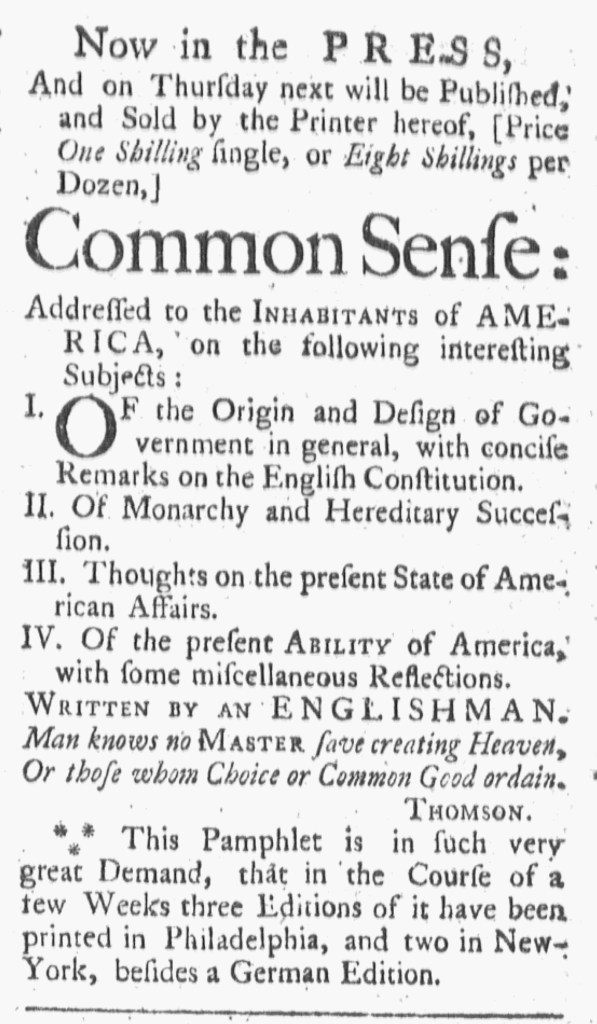
On February 17, 1776, John Carter, the printer of the Providence Gazette, became the first printer in New England to announce plans to publish a local edition of Thomas Paine’s Common Sense. “Now in the PRESS,” he proclaimed, “And on Thursday next will be Published … Common Sense: Addressed to the INHABITANTS of AMERICA, on the following interesting Subjects.” Carter then listed the titles of the sections of the political pamphlet, replicating many of the advertisements that previously ran in newspapers published in Philadelphia and New York. He even included the epigraph from “Liberty,” a poem by James Thomson, that appeared on the first page of the first edition published by Robert Bell and in many of Bell’s advertisements for the pamphlet.
Carter disseminated this advertisement on a Saturday, but readers had to wait until the following Thursday for the pamphlet to go on sale. To stoke anticipation even more, he reported, “This Pamphlet is in such very great Demand, that in the Course of a few Weeks three Editions of it have been printed in Philadelphia, and two in New-York, besides a German Edition.” Indeed, Bell first advertised Common Sense on January 9 and soon after advertised an unauthorized second edition. Unhappy with Bell’s failure to earn a profit on the first edition, Paine turned to William Bradford and Thomas Bradford to publish a new edition with additional content. Before its publication on February 14, Bell and Paine engaged in bitter exchanges in advertisements in the Pennsylvania Evening Post and other newspapers. In their advertisement, the Bradfords also indicated that a “German edition is likewise in the press.” Meanwhile, John Anderson advertised his local edition, the first printed in New York, on February 7. Even if readers of the Providence Gazette had not previously heard much about Paine’s incendiary political pamphlet, Carter intended for its popularity in Philadelphia and New York to encourage sales of his local edition. He clearly intended for retailers to purchase it to sell again, offering a discount of “One Shilling single, or Eight Shillings per Dozen.” Perhaps he expected that supporters of the American cause would also purchase by the dozen and distribute them to friends and relations. Allowing such a steep discount likely helped the pamphlet achieve even greater circulation.
Only four weeks passed between Bell’s advertisement promoting the publication of Common Sense in the January 9, 1776, edition of the Pennsylvania Evening Post and Anderson informing readers in New York that they could purchase a local edition. His newspaper carried the first advertisement for Common Sense in New York, listing William Green, a bookseller, as Bell’s local agent for distributing the pamphlet. Anderson likely acquired a copy from Green, either purchasing it or accepting it in lieu of payment for the advertisement. His advertisement for his “new and correct Edition” did not mention the dispute and controversy around the publication of Bell’s unauthorized edition that unfolded in Philadelphia in newspaper advertisements there, though he had likely seen some of those notices. After all, printers carefully perused newspapers printed in other cities to select content to reprint in their own newspapers. Anderson focused solely on giving the public greater access to Common Sense (and generating revenue in his printing office). His local edition met with sufficient success that he eventually published a second edition.
What was advertised in a revolutionary American newspaper 250 years ago today?
Pennsylvania Evening Post (January 30, 1776).
“The said gentlemen have not yet been able to settle with Robert Bell.”
The feud between the Thomas Paine, the author of Common Sense, and Robert Bell, the publisher of the first edition of Common Sense, intensified in the January 30, 1776, edition of the Pennsylvania Evening Post. Advertisements for Bell’s unauthorized “SECOND EDITION” and a “NEW EDITION” currently “In the press, and [to] be published as soon as possible” by William Bradford and Thomas Bradford dominated the final page of that newspaper. Variations of both advertisements appeared in the Pennsylvania Evening Post three days earlier, each of them stirring the pot and inspiring Bell and Paine to submit new material to Benjamin Towne, the printer of that newspaper, to incorporate into their advertisements.
The advertisement for the Bradfords’ edition still included an address “To the PUBLIC,” but it doubled in length with a “declaration” made by the author “for the sake of relieving the anxiety of his friends.” At this point, Paine remained anonymous, at least as far as associating his name with the political pamphlet in the public prints was concerned. He explained that his original plan for Common Sense had been to have it “printed in a series of newspapers,” but others, including Benjamin Rush, convinced him that was impractical and that even printers who supported the American cause would shy away from such radical content. Rush recommended Robert Bell, the noted bookseller as an alternative to the several printers who published newspapers in Philadelphia, acting as an intermediary between Paine and Bell. In this new “declaration,” Paine explained that “he knew nothing of Robert Bell, who was engaged to print it by a gentleman of this city,” referring to Rush but not naming him. Though Rush acted “from a well meaning motive,” his suggestion eventually embroiled Paine in “the unpleasant situation.”
Paine did not hesitate to name Bell, proclaiming that he “hath neither directly, nor indirectly, received, or is to receive, any profit or advantage from the edition printed by Robert Bell.” In the agreement negotiated by Rush, Paine paid for the expense of printing the pamphlet whether it sold or not. In addition, that “noisy man,” Bell, would receive “one half of the profits” if the pamphlet was a success. Paine estimated that amount should have been “upwards of thirty pounds.” Furthermore, the author did not intend to keep his half of the profits. Instead, “when news of our repulse at Quebec arrived in this city,” he committed his share “for the purpose of purchasing mittens for the troops ordered on that cold campaign.” An assault on Quebec City, part of the invasion of Canada undertaken by American forces, had failed on New Year’s Eve. The patriotic Paine wanted to send supplies, especially mittens, to the American soldiers who continued the siege of that city, but Bell did not turn over any money “into the hands of two gentlemen” that Paine designated as his intermediaries. Paine claimed that he had “Bell’s written promise” for that arrangement. Anyone who wished to do so could verify that by consulting with them since their “names are left at the bar of the London Coffee-house” for that purpose.
“The said gentlemen,” Paine continued, “have not yet been able to settle with Robert Bell according to the conditions of his written engagement.” In addition, when they examined his account of the expenses and sales, they did not consider it “equitable” according to that agreement. Paine warned that Bell had a week to make good on their agreement or else “he will be sued for the same.” He concluded by stating, “This is all the notice that will ever be taken of him in future.” Given the ferocity of the advertisements already published, readers may have doubted that.
The advertisement for the Bradfords’ edition featured far more new material than Bell’s advertisement. He added a few lines to the nota bene that ran in the previous edition of the Pennsylvania Evening Post, though he had been so anxious to publish his updated advertisement that he inserted it in the January 29 edition of Dunlap’s Pennsylvania Packetrather than waiting for it to appear in the Pennsylvania Evening Post on January 30. In Dunlap’s Pennsylvania Packet, Bell’s expanded advertisement ran next to the shorter version of the advertisement for the Bradfords’ edition of Common Sense, the one that included an address “TO THE PUBLIC” but not the additional “declaration” by the author.
Bell took the opportunity to demean the “NEW EDITION” the Bradfords were printing. He declared that “the public may be certain” that the “smallness of print and scantiness of paper” meant that it would be an inferior edition “when compared with Bell’s second edition.” Why would readers wait for the Bradfords’ edition “yet in the press” when Bell’s second edition was “out of the press” and available for sale? As a final insult, he trumpeted that comparing the Bradfords’ forthcoming edition to his own second edition was like the difference “in size and value” between a “British shilling” and a “British half-crown.” His second edition, Bell claimed, was the better value in so many ways. Even though Paine pledged that he had nothing more to say about Bell, that made it seem unlikely that the author and the publisher of the first edition would quietly discontinue their attacks in the public prints. In three short weeks since the first advertisement for Common Sense appeared in the Pennsylvania Evening Post, the controversy between Bell and Paine became its own commotion!
What was advertised in a revolutionary American newspaper 250 years ago today?
Pennsylvania Evening Post (January 27, 1776).
“An author, without a name, hath asserted absolute falsehoods.”
The dispute over publishing the second edition of Thomas Paine’s Common Sense continued in an advertisement in the January 27, 1776, edition of the Pennsylvania Evening Post. Robert Bell, the publisher of the first edition, and William Bradford and Thomas Bradford, the printers designated by Paine to publish a new edition with additional materials, ran competing advertisements on January 25. The Bradfords’ advertisement included a note that informed the public that the author had not authorized Bell to publish a second edition, yet the enterprising printer and bookseller moved forward with the project anyway. That advertisement ran once again on January 27.
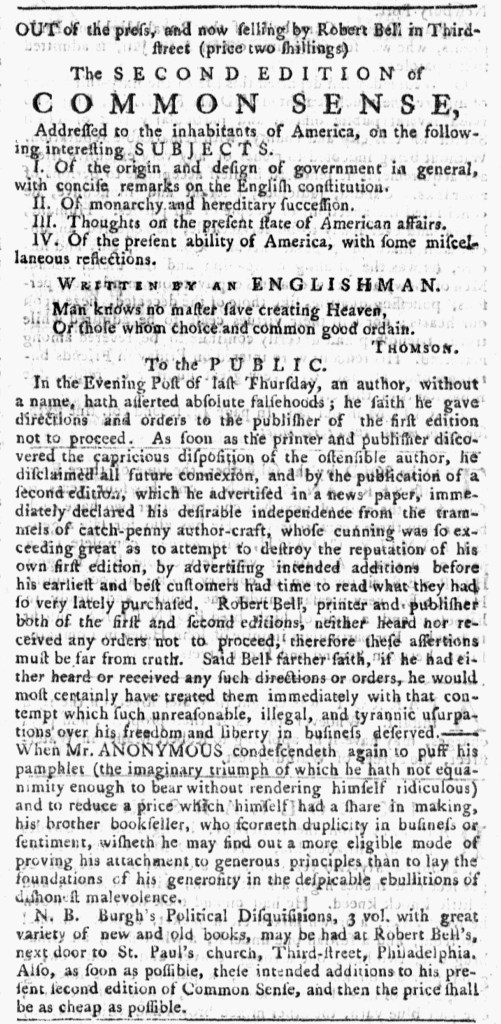
In response, Bell submitted a new advertisement to the printing office. An even more prominent headline proclaimed, “The SECOND EDITION of COMMON SENSE,” followed by a list of the four sections that appeared in the first edition. That overview had been part of most of Bell’s advertisements, as well as an epigraph from “Liberty,” a poem by James Thomson. In response to the address “To the PUBLIC” in the Bradfords’ advertisement, Bell added his own address “To the PUBLIC.” In it, he explained that in the previous edition of the Pennsylvania Evening Post, “an author, without a name, hath asserted absolute falsehoods.” At the time, Paine remained anonymous (and, for the first time, this advertisement described his political pamphlet as “WRITTEN BY AN ENGLISHMAN”). Bell objected to the claims that Paine made that “he gave directions and orders to the publisher of the first edition not to proceed.” For his part, Bell declared that “[a]s soon as the printer and publisher discovered the capricious disposition of the ostensible author, he disclaimed all future connexion,” perfectly content to break ties with Paine. Furthermore, “by the publication of a second edition which he advertised in a news paper, [Bell] immediately declared his desirable independence from the trammels of catch-penny author-craft, whose cunning was so exceeding great as to attempt to destroy the reputation of his own first edition, by advertising intended additions before his earliest and best customers had time to read what they had so very lately purchased.” That certainly was not a flattering portrait of Paine. The contents of Common Sense gave colonizers a lot to discuss. The dispute in the newspaper advertisements gave them even more.
Undaunted, Bell testified that he “neither heard nor received any orders not to proceed, there [the author’s] assertions must be far from truth.” In addition, Bell further dismissed Paine’s expectations for the publication of a second edition, stating that “if he had either heard or received any such directions or orders, he most certainly would have treated them immediately with that contempt which such unreasonable, illegal, and tyrannic usurpations over his freedom and liberty in business deserved.” Bell launched one more tirade: “When Mr. ANONYMOUS condescendeth again to puff his pamphlet … and to reduce a price which himself had a share in making, his brother bookseller, who scorneth duplicity in business or sentiment, wisheth he may find out a more eligible mode of proving his attachment to principles than to lay the foundations of his generosity in the despicable ebullitions of dishonest malevolence.” Bell was annoyed that Paine promoted the Bradfords’ edition as “one half of the price of the former edition,” a suggestion that Bell overcharged when, according to Bell, the author and the publisher set the price in consultation with each other. A lower price for the Bradfords’ edition was not truly “generosity,” especially when inspired by “despicable ebullitions of dishonest malevolence” rather than a desire to make the pamphlet more accessible to the public. Clearly, Paine’s address “To the PUBLIC” did not cause Bell to back down but instead to double down on printing and marketing his second edition of Common Sense.