July 14

What was advertised in a revolutionary American newspaper 250 years ago today?
North-Carolina Gazette (July 14, 1775).

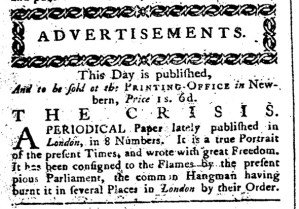
“THE CRISIS. A PERIODICAL Paper lately published in London, in 8 Numbers.”

Along with continued coverage of the Battle of Bunker Hill, the July 14, 1775, edition of the North-Carolina Gazettecarried an advertisement for The Crisis, a “PERIODICAL Paper lately published in London, in 8 Numbers.”  According to Neil L. York, The Crisis, published between January 1775 and October 1776, “was the longest-running weekly pamphlet series printed in the British Atlantic World during those years.”  (That London publication should not be confused with Thomas Paine’s “American Crisis,” a series of essays published in the United States between 1776 and 1783.)  The Crisis eventually included ninety-two editions, but James Davis, printer of the North-Carolina Gazette, had access to only the first eight.  According to his advertisement, he collected them together into a single volume.

Davis used the pamphlet’s colorful history in marketing it to readers in North Carolina.  “It is a true Portrait of the present Times,” he declared, “and wrote with great Freedom.  It has been consigned to the Flames by the present pious Parliament, the common Hangman having burnt it in several Places in London by their Order.”  York provides this overview: “The Crisis was condemned informally by leaders in the British government, and then formally in court, as a dangerous example of seditious libel [due to the depictions of George III].  Copies of it were publicly burned, and yet publication continued uninterrupted.”  American Patriots had their supporters among the British public, including authors and printers who “played on shared beliefs and shared fears: beliefs in the existence of fundamental rights … and the fear that loss of those rights in Britain’s American colonies could lead to their loss in Britain itself.”  York posits that the “men behind The Crisis were determined to interest the British public in American affairs and were no doubt pleased when various issues were reprinted in the colonies.”  Indeed, newspapers reprinted some of the essays in their entirety.  Printers also recognized opportunities to generate revenue while disseminating The Crisis to colonizers.  Advertisements for individual numbers of the pamphlet peppered the pages of American newspapers in the spring and summer of 1775 as printers in several colonies distributed new issues as they came to hand.  The day before Davis ran his advertisement in the North-Carolina Gazette, John Anderson announced in a notice in the New-York Journal that “on Monday will be published No. 9 of the CRISIS.”  Instead of printing one issue at a time, Davis packaged the first eight issues together for readers, hoping that providing such convenient access would entice them to buy the volume.

**********

This entry marks the final appearance of the North-Carolina Gazette in the Adverts 250 Project.  Few issues of that newspaper survive.  Only seven, all of them from 1775, have been digitized for greater access via databases of early American newspapers.  I have selected advertisements from the North-Carolina Gazette as often as possible to present a more complete representation of newspapers from throughout the colonies.

May 20

What was advertised in a revolutionary American newspaper 250 years ago today?

Pennsylvania Ledger (May 20, 1775).

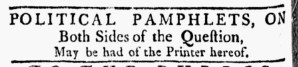
“POLITICAL PAMPHLETS, ON Both Sides of the Question.”

When he launched the Pennsylvania Ledger in the winter of 1775, James Humphreys, Jr., distributed proposals declaring that it would be a “Free and Impartial News Paper, open to All, and Influenced by None.”  With high hopes for operating an impartial press as the imperial crisis intensified, he soon advertised “POLITICAL PAMPHLETS … on Both Sides of the Question” in February 1775.  Several months later, he ran a notice advising that “POLITICAL PAMPHLETS, ON Both Sides of the Question, May be had of the Printer hereof” in the May 20 edition.  Doing so required both courage and commitment, especially considering recent events.

Humphreys published that advertisement a month after the battles at Lexington and Concord.  The siege of Boston continued, yet he did not allow news of the battles or the siege to dissuade him from hawking pamphlets on “Both Sides of the Question.”  Perhaps more significantly, James Rivington, the printer who also published pamphlets “on both sides, in the unhappy dispute with Great-Britain” at his “OPEN and UNINFLUENCED PRESS” in New York, had been hung in effigy in New Brunswick, New Jersey, by colonizers dissatisfied with what they considered his Loyalist sympathies.  Rivington covered that event in his newspaper, Rivington’s New-York Gazetteer, even including a woodcut depicting the scene.  Given that printers exchanged newspapers with their counterparts in other cities and towns, Humphreys likely read about the effigy; even if he did not, he almost certainly heard about it.  Even more recently, Rivington published a notice in which he acknowledged that “many Publications have appeared from my Press which have given great Offence … to many of my Fellow Citizens,” asserted that “Nothing which I have ever done, has proceeded from any Sentiments in the least unfriendly to the Liberties of this Continent,” and pledged “to conduct my Press upon such Principles as shall not give Offence to the Inhabitants of the Colonies.”  Despite his effort to clarify that he had not pursued a political agenda but instead followed his “duty as a Printer” to encourage “the Liberty of the Press,” the Sons of Liberty attacked his home and office on May 10.  Rivington took refuge on a British naval vessel.  Assistants continued publishing the newspaper, inserting his notice about his true intentions twice more.  Rivington had already discontinued advertising political pamphlets representing both sides of what he had previously called “The American Controversy” and “THE AMERICAN CONTEST.”

Although Humphreys advertised political pamphlets from “Both Sides” on May 20, word of what happened to Rivington may have prompted him to reconsider his courage in the weeks and months that followed.  He discontinued that advertisement.  In the next issue, he marketed only one pamphlet for sale at his printing office, The Group, a satire by Mercy Otis Warren that depicted a “SCENE AT BOSTON.”  That publication unabashedly supported the American cause.  A week later, that advertisement appeared on the first page of the Pennsylvania Ledger (as it had in the May 20 edition that carried the advertisement for political pamphlets on the final page), next to an advertisement for a multi-volume set of Political Disquisitions recommended for “all the friends of Constitutional Liberty, whether Britons or Americans.”  Still, the editorial perspective of the Pennsylvania Ledger, according to Isaiah Thomas, “was under the influence of the British government” and Humphreys eventually “refused to bear arms in favor of his country, and against the government of England.”[1]  He experienced sufficient difficulty that he suspended the newspaper at the end of November 1776.  In May 1775, a year and a half earlier, he grappled with what kinds of publications he would promote among the advertisements in his newspaper, first forging ahead with notices for pamphlets representing multiple perspectives and then emphasizing those that supported the American cause, perhaps doing so in hopes of avoiding the treatment that Rivington received.

**********

[1] Isaiah Thomas, The History of Printing in America: With a Biography of Printers and an Account of Newspapers (1810; New York: Weathervane Books, 1970), 398.

April 23

What was advertised in a revolutionary American newspaper 250 years ago this week?

Rivington’s New-York Gazetteer (April 20, 1775).

“Several pamphlets on the Whig and Tory side.”

Many Patriots did not care for the editorial stance that James Rivington took in his newspaper.  They considered him a Loyalist even though he declared in the masthead that he operated an “OPEN and UNINFLUENCED PRESS” that represented all views.  Similarly, he printed, advertised, and sold political pamphlets about “THE AMERICAN CONTEST … on the Whig and Tory side.”  Rivington aimed to keep colonizers informed and intended to generate revenue while doing so, believing that controversy could be good for business during the imperial crisis.

Late in 1774 and throughout the first months of 1775, Rivington regularly ran advertisements that listed the variety of political pamphlets available at his printing office.  He inserted an abbreviated version in the April 20, 1775, edition.  Colonizers in New York had not yet received word of the events at Lexington and Concord the previous morning.  Rivington instead published other news, including a recent instance of “some of the lower class of inhabitants, at New-Brunswick” hanging “an effigy, representing the person of Mr. Rivington … merely for acting consistent with his profession as a free printer.”  He not only covered that story but also illustrated it with a woodcut depicting the effigy hanging from a tree.

Rivington’s New-York Gazetteer (April 20, 1775).

The image almost certainly attracted attention, in part because news items in eighteenth-century newspapers so rarely featured illustrations of any sort.  Elsewhere in the same issue, readers encountered only five other images.  The masthead contained the coat of arms of Great Britain, as usual, and the drop cap for a letter to the editor appeared within a smaller version of the coat of arms.  A stock image of a ship adorned an announcement that the Earl of Dunmore would soon sail for London.  Similarly, a stock image of a horse being led by a man helped promote the stud services of Lath, Match ‘Em, Pilgrim, and Bashaw.  Abraham Delanoy’s woodcut depicting lobster traps was the only other image created to match the content of an advertisement or a news item.

The scarcity of images made the scene of the effigy even more conspicuous.  Rivington wrote a sarcastic description of the event and then affirmed “that his press has been open to publications from ALL PARTIES.”  He challenged “his enemies to produce an instance to the contrary,” noting that he treated his role as printer like “a public office” and reasoned that “every man has a right to have recourse” via his press.  “But the moment he ventured to publish sentiments which were opposed to the dangerous views and designs of certain demagogues,” Rivington asserted, “he found himself held up as an enemy to his country.”  His support for “LIBERTY OF THE PRESS” made him a target for “a most cruel tyranny,” as demonstrated by “very recent transactions” that included the effigy in New Brunswick.  His description of how some Patriots comported themselves along with his insistence on continuing to sell political pamphlets “on the Whig and Tory side” did not endear Rivington to “his enemies.”  Within in a month, a mob of Sons of Liberty would attack his printing office and destroy his press.  Rivington escaped, seeking refuge on a British naval ship in the harbor.

February 19

What was advertised in a colonial American newspaper 250 years ago this week?

Massachusetts Spy (February 16, 1775).

“THE PETITION of the American Continental Congress, to the KING.”

In February 1775, Isaiah Thomas, printer of the Massachusetts Spy, published and advertised “THE PETITION of the American Continental Congress, to the KING.”  During its meetings in Philadelphia in September and October 1774, the delegates to the First Continental Congress drafted several documents.  Almost as soon as they adjourned, William Bradford and Thomas Bradford, printers of the Pennsylvania Journal, advertised “EXTRACTS FROM THE VOTES AND PROCEEDINGS OF THE AMERICAN CONTINENTAL CONGRESS.”  Over the next several weeks, printers in towns throughout the colonies published local editions to supplement coverage in their newspapers.  By the end of November, the Bradfords published a more complete “JOURNAL OF THE PROCEEDINGS OF THE CONGRESS Held at PHILADELPHIA,” though not as many printers issued local editions of that pamphlet.  After all, the Extracts already contained “The BILL of RIGHTS; a List of GRIEVANCES; occasional RESOLVES; the ASSOCIATION; and ADDRESS to the people of Great-Britain; and a MEMORIAL to the Inhabitants of the British American Colonies.”

Yet neither the Extracts nor the Proceedings included all the work undertaken by the First Continental Congress.  In his advertisement, Thomas asserted that he published the Petition “For the benefit of those who have purchased the Votes and Proceedings of the Continental Congress, or the Extracts therefrom, as it is inserted in neither of said Pamphlets.”  He encouraged colonizers to complete their collections of these important documents.  As part of that marketing strategy, he noted that he printed the Petition “in a Pamphlet that it may be either bound of stitched up with the Votes and Proceedings.”  Buyers had the option to collect the several pamphlets together under a single cover, though few seem to have done so.  In a description of the copy now in the collections of the Princeton University Library, the William Reese Company declared, “We can locate only three copies of this rarity, those at the Library of Congress, Massachusetts Historical and American Antiquarian Society.”  That colonizers did not bind the Petition with other pamphlets, however, does not necessarily mean that they did not purchase or read it.  Thomas described the Petition as “Worthy the perusal of his Majesty and every subject in his dominions.”  As the imperial crisis intensified in the winter and spring of 1775, readers may have been eager to consume as much as they could about the positions taken by the First Continental Congress, including this eight-page pamphlet for “two coppers.”  In an advertisement for another political pamphlet claimed that such a “small price” made it affordable to “every person who is desirous” of reading about “our political Controversy.”

February 11

What was advertised in a colonial American newspaper 250 years ago today?

Supplement to the Pennsylvania Ledger (February 11, 1775).

“POLITICAL PAMPHLETS … on Both Sides of the Question.”

As the imperial crisis intensified in late 1774 and early 1775, most American newspapers became increasingly partisan, even those that claimed that they did not take a side in the contest between Patriots and Parliament.  Printers sometimes ran advertisements for pamphlets that did not align with the principles most often espoused in their publications, but few made a point of declaring that they did so.  James Rivington, printer of Rivington’s New-York Gazetteer and a noted Loyalist, took the most strident approach in a series of advertisements for “POLITICAL PUBLICATIONSwritten on the Whig and the Tory Side of the Question.”  Sporting headlines like “The American Contest” and “The American Controversy,” those advertisements listed several pamphlets, many of them written in response to others also advertised.

Yet Rivington was not alone.  In the supplement that accompanied the third issue of the new Pennsylvania Ledger, James Humphreys, Jr., the printer, inserted a short notice that announced, “Most of the POLITICAL PAMPHLETS That have been published, on Both Sides of the Question, May be had of the Printer hereof.”  On the first page, he once again ran the proposals for the newspaper, stating that he established a “Free and Impartial News Paper, open to All, and Influenced by None.”  Despite that assertion, “[i]t was supposed that Humhreys’s paper would be in the British interest,” according to Isaiah Thomas in his History of Printing in America (1810).[1]  He further explained that “in times more tranquil than those in which it appeared, [Humphreys] might have succeeded in his plan” to “conduct his paper with political impartiality.”[2]

When it came to marketing strategies for political pamphlets, printers associated with supporting the Tory “Side” took the more evenhanded approach of drawing attention to their commitment to selling and disseminating work on “Both Sides of the Question.”  In Rivington’s case, doing so was a matter of generating revenue as much as operating an impartial press and bookstore.  For Humphreys, on the other hand, doing so seemed to fall in line with the commitment he made in his proposals for the Pennsylvania Ledger.  Even taking those motivations into account, both printers may have considered it necessary to profess that they sold pamphlets on “Both Sides” to justify how many titles they sold that argued from the Tory perspective.

**********

[1] Isaiah Thomas, The History of Printing in America: With a Biography of Printers and an Account of Newspapers (1810; New York: Weathervane Books, 1970), 399.

[2] Thomas, History of Printing, 439.

February 9

What was advertised in a colonial American newspaper 250 years ago today?

Rivington’s New-York Gazetteer (February 9, 1774).

“Pamphlets published on both sides, in the unhappy dispute with Great-Britain.”

As the imperial crisis intensified in the winter of 1775, James Rivington continued to print a newspaper “at his OPEN and UNINFLUENCED PRESS” in New York.  He also ran a bookstore, peddling “Pamphlets published on both sides, in the unhappy dispute with Great-Britain.”  Both Patriot and Tory printers professed to operate free presses that delivered news and editorials from various perspectives, yet the public associated most newspapers with supporting one side over the other and even actively advocating for their cause.  Tory printers invoked freedom of the press as a means of justifying their participation in public discourse rather than allowing Patriot printers to have the only say.  When it came to advertising books and pamphlets about current events, Tory printers, especially Rivington, took the more balanced approach.

For Rivington, it was a matter of generating revenue as much as political principle.  He saw money to be made from printing and selling pamphlets about “The American Controversy.”  That was the headline he used for an advertisement that listed ten pamphlets in the February 9, 1775, edition of Rivington’s New-York Gazetteer.  He previously ran a similar advertisement for “POLITICAL PAMPHLETSon the Whig and Tory Side of the Question” and another about “The American Contest” that included some of the same pamphlets as well as others.  In his “American Controversy” advertisement, Rivington once again offered some familiar titles and new ones.  He made clear that the first two represented different positions, “The Friendly Address to all reasonable Americans, on our present political Confusions” and “The ANSWER to ditto,” though he did not indicate which took which side.

The printer positioned this venture as a service that kept the public better informed of the arguments “on both sides.”  He sought to disseminate his pamphlets beyond New York to “gentlemen at a distance from this city,” promising to “immediately comply with Orders.”  In turn, customers could do their part in making the pamphlets available far and wide since Rivington made “considerable allowance” or deep discounts “to those who purchase by the dozen, to distribute amongst those who cannot afford to purchase them.”  Though he portrayed himself as a fair dealer who marketed pamphlets “on both sides,” he did not express any expectation that customers would purchase or distribute both Patriot and Tory pamphlets.  Rivington presented readers with the freedom to consume (and further disseminate) the ideas they wished, seemingly hoping the public would allow him the same freedom in printing the content that he wished.  Whether he was sincere in such idealism or sought to justify printing editorials and pamphlets that many found objectionable, Rivington increasingly ran afoul of Patriots who did not share his outlook on freedom of the press when it came to disseminating news and opinion that favored the Tory side in “the unhappy dispute with Great-Britain.”

January 1

What was advertised in a colonial American newspaper 250 years ago this week?

Rivington’s New-York Gazetteer (December 29, 1774).

“The American Contest.”

In the final issue of Rivington’s New-York Gazetteer for 1774, James Rivington continued advertising pamphlets “written on the Whig and Tory Side of the Question.”  He inserted an advertisement similar to the “POLITICAL PUBLICATIONS” catalog that he ran on December 15.  Both listed nine tracts that Rivington sold to readers or to “Gentlemen living at a Distance … to distribute amongst their Friends.”  Some of the titles appeared a second time.  Rivington eliminated some, added others, and reorganized the order accordingly.

For instance, a pamphlet documenting the Continental Association, a nonimportation agreement adopted by the First Continental Congress had been first in the previous iteration, but Rivington listed it fourth in the new one.  A new entry led the catalog: “The Congress Canvassed, OR, An Examination into the Conduct of the Delegates, At the Grand Continental Congress, Addressed to the Merchants of New-York, By the FARMER, A.W.”  Rivington had previously advertised that he would soon publish that piece, having included “Free Thoughts on the Proceedings of the Continental Congress” among the “POLITICAL PUBLICATIONS” in his earlier catalog.  That item appeared once again, paired this time with “A full Vindication of the Measures of the Continental Congress IN ANSWER TO Free Thoughts on the Proceedings of the said Congress.”  Again, Rivington had previously advertised “A full Vindication” separately, but collated together “Free Thoughts” and the pamphlet that responded to it in the new catalog.  The enterprising printer aimed to help prospective customers craft a narrative when selecting among his offerings.

Rivington gave this catalog a new headline.  Instead of “POLITICAL PUBLICATIONS,” he called it “The American Contest.”  That dramatic flourish did not exaggerate the tensions in New York and other colonies as the imperial crisis intensified.  Within months, the Revolutionary War would commence with battles at Lexington and Concord in Massachusetts.  As Rivington reported on current events and political debates, he often took a more balance approach than many of his fellow printers who made their support for the Patriot cause very plain.  The masthead for his newspaper proclaimed that it was “PRINTED at his OPEN and UNINFLUENCED PRESS.”  Rivington enacted the same policy for the pamphlets he printed, marketed, and sold.  No other American printer so vigorously represented both perspectives in “The American Contest” in the advertisements in their newspapers.

**********

January 1, 1775, fell on a Sunday.  Colonial printers distributed newspapers every day except Sunday.  The Adverts 250 Project will commence examining advertisements from 1775 tomorrow.

December 18

What was advertised in a colonial American newspaper 250 years ago this week?

Rivington’s New-York Gazetteer (December 15, 1774).

“POLITICAL PUBLICATIONS … written on the Whig and Tory Side of the Question.”

In chronicling the momentous events of 1774, the Adverts 250 Project has frequently featured advertisements for books, pamphlets, and other items related to the imperial crisis as it intensified following the Boston Tea Party and the Coercive Acts passed by Parliament in retaliation.  Most printers increasingly privileged the Patriot’s perspective, both in terms of the news and editorials they selected for their newspapers and the works that they published, advertised, and sold.  Yet they did not uniformly do so.

James Rivington, a Loyalist, proclaimed in the masthead of Rivington’s New-York Gazetteer that his newspaper was “PRINTED at his OPEN and UNINFLUENCED PRESS.”  In Revolutionary Networks: The Business and Politics of Printing the News, 1763-1789, Joseph M. Adelman notes that “Rivington’s bookselling career was about making money rather than promoting a political ideology, so much so that he wanted to capitalize on relatively popular anti-imperial political tracts.”[1]  One of his advertisements in the December 15, 1774, edition of his newspaper listed nine “POLITICAL PUBLICATIONS” that he sold.  He explained that he stocked pamphlets “written on the Whig and Tory Side of the Question.”  He demonstrated that was the case in the descriptions of some of those tracts.  For instance, he carried “A Friendly Address to all Reasonable Americans; ON THE Subject of our Political Confusions: In which the necessary Consequences of violently opposing the King’s Troops, and of a General Non-Importation are fairly stated” and “The other Side of the Question; OR, A Defence of the Liberties of North America; In Answer to the above Friendly Address.”  Debates over current events extended beyond the town common and newspaper editorials into pamphlet wars during the imperial crisis.

Those nine “POLITICAL PUBLICATIONS” included “Free Thoughts on the Proceedings of the Continental Congress,” in which “a FARMER” commented on the widely published and advertised account of the meetings held in Philadelphia in September and October.  In that pamphlet, “their Errors are exhibited, their Reasonings confuted, and the fatal tendency of their Non-Importation, Non-Exportation, and Non-Consumption Measures, are laid open to the plainest Understandings, and the only Means pointed out for preserving and securing our present happy Constitution.”  On the first page of the same issue, Rivington advertised “A full Vindication of the Measures of the Continental Congress, IN ANSWER TO Free Thoughts on the Proceedings of the said Congress.”  The advertisement mocked “a FARMER” and his pamphlet, stating that in this response “his Sophistry is exposed, his Cavils confuted, his Artifices detected, and his Wit ridiculed.”  Rivington added his own note: “The Printer, with humble Deference, presumes that this answer will meet with a gracious reception at the hands of every reader who has expressed disapprobation to the Freethoughts of Farmer.”  For those who appreciated that pamphlet, however, Rivington announced that he would soon publish “THE CONGRESS CANVASSED; OR, An Examination into the Conduct of the Delegates … By the FARMER … Who wrote Free Thoughts on their Proceedings.”  Rivington believed that political controversy meant business as he published, advertised, and sold works “on the Whig and Tory Side of the Question.”  Seeking to maximize revenues, he suggested that “Gentlemen living at a Distance” submit orders for “any Quantity to distribute amongst their Friends.”

Rivington simultaneously asserted that he was “A Free PRINTER, approved such, by both PARTIES,” yet many observers did not care for his “OPEN and UNINFLUENCED” approach that undermined the Patriots’ perspective.  Adelman explains that “Patriots eventually targeted Rivington and intended to destroy his business, by force if necessary.”  In December 1774, as Rivington published these advertisements, an anonymous group of Patriots sent a letter to Stephen Ward and Stephen Hopkins in Newport.  They “urged Ward and Hopkin to obtain a general agreement in Rhode Island not to purchase his New-York Gazetteer or deal with anyone advertising in it.”[2]  Less than a year later, a contingent from the Sons of Liberty marched from New Haven to New York to capture Loyalist leaders and silence Rivington.  They seized his types, reportedly melting them down for shot, and destroyed his press.  Seeking to represent both sides (and generate revenues while doing so) came with consequences for the printer.

**********

[1] Joseph M. Adelman, Revolutionary Networks: The Business and Politics of Printing the News, 1763-1789 (Baltimore: Johns Hopkins University Press, 2019), 127.

[2] Adelman, Revolutionary Networks, 129.

December 16

What was advertised in a colonial American newspaper 250 years ago today?

Connecticut Gazette (December 16, 1774).

“Embellish’d with an Engraving of the patriotic Bishop of ST. ASAPH.”

With a new year only weeks away, advertisements for almanacs appeared in newspapers throughout the colonies in December 1774.  Most printers who published newspapers also produced almanacs as an alternate revenue stream, joined by other printers who supported themselves by performing job printing.  Consumers had an array of choices when they selected their almanacs for the coming year.

As a result, printers often marketed the contents of their almanacs, emphasizing anything that made them distinctive.  When Timothy Green, the printer of the Connecticut Gazette, advertised “DABOLL’s New-England ALMANACK For the Year 1775,” he indicated that it included the “usual Calculations” as a well as a “Variety of other Matter, both useful and entertaining.”  He emphasized a particular item: “the celebrated SPEECH of the Rev’d Doct. JONATHAN SHIPLEY, Lord Bishop of St. ASAPH; intended to have been spoken on the Bill for altering the Charter of the Province of Massachusetts-Bay; but want of Time or some other Circumstance, prevented his delivering it in the House of Lords.”  Shipley had gained acclaim in the colonies because he had been the only bishop in the Church of England who expressed opposition to the Massachusetts Government Act when Parliament considered how to respond to the Boston Tea Party.  When he did not have a chance to deliver the speech, he opted to publish it instead.

Though Shipley’s speech had little impact in England, the colonizers greeted it warmly.  Several newspapers published the speech, printers advertised pamphlets containing the speech, and Green devoted twelve of the thirty-two pages of Daboll’s New-England Almanack to the speech, anticipating that doing so would entice customers.  Furthermore, he “Embellished [the almanac] with an Engraving of the patriotic Bishop of ST. ASAPH” on the front cover.  Each time readers consulted any of the contents, they glimpsed the bishop whether or not they also read any portion of his speech.  Green advertised Daboll’s New-England Almanack at the same time he promoted his own edition of “The PROCEEDINGS and RESOLUTIONS of The Continental Congress,” joining other printers in producing and disseminating an array of items related to current events and, especially, making a case against the abuses perpetrated by Parliament.

Daboll’s New-England Almanack, For the Year 1775 (New London: Timothy Green, 1774). Courtesy Freeman’s | Hindman.

December 13

What was advertised in a colonial American newspaper 250 years ago today?

Essex Gazette (December 13, 1774).

“The WONDERFUL APPEARANCE of an Angel, Devil and Ghost.”

It resembled a Dickens story decades before Charles Dickens wrote “A Christmas Carol” or anything else!  In December 1775, John Boyle published and advertised “The WONDER of WONDERS! Or, the WONDERFUL APPEARANCE of an Angel, Devil and Ghost, To a Gentleman in the Town of BOSTON, in the Nights of the 14th, 15th, and 16th of October last.”  His advertisements first appeared in the Massachusetts Spy in early December and very soon after in other newspapers in Boston as well the Essex Gazette in Salem and the Essex Journal in Newburyport.

That gentleman, Boyle suggested in his advertisements, was apparently a Loyalist “To whom in some Measure may be attributed the Distresses that have of late fallen upon that unhappy Metropolis.”  The Boston Port Act had closed the harbor to commercial shipping, the Massachusetts Government Act had given the royally appointed governor more authority at the expense of the locally elected legislature and town meetings, and the Quartering Act provided for a greater presence of British soldiers.  The unnamed gentleman who supposedly experienced these visitations shared his experience with a neighbor and then agreed to their publication “as a solemn Warning to all those, who, for the sake of aggrandizing themselves and their Families, would entail the most abject Wretchedness upon Millions of their Fellow-Creatures.”  J.L. Bell, who has been chronicling Boston in the era of the American Revolution in a daily research blog for nearly two decades, notes, “All but the most credulous readers knew that this presentation was a sham designed to lend a wild cautionary tale some veneer of veracity.”

Bell examines “Wonder of Wonders” in three entries, the first introducing the pamphlet and its publication history, the second relaying the visitation by the angel, and the third recounting the visits by the devil and a ghost as well as interpreting the story in the context of how the imperial crisis unfolded in Boston.  Bell summarizes the pamphlet as purportedly an “account of a wealthy friend of the royal government whose sleep was disturbed by three supernatural visitors warning him to change his ways and start caring more about his neighbors.”  On the first night, the angel provides a warning to get back on the right path, a footnote explaining that the gentleman received compensation for his support of the officials dispatched to Boston from Britain but not specifying which services he provided.  The gentleman initially dismissed this visitor as “a delusion” until the devil visited the next night.  Their conversation covered “the previous nine years of conflict through Loyalist eyes.”  The editor conveniently provided an alternate interpretation of events in footnotes.  On the third night, the ghost of one of the gentleman’s ancestors appeared and chastised him for betraying principles that had been in place since the founding of the colony.  Colonizers settled New England, the ghost declared, “for the sake of enjoying that liberty which was denied them at home.”  The gentleman realizes the error of his way and vows to repent.

Bell wonders about the intended audience for the pamphlet, “Loyalists who needed converting” or Patriots “who enjoyed the sight of an opposing gentleman scared into submission.”  It very well could have been both, though describing it as “a solemn Warning” seemed to invite Loyalists to take heed.  The advertisement invited the curious of all political persuasions to purchase and read the pamphlet, supplementing the spectacular title with promises of four images that adorned the work.  Depictions of “THE DEVIL,” “AN ANGEL, with a Sword in one Hand, a Pair of Scales in the other,” “BELZEBUB, holding in his right Hand a folio Book, and in his left a Halter,” and “A GHOST, having on a white Gown, his Hair much dishevelled,” enhanced the story.  Whoever the intended audience may have been, Boyle aimed to generate revenue with the pamphlet by advertising widely and disseminating copies to local agents in other towns.

**********

Quotations not drawn from the advertisement come from J.L. Bell’s Boston 1775: History, Analysis, and Unabashed Gossip about the Start of the American Revolution in Massachusetts.