September 18

What was advertised in a colonial American newspaper 250 years ago this week?
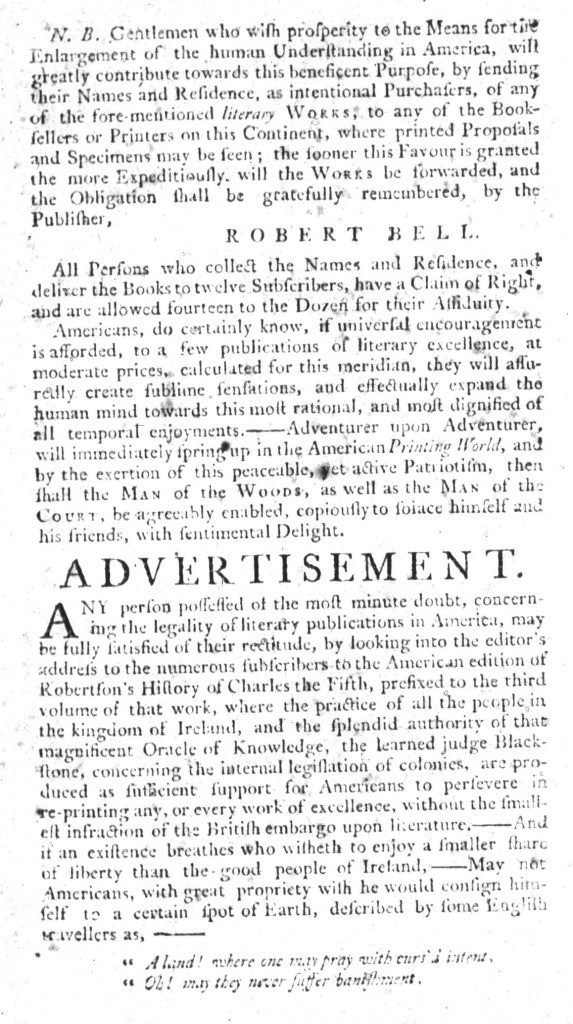
Final page of Robert Bell’s subscription notice for Blackstone’s Commentaries that may (or may not) have been distributed with the September 17, 1771, edition of the South-Carolina and American General Gazette.

“Peaceable, yet active Patriotism.”

Yesterday, the Adverts 250 Project featured Robert Bell’s subscription notice for Blackstone’s Commentaries on the Laws of England that Accessible Archives included with the September 17, 1771, edition of the South-Carolina and American General Gazette and addressed the difficulty of determining whether the subscription notice originally accompanied the newspaper.  Today, the marketing strategies deployed by Bell merit consideration.

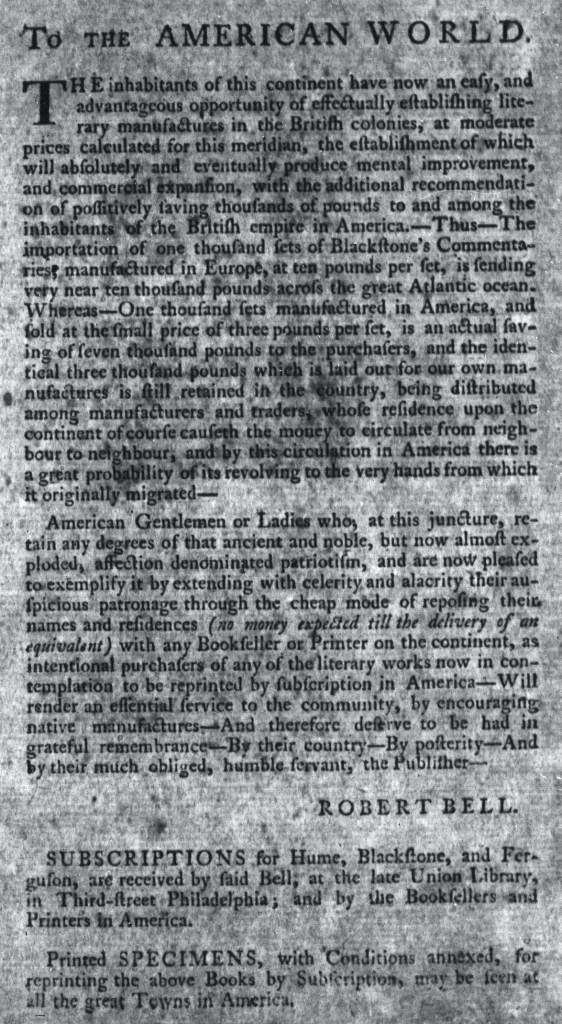
First, however, consider the format of the subscription notice, a four-page flier.  On the first page, addressed “TO THE AMERICAN WORLD,” Bell encouraged prospective customers throughout the colonies to purchase American editions rather than imported books.  It could also have been published separately as a handbill, similar to the second page featuring two advertisements for books “Lately Published” by Bell, “YORICK’S Sentimental Journal Through FRANCE and ITALY” by Laurence Stern and “HISTORY OF BELISARIUS, THE HEROIC AND HUMANE ROMAN GENERAL” by Jean-François Marmontel.  On the third and fourth pages, Bell promoted William Robertson’s “HISTORY of CHARLES the FIFTH, EMPEROR of GERMANY,” a work he widely advertised in newspapers throughout the colonies, and other American editions.  The flier concluded with a note defending “the legality of literary publications in America.”

Both before and after the American Revolution, Bell established a reputation as one of the most vocal proponents of creating a distinctly American literary market served by printers and publishers in the colonies and, later, the new nation.  Bell advanced both political, economic, and cultural arguments in favor of an American book trade during the imperial crisis.  He opened his address “TO THE AMERICAN WORLD” by proclaiming that “THE inhabitants of this continent have now an easy, and advantageous opportunity of effectually establishing literary manufactures … the establishment of which will absolutely and eventually produce mental improvement, and commercial expansion.”  In addition, purchasing books published in America would result in “saving thousands of pounds” by consumers as well as keep the money on that side of the Atlantic.  Colonists could pay lower prices and, in the process, what they did spend would be “distributed among manufacturers and traders, whose residence upon the continent of course causeth the money to circulate from neighbour to neighbour, and by this circulation in America there is a great probability of its revolving to the very hands from which it originally migrated.”  Supporting domestic manufactures, including American publications, would create stronger local economies, Bell argued.

“American Gentlemen or Ladies” had a patriotic duty to lend their “auspicious patronage” to such projects by informing their local bookseller or printer that they wished to become “intentional purchasers of any of the literary works now in contemplation to be reprinted by subscription in America.”  In so doing, they would “render an essential service to the community, by encouraging native manufactures.  In turn, they “deserve[d] … grateful remembrance—By their country—By posterity.”  These subscribers would also contribute to the enlightenment of the entire community, the “MAN of the WOODS” as well as the “MAN of the COURT.”  In the hyperbolic prose he so often used in his marketing materials, Bell declared that “Americans, do certainly know, if universal encouragement is afforded, to a few publications of literary excellence … they will assuredly create sublime sensations, and effectually expand the human mind towards this most rational, and most dignified of all temporal enjoyments.”  In addition, he described himself and other American printers and publishers as engaging in “peaceable, yet active Patriotism” in making inexpensive American editions of several “literary WORKS” available to consumers.

Bell frequently inserted advertisements with similar messages into newspapers from New England to South Carolina, but those were not his only means of encouraging “THE AMERICAN WORLD” to support domestic manufactures and the creation of an American literary market that would result in self-improvement among readers far and wide.  In subscription notices (which may have been distributed with newspapers on occasion), book catalogs, and broadsides, he advanced the same arguments much more extensively than space in newspapers allowed.
September 17

What was advertised in a colonial American newspaper 250 years ago today?

First page of Robert Bell’s subscription notice for Blackstone’s Commentaries that may (or may not) have been distributed with the September 17, 1771, edition of the South-Carolina and American General Gazette.

“SUBSCRIPTIONS for Hume, Blackstone, and Ferguson, are received by said Bell … and by the Booksellers and Printers in America.”

Digitization makes primary sources more widely available, but digital surrogates sometimes introduce questions about those sources that might be more easily answered by examining the originals.  Consider the September 17, 1771, edition of the South-Carolina and American General Gazette made available by Accessible Archives.  That company provides nine pages associated with that issue.  The first four comprise the standard issue, two pages printed on each side of a broadsheet then folded in half.

Another page filled entirely with advertising lacks a masthead, but does have the title, “THE SOUTH CAROLINA & AMERICAN GENERAL GAZETTE, for 1771,” and date “Sept. 10-17” running across the top.  It also features a page number, 192, in the upper left corner as well as a colophon at the bottom of the last column.  This may have been a one-page supplement, but paper was such a precious commodity that printers tended to fill both sides when they distributed supplements.  The page numbering for the standard issue went from 187 to 190.  Did the printer skip 191 in order to have the next issue begin, as usual, with an odd number?  Or, is the first page of a two-page supplement missing from the digital edition?  It is impossible to simply flip over the page with a digital edition, making it difficult to answer a question that likely would not even have been an issue when examining the original.

The final four pages associated with that issue of the South-Carolina and American General Gazette look like a subscription notice distributed by Robert Bell, a bookseller and publisher in Philadelphia.  The digital images suggest they were on a sheet of a much smaller size than either the standard issue or the supplement, but specific information about the relative sizes of these pages disappeared when remediating them to photographs and digital files.  How did this subscription notice become associated with that issue of the newspaper?  Bell incorporated Robert Wells, printer of the South-Carolina and American General Gazette, into his network of local agents who advertised and received subscriptions for Blackstone’s Commentaries on the Laws of England on his behalf.  An advertisement for that volume appeared on the final page of the standard issue as well as the first page of the subscription notice.  Perhaps Wells distributed Bell’s subscription notice with his newspaper.  On the other hand, the subscription notice may have been added to the collection of newspapers at a later time by the printer, a contemporary reader, a later collector, or an archivist.  Modern readers could ask a librarian or cataloger about the provenance when working with the original.  Even though that might or might not reveal an answer, it is an opportunity that readers consulting digital sources may not pursue, at least not easily.

On the whole, digitization has revolutionized access to primary sources, making them more widely available rather than confined to research libraries and historical societies.  Yet digital copies are not replacements for originals.  They sometimes introduce questions that either would not have been part of working with original copies or would have been more easily answered.  Even the most enthusiastic proponents of digitization readily recognize that digital surrogates are best considered complements to, rather than replacements for, original primary sources.

Slavery Advertisements Published September 17, 1771

The Slavery Adverts 250 Project chronicles the role of newspaper advertising in perpetuating slavery in the era of the American Revolution. The project seeks to reveal the ubiquity of slavery in eighteenth-century life from New England to Georgia by republishing advertisements about enslaved people – for sale as individuals or in groups, wanted to purchase or for hire for short periods, runaways who liberated themselves, and those who were subsequently captured and confined in jails and workhouses – in daily digests on this site as well as in real time via the @SlaveAdverts250 Twitter feed, utilizing twenty-first-century media to stand in for the print media of the eighteenth century.

The project aims to provide modern audiences with a sense of just how often colonists encountered these advertisements in their daily lives. Enslaved men, women, and children appeared in print somewhere in the colonies almost every single day. Those advertisements served as a constant backdrop for social, cultural, economic, and political life in colonial and revolutionary America. Colonists who did not purport to own enslaved people were still confronted with slavery as well as invited to maintain the system by purchasing enslaved men, women, and children or assisting in the capture of so-called “runaways” who sought to free themselves from bondage. The frequency of these newspaper advertisements suggests just how embedded slavery was in colonial and revolutionary American culture in everyday interactions beyond the printed page.

These advertisements also testify to the experiences of enslaved men, women, and children, though readers must consider that those experiences have been remediated through descriptions offered by enslavers rather than enslaved people themselves. Often unnamed in the advertisements, enslaved men, women, and children were not invisible or unimportant in early America.

These advertisements appeared in colonial American newspapers 250 years ago today.

Connecticut Courant (September 17, 1771).

**********

South-Carolina and American General Gazette (September 17, 1771).

**********

South-Carolina and American General Gazette (September 17, 1771).

**********

South-Carolina and American General Gazette (September 17, 1771).

**********

South-Carolina and American General Gazette (September 17, 1771).

**********

South-Carolina and American General Gazette (September 17, 1771).

**********

South-Carolina and American General Gazette (September 17, 1771).

**********

South-Carolina and American General Gazette (September 17, 1771).

**********

South-Carolina and American General Gazette (September 17, 1771).

**********

South-Carolina and American General Gazette (September 17, 1771).

**********

South-Carolina Gazette and Country Journal (September 17, 1771).

**********

South-Carolina Gazette and Country Journal (September 17, 1771).

**********

South-Carolina Gazette and Country Journal (September 17, 1771).

**********

South-Carolina Gazette and Country Journal (September 17, 1771).

**********

South-Carolina Gazette and Country Journal (September 17, 1771).

**********

South-Carolina Gazette and Country Journal (September 17, 1771).

**********

South-Carolina Gazette and Country Journal (September 17, 1771).

**********

South-Carolina Gazette and Country Journal (September 17, 1771).

**********

South-Carolina Gazette and Country Journal (September 17, 1771).

**********

South-Carolina Gazette and Country Journal (September 17, 1771).

**********

South-Carolina Gazette and Country Journal (September 17, 1771).

**********

South-Carolina Gazette and Country Journal (September 17, 1771).

**********

South-Carolina Gazette and Country Journal (September 17, 1771).

**********

South-Carolina Gazette and Country Journal (September 17, 1771).

**********

South-Carolina Gazette and Country Journal (September 17, 1771).

**********

South-Carolina Gazette and Country Journal (September 17, 1771).

**********

Supplement to the South-Carolina Gazette and Country Journal (September 17, 1771).

**********

Supplement to the South-Carolina Gazette and Country Journal (September 17, 1771).

**********

Supplement to the South-Carolina Gazette and Country Journal (September 17, 1771).

**********

Supplement to the South-Carolina Gazette and Country Journal (September 17, 1771).

**********

Supplement to the South-Carolina Gazette and Country Journal (September 17, 1771).

**********

Supplement to the South-Carolina Gazette and Country Journal (September 17, 1771).

September 16

What was advertised in a colonial American newspaper 250 years ago today?

Boston-Gazette (September 16, 1771).

“George Spriggs, Gardner to John Hancock, Esq.”

In the early 1770s, George Spriggs supplied colonists with fruit trees.  In September 1771, he placed advertisements in the Boston-Gazette to promote “ABOUT four or five Thousand Mulberry Trees of different Sizes,” “a large Assortment of English Fruit Trees,” and “an Assortment of flowering Shrubs.”  Those were not just any mulberry trees, Spriggs asserted.  They grew from seeds from “the first ripe Fruit of Mulberries, from a Tree of Mr. David Colson’s, which is the largest and finest Fruit that is in America.”  He expected consumers to be familiar with Colson and his trees or at least trust his expertise about the significance.  He carefully timed his marketing, advising prospective customers that “the best Time of transplanting” the fruit trees “is about the Middle of October.”  Anyone interested in purchasing trees or shrubs from Spriggs could plan accordingly.

In addition to establishing a connection to Colson, Spriggs leveraged his connection to a colonist so prominent that readers of the Boston-Gazette almost certainly knew who he was.  Before he even described the trees and shrubs he offered for sale, Spriggs described himself as “Gardner to John Hancock, Esq.”  It was not the first time he deployed that strategy, seeking to benefit from the celebrity of one of his clients.  In February 1770, for instance, he opened another advertisement in the same manner.  Nor was he the only advertiser who named a famous client as a means of establishing his credentials.  Elsewhere in the Boston-Gazette, Jacob Hemet introduced himself as “DENTIST to her Majesty, and the Princess Amelia.”  Doctors and dentists who migrated to the colonies frequently claimed they previously provided their services to nobles and the gentry in Europe, expecting prospective clients to take their word for it.  Spriggs, on the other hand, knew that customers could much more easily confirm whether he actually was a “Gardner to John Hancock, Esq.”  He did not publish a testimonial from the prominent merchant, but encouraged customers to believe that his association with Hancock was recommendation enough.

Slavery Advertisements Published September 16, 1771

The Slavery Adverts 250 Project chronicles the role of newspaper advertising in perpetuating slavery in the era of the American Revolution. The project seeks to reveal the ubiquity of slavery in eighteenth-century life from New England to Georgia by republishing advertisements about enslaved people – for sale as individuals or in groups, wanted to purchase or for hire for short periods, runaways who liberated themselves, and those who were subsequently captured and confined in jails and workhouses – in daily digests on this site as well as in real time via the @SlaveAdverts250 Twitter feed, utilizing twenty-first-century media to stand in for the print media of the eighteenth century.

The project aims to provide modern audiences with a sense of just how often colonists encountered these advertisements in their daily lives. Enslaved men, women, and children appeared in print somewhere in the colonies almost every single day. Those advertisements served as a constant backdrop for social, cultural, economic, and political life in colonial and revolutionary America. Colonists who did not purport to own enslaved people were still confronted with slavery as well as invited to maintain the system by purchasing enslaved men, women, and children or assisting in the capture of so-called “runaways” who sought to free themselves from bondage. The frequency of these newspaper advertisements suggests just how embedded slavery was in colonial and revolutionary American culture in everyday interactions beyond the printed page.

These advertisements also testify to the experiences of enslaved men, women, and children, though readers must consider that those experiences have been remediated through descriptions offered by enslavers rather than enslaved people themselves. Often unnamed in the advertisements, enslaved men, women, and children were not invisible or unimportant in early America.

These advertisements appeared in colonial American newspapers 250 years ago today.

Boston-Gazette (September 16, 1771).

**********

Boston-Gazette (September 16, 1771).

**********

Boston-Gazette (September 16, 1771).

**********

Newport Mercury (September 16, 1771).

**********

New-York Gazette and Weekly Mercury (September 16, 1771).

**********

New-York Gazette and Weekly Mercury (September 16, 1771).

**********

New-York Gazette and Weekly Mercury (September 16, 1771).

**********

New-York Gazette and Weekly Mercury (September 16, 1771).

**********

New-York Gazette and Weekly Mercury (September 16, 1771).

September 15

What was advertised in a colonial American newspaper 250 years ago this week?

Pennsylvania Gazette (September 12, 1771).

“Just Published … POOR RICHARD’S ALMANACK, for the YEAR 1772.”

It was a familiar sign of the changing seasons when advertisements for almanacs first appeared in colonial newspapers in the fall.  Two such advertisements ran in the September 12, 1771, edition of the Pennsylvania Gazette.  The printers of that newspaper, David Hall and William Sellers, hawked “POOR RICHARD’S ALMANACK, for the YEAR 1772,” the popular almanac they published.  Isaac Collins advertised the “BURLINGTON ALMANACK” available at his printing office in Burlington, New Jersey.

Neither advertisement provided much additional information, the printers likely not considering it necessary at the time.  After all, prospective customers had more than four months to purchase copies before the new year began.  The brief advertisements drew attention to these almanacs before competitors began marketing their own publications.  John Fleeming adopted a similar strategy for “Bickerstaff’s Almanack For the Year 1772” when he placed an advertisement in the August 15, 1771, edition of the Massachusetts Gazette and Boston Weekly News-Letter to announce that the almanac “Will be published in September next.”  As fall progressed, more advertisements for almanacs would appear in newspapers from New England to South Carolina.  Each year, printers placed increasing elaborate advertisements in October, November, and December as competition for customers intensified.

For the moment, however, Hall and Sellers simply announced that they “Just publishedPoor Richard’s Almanackat theNew Printing-Office, in Market-street, Philadelphia.”  Collins offered a little more information, stating that his almanac contained “besides the usual astronomical Calculations, a Variety of useful and entertaining Matter, both in Prose and Verse.”  Collins also declared that he sold the Burlington Almanac “Wholesale and Retail,” encouraging booksellers, shopkeepers, and others to acquire copies to retail in their own shops.  Although Hall and Sellers did not mention wholesale transactions, alerting customers that they could add Poor Richard’s Almanack to their inventory may have been one of the primary purposes of publishing the almanac and advertising its availability so early.

Daylight hours diminished in September compared to the summer months.  Temperatures became colder.  Yet the natural world did not offer the only evidence that fall would soon arrive.  Readers of the Pennsylvania Gazette and other newspapers began encountering advertisements for almanacs for the coming year, another sure sign that summer was in its final days.

September 14

What was advertised in a colonial American newspaper 250 years ago today?

Providence Gazette (September 14, 1771).

“Those who favor him with their custom, either personally or by letter, may depend on the best treatment.”

When John Jenkins advertised his “Store and Shop … near the Great Elm-Tree” in the Providence Gazette in the late summer and early fall of 1771, he hoped to attract customers from towns throughout the countryside.  As one of only two newspapers published in Rhode Island at the time, the Providence Gazette, like the Newport Mercury, circulated far beyond its place of publication.  As a result, consumers in norther Rhode Island as well as portions of Connecticut and Massachusetts encountered the advertisements it carried, including Jenkins’s advertisement for an “assortment of English and India goods,” groceries, and “many articles suitable for the ladies.”

Patrons did not need to visit his shop and warehouse to purchase his merchandise.  Instead, Jenkins offered the eighteenth-century equivalent of mail order service, requesting that customers contact him “by letter” to place orders.  In turn, he pledged that he made no distinction between local customers who visited in person and those who instead sent letters.  Everyone received the same low prices and everyone could “depend on the best treatment, with thanks.”  That likely included prompt and courteous attention as well as access to the newest and most fashionable wares.

Jenkins incorporated convenience and customer service into his marketing efforts.  Other advertisers did so as well in the eighteenth century, but not to the same extent as they pursued other strategies that Jenkins also included in his advertisement.  Purveyors of goods often made appeals to price, as Jenkins did when he described his merchandise as “Very cheap,” and consumer choice, as he did in listing broad categories that ranged from “Stationary ware” to “Brasiery and hardware” to “Earthen ware.”  With a few lines promising “the best treatment” and providing an option to order “by letter,” Jenkins enhanced his advertisement, distinguishing it from otherwise similar notices than ran alongside it in the Providence Gazette.

September 13

What was advertised in a colonial American newspaper 250 years ago today?

Connecticut Journal (September 13, 1771).

“STAGE-COACH … to pass thro’ this Coolony.”

Nicholas Brown aimed to improve the infrastructure that connected the major towns in New England in the early 1770s, establishing his own stagecoach service between Hartford and New Haven to supplement other routes already in existence.  In the summer of 1771, for instance, John Stavers placed advertisements in the Massachusetts Gazette and Boston Weekly News-Letter and the New-Hampshire Gazette to promote “Stage-Coach, Number One” that ran between Boston and Portsmouth.  Stavers sought to ward off competition from a competitor who had only recently established service along the same route.

Brown, on the other hand, added a new route in hopes of better connecting the region.  To that end, he acquired “an elegant, and convenient Stage Coach and four Horses” to cover a route between Hartford and New Haven once a week. He anticipated that another operator would soon set up service from Hartford to Boston, allowing “Gentlemen from the Southern Provinces” to pass through Connecticut on their way to Boston rather than “go by Water from New-York to Providence” and then continue overland to Boston.  New routes meant more options for transporting passengers and freight.

In an advertisement in the September 13, 1771, edition of the Connecticut Journal, Brown framed his endeavor as an investment opportunity and a service that merited the support of local benefactors.  He mentioned “a low and moderate Price,” but did not specify which days his stagecoach ran between Hartford and New Haven or where to meet it in either town.  Instead, he focused primarily on the “great Expence” he already incurred, requesting that “all Gentlemen disposed to countenance the Undertaking” would leave their names and “such Sum … as their Generosity shall dictate” at the printing office.  In addition to accepting donations to make stagecoach service between Hartford and New Haven viable, Brown also invited “any Gentleman … disposed to share with him the Loss or Gain of the Undertaking” to join him as partners.  That first advertisement alerted prospective customers to a new “STAGE-COACH” route, but the proprietor also used it as a prospectus for gaining other kinds of support for his new enterprise.

September 12

What was advertised in a colonial American newspaper 250 years ago today?

Pennsylvania Gazette (September 12, 1771).

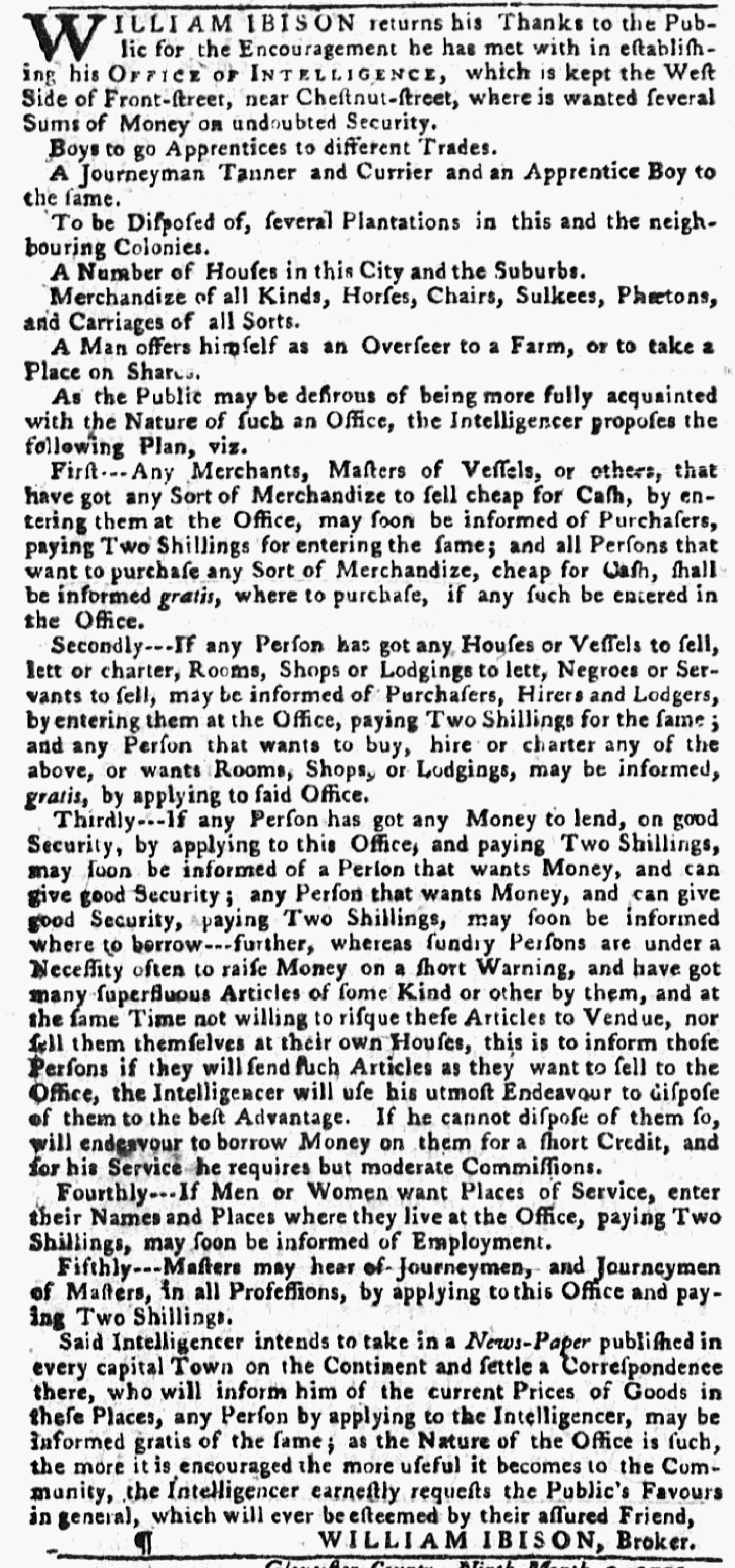
“OFFICE OF INTELLIGENCE.”

William Ibison offered his services as a broker to prospective clients who saw his advertisement in the September 12, 1771, edition of the Pennsylvania Gazette.  He informed them that he established an “OFFICE OF INTELLIGENCE” on Front Street in Philadelphia.  At that time, he could provide information about “Boys to go Apprentices to different Trades,” “A Number of Houses” for sale “in this City and the Suburbs,” and “Merchandize of all Kinds.”

Realizing that some readers might not have been familiar with the work of a broker or, as Ibison called himself, an “Intelligencer,” he offered an overview of his services.  For a small fee, he collected information about goods for sale from “Merchants, Masters of Vessels, or others,” and then introduced them to prospective buyers.  He also facilitated selling houses and ships, renting lodgings and shops, and selling indentured servants and enslaved laborers.  In addition, Ibison oversaw loans and investments, placed men and women seeking work into jobs, and introduced masters and journeymen “in all Professions.”  For each of those services, he charged “moderate Commissions” or small fees.

Ibison presented his “OFFICE OF INTELLIGENCE” as the hub of an information network.  Some of that information he collected directly from clients, but he also relied on newspapers.  The broker announced his plan “to take in a News-Paper published in every capital Town on the Continent and settle a Correspondence there.”  Doing so would allow him to keep track of “current Prices of Goods in these Places” in order to pass along the intelligence to his clients.  Unlike his other services, he offered that information “gratis.”  He likely hoped that colonists who called on him for that information would be more likely to share information of their own or hire him for other ventures once they discovered how useful it could be to work with a broker who made it his business to collect, collate, and assess information from so many different sources.

The “Intelligencer” declared that “the Nature of the Office is such, the more it is encouraged the more useful it becomes to the Community.”  His services, he asserted, benefited more than just his clients.  That being the case, he “earnestly requests the Public’s Favours in general.”  Only in combining a growing clientele with correspondents and newspapers from other cities could his “OFFICE OF INTELLIGENCE” achieve its full potential in assisting others in acquiring whatever information they needed to successfully pursue their own endeavors.

Slavery Advertisements Published September 12, 1771

The Slavery Adverts 250 Project chronicles the role of newspaper advertising in perpetuating slavery in the era of the American Revolution. The project seeks to reveal the ubiquity of slavery in eighteenth-century life from New England to Georgia by republishing advertisements about enslaved people – for sale as individuals or in groups, wanted to purchase or for hire for short periods, runaways who liberated themselves, and those who were subsequently captured and confined in jails and workhouses – in daily digests on this site as well as in real time via the @SlaveAdverts250 Twitter feed, utilizing twenty-first-century media to stand in for the print media of the eighteenth century.

The project aims to provide modern audiences with a sense of just how often colonists encountered these advertisements in their daily lives. Enslaved men, women, and children appeared in print somewhere in the colonies almost every single day. Those advertisements served as a constant backdrop for social, cultural, economic, and political life in colonial and revolutionary America. Colonists who did not purport to own enslaved people were still confronted with slavery as well as invited to maintain the system by purchasing enslaved men, women, and children or assisting in the capture of so-called “runaways” who sought to free themselves from bondage. The frequency of these newspaper advertisements suggests just how embedded slavery was in colonial and revolutionary American culture in everyday interactions beyond the printed page.

These advertisements also testify to the experiences of enslaved men, women, and children, though readers must consider that those experiences have been remediated through descriptions offered by enslavers rather than enslaved people themselves. Often unnamed in the advertisements, enslaved men, women, and children were not invisible or unimportant in early America.

These advertisements appeared in colonial American newspapers 250 years ago today.

Maryland Gazette (September 12, 1771).

**********

Maryland Gazette (September 12, 1771).

**********

Maryland Gazette (September 12, 1771).

**********

Massachusetts Gazette and Boston Weekly News-Letter (September 12, 1771).

**********

Supplement to the Massachusetts Gazette and Boston Weekly News-Letter (September 12, 1771).

**********

Pennsylvania Gazette (September 12, 1771).

**********

Pennsylvania Gazette (September 12, 1771).

**********

South-Carolina Gazette (September 12, 1771).

**********

South-Carolina Gazette (September 12, 1771).

**********

South-Carolina Gazette (September 12, 1771).

**********

South-Carolina Gazette (September 12, 1771).

**********

South-Carolina Gazette (September 12, 1771).

**********

South-Carolina Gazette (September 12, 1771).

**********

Supplement to the South-Carolina Gazette (September 12, 1771).

**********

Supplement to the South-Carolina Gazette (September 12, 1771).

**********

Supplement to the South-Carolina Gazette (September 12, 1771).

**********

Supplement to the South-Carolina Gazette (September 12, 1771).

**********

Supplement to the South-Carolina Gazette (September 12, 1771).

**********

Supplement to the South-Carolina Gazette (September 12, 1771).

**********

Supplement to the South-Carolina Gazette (September 12, 1771).

**********

Supplement to the South-Carolina Gazette (September 12, 1771).

**********

Supplement to the South-Carolina Gazette (September 12, 1771).

**********

Virginia Gazette [Purdie and Dixon] (September 12, 1771).

**********

Virginia Gazette [Purdie and Dixon] (September 12, 1771).

**********

Virginia Gazette [Purdie and Dixon] (September 12, 1771).

**********

Virginia Gazette [Purdie and Dixon] (September 12, 1771).

**********

Virginia Gazette [Purdie and Dixon] (September 12, 1771).

**********

Virginia Gazette [Purdie and Dixon] (September 12, 1771).

**********

Virginia Gazette [Purdie and Dixon] (September 12, 1771).

**********

Virginia Gazette [Purdie and Dixon] (September 12, 1771).

**********

Virginia Gazette [Purdie and Dixon] (September 12, 1771).

**********

Virginia Gazette [Purdie and Dixon] (September 12, 1771).

**********

Virginia Gazette [Purdie and Dixon] (September 12, 1771).