January 15

What was advertised in a colonial American newspaper 250 years ago this week?

Boston-Gazette (January 13, 1772).

“Any Person, by attending to the Instructions given in this Book, may soon attain to a competent Knowledge in the Art of Cookery.”

Cox and Berry sold “Modern Books of all Kinds” as well as “School Books” and “Prayer Books of various Sizes” at their store on King Street in Boston, but they targeted women and children (or parents and others who bought books to give to children) as prospective customers in an advertisement that ran in the January 13, 1772, edition of the Boston-Gazette.  That notice listed several “Little Books for the Instruction and Amusement of all good Boys and Girls,” including “Brother Gift, or the Naughty Girl Reformed” and “Sister Gift, or the Naughty Boy Reformed.”  They also stocked abridged versions of popular novels by Henry Fielding and Samuel Richardson.

The partners devoted half of their advertisement to promoting “THE FRUGAL HOUSE-WIFE, OR COMPLETE WOMAN COOK … by SUSANNAH CARTER, of London” to female consumers (or others who believed that women they knew would benefit from the guidance offered in that volume).  Quoting from the extensive title, Cox and Berry explained that the book provided instruction in “the Art of Dressing all Sorts of Viands [or Foods] with Cleanliness, Decency and Elegance.”  It contained five hundred “approved Receipts” or recipes as well as the “best Methods” for “Preserving, Drying, Candying, [and] Pickling” various foods.  In addition to the recipes, readers would encounter menus or “various Bills of Fare, for Dinners and Suppers in every Month of the Year” as well as a “copious Index to the Whole” to help them navigate so much content.  To further entice prospective customers, Cox and Berry declared that The Frugal House-Wife “contains more in Quantity than most other Books of a much higher Price.”  Such a bargain!

The booksellers promised that “Any Person, by attending to the Instructions given in this Book, may soon attain to a competent Knowledge in the Art of Cookery.”  That theme ran throughout Cox and Berry’s advertisement.  They targeted women and children as consumers out of a belief that they merited special instruction in performing their household duties or behaving appropriately.  They deployed consumer culture, especially choices about which books to purchase, as a means of promoting good order within households, though they suggested that the readers of these books would experience “Amusement” as well as “Instruction” in the process of learning their proper roles.

January 14

What was advertised in a colonial American newspaper 250 years ago today?

Essex Gazette (January 14, 1772).

“Two LIGHT-HOUSES on Thatcher’s Island for the Safety of Navigation.”

Advertisements in colonial newspapers often carried important news that supplemented the contents that appeared elsewhere.  Consider, for example, an advertisement that first ran in the Essex Gazette on December 31, 1771, and then continued to appear in subsequent issues in 1772.  “WHeras the Government having at their own Charge erected Two LIGHT-HOUSES on Thatcher’s Island for the Safety of Navigation,” the advertisement informed readers, “This is to give Notice, that said LIGHT-HOUSES are finished.”  Furthermore, “the LAMPS in said HOUSES have been light ever since the 21st of this Month.”  According to the National Park Service, “The original towers [constructed in 1771] were replaced by the present 124-foot tall, twin granite towers in 1861.”  Now known as the Cape Ann Light Station, those towers are a distinctive site (and sight!) in the region.

The National Park Service also explains that Thacher Island, located about a mile offshore from Rockport, Massachusetts, gained its name “when the General Court granted it to Anthony Thacher in 1636-1637.”  Thacher and his wife were the sole survivors of a shipwreck near the island in 1635.  Over the next four decades, several other shipwrecks occurred in the area, prompting the Massachusetts colonial government to purchase the island with the intention of establishing a light station.  Only nine lighthouses operated in North America prior to the twin lights on Thacher Island.  The two towers made the site easy for mariners to identify.  The other lighthouses guided ships to entrances to harbors, making these lights the first to mark a hazardous location.  As the advertisement in the Essex Gazette noted, they contributed to “the Safety of Navigation.”  They were also the last lighthouses built before the colonies declared independence.

Readers of the Essex Gazette may very well have been aware of the construction of the lights on Thacher Island, but this advertisement confirmed for the entire community that the project had been completed and the lights now lit.  In addition, printers and merchants participated in extensive networks for exchanging newspapers and the information contained in them.  An advertisement in the Essex Gazette, the newspaper printed closest to the location of the new lighthouses, almost certainly helped in disseminating news that the lights on Thacher Island now warned vessels of treacherous waters.

Slavery Advertisements Published January 14, 1772

GUEST CURATOR: Chris Barone

The Slavery Adverts 250 Project chronicles the role of newspaper advertising in perpetuating slavery in the era of the American Revolution. The project seeks to reveal the ubiquity of slavery in eighteenth-century life from New England to Georgia by republishing advertisements about enslaved people – for sale as individuals or in groups, wanted to purchase or for hire for short periods, runaways who liberated themselves, and those who were subsequently captured and confined in jails and workhouses – in daily digests on this site as well as in real time via the @SlaveAdverts250 Twitter feed, utilizing twenty-first-century media to stand in for the print media of the eighteenth century.

The project aims to provide modern audiences with a sense of just how often colonizers encountered these advertisements in their daily lives. Enslaved men, women, and children appeared in print somewhere in the colonies almost every single day. Those advertisements served as a constant backdrop for social, cultural, economic, and political life in colonial and revolutionary America. Colonizers who did not purport to own enslaved people were still confronted with slavery as well as invited to maintain the system by purchasing enslaved men, women, and children or assisting in the capture of so-called “runaways” who sought to free themselves from bondage. The frequency of these newspaper advertisements suggests just how embedded slavery was in colonial and revolutionary American culture in everyday interactions beyond the printed page.

These advertisements also testify to the experiences of enslaved men, women, and children, though readers must consider that those experiences have been remediated through descriptions offered by enslavers rather than enslaved people themselves. Often unnamed in the advertisements, enslaved men, women, and children were not invisible or unimportant in early America.

These advertisements appeared in colonial American newspapers 250 years ago today.

South-Carolina Gazette and Country Journal (January 14, 1772).

**********

South-Carolina Gazette and Country Journal (January 14, 1772).

**********

South-Carolina Gazette and Country Journal (January 14, 1772).

**********

South-Carolina Gazette and Country Journal (January 14, 1772).

**********

South-Carolina Gazette and Country Journal (January 14, 1772).

**********

South-Carolina Gazette and Country Journal (January 14, 1772).

**********

South-Carolina Gazette and Country Journal (January 14, 1772).

**********

South-Carolina Gazette and Country Journal (January 14, 1772).

**********

South-Carolina Gazette and Country Journal (January 14, 1772).

**********

South-Carolina Gazette and Country Journal (January 14, 1772).

**********

South-Carolina Gazette and Country Journal (January 14, 1772).

**********

South-Carolina Gazette and Country Journal (January 14, 1772).

**********

South-Carolina Gazette and Country Journal (January 14, 1772).

**********

Supplement to the South-Carolina Gazette and Country Journal (January 14, 1772).

**********

Supplement to the South-Carolina Gazette and Country Journal (January 14, 1772).

**********

Supplement to the South-Carolina Gazette and Country Journal (January 14, 1772).

**********

Supplement to the South-Carolina Gazette and Country Journal (January 14, 1772).

**********

Supplement to the South-Carolina Gazette and Country Journal (January 14, 1772).

**********

Supplement to the South-Carolina Gazette and Country Journal (January 14, 1772).

**********

Supplement to the South-Carolina Gazette and Country Journal (January 14, 1772).

**********

Supplement to the South-Carolina Gazette and Country Journal (January 14, 1772).

**********

Supplement to the South-Carolina Gazette and Country Journal (January 14, 1772).

**********

Supplement to the South-Carolina Gazette and Country Journal (January 14, 1772).

**********

Supplement to the South-Carolina Gazette and Country Journal (January 14, 1772).

**********

Supplement to the South-Carolina Gazette and Country Journal (January 14, 1772).

**********

Supplement to the South-Carolina Gazette and Country Journal (January 14, 1772).

**********

Supplement to the South-Carolina Gazette and Country Journal (January 14, 1772).

**********

Supplement to the South-Carolina Gazette and Country Journal (January 14, 1772).

January 13

What was advertised in a colonial American newspaper 250 years ago today?

Massachusetts Gazette and Boston Post-Boy (January 13, 1772).

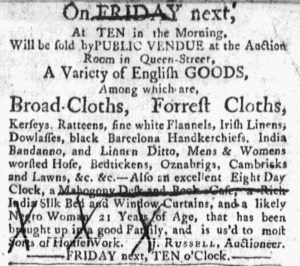
“A Mahogony Desk and Book-Case.”

This advertisement presents a conundrum.  It attracted my attention because someone made manuscript notations on the copy of the Massachusetts Gazette and Boston Post-Boy that has been preserved in an archive and digitized for greater accessibility.  They crossed out “FRIDAY” in the portion of the headline that gave the date of an auction, crossed out “a Mahagony Desk and Book-Case” midway through the advertisement, and placed three large “X” over most of the rest of the content.  I suspected that either Joseph Russell or John Green, the partners who published the Massachusetts Gazette and Boston Post-Boy, made those notations to guide the compositor in setting type for a revised version of the advertisement to appear in a subsequent issue.  Russell, the auctioneer who placed the advertisement, focused primarily on operating the “Auction Room in Queen-Street” while Green oversaw the newspaper and the printing office.

A revised version did not appear in a subsequent edition of the Massachusetts Gazette and Boston Post-Boy.  The same advertisement did run in the Boston Evening-Post and the Boston Gazette on Monday, January 13, 1772, the same day it appeared in the Massachusetts Gazette and Boston Post-Boy.  Those newspapers ran the same copy, but with variations in line breaks because the compositors made their own decisions about format.  I also looked for revised versions of the advertisement in other newspapers published in Boston between January 13 and the day of the sale.  The Massachusetts Spy published on Thursday, January 16, the day before the say, did not carry the advertisement, but the Massachusetts Gazette and Boston Weekly News-Letter distributed on the same day did feature a slightly revised version.  Only the first line differed from the original version, stating that the auction would take place “TO-MORROW” rather than “On FRIDAY next.”

Massachusetts Gazette and Boston Weekly News-Letter (January 16, 1772).

The rest of the advertisement was identical to the one that ran in the Massachusetts Gazette and Boston Post-Boy earlier in the week.  The copy was identical and the format (including line breaks, spelling, and capitals) was identical.  Even the lines on either side of “FRIDAY next, TEN o’Clock” on the final line were identical.  Both advertisements lacked a space between “by” and “PUBLIC VENDUE” on the third line.  The manuscript notations on the original advertisement may have directed someone in revising the first line, but not the remainder of the notice.  Even more puzzling, it looks as though Green and Russell shared type already set at their printing office with Richard Draper, the printer of the Massachusetts Gazette and Boston Weekly News-Letter.  This is not the first time that I have detected such an instance in newspapers published by these printers in the late 1760s and early 1770s.  It raises questions about both the logistics and the business practices of those involved, questions that merit greater attention and closer examination of the contents, both news and advertising, in the two newspapers.

Slavery Advertisements Published January 13, 1772

GUEST CURATOR: Chris Barone

The Slavery Adverts 250 Project chronicles the role of newspaper advertising in perpetuating slavery in the era of the American Revolution. The project seeks to reveal the ubiquity of slavery in eighteenth-century life from New England to Georgia by republishing advertisements about enslaved people – for sale as individuals or in groups, wanted to purchase or for hire for short periods, runaways who liberated themselves, and those who were subsequently captured and confined in jails and workhouses – in daily digests on this site as well as in real time via the @SlaveAdverts250 Twitter feed, utilizing twenty-first-century media to stand in for the print media of the eighteenth century.

The project aims to provide modern audiences with a sense of just how often colonizers encountered these advertisements in their daily lives. Enslaved men, women, and children appeared in print somewhere in the colonies almost every single day. Those advertisements served as a constant backdrop for social, cultural, economic, and political life in colonial and revolutionary America. Colonizers who did not purport to own enslaved people were still confronted with slavery as well as invited to maintain the system by purchasing enslaved men, women, and children or assisting in the capture of so-called “runaways” who sought to free themselves from bondage. The frequency of these newspaper advertisements suggests just how embedded slavery was in colonial and revolutionary American culture in everyday interactions beyond the printed page.

These advertisements also testify to the experiences of enslaved men, women, and children, though readers must consider that those experiences have been remediated through descriptions offered by enslavers rather than enslaved people themselves. Often unnamed in the advertisements, enslaved men, women, and children were not invisible or unimportant in early America.

These advertisements appeared in colonial American newspapers 250 years ago today.

Boston Evening-Post (January 13, 1772).

**********

Boston Evening-Post (January 13, 1772).

**********

Boston-Gazette (January 13, 1772).

**********

Boston-Gazette (January 13, 1772).

**********

Boston-Gazette (January 13, 1772).

**********

Massachusetts Gazette and Boston Post-Boy (January 13, 1772).

**********

New-York Gazette and Weekly Mercury (January 13, 1772).

**********

New-York Gazette and Weekly Mercury (January 13, 1772).

**********

New-York Gazette and Weekly Mercury (January 13, 1772).

**********

New-York Gazette and Weekly Mercury (January 13, 1772).

**********

New-York Gazette and Weekly Mercury (January 13, 1772).

**********

South-Carolina and American General Gazette (January 13, 1772).

**********

South-Carolina and American General Gazette (January 13, 1772).

**********

South-Carolina and American General Gazette (January 13, 1772).

**********

South-Carolina and American General Gazette (January 13, 1772).

**********

South-Carolina and American General Gazette (January 13, 1772).

**********

South-Carolina and American General Gazette (January 13, 1772).

**********

South-Carolina and American General Gazette (January 13, 1772).

**********

South-Carolina and American General Gazette (January 13, 1772).

**********

South-Carolina and American General Gazette (January 13, 1772).

**********

South-Carolina and American General Gazette (January 13, 1772).

**********

South-Carolina and American General Gazette (January 13, 1772).

**********

South-Carolina and American General Gazette (January 13, 1772).

**********

South-Carolina and American General Gazette (January 13, 1772).

**********

South-Carolina and American General Gazette (January 13, 1772).

**********

South-Carolina and American General Gazette (January 13, 1772).

**********

South-Carolina and American General Gazette (January 13, 1772).

**********

South-Carolina and American General Gazette (January 13, 1772).

January 12

What was advertised in a colonial American newspaper 250 years ago this week?

Pennsylvania Gazette (January 9, 1772).

“Friends to American Manufactures will give the preference to his Parchment.”

Advertising campaigns that encouraged consumers to “Buy American” predate the American Revolution.  During the period of the imperial crisis that eventually culminated in thirteen colonies declaring independence, advertisers promoted “domestic manufactures” as alternatives to goods imported from England.  Robert Wood did so in the early 1770s.  He drew attention to “PARCHMENT MADE and SOLD by ROBERT WOOD” in an advertisement in the January 9, 1772, edition of the Pennsylvania Gazette.  Several printers also stocked and sold Wood’s parchment, making it convenient for consumers to acquire.

Producing parchment in Philadelphia might not seem like a significant act itself, but Wood insisted that “EVERY Manufacture carried on among us, however small,” yielded “good consequences to the country in general.”  He did his part to support the local economy and resist the abuses of Parliament (including duties on imported paper and other goods that had only recently been repealed) by making and selling parchment, but he needed consumers as partners to complete the transaction and truly make an impact.  For those who had concerns about the quality of his parchment compared to what they might acquire from merchants and shopkeepers who imported parchment, he asserted that “several of the most eminent Conveyancers in this city” had been purchasing from him “for some time past” and they considered his product “superior to the generality of what is imported.”  Furthermore, he set prices “as low as that imported,” yet another reason to purchase his parchment.

Wood concluded by reminding consumers that their choices in the marketplace had consequences.  He requested that the “friends to American Manufactures … give the preference to his Parchment” over any other, especially imported parchment.  In deploying such a title, “friends to American Manufactures,” Wood implicitly suggested to consumers that making other choices made them opponents of goods produced in the colonies and the welfare of their community.

January 11

What was advertised in a colonial American newspaper 250 years ago today?

Providence Gazette (January 11, 1772).

“The Names of the Subscribers to any of the above will be printed.”

Robert Bell, one of the most influential booksellers of the eighteenth century, worked to create an American literary market both before and after the American Revolution.  In the early 1770s, he published an American edition of William Blackstone’s Commentaries on the Laws of England.  He promoted this project to supporters of “domestic manufactures,” goods produced in the colonies.

In an advertisement in the January 11, 1772, edition of the Providence Gazette, for instance, he addressed the “Gentlemen of Rhode-Island, and all those who are animated by the Wish of seeing NATIVE FABRICATIONS flourish in AMERICA.”  Such “FABRICATIONS” included not only printing an American edition but doing so “on American Paper.”  That eliminated two kinds of imported goods, “the last British Edition” that Bell consulted in producing his American edition and paper produced in England.  In turn, this provided employment for papermakers and printers in the colonies.  In addition, those who purchased the American edition acquired it for a bargain price.  Bell indicated that the first volume of the British Edition “is sold for above Six Dollars,” but he charged “the small Price of Two Dollars” for the American edition.  The enterprising bookseller also hawked an “American Edition of ROBERTSON’s History of Charles the Fifth” and accepted subscriptions for another proposed project, “HUME’s History of ENGLAND.”  Colonizers could support the local economy by stocking their libraries with a significant number of American editions.

In the process, they could also receive recognition for their support of “NATIVE FABRICATIONS.”  Bell concluded his advertisement with a note that the “Names of the Subscribers to any of the above will be printed.”  Buyers had the chance to see their names in print in good company with others who had the good taste and intellectual acumen to read (or at least purchase) these works by Blackstone, Robertson, and Hume.  While relatively few friends and acquaintances might see any of these volumes in subscribers’ homes or offices, anyone who perused the lists, often bound into the books, would see who purchased copies of their own.  Bell hoped that a desire to support domestic manufactures would convince colonizers to buy his American editions, but he hedged his bets by also offering the opportunity to have such support publicly acknowledged.

January 10

What was advertised in a colonial American newspaper 250 years ago today?

Connecticut Journal (January 10, 1772).

“ROYAL SPIRITUAL MAGAZINE.”

Among the advertisements placed by local merchants and shopkeepers in the January 10, 1772, edition of the Connecticut Journal and New-Haven Post-Boy, readers encountered a subscription notice for “The ROYAL SPIRITUAL MAGAZINE: OR, THE CHRISTIAN’s GRAND TREASURE,” a magazine published in Philadelphia.  Joseph Crukshank printed the magazine for John McGibbons, who also invited readers to subscribe to “The WORKS of Flavius Josephus, In Four Volumes.”  McGibbons instructed “GENTLEMEN who are pleased to exemplify and encourage” the Royal Spiritual Magazine to submit their names to the printers of the Connecticut Journal or one of several other local agents.  McGibbons also noted he published one issue a month, with the “Fourth Number … already published, and the Fifth in the Press.”  The promise of forthcoming issues did not meet with the success that the publisher hoped.  The Royal Spiritual Magazine soon folded.  Rather than publish magazines in the colonies, printers and booksellers imported magazines from London, often listing them among the various titles available at their shops.

According to Frank Luther Mott’s “Chronological List of Magazines,” the Royal Spiritual Magazine was only the fourteenth magazine attempted in the colonies.[1]  Most previous efforts lasted less than a year, some only a few issues.  The most successful, the American Magazine and Historical Chronicle published by Rogers and Fowle in Boston, ran for just over three years from September 1743 to December 1746.  Mott mentions the Royal Spiritual Magazine only twice in A History of American Magazine, 1741-1850.  In addition to including it in the “Chronological List,” he states that “from 1760 to 1774 there were only three magazines started, the least unsuccessful of which was a nine months’ wonder.”[2]  A footnote indicates that the Royal Spiritual Magazine was one of them.

McGibbons did not effectively deploy advertising to promote the Royal Spiritual Magazine and attract subscribers.  Even though he advertised in the Connecticut Journal and established a network of local agents to receive subscriptions, he did not place similar advertisements for the magazine in other newspapers simultaneously.  He did not target prospective subscribers in the largest cities, Boston, Charleston, New York, and Philadelphia.  Given the lackluster performance of magazines published in the colonies, a more robust advertising campaign would not necessarily have yielded greater success for the Royal Spiritual Magazine.  Yet McGibbons did seem to appreciate the value of advertising widely when it came to his other project.  The January 9 edition of the New-York Journal featured an extensive subscription notice for “The Works of FLAVIUS JOSEPHUS” that included local agents in six cities and towns in Pennsylvania, New Jersey, and New York.  Why did he settle on the Connecticut Journal as the only newspaper for promoting the Royal Spiritual Magazine, especially when other printers and publishers placed subscription notices for other works in multiple newspapers simultaneously and cultivated networks of local agents throughout the colonies?

**********

[1] Frank Luther Mott, A History of American Magazines, 1741-1850 (Cambridge: Harvard University Press, 1939), 787.

[2] Mott, History of American Magazines, 26.

January 9

What was advertised in a colonial American newspaper 250 years ago today?

Massachusetts Gazette and Boston Weekly News-Letter (January 9, 1772).

“Cutlery Ware.”

Chris Barone, a student in my Revolutionary America class in Fall 2021, selected this advertisement that Nathan Frazier placed in the January 9, 1772, edition of the Massachusetts Gazette and Boston Weekly News-Letter.  It prompted a conversation about how the meanings of some words have shifted since the eighteenth century.  Frazier advertised “Cutlery Ware” among his “fresh Assortment of English and Scotch GOODS,” but that phrase did not mean knives, forks, and spoons to the shopkeeper or his prospective customers.

Instead, cutlery referred to “the art or trade of the cutler,” according to the Oxford English Dictionary.  That gave us a chance to discuss the cutler, “one who makes, deals in, or repairs knives and similar cutting utensils,” as a common occupation in the eighteenth century.  It also prompted us to explore the entry for “cutlery” in the Oxford English Dictionary in greater detail.  We learned that the word also refers to “articles made or sold by cutlers, as knives, scissors, etc.”  That definition included an example from 1787, the same period as the advertisement Chris selected.  For other examples, we looked to previous entries in the Adverts 250 Project.  We discovered several advertisements placed by cutlers that listed a variety of items they made, sold, and repaired.  Samuel Wheeler advertised “good scythes and sickles” in the Pennsylvania Gazette in June 1770.  Amos Atwell listed “Case Knives and Forks, Carving Knives and Forks, Pocket and Pen Knives of various Kinds, Razors, [and] Surgeons Instruments” in an advertisement for his “CUTLERY BUSINESS” in the Providence Gazette in 1771.  Bailey and Youle, “Cutlers from Sheffield,” informed the public that they “MAKE all sorts of surgeons instruments” and “grinds all sorts of knives, razors, shears, and scissors” in an advertisement in the New-York Gazette and Weekly Mercury in March 1771.  A month later, Richard Sause ran a similar advertisement that included the same services and added “sword cutling.”  Bailey and Youle included an image depicting about a dozen cutlery items.  Sause again imitated his competitors with a similar image.

The Oxford English Dictionary also includes a definition for cutlery more familiar to modern readers: “knives, forks, spoons, etc., used for eating or serving food; a set of table utensils of this kind.”  That entry includes several examples, though the earliest dates from 1821, half a century after Frazier placed his advertisement.  A note also states that in earlier examples it is difficult to distinguish this meaning from “articles made or sold by cutlers.”  Frazier’s advertisement for “Cutlery Ware” demonstrated that colonizers easily spoke a language of consumption among themselves that requires some effort by historians to understand 250 years later.

Welcome, Guest Curator Chris Barone

Chris Barone is a junior majoring in Criminology and minoring in History at Assumption University in Worcester, Massachusetts. His interests in history include Colonial America, the American Civil War, and World War II. Beyond the classroom, Chris plays for the University’s hockey team. He also works for his parents as an engineering assistant at their company, Live Automation. He is the oldest of three children. He made contributions to the Adverts 250 Project and the Slavery Adverts 250 Project when enrolled in Revolutionary America, 1763-1815, in Fall 2021.

Welcome, guest curator Chris Barone!