March 19

What was advertised in a revolutionary American newspaper 250 years ago today?
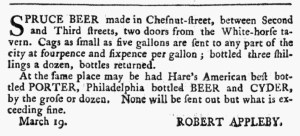
Pennsylvania Evening Post (March 19, 1776).

“Hare’s American best bottled PORTER.”

Robert Appleby apparently specialized in beers brewed locally.  Those were the only products that he promoted in an advertisement that ran in the March 19, 1776, edition of the Pennsylvania Evening Post.  He opened with “SPRUCE BEER” that he brewed himself “in Chesnut-street, between Second and Third streets, two doors from the White-horse tavern” in Philadelphia.  Even if prospective customers were not already familiar with his beer, they could certainly find him once they were in the vicinity of the tavern.  Flavored with spruce needles or buds, this popular beverage helped in preventing scurvy.  Appleby sold his spruce beer in bottles, charging three shillings a dozen, or kegs as small as five gallons.  For the convenience of his customers, he offered delivery “to any part of the city.”

He also distributed beer that he did not brew, “Hare’s American best bottled PORTER.”  That beverage already had quite a reputation in Philadelphia.  Over the past several months, several tavernkeepers placed advertisements to alert prospective patrons when they planned to “open a TAP of Mr. HARE’s best AMERICAN DRAUGHT PORTER,” often associating drinking a brew brewed in the colony (and gathering together to do so) with support for the American cause.  Patrick Meade, for instance, declared that he “expects the Associators of Freedom will encouragement to the American Porter it deserves,” and Joseph Price called on “all the SONS of AMERICAN LIBERTY” to drink it at his tavern at “the sign of the Bull and Dog.”

In addition to his spruce beer and the most famous beer brewed in the city at the time, Appleby also sold “Philadelphia bottled BEER and CYDER, by the grose or dozen,” pledging that “None will be sent out but what is exceeding fine.”  Elsewhere in the same issue, Robert Bell placed competing advertisements for his third edition of Thomas Paine’s Common Sense and James Chalmers’s Plain Truth, a response that depicted the “scheme of INDEPENDANCE” as “ruinous, delusive, and impracticable.”  Whether or not they purchased those pamphlets, the readers who consumed Appleby’s spruce beer and Hare’s porter likely had animated conversations as they discussed current events.
March 18

What was advertised in a revolutionary American newspaper 250 years ago today?

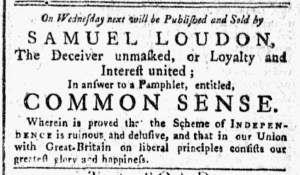
New-York Gazette and Weekly Mercury (March 18, 1776).

“The Deceiver unmasked … In answer to a Pamphlet, entitled, COMMON SENSE.”

As Robert Bell advertised Plain Truth, a response to Thomas Paine’s Common Sense, in Philadelphia in March 1776, Samuel Loudon, a printer and bookseller in New York, prepared to publish and sell “The Deceiver unmasked, or Loyalty and Interest united; in answer to a Pamphlet, entitled COMMON SENSE.”  On Monday, March 18, he announced that two days later he would make available a new pamphlet “Wherein is proved that the Scheme of INDEPENDENCE is ruinous and delusive, and that in our Union with Great-Britain on liberal principles consists our greatest glory and happiness.”  By the time Loudon placed this advertisement, he may have seen an advertisement for Plain Truth in a newspaper printed in Philadelphia, borrowing the words “ruinous” and “delusive” for his own advertisement.

At first glance, this advertisement seems to contradict Thomas R. Adams’s assertion that only two pamphlets directly responding Common Sense appeared in the colonies in the six months between its publication in January and the Continental Congress declaring independence in July.  Bell published Plain Truth in the middle of March and James Humphreys, Jr., published The True Interest of America Impartially Stated in Certain Strictures on a Pamphlet Intitled Common Sense at the end of May.[1]  What about Loudon’s Deceiver Unmasked?  In a footnote, Adams explains that a “third pamphlet … was printed by Samuel Loudon in New York, but it was never sold because a Committee of Mechanics under Christopher Duyckinck destroyed almost all of the 1,500 copies.”[2]  One of the notes in the American Antiquarian Society’s catalog entry for Deceiver Unmasked provides more information: “The New-York Historical Society copy bears the [manuscript] note: General Duykinck’s Committee went to the House of Mr. Loudon’s and destroyed all these pamphlets just as they were ready to be published. — this Copy was saved.”  That delayed rather than prevented dissemination of Deceiver Unmasked.  The pamphlet eventually came off Humphreys’s press in Philadelphia as The True Interest of America.  Readers intrigued by Loudon’s advertisement for Deceiver Unmasked had to wait months for its publication, not knowing during that time whether Loudon or any other printer would even attempt it.  The first edition met with sufficient success that Humphreys issued a second edition.  While neither Plain Truth nor Deceiver Unmasked/True Interest of America had much impact, the publication and marketing of these responses to Common Sense demonstrates that printers believed a market existed for Loyalist tracts.

**********

[1] Thomas R. Adams, “The Authorship and Printing of Plain Truth by ‘Candidus,’” Papers of the Bibliographical Society of America 49, no. 3 (1955): 230-231.

[2] Adams, “Authorship and Printing,” 230.

March 17

What was advertised in a revolutionary American newspaper 250 years ago this week?

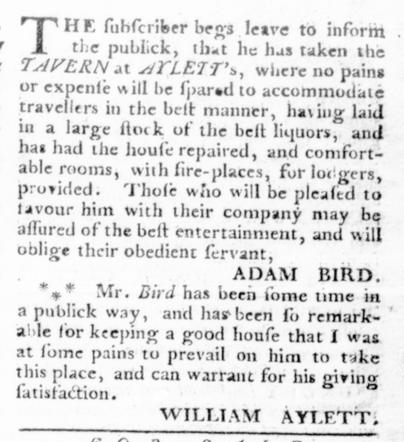
Virginia Gazette [Purdie] (March 15, 1776).

“Mr. Bird … has been so remarkable for keeping a good house.”

When Adam Bird commenced operating the “TAVERN at AYLETT’s” in the spring of 1776, he took to the pages of Alexander Purdie’s Virginia Gazette to invite patrons to his establishment.  He assured prospective customers that “no pains or expense will be spared to accommodate travellers in the best manner.”  To that end, he had “laid in a large stock of the best liquors” for their enjoyment.  In addition, he “had the house repaired, and comfortable rooms, with fire-places, for lodgers, provided.”  Whether or not readers had previously visited the tavern at that location, Bird hoped that the improvements he made would entice them to visit.  “Those who will be pleased to favour him with their company,” he pledged, “may be assured of the best entertainment” as “their obedient servant” catered to them.  Bird made common appeals that tavernkeepers and innkeepers incorporated into their advertisements.

He also included an uncommon element that distinguished his advertisement from others.  As an addendum, William Aylett gave his endorsement of Bird and his management of the tavern.  “Mr. Bird has been some time in a publick way,” Aylett explained, “and has been so remarkable for keeping a good house that I was at some pains to prevail on him to take this place.”  In other words, Aylett, who may have had experience as a tavernkeeper himself or may have been merely the proprietor of the building, was familiar with Bird’s previous experience running a public house and that prompted him to invite Bird to open an establishment at the “TAVERN at AYLETT’s.”  He intended to leverage Bird’s reputation through vouching for him, aiming to convince prospective customers that they would indeed enjoy eating, drinking, and lodging at the tavern.  Aylett nearly gave a guarantee, declaring that he could “warrant for [Bird] giving satisfaction to his patrons.  Prospective patrons who did not know Bird, the new manager at the “TAVERN at AYLETT’s,” but did know Aylett, the proprietor, may have found the endorsement more enticing than Bird’s overview of the services he provided.

March 16

What was advertised in a revolutionary American newspaper 250 years ago today?

Pennsylvania Ledger (March 16, 1776).

“PLAIN TRUTH … containing Remarks on a late Pamphlet intituled COMMON SENSE.”

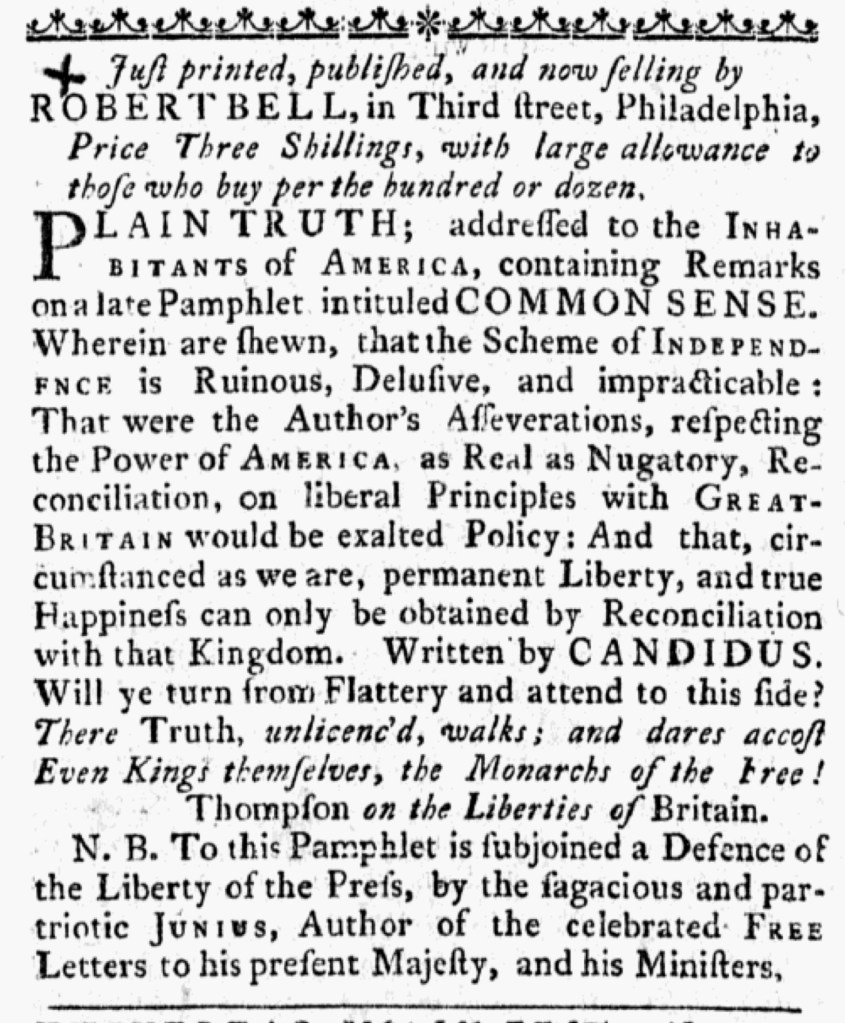
Robert Bell published the first edition of Thomas Paine’s Common Sense on January 9, 1776, and not long after that he published a response, “PLAIN TRUTH; addressed to the INHABITANTS of AMERICA, containing Remarks on a late Pamphlet intituled COMMON SENSE.”  As was often the case in eighteenth-century advertisements for books and pamphlets, Bell used the extensive subtitle as the copy for marketing the volume: “Wherein are shewn, that the Scheme of INDEPENDENCE is Ruinous, Delusive, and impracticable: That were the Author’s Asseverations, respecting the Power of AMERICA, as Real as Nugatory, Reconciliation, on liberal Principles with GREAT-BRITAIN would be exalted Policy: And that, circumstances as we are, permanent Liberty, and true Happiness can only be obtained by Reconciliation with that Kingdon.”

According to Thomas R. Adams, only two pamphlets answered Common Sense in the six months between its publication in January and the Continental Congress declaring independence in July.  Robert Bell first advertised Plain Truth in the Pennsylvania Gazette on March 13.  Near the end of May, James Humphreys, Jr., published The True Interest of America Impartially Stated in Certain Strictures on a Pamphlet Intitled Common Sense.[1]  Bell quickly placed advertisements in other newspapers printed in Philadelphia, including the Pennsylvania Evening Post on March 14 and the Pennsylvania Ledger on March 16.  In each advertisement, he set the price at three shillings for a single copy “with large allowance to those who buy per the hundred or dozen.”  In other words, Bell offered a significant discount for buying in volume, hoping to make the pamphlet more attractive to consumers who might buy a dozen to share with friends and retailers who might buy a hundred to sell in their own shops in Philadelphia and beyond.  He may not have anticipated that Plain Truth would achieve the same popularity as Common Sense, yet he was still a savvy entrepreneur who aimed to generate revenue from the debate over declaring independence.  “To this Pamphlet is subjoined,” a nota bene at the end of the advertisement informed readers, “a Defence of the Liberty of the Press.”  Adams asserts that Bell “pleaded for the right to present both sides of the question.  No doubt he hoped thereby to increase the sales of both pamphlets.”[2]  James Rivington had done the same in advertisements with headlines like “THE AMERICAN CONTEST” and “The American Controversy” that promoted pamphlets “on both sides, in the unhappy dispute with Great-Britain.”  Humphreys, who eventually published The True Interest of America Impartially Stated, also ran advertisements for “POLITICAL PAMPHLETS, ON Both Sides of the Question.”  Such pamphlets educated colonizers and helped them understand and formulate their own positions, yet they also presented opportunities for printers to generate revenue from current events.

**********

[1] Thomas R. Adams, “The Authorship and Printing of Plain Truth by ‘Candidus,’” Papers of the Bibliographical Society of America 49, no. 3 (1955): 230-231.

[2] Adams, “Authorship and Printing,” 235.

March 15

What was advertised in a revolutionary American newspaper 250 years ago today?

Henrich Millers Pennsylvanischer Staatsbote (March 15, 1776).

“Gesunde Bernunft.”

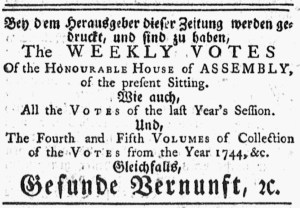
An advertisement partially in English and partially in German informed readers of the March 15, 1776, edition of Henrich Millers Pennsylvanischer Staatsbote that the printer stocked and sold several political journals, including “The WEEKLY VOTES Of the HONOURABLE HOUSE of ASSEMBLY, of the present Sitting,” “All the VOTES of the last Year’s Session,” and “The Fourth and Fifth VOLUMES of [the] Collection of the VOTES from the Year 1744.”  Miller offered his readers opportunities to learn more about current events as well as the political history of Pennsylvania over the past three decades.  “Gleichfalls” or likewise, he sold “Gesunde Bernunft,” a German translation of Thomas Paine’s Common Sense.  Among the many printers who had advertised the popular political pamphlet in the two months since Robert Bell published the first edition in Philadelphia on January 9, Miller was the first to list it as an item also available for purchase rather than making it the focal point of his advertisement.

That had not always been the case in the pages of Henrich Millers Pennsylvanischer Staatsbote.  On January 16, Bell inserted an advertisement (in English) that announced the publication and sale of Common Sense at his shop on Third Street.  A week later, Bell’s advertisement ran once again, this time competing with an advertisement (in German) that announced that Gesunde Bernunft “Es ist jebt under der Presse” or “is in the press” and soon to be published by Melchior Steiner and Carl Cist.  Although Steiner and Cist did not collaborate with Bell on their German edition, they replicated much of his advertisement.  That included giving readers an overview of the contents by listing the headings for the four sections of pamphlet and publishing an epigraph from “Liberty,” a poem by James Thomson.  A month later, Steiner and Cist ran another advertisement (in German) announcing publication of Gesunde Bernunft.  They charged one shilling for a single copy or nine shillings for a dozen.  Like other printers, they offered a discount for those who purchased in volume for retail sales or to distribute to family and friends.

The Adverts 250 Project continues to track the proliferation of local editions of Common Sense and newspaper advertisements intended to disseminate the pamphlet widely, yet a complete accounting cannot overlook the German translation, Gesunde Bernunft, published and advertised by Steiner and Cist.  Very shortly after the pamphlet grabbed the attention of English-speaking colonizers, Steiner and Cist set about making Paine’s radical ideas accessible to German-speaking colonizers in Philadelphia and the backcountry.

March 14

What was advertised in a revolutionary American newspaper 250 years ago today?

New-England Chronicle (March 14, 1776).

“A few copies of the valuable pamphlet, intitled, COMMON SENSE, to be sold by the Printer hereof.”

Just three days before the British evacuated Boston, ending the siege that began nearly a year earlier following the battles at Lexington and Concord, the first advertisement for Thomas Paine’s Common Sense appeared in the New-England Chronicle.  Samuel Hall published that newspaper, according to the masthead, “at his Printing-Office in Stoughton-Hall, HARVARD-COLLEGE,” in Cambridge.  Most of the newspapers published in Boston before the fighting commenced ceased or suspended publication or relocated beyond the city.  Amid such disruption, Hall moved the Essex Gazette, formerly published in Salem, to Cambridge and renamed it the New-England Chronicle.  During the first year of the Revolutionary War, it served the towns outside of Boston and the American encampment where General George Washington oversaw the siege.

That first advertisement for Paine’s influential political pamphlet in the New-England Chronicle contained little fanfare.  Unlike the advertisements that ran in most other newspapers, it did not provide an overview by listing the several sections within the pamphlet.  Instead, two brief lines advised, “A few copies of that valuable pamphlet, intitled COMMON SENSE, to be sold by the Printer hereof.”  Perhaps Hall felt that Common Sense did not need much introduction, especially if prospective customers had already heard about it and discussed the radical ideas that Paine espoused.  After all, Robert Bell published the first edition in Philadelphia two months earlier.  That was plenty of time for word to spread to Cambridge.  In addition, the pamphlet was so popular that Bell quickly took a second (unauthorized) edition to press, Paine worked with William Bradford and Thomas Bradford to publish a new edition in Philadelphia, and printers in several towns in New York and New England published, advertised, and sold local editions.  Which edition did Hall have on hand to sell at his printing office?  He may have acquired copies of the edition jointly published by Timothy Green, the printer of the Connecticut Gazette in New London, and Judah P. Spooner, a printer in Norwich, or the edition published by John Carter, the printer of the Providence Gazette.  Alternately, he may have received copies of other editions sent to him from as far away as New York or Philadelphia … or perhaps even a local edition published in Salem by Ezekiel Russell not previously advertised in any newspaper.  Even if readers of the New-England Chronicle already knew about the ideas that Paine presented in Common Sense, few had likely read the pamphlet for themselves.  Hall provided an opportunity for them to do so, aiding in the dissemination of the pamphlet in the months before the Continental Congress declared independence.

March 13

What was advertised in a revolutionary American newspaper 250 years ago tiday?

Connecticut Journal (March 13, 1776).

“That much esteemed Pamphlet, intitled, COMMON SENSE.”

Two months after Robert Bell published the first edition of Thomas Paine’s Common Sense in Philadelphia, printers in other cities and towns in New York and New England published local editions that increased the circulation of the popular political pamphlet.  Advertisements for Common Sense proliferated as those printers marketed their editions and other printers and booksellers acquired copies that they sold in their communities.  On March 13, 1776, an advertisement for Common Sense appeared in the Connecticut Journal, published in New Haven, for the first time.

Just published & to be sold by the Printers hereof,” Thomas Green and Samuel Green announced, “That much esteemed Pamphlet, intitled, COMMON SENSE; ADDRESSED To the INHABITANTS of AMERICA.”  The Greens, however, had not published their own local edition.  As was the case with so many other advertisements for books and pamphlets, eighteenth-century readers knew to separate the phrases “Just published” and “sold by the Printers hereof.”  The latter did not mean that the printers had published the pamphlet themselves; instead, it meant that the pamphlet was “now available” rather than “forthcoming” or “in the press.”

The Greens stocked an edition that included “an APPENDIX to Common Sense, and an Address to the Representatives of the People called Quakers.”  Paine included that additional material in his approved new edition published by William Bradford and Thomas Bradford, the printers of the Pennsylvania Journal, after he parted ways with Bell.  It did not take long for Bell to pirate those items and incorporate them into a supplementary pamphlet of essays he marketed as related to Common Sense.  On the same day that the Greens first advertised Common Sense in the Connecticut Journal, the Bradfords once again cautioned the public that the “Pamphlet advertised by Robert Bell, entitled Additions to Common Sense … consists of pieces taken out of the News-papers, and not written by the author of Common Sense.”  That the Greens did not mention any additional material except the “APPENDIX, and an Address to the Representatives of the People called QUAKERS” suggests that they stocked copies published by the Bradfords rather than by Bell.  The advertisement does not definitively demonstrate that was the case, but it does show that more and more printers made some version of the political pamphlet available to readers.  The Greens simultaneously advertised “EXTRACTS from the VOTES and PROCEEDINGS of the American CONTINENTAL CONGRESS,” supplying customers with other products to keep informed beyond what they read in the newspaper.

March 12

What was advertised in a revolutionary American newspaper 250 years ago today?

Dunlap’s Maryland Gazette (March 12, 1776).

“AN ORATION, IN MEMORY OF GENERAL MONTGOMERY.”

The March 12, 1776, edition of Dunlap’s Maryland Gazette carried an advertisement for “AN ORATION, IN MEMORY OF GENERAL MONGTOMERY: And of the OFFICERS and SOLDIERS who fell with him before QUEBEC.”  Readers knew well that Major General Richard Montgomery, the commander of the American invasion of Canada, had been killed in action in failed attack on Quebec City on December 31, 1775.  The deaths of Montgomery and Major General Joseph Warren at the Battle of Bunker Hill on June 17, 1775, had been the most significant losses during the first year of the Revolutionary War.  After the war, John Trumbull memorialized both patriots in paintings that depicted their sacrifice.

Shortly after Montgomery’s death, the Continental Congress invited William Smith, an Anglican minister and provost of the College of Philadelphia (now the University of Pennsylvania, to preach at a memorial service for Montgomery on February 19, 1776.  The message that he delivered surprised many members of the Continental Congress, angering them with the blatant loyalism he espoused.  As Christopher A. Hunter outlines, Smith “prais[ed] Montgomery’s ‘loyalty to his sovereign.’”  Furthermore, he proclaimed that “the delegated voice of the continent … supports me in praying for a restoration ‘of the former harmony between Great Britain and these Colonies.”[1]  Smith directly quoted the Olive Branch Petition, a final effort to broker peace and a redress of grievances.  When George III refused to even read that missive, it convinced many colonizers that reconciliation was not possible.

In a letter to Abigail Adams, John described the oration as “an insolent Performance” and described what happened after William Livingston, a delegate from New Jersey, suggested that the Continental Congress publish Smith’s memorial to Montgomery.  “A Motion was made to Thank the orator and ask a Copy—But opposed with great Spirit, and Vivacity from every Part of the Room, and at last withdrawn, lest it be should be rejected as it certainly would have been with Indignation.”  Yet an advertisement for the oration appeared in Dunlap’s Maryland Gazette and several other newspapers.  “The orator then printed it himself,” Adams continued, “after leaving out or altering some offensive Passages.”  Hunter notes that Smith doubled down on some parts that Adams and others found most troublesome, “adding a preface declaring, ‘whatever claim he may have to the appellation of a good Citizen or Friend to Liberty’ must rest on his efforts to prevent American independence.”[2]

John Dunlap, the printer of Dunlap’s Pennsylvania Packet and Dunlap’s Maryland Gazette, printed the “ORATION,” advertised it in his newspapers, and sold it at his printing offices in Philadelphia and Baltimore.  Despite the controversy, printers in New York, Newport, and Norwich published local editions, disseminating even more copies.  Each also published, marketed, and sold their own editions of Thomas Paine’s Common Sense, a pamphlet that strongly advocated for declaring independence.  Perhaps they thought that honoring Montgomery and the officers and soldiers killed during the Battle of Quebec outweighed the portions of Smith’s commentary that patriots found so “insolent.”  Perhaps they merely sought to generate revenue by publishing a pamphlet that commemorated Montgomery.  Maybe they simultaneously pursued both courses.  Whatever their inspiration, readers of Dunlap’s Maryland Gazette and other newspapers repeatedly saw Montgomery memorialized when they perused the advertisements.  Many likely did not associate that act of veneration with the problematic rhetoric Smith introduced in his “ORATION.”

**********

[1] Christopher A. Hunter, “William Smith’s Catonian Loyalism, Race, and the Politics of Language,” Early American Literature 52, no. 3 (2017): 531.

[2] Hunter, “William Smith’s Catonian Loyalism,” 531.

March 11

What was advertised in a revolutionary American newspaper 250 years ago today?

Norwich Packet (March 11, 1776).

“A few Copies of a Pamphlet, ENTITLED, COMMON SENSE, May be had of the Printers hereof.”

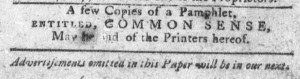
Alexander Robertson, James Robertson, and John Trumbull, the printers of the Norwich Packet, ran out of space for all the content intended for the March 11, 1776, edition of their newspaper.  They inserted a brief notice advising, “Advertisements omitted in this Paper will be in our next.”  They did have just enough space to insert a revised advertisement for Thomas Paine’s Common Sense immediately above that notice: “A few Copies of a Pamphlet, ENTITLED, COMMON SENSE, May be had of the Printers hereof.”

Norwich Packet (March 11, 1776).

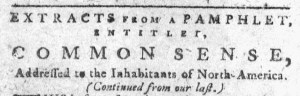
The printers first ran a variation of that advertisement on February 26, but that was not the extent of the notice that Common Sense received in that issue.  Nathanel Patten, a bookbinder and stationer, inserted a separate advertisement that provided an overview of the contents by listing the section headings.  That replicated advertisements for Common Sensethat previously appeared in other newspapers.  In addition, the Robertsons and Trumbull published “EXTRACTS from aPamphlet entitled COMMON SENSE; addressed to the INHABITANTS of AMERICA” on the third page.  In making their selection, they passed over the first section of the pamphlet, “Of the Origin and Design of Government in general, with concise Remarks on the English Constitution,” and went directly to the second section, “Of MONARCHY and hereditary succession.”  The printers devoted half a column to the “EXTRACTS” and promised, “[To be continued.]” They were more generous the following week, allowing nearly two columns for “EXTRACTS FROM A PAMPHLET, ENTITLED, COMMON SENSE.”  In the issue that “omitted” advertisements and promised publication “in our next,” the printers designated two columns for further “EXTRACTS.”  They sacrificed valuable advertising revenue as they disseminated a portion of the popular political pamphlet to readers, though they may have recouped some of that lost revenue by enticing readers to purchase the pamphlet.  The Robertsons and Trumbull continued publishing “EXTRACTS” in another two columns on March 18 and just over two columns on March 25.  On April 1, they gave over the entire first page and another two columns on the last page to continuing the “EXTRACTS.”  On April 8, they concluded the extracted portion of Common Sense, once again featuring it on the first page along with nearly two columns on the last page.  They also promised more material related to the pamphlet, “Additions to the above,” in the next issue.  The Robertsons and Trumbull made it possible for colonizers to engage with Common Sense along multiple trajectories. They could purchase the entire pamphlet and read it for themselves, peruse the extracts in the Norwich Packet, and discuss what they read with others who debated the merits of declaring independence.

March 10

What was advertised in a revolutionary American newspaper 250 years ago this week?

Constitutional Gazette (March 9, 1776).

“The surest means to acquire a speedy sale … is to make them of full quality at a moderate charge.”

In March 1776, Richard Deane, a distiller in New York, took to the pages of the Constitutional Gazette to promote the spirits that he “has now ready for sale at his distillery between the College and the North Rover, in Murray Street, near Vaux-Hall.”  He listed a variety of products, including “Cherry Brandy,” “Shrub of the best quality,” “Royal Usquebaugh,” and “Cinamon water.”  Deane expressed confidence in the reputation his spirits earned in the early 1770s.  “The good quality of said DEANE’s liquors,” he proclaimed, “has for several years past been so well experienced, mostly throughout this continent, that they need no other recommendation.”  Consumers far beyond New York, he suggested, had enjoyed the spirits produced at his distillery.  Not content to rest on his laurels, however, Deane declared that “still he is determined, if possible, to make better.”  If customers liked the liquors he previously produced, then they would be even more satisfied with his current and future endeavors.

As part of this promotion, Deane shared his business philosophy, an aspect of his marketing that may have been familiar to readers who had encountered his advertisements in the New-York Gazette and Weekly Mercury and the New-York Journal over the years.  “Being fully convinced by long experience,” the distiller confided, “that the surest means to acquire a speedy sale of the above articles, is to make them of full quality at a moderate charge.”  Accordingly, he was “determined to sell on as reasonable terms as any one else” and give “good attendance” or customer service to “all his Friends and Customers.”  Such pledges became more powerful through repetition.  Deane built his brand by publishing his business philosophy often so consumers would associate the combination of experience, quality, and reasonable prices with him and his distillery.  He apparently considered it an effective marketing strategy since he published advertisements with the same content in multiple newspapers over the course of several years.