May 26

What was advertised in a revolutionary American newspaper 250 years ago this week?
Virginia Gazette [Dixon and Hunter] (May 25, 1776).

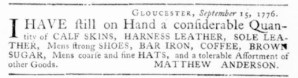
“A CATALOGUE OF BOOKS FOR SALE … By DIXON & HUNTER.”

The May 25, 1776, edition of John Dixon and William Hunter’s Virginia Gazette concluded with a “CATALOGUE OF BOOKS” for sale at their printing office.  It filled most of the final column on the last page.  An advertisement for a “VIEW of the late BATTLE at CHARLESTOWN,” now known as the Battle of Bunker Hill, appeared immediately above it.  Dixon and Hunter also sold that print.  While they certainly wished to generate revenue beyond newspaper subscriptions and advertisements, it appears that the printers also used these notices as filler to complete that edition of their newspaper.

Consider, for instance, the contents of the book catalogue.  Dixon and Hunter updated a book catalogue that previously appeared in the Virginia Gazette six months earlier.  That version classified books by size – folios, quartos, octavos, and duodecimos – and listed titles in alphabetical order by author.  The printers made adjustments to the folios, quartos, and octavos listed in the new catalogue based on their current inventory.  They did not, however, include any duodecimos.  Indeed, the list of octavos ended abruptly with “Martin’s English Dictionary.”  This indicates that Dixon and Hunter included as much of the catalogue as would fit in that final column but did not make it a priority to publish the entire catalogue in that issue.  They may have been printing and distributing the catalogue as a separate broadside or pamphlet, taking advantage of type already set when they needed material for the last page of the May 25 issue.

When they did so, the printers did not attempt to highlight those titles that they thought most likely to attract customers, nor did they make any sales pitch except stating they sold the books “at a low Advance.”  In other words, they charged reasonable prices with only a small markup from what they paid to acquire the imported books.  They did expect customers to pay “READY MONEY” at the time of purchase rather than take away any of the titles on credit.  In the masthead, Dixon and Hunter gave the prices for an annual subscription to the newspaper (twelve shillings and six pence) and running advertisements “of a moderate Length” (three shillings for the first insertion and two shilling for each subsequent insertion).  They also stated that they did job printing “in the NEATEST Manner, with Care and Expedition.” Like most other newspaper printers, they supplemented revenue from printing with revenue from selling books.  They hoped that the incomplete book catalogue would entice prospective customers to find out what other volumes they offered for sale.

May 25

What was advertised in a revolutionary American newspaper 250 years ago today?

Freeman’s Journal (May 25, 1776).

“The Printing-Business, in its different branches carried on with care and fidelity.”

When Benjamin Dearborn circulated subscription proposals for establishing a “NEW WEEKLY PAPER ENTITLED The FREEMAN’s JOURNAL, OR New-Hampshire GAZETTE” in April 1776, he stated that “[a]s soon as a sufficient number of Subscribers appear, the first number will be publish’d.”  It did not take long for him to gain enough subscribers to begin publishing the newspaper.  On May 25, he distributed the first issue.

It may have worked to Dearborn’s advantage that Daniel Fowle, the printer of the New-Hampshire Gazette, suspended his newspaper in January or February.  It had been the only newspaper printed in the colony, which meant that residents relied even more on newspapers printed in Massachusetts and other colonies to supply them with news about current events, including the progress of the war and meetings of the Second Continental Congress in Philadelphia and provincial conventions throughout the colonies.  In the subscription proposals, Dearborn declared that the Freeman’s Journal would include “all authentic domestic intelligence worth notice; together with the most material Extracts from the Southern and other papers.”  He may have received some of those newspapers via exchange networks with other printers, though, like other printers, he would have also participated in a process of reprinting news from one newspaper to another in a chain of disseminating information.

The inaugural issue of the Freeman’s Journal featured a small number of advertisements, enough to fill the final column on the last page.  As many other printers did, Dearborn used the colophon that ran across the bottom of that page as an advertisement for his printing office that concluded each issue week after week: “PORTSMOUTH: Printed by BENJAMIN DEARBORN, near the Parade, where this Paper may be had at Eight Shillings L[awful]. M[oney]. Per year, one half at entrance.  The Printing-Business, in its different branches carried on with care and fidelity.”  New subscribers had to pay four shillings when they began their subscription.  Customers of all sorts could have job printing, such as handbills and broadsides, done at Dearborn’s printing office.  That gave the printer another revenue stream to supplement subscriptions and advertisements.

May 24

What was advertised in a revolutionary American newspaper 250 years ago today?

Supplement to the Virginia Gazette [Purdie] (May 24, 1776).

“For a catalogue, and terms, apply to the PRINTER.”

In the spring of 1776, Alexander Purdie’s Virginia Gazette carried and advertisement for “A VALUABLE LIBRARY of BOOKS, consisting of Law, Physick, Divinity, &c. &c.”  Using “&c.” (the abbreviation for et cetera commonly used in the eighteenth century) indicated that the library included books on many other topics.  The advertisement did not list any titles but instead instructed interested parties to “apply to the PRINTER” to receive a catalogue and learn more about the terms of the sale.  Purdie may have generated additional revenue by printing the catalogue for the anonymous advertiser …

Virginia Gazette [Dixon and Hunter] (May 25, 1776).

… or his competitors, John Dixon and William Hunter, may have printed the catalog.  An advertisement with nearly identical copy simultaneously ran in their newspaper.  It announced, “A VALUABLE LIBRAY OF BOOKS TO BE SOLD.”  It also told readers how to learn more: “For a CATALOGUE, and TERMS, apply to Printers of this Gazette.”  Perhaps the catalogue was an example of the “PRINTING WORK done at this Office in the NEATEST Manner, with Care and Expedition,” that Dixon and Hunter promoted in the masthead.  Both advertisements included a notation to remind the compositor to run the advertisement for four weeks.  The two advertisements almost certainly referred to the same “LIBRARY of BOOKS” for sale and the same catalogue.

The anonymous advertiser arranged for an additional form of marketing media, a catalogue, to supplement the notices that appeared in the newspapers printed in Williamsburg.  That catalogue may have been a small pamphlet, though it could have been a broadside printed only on one side or a broadsheet printed on both, depending on how many books it listed and the preferences of the advertiser and the decisions of the compositor.  The advertiser most likely did not have catalogues printed in both printing offices.  That meant coordinating the delivery of the catalogue from one printing office to the other.  No matter which printing office produced the catalogue, it increased the amount of advertising media available and circulating in Virginia in the 1770s.  Newspaper advertisements suggest that other kinds of marketing materials were more prevalent than the number of those that have survived in research libraries, historical societies, and private collections.

May 23

What was advertised in a revolutionary American newspaper 250 years ago today?

New-York Journal (May 23, 1776).

“AN ORATION, Delivered … on the Re-Interment of the Remains of … JOSEPH WARREN.”

Joseph Warren was an American hero, not just a hero in Massachusetts.  That was part of the point of the proliferation of local editions of the oration that Perez Morton delivered “on the Re-Interment of the Remains of the late Most Worshipful GRAND MASTER, … President of the late CONGRESS of this Colony, AND MAJOR-GENERAL of the Massachusetts Forces; Who was slain in the battle of BUNKER’s HILL, [on] June 17, 1775.”  When the siege of Boston ended with the departure of British forces on March 17, 1776, Warren’s brothers searched for his body.  After identifying it by an artificial tooth, they arranged for a Masonic funeral and burial in the Granary Burial Ground.  A few weeks later, John Gill advertised Morton’s oration from the occasion.  It met with such demand that he issued a second edition.

Yet Gill was not the only printer to publish, advertise, and distribute the oration in memory of Warren.  John Dunlap, the printer of Dunlap’s Pennsylvania Packet, produced an edition in Philadelphia.  Simultaneously, John Holt, the printer of the New-York Journal, published yet another edition.  Advertisements for the various local editions featured nearly identical copy drawn from the extensive title of the oration.  Not only did that relieve the printers of composing their own advertisements, but it also provided readers in New England, New York, and Pennsylvania with a succinct overview of Warren’s most significant achievements, his commitment as a Patriot, and the sacrifice he made for the American cause.  As the war entered its second year and more colonizers advocating for declaring independence rather than seeking redress of grievances within the imperial system, newspapers throughout the colonies regularly carried letters, resolutions, and other items that made John Hancock, the president of the Second Continental Congress, and George Washington, the commander of the Continental Army, known far and wide.  Yet the movement benefited from having even more heroes for Patriots to venerate.  The local editions of Morton’s oration in memory of Warren and the advertisements for in newspapers that circulated far beyond Boston, New York, and Philadelphia played a part in constructing a pantheon of American heroes.

May 22

What was advertised in revolutionary American newspaper 250 years ago today?

Pennsylvania Gazette (May 22, 1776).

“AN approved new edition of the Laws of New-Jersey.”

An advertisement in the May 22, 1776, edition of the Pennsylvania Gazette alerted the public that an “approved new edition of the Laws of New-Jersey (including those of the last session)” had been published and was available for sale.  Some readers apparently anticipated that volume since the advertisement indicated that it “has been largely subscribed for” because it was “much wanted.”  In other words, there had been so much demand for an updated compendium of the laws of the colony that the printer distributed a subscription notice announcing his intention to publish such a work and inviting those who wished to reserve copies to do so.

Publishing by subscription was common in eighteenth-century America.  It allowed printers to assess the viability of a project and avoid printing too many surplus copies that would never sell.  Local agents often assisted in collecting the names of subscribers to transmit to the printer and distributing the books after publication.  In this instance, the advertisement declared that the books were “now sent to those persons who took in the subscriptions, ready for delivery to the subscribers, who are desired to call for the same.”  In addition, “not many more volumes than subscribed for were struck off,” so “those who are desirous of having this body of laws, may do well to apply speedily, or they may not be able to furnish themselves.”  With a limited supply, anyone who had not previously reserved their copies needed to act quickly.

The advertisement did not definitively indicate who printed this new edition, only that local agents sold the remaining copies.  Joseph Crukshank did so in Philadelphia, along with Samuel Allinson in Burlington, New Jersey, and Elias Boudinot in Elizabethtown, New Jersey.  This advertisement most likely referred to Acts of the General Assembly of the Province of New-Jersey, from the Surrender of the Government to Queen Anne, on the 17th Day of April, in the Year of Our Lord 1702, to the 14th Day of January 1776, printed in Burlington by Isaac Collins, Printer to the King, for the Province of New-Jersey.”  A note on the title page reported that the laws had been “Compiled and published under the Appointment of the GENERAL ASSEMBLY, and compared with the ORIGINAL ACTS, BY SAMUEL ALLINSON,” one of the local agents listed in the advertisement.  Collins advertised in the Pennsylvania Gazette because New Jersey did not have its own newspaper.  Newspapers published in New York and Philadelphia were regional newspapers that served readers in several colonies, including New Jersey.

May 21

What was advertised in a revolutionary American newspaper 250 years ago today?

Dunlap’s Maryland Gazette (May 21, 1776).

“Enquire of the Printer.”

John Dunlap’s printing office in Baltimore was a busy place.  The colophon for Dunlap’s Maryland Gazette informed readers that in addition to printing the newspaper there, it was the place to purchase subscriptions and submit advertisements.  In addition, they could have “all manner of Printing Work done with the utmost Expedition.”  Yet those were not the only services available at the printing office.  Even more information flowed in conversations with the printer than in the newspapers, broadsides, and handbills that came off the press.  Advertisements placed for a variety of purposes instructed interested parties to “Enquire of the Printer” for more details.

That included employment advertisements.  Consider those that appeared in the May 21, 1776, edition of Dunlap’s Maryland Gazette.  One prospective employee, “A PERSON regularly bred to the mercantile business,” hoped to gain a position “in the writing way.”  In other words, he sought work as a bookkeeper, advising “[a]ny merchant or trader having their books unposted, or wanting them put in proper order, or accounts drawn, may depend on their being speedily and well done at a reasonable rate.”  The advertiser did not reveal his identity but instead asked such merchants and traders to “Enquire of the Printer” for an introduction.  The headline “WANTED” started another advertisement, that one seeking a distiller who “mist be a single Man, honest, capable, and sober.”  His “chief employment will be to make Whiskey from rye, apples and peaches” in exchange for a “good salary and kind treatment” by his employer.  To learn more, prospective applicants had to “Enquire of the Printer.”  Another “WANTED” notice sought a “Person properly qualified to teach a SCHOOL.”  Candidates needed references.  Upon “being well recommended,” one would “meet with great encouragement by applying to the Printer.”  The advertisement did not specify whether the printer would make the call about what qualified as “being well recommended” before making an introduction to the prospective employer.

The printing office was not a brokerage, an intelligence office, or an employment agency, but it served some of those functions, especially when printers acted as intermediaries who supplied details that did not appear in advertisements and made introductions.  Early American printers trafficked in information via conversations in their bustling offices and correspondence directed there in addition to printing and distributing newspapers and other advertising media.

May 19

What was advertised in a revolutionary American newspaper 250 years ago this week?

Virginia Gazette [Dixon and Hunter] (May 18, 1776).

To be SOLD … a considerable Number of other Articles too tedious to enumerate.”

In the spring of 1776, William Pitt advised the readers of John Dixon and William Hunter’s Virginia Gazette that he stocked a variety of items “at his Store in WILLIAMSBURG.”  His advertisement had a familiar format, a short introduction followed by a dense paragraph of text with his name at the end and a final note that drew attention to items of particular interest.

In the introduction, Pitt declared that he sold “the following Articles, for ready Money only.”  Generous credit had been an important aspect of the consumer revolution, but in times of distress many retailers insisted that their customers had to pay at the time of purchase.  Pitt certainly was not alone in doing so after the war began with the skirmishes at Lexington and Concord.  The body of the advertisement consisted entirely of a catalog of Pitt’s merchandise, a means of demonstrating the array of choices he made available to consumers.  He stocked everything from fabrics and accessories to housewares and tools, including “BROADCLOTHS, … Muslins, Gauze, Cambrick, Lawn and Gauze Handkerchiefs and Aprons, black Minionet and Blond Lace, … Women’s Hats and Bonnets, Gloves, Ribands, Fans, Necklaces, … large Dressing Glasses, black Walnut Tea Chest, … Saws, Scythes, … a Variety of China Cups, Saucers, and Teapots, Guns and Gun Locks, … broad and narrow Axes, … Brass and Iron Skillets, … Sheep and Tailors Shears, Scissors, Razor Straps, Combs, Fish Hooks, Cork Screws, Shoemakers and Saddlers Tools, Saddles, [and] Bridles.”  The length of the list was an appeal to customers in and off itself.  Some of those items, especially the textiles, are not readily familiar to modern readers, but eighteenth-century consumers recognized them and could distinguish among them.  Just in case he had not convinced prospective customers of the variety that awaited at his store, Pitt proclaimed that he sold “a considerable Number of other Articles too tedious to enumerate.”  That was a common pitch throughout the colonies.  He concluded with a shorter entry.  Many advertisers used “N.B.” for nota bene (“take note”), but Pitt inserted a manicule for the same effect.  “I have also,” he noted, “a LARGE and ELEGANT ASSORTMENT of SWORDS.”  Gentlemen looking to outfit themselves for military service or simply to defend themselves, Pitt suggested, should visit his store.  Even with the final entry about swords, his advertisement looked much like those published before the war began.

May 18

What was advertised in a revolutionary American newspaper 250 years ago today?

Providence Gazette (May 18, 1776).

“ONCE MORE!”

Levi Hall and John Foster wanted the headline for their advertisement in the May 18, 1776, edition of the Providence Gazette to catch the attention of readers.  Every advertiser certainly wanted their notice to reach the public, but crafting a catchy headline was not a standard practice in the eighteenth century.  Some advertisements did not have headlines at all.  Others gave a generic summary of the purpose of the notice, such as “WANTED,” “FOUND,” and “TO BE SOLD.”  Some named items offered for sale, like “WRITING PAPER,” and others gave the name of the advertiser, including “NATHANIEL GREENE,” “CLARK and NIGHTGALE,” and “ELIHU ROBINSON, Hatter.”  John Sebring, the “saddler and Cap-Maker, from London,” once again deployed his mononym, “SEBRING,” as the headline for an advertisement.  Weel after week, similar headlines for paid notices appeared in the Providence Gazette.

That made “ONCE MORE!” stand out.  Its distinctiveness may have enticed readers to look more closely at the rest of the advertisement.  When they did, they learned that Hall and Metcalf called on those “indebted to the late Company of HALL and METCALF … to pay their respective Debts.”  Hall placed the notice as the “surviving Partner of said Company,” while Foster did so as the “Attorney to Desire Metcalf, Executrix to Nathaniel Metcalf, deceased.”  Tyey reported that a “Settlement of the Company’s Affairs [was] immediately demanded,” warning that “those who neglect this last friendly Notice, must expect to be sued, without Distinction.”  In other words, neither social status nor customer loyalty nor any other factor would prevent Hall and Foster from taking to court those who refused to settle accounts.  Hall and Metcalf’s widow had placed a similar advertisement nearly a year earlier on July 29, 1775, so it was not the first time that such a notice appeared in the Providence Gazette, but it would be the last, especially considering that an attorney rather Desire Metcalf signed the notice.  “ONCE MORE!” signaled some frustration, even though Hall and Foster asked readers to think of the advertisement as a “friendly Notice.”  The headline underscored that they were running out of patience.

In both advertisements, Hall, the “surviving Partner,” added a nota bene to inform the public that he “continues to sell the best dressed Leather of all kinds” and made “Leather Breeches, at the most reasonable Rates, and on very short Notice.”  Although the partnership had been dissolved upon the death of Metcalf, Hall continued the business “at the Sign of the Buck, opposite the Church,” hoping that years of experience serving the residents of Providence would help him gain and maintain his clientele.

May 17

What was advertised in a revolutionary American newspaper 250 years ago today?

Virginia Gazette [Purdie] (May 17, 1776).

“COMMON SENSE … to be sold at the CONSTITUTIONAL POST OFFICE.”

In an advertisement in the May 17, 1776, edition of the Virginia Gazette, Alexander Purdie, the printer, listed a trio of books and “WRITING PAPER, in small quantities, to be sold at the CONSTITUTIONAL POST OFFICE” in Williamsburg.  Those books included two military manuals, “Simes’s MILITARY GUIDE” and “Stevenson’s MILITARY INSTRUCTIONS,” as well as Thomas Paine’s Common Sense, a popular political pamphlet that boldly advocated for declaring independence rather than seeking redress of grievances within the imperial system.  All three works, each of them related to the war, had been published in Philadelphia and transported to Williamsburg.  This was a rare instance of Common Sense being advertised along with other books rather than featured exclusively.

Common Sense appeared first in the advertisement, a fitting placement considering other content in that issue of the Virginia Gazette.  A report from the provincial convention informed readers of a resolution, approved unanimously on May 15, that “the delegates appointed to represent this colony in General Congress be instructed to propose to that respectable body “TO DECLARE THE UNITED COLONIES FREE AND INDEPENDENT STATES, absolved from all allegiance to, or dependence upon, the crown or parliament of Great Britain.”  The following day, the Committee of Safety, members of the General Convention, and residents of Williamsburg gathered for a ceremony at which the resolution was “read aloud to the army,” followed by a series of toasts to “The American independent states,” “The Grand Congress of the United States, and their respective legislatures,” and “General Washington, and victory to the American arms.”  A “discharge of the artillery and small-arms, and the acclamations of all present” followed each toast.  In addition, the “UNION FLAG of the American states waved upon the Capitol during the whole of this ceremony.”  Those present embraced Paine’s arguments for independence that had seemed too radical to many only a few months earlier.

Virginia Gazette [Purdie] (May 17, 1776)

That Purdie sold the pamphlet and the military manuals “at the CONSTITUTIONAL POST OFFICE” also resonated with readers.  They knew that the Second Continental Congress established the Constitutional Post Office as an alternative to the imperial post, appointing Patriots as postmasters.  In addition, Purdie introduced a new masthead for the May 17 edition of the Virginia Gazette.  The previous one featured an image depicting the arms of the monarch and the motto, “En Dat Virginia Quartam” or “Behold, Virginia gives the fourth.”  That referred to the colony as a dominion of the crown along with Great Britain (England and Scotland) and claims to Ireland and France.  The new masthead, however, did not include an image.  Instead, a border of decorative type enclosed, “THIRTEEN UNITED COLONIES” and “United, we stand—Divided, we fall,” a message that echoed the one represented by the severed snake that other printers previously incorporated into the mastheads of the Massachusetts Spy, the New-York Journal, and the Pennsylvania Journal.  As Purdie advertised Common Sense, several elements of his newspaper revealed his endorsement of arguments presented in the political pamphlet.

Virginia Gazette [Purdie] (May 10, 1776).

May 16

What was advertised in a revolutionary American newspaper 250 years ago today?

New-York Journal (May 16, 1776).

“STOP A TORY!”

The headline almost certainly grabbed the attention of readers of the New-York Journal.  Other advertisements had headlines that announced, “WRITING PAPER,” “SCRIVENER’S OFFICE,” or “GEORGE WEBSTER, GROCER,” but this one proclaimed, “STOP A TORY!”  It delivered news that Moses Kirkland “MADE his escape from the gaol” in Philadelphia on the evening of May 7, 1776.  Colonel Kirkland, a Loyalist planter from South Carolina, had been confined in the jail “by order of the Honourable Congress, for practices inimical to this Colony.”  An account that first appeared in the January 17, 1776, edition of the Pennsylvania Journal and subsequently in many other newspapers reported that Kirkland had been “at the head of the tories in the back parts of South Carolina” before making his way to Lord Dunmore, the royal governor of Virginia who offered freedom to enslaved people who fled from Patriot enslavers and joined the king’s forces.  Dunmore dispatched Kirkland “to general Howe at Boston,” but he was captured along the way, imprisoned in Cambridge, and then transported to Philadelphia.

The advertisement provided a physical description of Kirkland and documented the clothes he had been wearing when he made his escape, though he “may possibly have taken other clothes with him” and donned them to elude capture.  The advertisement also gave an account of Kirkland’s likely movements, noting that he crossed the Delaware River into New Jersey at Cooper’s Ferry and “it is supposed [he] will either endeavour to get on board one of the men of war in the river, or at Sandy Hook.”  According to Michael Adelberg, Sandy Hook became a haven for Loyalists as the Revolutionary War entered its second year.  The British Navy took possession of Sandy Hook in April 1776, making it an appealing destination for Loyalists seeking refuge and a good place for Kirkland to make his escape.

The notice further advised that the “public are earnestly desired to endeavour to apprehend this dangerous enemy to the American cause.”  To that end, “a reward of One Hundred Dollars is hereby offered to any person, or persons that shall take and bring him back” to the jail in Philadelphia.  A nota bene called on the “Printers of the several news papers in the Colonies” to aid in the search for Kirkland by running the advertisement.  Several newspapers from New York to Virginia, Adelberg states, did publish the notice, though not all of them gave it a vivid headline that called on readers to “STOP A TORY!”  Despite the reward and the widespread dissemination of the advertisement, Kirkland managed to elude capture and went on to serve as a Loyalist officer in southern campaigns during the Revolutionary War.[1]

**********

[1] See, for instance, Randall M. Miller, “A Loyalist Plan to Retake Georgia and the Carolina, 1778,” South Carolina Historical Magazine 75, no. 4 (October 1974): 207-214.