April 13

What was advertised in a colonial American newspaper 250 years ago today?
Maryland Gazette (April 13, 1775).

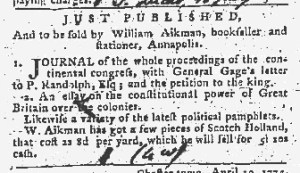
“JOURNAL of the whole proceedings of the continental congress.”

An advertisement by William Aikman, a bookseller and stationer in Annapolis, in the April 13, 1775, edition of the Maryland Gazette proclaimed, “JUST PUBLISHED, And to be sold … JOURNAL of the whole proceedings of the continental congress” and “An essay on the constitutional power of Great Britain over the colonies.”  While Aikman no doubt sold those items, they had not been “JUST PUBLISHED,” nor had he published them.

Readers understood that “JUST PUBLISHED” did not always mean that an item was hot off the presses; sometimes that phrase was a vestige of an advertisement originally composed and disseminated weeks or months earlier and printed once again without revisions.  Readers also understood that “JUST PUBLISHED, and to be sold by” did not necessarily mean that the retailer was also the publisher, merely that the retailer sold an item that had been published by someone, somewhere.  Keeping that in mind yields a better understanding of the production and dissemination of the items that Aikman advertised.

Although printers in many towns, including Anne Catharine Green and Son in Annapolis, produced and advertised local editions of the Extracts from the Votes and Proceedings of the American Continental Congress in the weeks after the First Continental Congress concluded its meetings in Philadelphia near the end of October 1774, only two printing offices published the complete Journal of the Proceedings of the Congress in the following months.  William Bradford and Thomas Bradford printed an edition in Philadelphia, as did Hugh Gaine in New York.  Aikman most likely stocked and advertised the Bradfords’ edition, especially considering that they also printed John Dickinson’s Essay on the Constitutional Power of Great-Britain over the Colonies in America in 1774.  Gaine did not publish a New York edition of that volume.

Aikman’s advertisement also stated that he carried “a variety of the latest political pamphlets,” but he did not list additional titles.  Perhaps he followed the lead of James Rivington in New York and tried to profit from selling pamphlets “on both sides, in the unhappy dispute with Great-Britain.”  As the imperial crisis reached its boiling point in April 1775, Aikman took to the pages of the Maryland Gazette to hawk two items published by the Bradfords in 1774 that became more timely and relevant as well as the “latest political pamphlets” that provided even more for colonizers to consider as they learned about and participated in current events.
February 1

What was advertised in a colonial American newspaper 250 years ago today?

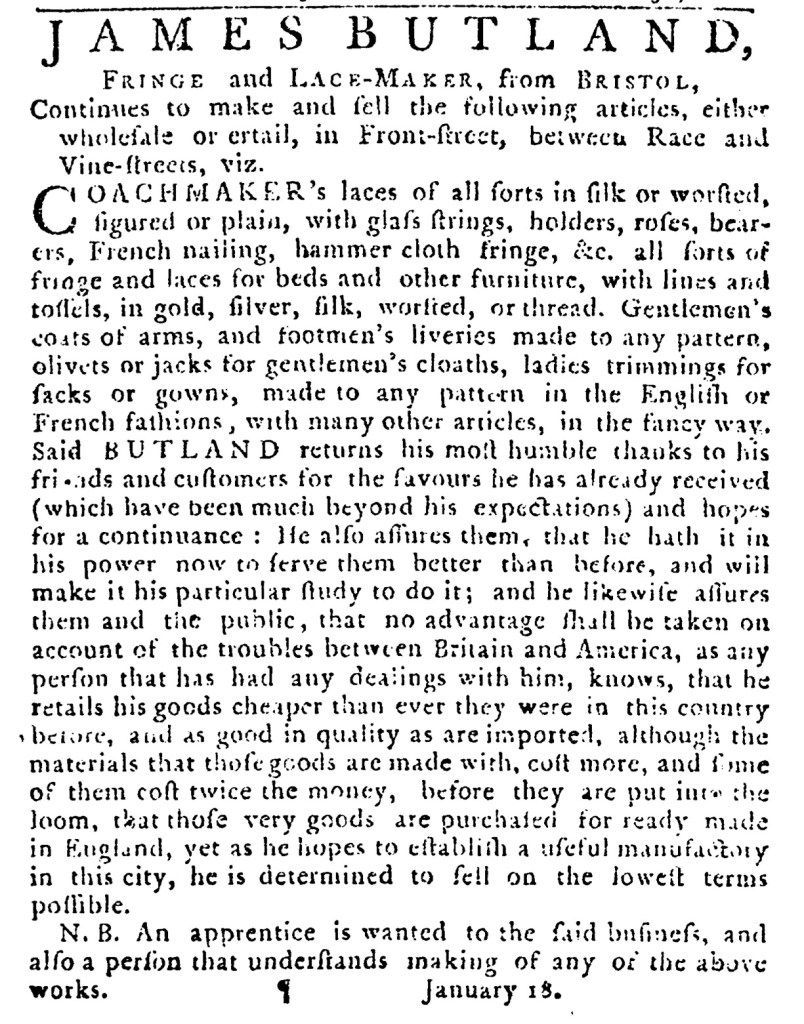
Pennsylvania Journal (February 1, 1775).

“No advantage shall be taken on account of the troubles between Britain and America.”

James Butland, a “FRINGE and LACE-MAKER, from BRISTOL,” set up shop in Philadelphia in the 1770s.  In an advertisement in the February 1, 1775, edition of the Pennsylvania Journal, he informed the public that he made and sold “COACHMAKER’s laces of all sorts in silk or worsted,” “all sorts of fringe and laces for beds and other furniture,” and other trimmings according to “any pattern in the English or French fashions.”

Colonizers observed the Continental Association, a nonimportation agreement enacted by the First Continental Congress in response to the Coercive Acts, at the time that Butland placed his advertisement.  Butland certainly had the Continental Association, in particular, and the imperial crisis, more generally, in mind when he made his pitch to prospective customers.  He made assurances to “the public, that no advantage shall be taken on account of the troubles between Britain and America.”  In other words, he would not raise prices on the fringe and lace he produced locally at a time that patriots refused to purchase imported goods.  Butland asserted that he had been in Philadelphia long enough that former customers knew his reputation on the matter: “any person that has had any dealings with him, knows, that he retails his goods cheaper than ever they were in this country before, and as good in quality as are imported.”  He did so even though “the materials that those goods are made with, cost more, and some of them twice the money, before they are put into the loom” compared to readymade alternatives from England.  That Butland offered such low prices under those circumstances suggested a significant markup on imported fringe and lace.

Butland did his part to satisfy consumers and to serve the American cause as the imperial crisis intensified.  Beyond his pledge not to gouge his customers with unreasonable prices during the boycott of imported goods, he sought to increase the inventory of locally produced fringes and laces available to them.  He planned “to establish a useful manufactory in this city,” vowing “to sell on the lowest terms possible.”  To that end, he sought an apprentice and an employee to assist him and aid in expanding his business.  As his advertisement made clear, Butland did his part as a producer to honor the Continental Association.  Readers now had a duty as consumers to do their part to support his endeavor.

January 2

What was advertised in a colonial American newspaper 250 years ago today?

Boston-Gazette (January 2, 1775).

The GRAND AMERICAN CONTINENTAL ASSOCIATION … to be pasted up in every Family.”

In the first issue of the Boston-Gazette published in 1775, Benjamin Edes and John Gill, the printers, opened with a notice concerning the Continental Association as the first item in the first column on the first page.  The First Continental Congress had devised that nonimportation, nonconsumption, and nonexportation pact when it met in Philadelphia in September and October 1774, intending for it to go into effect on December 1.  The Continental Association answered the Boston Port Act, the Massachusetts Government Act, and the other Coercive Acts that Parliament had passed in retaliation for the Boston Tea Party, perhaps not expecting a unified response from the colonies.  The First Continental Congress, however, devised a plan that allowed consumers from New England to Georgia to express their political principles through the decisions they made in the marketplace., drawing inspiration from the nonimportation agreements that went into effect to protest the Stamp Act and the duties on imported goods in the Townshend Acts.

Edes and Gill helped to raise awareness of the Continental Association not only through newspaper coverage but also by disseminating copies far and wide.  “ANY Town or District within this Province,” their notice advised, “may be supplied by Edes and Gill, on the shortest Notice, with the GRAND AMERICAN CONTINENTAL ASSOCIATION, printed on one Side of a Sheet of Paper.”  They offered the pact as a broadside “on purpose to be pasted up in every Family.”  The printers wished for local governments to purchase their edition of the Continental Association and distribute them to households for constant reference.  Putting the pact on display demonstrated support for the American cause against Parliament or at least signaled an intention to comply.  Posting it in homes as well as public spaces made it easy to consult, reminding everyone that they had a part to play in the protest.  The Continental Association made decisions about participating in the marketplace inherently political, making it impossible for any individual or household to take a neutral stance.  Edes and Gill recognized that was the case.  Although they stood to generate revenue from selling broadside copies of the Continental Association by the dozen or gross, the political stance they consistently advanced throughout the imperial crisis suggested that increasing awareness of the pact and encouraging compliance with it motivated them as much or even more.

December 31

What was advertised in a colonial American newspaper 250 years ago today?

Providence Gazette (December 31, 1774).

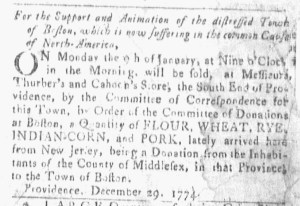
For the Support … of the distressed Town of Boston … suffering in the common Cause of North-America.”

As 1774 ended, readers of the Providence Gazette contemplated how they could aid the town of Boston where the harbor had been closed to commerce for seven months.  The Boston Port Act went into effect on June 1, retribution for the Boston Tea Party.  In turn, that inspired a variety of responses, including the meetings of the First Continental Congress in Philadelphia in September and October and the formation of relief efforts for Boston.  Local committees throughout the colonies started subscriptions for collecting food to send to the town, as Bob Ruppert documents in “The Winter of 1774-1775 in Boston.”

An advertisement in the December 31, 1774, edition of the Providence Gazette announced an upcoming sale of a “Quantity of FLOUR, WHEAT, RYE, INDIAN-CORN, and PORK” that would be held “For the Support and Animation of the distressed town of Boston, which is now suffering in the common Cause of North-America.”  Although Parliament aimed the Boston Port Act, the Massachusetts Government Act, and the other Coercive Acts at agitators in Massachusetts, that legislation prompted a unified response, a sense of a “common Cause” as other colonies realized that Parliament could just as easily target them.  The shipment of grains and pork that arrived in Providence came from New Jersey, “a Donation … to the Town of Boston.”  According to the advertisement, the Committee of Correspondence in Boston instructed the Committee of Correspondence in Providence to sell the grains and pork to raise funds rather than attempt to transport them to Boston.

John Carter, the printer of the Providence Gazette, gave that advertisement a privileged place both times that it ran in his newspaper.  The first time that it appeared, he inserted it immediately after local news and before other advertisements.  Readers likely experienced it as a continuation of news related to the imperial crisis, including updates about other “Donations … to the Town of Boston.”  When the advertisement ran a week later, two days before the sale, it was the first item in the first column on the first page, making it nearly impossible for readers to miss.  Through the choices he made about the layout of his newspaper, the printer made his own contribution in support of the “common Cause of North-America.”

December 22

What was advertised in a colonial American newspaper 250 years ago today?

New-York Journal (December 22, 1774).

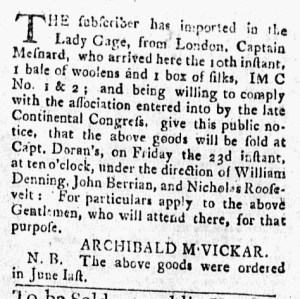
“Willing to comply with the association entered into by the late Continental Congress.”

When a shipment of “1 bale of woolens and 1 box of silks” arrived in New York via the Lady Gage on December 10, 1774, Archibald McVickar surrendered the good to the local Committee of Inspection and placed an advertisement to that effect in the New-York Journal.  He declared that he was “willing to comply with the association entered into by the late Continental Congress.”  Accordingly, those goods “will be sold … under the direction of William Denning, John Berrian, and Nicholas Roosevelt.”  Anyone wishing to learn more about the sale should “apply to the above Gentlemen” rather than to the McVickar.

McVickar abided by the Continental Association, a nonimportation agreement enacted by the First Continental Congress in response to the Coercive Acts.  In particular, the tenth article stated, “In Case any Merchant, Trader, or other Persons, shall import any Goods or Merchandise after the first Day of December [1774], and before the first Day of February next, the same ought forthwith, at the Election of the Owner, to be either reshipped or delivered up to the Committee of the County or town wherein they shall be imported, to be stored at the Risk of the Importer, until the Non-importation Agreement shall cease, or be sold under the Direction of the Committee aforesaid.”  In other words, McVickar had three options since his shipment arrived on December 10.  He could return it, turn the goods over to the committee to store until the nonimportation agreement ended, or turn the goods over to the committee to sell.

McVickar chose the final option.  The Continental Association made further provisions that he would be reimbursed for the cost of the goods yet could not earn any profit on them.  Instead, any profit was to be applied to relief efforts for Boston where the harbor had been closed and blockaded since the Boston Port Act went into effect on June 1.  McVickar added a nota bene to clarify that the “goods were ordered in June last.”  At that time, colonizers suspected that a nonimportation agreement might go into effect in the future, but the First Continental Congress had not yet met or composed and disseminated the Continental Association.  McVickar suggested that he had not deliberately attempted to get around that agreement, as he further demonstrated in asserting that he was “willing to comply with the association.”  Whatever he lost in profit, he gained in staying in the good graces of members of the community who supported the Patriot cause.

December 20

What was advertised in a colonial American newspaper 250 years ago today?

Essex Gazette (December 20, 1774).

“I find the retaining said Commission is contrary to the Sentiments of the Publick in general.”

The December 20, 1774, edition of the Essex Gazette, published in Salem, carried three advertisements in which residents of Marblehead disavowed commissions granted to them by the former governor, Thomas Hutchinson.  Nathaniel Lindsey, for instance, declared, “I find the retaining said Commissions is contrary to the Sentiments of the Publick in general, as well as inconsistent with my private Opinion.”  He carefully asserted that his politics aligned with the principles espoused by Patriots, though such an assertion may have been performative rather than authentic.  Either way, Lindsey distanced himself from his affiliation with the unpopular former governor, proclaiming, “I will not act any farther under said Commission, neither will I receive any Commission or act under any Authority whatsoever, that proceeds from any Creature which appears to have two Faces.”  In other words, he did not find the current administration trustworthy to act in the interests of the colonies instead of Parliament.  “I am a Well-Wisher to my Country and Town,” Lindsey concluded.

Ebenezer Graves and Samuel Trevett published the other two notices with similar messages.  Indeed, their advertisements featured identical wording except for the first line.  Graves stated that he “some Time since received a military Commission from the late infamous Governor Hutchinson,” while Trevett similarly declared, “I was so unhappy as to receive a military Commission from the late infamous Governor Hutchinson.”  Each of them acknowledged that the “Commission has been continued by his successor,” General Thomas Gage.  Graves and Trevett used identical language throughout the remainder of their notices: “I hereby publish a full Resignation of said Commission, as I conceive it inconsistent with the Laws of God and the Welfare of my Country, to hold it under the Command of such an enemy of my Country’s Liberties.”  Hutchinson enforced the Coercive Acts, including the Boston Port Act, the Massachusetts Government Act, and the Quartering Act.

These advertisements resembled the apologies that many colonizers published to distance themselves from an address to Governor Hutchinson that they signed upon his departure for England.  They claimed that they signed in haste, not having carefully read or fully comprehended the document.  As William Huntting Howell has noted, many of the apologies featured identical language, leading him to argue that the signatories were not necessarily sincere but merely wanted to return to the good graces of their neighbors.  Furthermore, Howell argues, what mattered most to Patriots was the public expression of allegiance to their cause, finding that more important for shaping public opinion than the true conversion of any individual.  When Lindsay, Graves, and Trevett ran advertisements resigning their military commissions, they perhaps followed a similar path as their counterparts who apologized for signing the address to Hutchinson.

December 16

What was advertised in a colonial American newspaper 250 years ago today?

Connecticut Gazette (December 16, 1774).

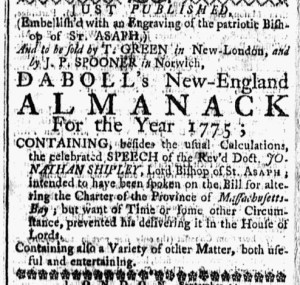
“Embellish’d with an Engraving of the patriotic Bishop of ST. ASAPH.”

With a new year only weeks away, advertisements for almanacs appeared in newspapers throughout the colonies in December 1774.  Most printers who published newspapers also produced almanacs as an alternate revenue stream, joined by other printers who supported themselves by performing job printing.  Consumers had an array of choices when they selected their almanacs for the coming year.

As a result, printers often marketed the contents of their almanacs, emphasizing anything that made them distinctive.  When Timothy Green, the printer of the Connecticut Gazette, advertised “DABOLL’s New-England ALMANACK For the Year 1775,” he indicated that it included the “usual Calculations” as a well as a “Variety of other Matter, both useful and entertaining.”  He emphasized a particular item: “the celebrated SPEECH of the Rev’d Doct. JONATHAN SHIPLEY, Lord Bishop of St. ASAPH; intended to have been spoken on the Bill for altering the Charter of the Province of Massachusetts-Bay; but want of Time or some other Circumstance, prevented his delivering it in the House of Lords.”  Shipley had gained acclaim in the colonies because he had been the only bishop in the Church of England who expressed opposition to the Massachusetts Government Act when Parliament considered how to respond to the Boston Tea Party.  When he did not have a chance to deliver the speech, he opted to publish it instead.

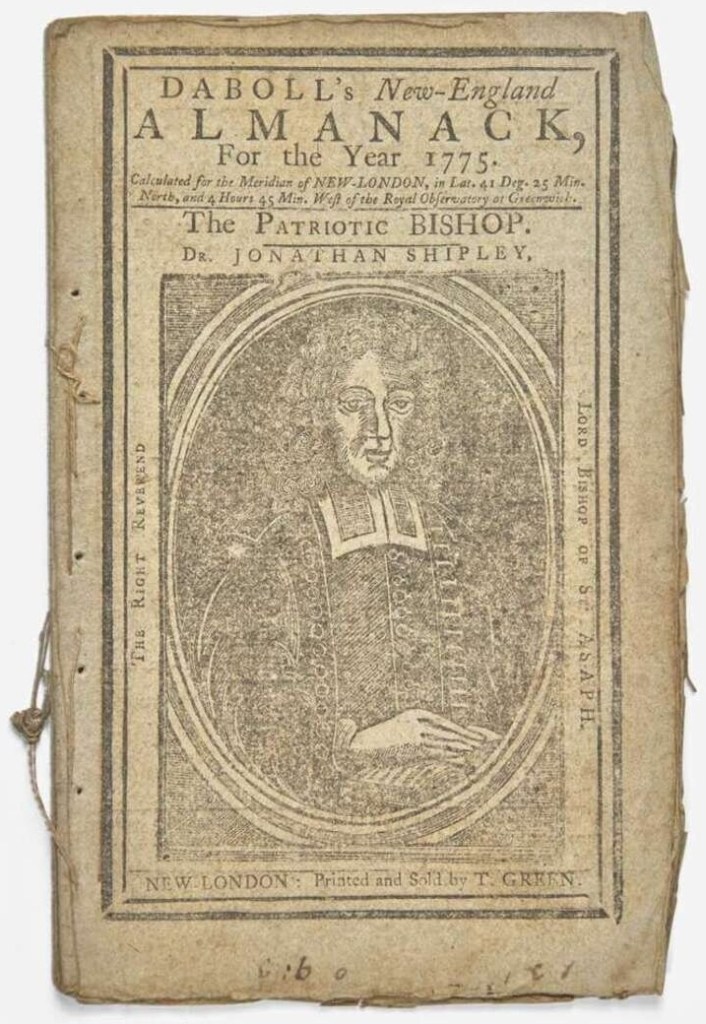
Though Shipley’s speech had little impact in England, the colonizers greeted it warmly.  Several newspapers published the speech, printers advertised pamphlets containing the speech, and Green devoted twelve of the thirty-two pages of Daboll’s New-England Almanack to the speech, anticipating that doing so would entice customers.  Furthermore, he “Embellished [the almanac] with an Engraving of the patriotic Bishop of ST. ASAPH” on the front cover.  Each time readers consulted any of the contents, they glimpsed the bishop whether or not they also read any portion of his speech.  Green advertised Daboll’s New-England Almanack at the same time he promoted his own edition of “The PROCEEDINGS and RESOLUTIONS of The Continental Congress,” joining other printers in producing and disseminating an array of items related to current events and, especially, making a case against the abuses perpetrated by Parliament.

Daboll’s New-England Almanack, For the Year 1775 (New London: Timothy Green, 1774). Courtesy Freeman’s | Hindman.

November 30

What was advertised in a colonial American newspaper 250 years ago today?

Pennsylvania Journal (November 30, 1774).

“The Sign of the SPINNING-WHEEL.”

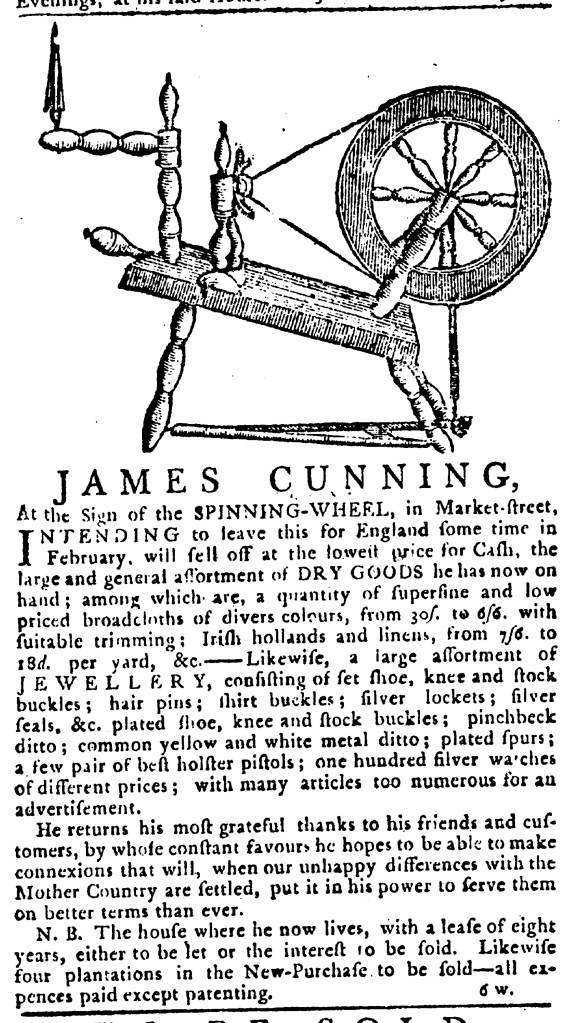
James Cunning ran a shop “At the Sign of the SPINNING-WHEEL” in Philadelphia in the early 1770s, occasionally advertising in the local newspapers.  In the fall of 1774, he made plans to depart for England the following February.  His preparations included running a new notice and selling his remaining merchandise “at the lowest price for Cash.”  He did not indicate why he planned to leave Philadelphia or how long he would be away, but he did state that during his time on the other side of the Atlantic that he “hopes to be able to make connexions that will, when our unhappy differences with the Mother Country are settled, put it in his power to serve [his customers] on better terms than ever.”  Neither Cunning nor readers knew that armed conflict between the colonies and Britain would erupt in Massachusetts in April 1775 or that the “unhappy differences” would be settled with a war for independence that would last eight years.

They did know, however, that the imperial crisis had intensified to the point that delegates from twelve colonies convened the First Continental Congress in Philadelphia in September and October 1774.  They also knew that meeting resulted in the Continental Association, a nonimportation agreement intended to unify the colonies.  That pact was scheduled to go into effect on December 1, the day after Cunning’s advertisement made its first appearance in the Pennsylvania Journal. Envisioning the difficulty ahead, the shopkeeper may have decided to make the best of the situation by liquidating his inventory and making plans for what he hoped would be a better future.

Given the stakes, Cunning sought to increase the chances that readers would take note of his advertisement.  To that end, he included a woodcut that depicted a spinning wheel, the same device that marked the location of his shop.  He had incorporated that image into advertisements he placed in October 1771 and December 1772.  More recently, including in an advertisement in the December 6, 1773, edition of Dunlap’s Pennsylvania Packet, he did not feature a visual image.  When he decided to visit England, Cunning either remembered where he had stored the woodcut or managed to find it after some searching, determined to use it to his advantage during difficult times.  A nick in the spindle reveals that it was the same woodcut from his earlier advertisements, collected from the printing office where John Dunlap published the Pennsylvania Packet and later delivered to the printing office where William Bradford and Thomas Bradford published the Pennsylvania Journal.  The shopkeeper intended, at least one more time, to get a return on the investment he made when he commissioned the woodcut.

November 25

What was advertised in a colonial American newspaper 250 years ago today?

South-Carolina and American General Gazette (November 25, 1774).

“EXTRACTS from the VOTES and PROCEEDINGS of the AMERICAN CONTINENTAL CONGRESS.”

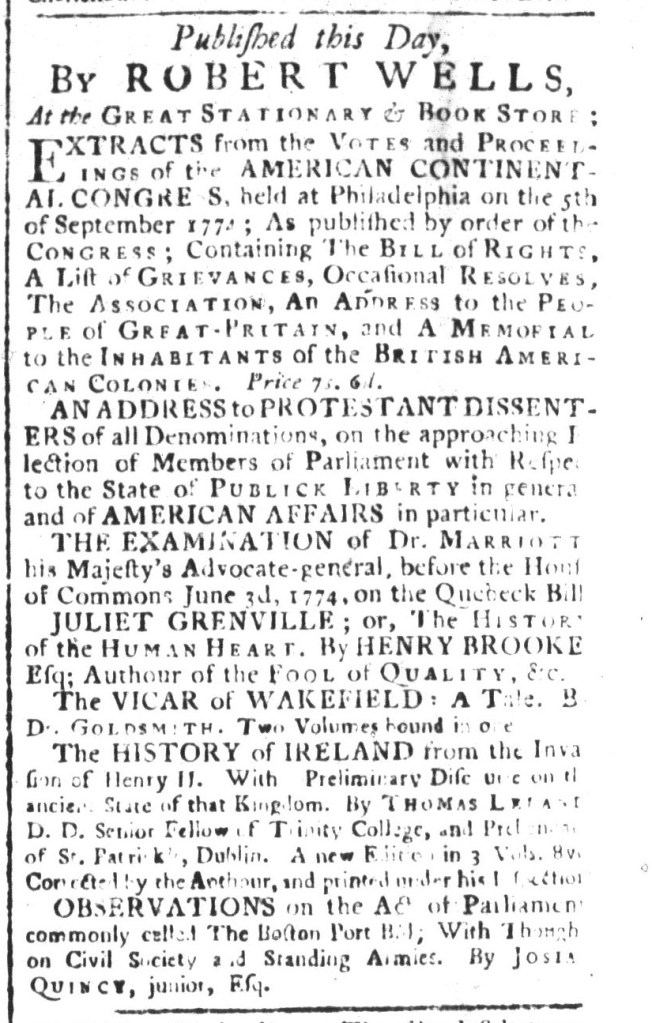
As soon as the First Continental Congress adjourned near the end of October 1774, printers set about publishing, advertising, and selling “EXTRACTS from the VOTES and PROCEEDINGS of the AMERICAN CONTINENTAL CONGRESS, held at Philadelphia.”  William Bradford and Thomas Bradford, printers of the Pennsylvania Journal, were the first to advertise this political pamphlet, but other printers soon advertised that they produced local editions in their own towns, helping to disseminate the news far and wide.  Conveniently packaging “The BILL of RIGHTS, A List of GRIEVANCES, Occasional RESOLVES, The ASSOCIATION, An ADDRESS to the PEOPLE of GREAT-BRITAIN, and A MEMORIAL to the INHABITANTS of the BRITISH AMERICAN COLONIES” in one volume, this pamphlet supplemented coverage in newspapers.  Its format allowed for easier reference than saving and scouring issue after issue of newspapers that relayed some but not all the contents of the Extracts.  The pamphlet met with such demand that some printers quickly printed second editions.  In the November 24 edition of the Norwich Packet, for instance, Alexander Robertson, James Robertson, and John Trumbull advertised the “second Norwich EDITION” of the Extracts.

The Adverts 250 Project has examined the publication and dissemination of the Extracts in Pennsylvania, the neighboring colonies of Maryland and New York, and multiple towns in New England.  It took a little longer for printers in southern colonies to publish the pamphlet, but within a month of the First Continental Congress finishing its business Robert Wells, the printer of the South-Carolina and American General Gazette, advised readers that they could purchase the Extracts at his “GREAT STATIONARY & BOOK STORE.”  Unlike other printers who ran separate advertisements for the pamphlet, Wells included it among a list of half a dozen titles he sold.  He gave it a privileged place, first on the list, acknowledging its importance and likely interest among readers.  The other items included a couple of novels and a history of Ireland, but Wells concluded the list with “OBSERVATIONS on the Act of Parliament commonly called The Boston Port Bill, With Thoughts on Civil Society and Standing Armies.  By JOSIAH QUINCY, junior, Esq.”  Among the many volumes available at his bookstore, Wells chose to emphasize two concerning current events as the imperial crisis intensified.  Like so many other printers, he marketed items that supplemented the news he published in his newspaper.

October 31

What was advertised in a colonial American newspaper 250 years ago today?

Boston Evening-Post (October 31, 1774).

“The Manual Exercise, recommended to be practised by the above Resolve of the Congress.”

The placement of advertisements varied in colonial newspapers.  Many printers reserved them for the final pages, while others positioned them on the first and last pages with news on the middle pages.  Sometimes advertisements and news appeared on the same page, such as two columns of news and one column of advertising on the front page or advertisements completing a column of news on any page.  Even with those variations, advertisements and news typically did not alternate within the columns on any page of early American newspapers.

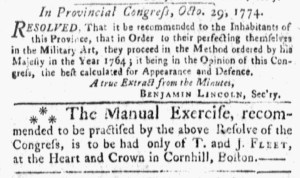
That made an advertisement on the third page of the October 31, 1774, edition of the Boston Evening-Post both unusual and notable.  The first column bore the headline “In PROVINCIAL CONGRESS” and commenced with “A true Extract from the Minutes” of a meeting held on October 26.  The same headline, in smaller font, occurred three more times in the first and second columns, reporting on meetings held on October 28 and 29.  The last of those featured a short resolution: “That it be recommended to the Inhabitants of this Province, that in Order to their perfecting themselves in the Military Art, they proceed in the Method ordered by his Majesty in the Year 1764; it being in the Opinion of this Congress, the best calculated for Appearance and Defence.”  That recommendation came as Boston and the rest of the colony reacted to the Quartering Act, the Massachusetts Government Act, and the other Coercive Acts that Parliament passed in retaliation for the Boston Tea Party.

A brief advertisement immediately followed the resolution: “The Manual Exercise, recommended to be practised by the above Resolve of the Congress, is to be had only of T. and J. Fleet, at the Heart and Crown in Cornhill, Boston.”  The column returned to news, that lone advertisement embedded between articles.  The Fleets happened to be the printers of the Boston Evening-Post, known for their support of the patriot cause.  They likely had dual purposes in running the advertisement and selecting where to place it.  Supplying the public with a military manual reflected their political principles, yet as entrepreneurs the Fleets also stood to generate revenue from its sale.  They served the public good, both in printing the manual and the proximity of their advertisement to the resolution, while also attempting to increase sales in their printing office.  Scholars have debated whether printers who sold political tracts during the era of the American Revolution merely seized an opportunity to line their pockets, yet participating in politics and earning their livelihoods were not necessarily mutually exclusive endeavors.