November 24

What was advertised in a colonial American newspaper 250 years ago this week?

Massachusetts Gazette and Boston Weekly News-Letter (November 22, 1771).

“Proper Allowances made to those that sell again.”

Numerous merchants and shopkeepers regularly placed advertisements in the Massachusetts Gazette and Boston Weekly News-Letter as well as the other newspaper published in Boston in the early 1770s.  While the shopkeepers aimed their notices at consumers, some merchants address both retailers and consumers.  William Bant, for instance, stocked a “large and general Assortment of GOODS … to sell by Wholesale and Retail.”  Not every advertiser identified their intended customers so explicitly; some instead made more specific appeals that invited both retailers and consumers to purchase their merchandise.

John Adams and Company advertised a “complete Assortment of Cream-colour’d China, Glass, Delph and Stone Ware” as well as groceries and a “small Assortment of English Goods” available at their shop near the Old South Meeting House.  Adams and Company informed prospective buyers that they sold their wares “very low for Cash – with proper Allowances made to those that sell again.”  In other words, retailers who bought in volume received discounts.  Similarly, William Bant concluded his extensive advertisement that listed dozens of items with a nota bene that alerted “Traders and Shopkeepers” that they “may be supplied with Assortments of the foregoing Articles, upon as good Terms, as at any Store in Town.”  Bant hoped to entice retailers by offering to match the prices set by his competitors.

In another advertisement in the Massachusetts Gazette and Boston Weekly News-Letter, Smith and Atkinson made it clear that they intended to deal with retailers exclusively.  They acquired a “Large and General Assortment of European and India Goods … on the very best Terms,” allowing them to sell their merchandise “(by Wholesale only) at such Prices as shall give full Satisfaction to those in Town and Country who purchase their Assortments here.”  In addition, they encouraged retailers who imported goods on their own to supplement their inventories and “compleat their Assortments” by selecting from among the items Smith and Atkinson had on hand.

Readers encountered numerous advertisements for consumer goods in just about every issue of newspapers published in Boston in the early 1770s.  Merchants and shopkeepers hoping to sell directly to consumers placed the majority of those advertisements, but not all of them.  William Bant, John Adams and Company, and Smith and Atkinson were among the many merchants who sold imported goods wholesale, designing marketing materials aimed at retailers rather than consumers.

November 7

GUEST CURATOR:  Nicholas Macchione

What was advertised in a colonial American newspaper 250 years ago today?

Supplement to the Massachusetts Gazette and Boston Weekly News-Letter (November 7, 1771).

“A New MEDICINAL DISCOVERY, of the UTMOST CONSEQUENCE to MANKIND; known abroad by the Name of, VELNOS’ Vegetable SYRUP: An acknowledged Specific in all Venereal and Scorbutic Cases”

This plant-based medication is proposed as a safer alternative to the conventional treatment of the day, which involved exposing patients to mercury in the hopes that it would induce them to expel the disease through bodily secretions. Despite the known dangers of mercury, and its unsavory side effects, it was still widely accepted in the medical community in the late eighteenth century. The advertisement claims that in addition to acting as a substitute for mercury, it also “repairs the havock it has made.” To emphasize the legitimacy of this alternative treatment to any skeptics, the advertisement describes the rigorous testing and clinical trials that the syrup underwent in Paris. Another selling point is the substance’s use in the relief of a number of ailments “arising from a foulness of the blood” not limited to venereal cases.

J. Burrows, the physician who claimed to be the “sole Proprietor of this remedy,” appears to have been one of several enterprising men who began selling their own version of vegetable syrup under the same name throughout the colonies. A certain Isaac Swainson took issue with this and denounced these imposters in his 1792 work, An Account of Cures by Velnos’ Vegetable Syrup, mentioning Burrows and others by name and assuring the public that “the Genuine Syrup of De Velnos can be prepared only by me.” This reveals that a certain level of competition between purveyors of this cure must have existed which prompted Swainson to put such a warning in writing, either out of concern for prospective patients or, more likely, to discredit his competition.

A 1789 etching published in London depicts angry physicians armed with scalpels and mercury who are unable to contend with Velnos’ Syrup being sold by Swainson, who stands smiling, surrounded by bottles of his cure. The cartoon also includes a reference to the number of people allegedly cured in 1788 and 1789 demonstrating that the syrup remained popular in the subsequent decades.

Thomas Rowlandson, Mercury and His Advocates Defeated, or Vegetable Intrenchment (London: S.W. Fores, 1789). Courtesy British Museum.

**********

ADDITIONAL COMMENTARY:  Carl Robert Keyes

This advertisement lists “J. BURROWS, M.D.” as the “Sole Proprietor of this Remedy,” yet he did not market it in Boston.  Instead, a local agent, John Fleeming, hawked Velnos’ Vegetable Syrup to prospective patients in Boston and its hinterlands in the fall of 1771.  The lengthy advertisement focused primarily on the patent medicine, but a brief note at the end informed readers that Fleeming also sold “Cheap Books and Stationary” at his shop “opposite the South Door of the Town-House.”  In another advertisement in the same issue of the Massachusetts Gazette and Boston Weekly News-Letter, Fleeming announced his plans to publish the “NEW-ENGLAND REGISTER, With an Almanack for 1772” in December.

Fleeming was well known in Boston as a printer, publisher, and bookseller, especially because he partnered with John Mein in publishing the Boston Chronicle, a newspaper that unapologetically expressed a Tory perspective and mocked Patriot leaders, from 1767 to 1770.  Mein took the lead in that enterprise and caused so much controversy that he fled Boston for his own safety in 1769.  Fleeming continued publishing the newspaper for only a few months.  He turned his attention to other projects, including publishing an account of the trials that followed the Boston Massacre.

Like most colonial printers, Fleeming supplemented his revenues by selling “Cheap Books and Stationary.” A good number of printers also listed patent medicines in their advertisements, making those remedies the most common goods not directly associated with the books trades to appear in their newspaper notices.  Eighteenth-century consumers would not have considered it out of the ordinary that Fleeming sold patent medicines, though the length and detail of the advertisement for Velnos’ Vegetable Syrup far exceeded the attention printers usually devoted to such nostrums.  They tended to carry popular potions that needed no further explanation, but Fleeming and his associates apparently believed that prospective customers would be more likely to purchase this “New MEDICINAL DISCOVERY” when they learned more about it.  The prospects for increased sales justified the greater expense for such a lengthy advertisement.

October 6

What was advertised in a colonial American newspaper 250 years ago this week?

Massachusetts Gazette and Boston Weekly News-Letter (October 3, 1771).

“Fifes, Violins, Powder, / Lead, Shott, / Steel, &c.”

Gilbert Deblois used graphic design to increase the likelihood that his newspapers advertisements would attract the attention of prospective customers interested in the “very large Assortment of Winter Goods” available at his shop on School Street in Boston in the fall of 1771.  Rather than publish a dense block of text like most of his competitors who advertised, he instead opted for arranging the copy in the shape of a diamond.  The shopkeeper did so consistently in three newspapers printed in Boston, starting with the Boston Evening-Post and the Boston-Gazette on September 30 and then continuing in the Massachusetts Gazette and Boston Weekly News-Letter on October 3.  The unique design likely made his advertisement notable for readers who saw it once and even more memorable for anyone who encountered variations of it in two or three newspapers.

In most instances, advertisers were responsible for generating the copy for their notices and then compositors determined the format.  On occasion, however, advertisers like Deblois made special requests, submitted instructions, or possibly even consulted with printers and compositors about how they wanted their advertisements to appear.  The compositors at the first two newspapers who ran Deblois’s advertisement took different approaches.  In the Boston Evening-Post, the text ran upward at a forty-five degree angle and formed an irregular diamond that filled the entire space purchased by the shopkeeper.  In contrast, the compositor for the Boston-Gazette used the same copy but arranged it in lines of increasing and then decreasing length to form a diamond surrounded by a significant amount of white space.  Though different, both sorts of diamonds made Deblois’s advertisements much more visible in the pages of the newspapers.  The advertisement in the Massachusetts Gazette and Boston Weekly Mercury followed the latter design, but the compositor did not merely copy it from the Boston-Gazette.  The advertisement published on October 3 had a longer list of goods that the compositor had to accommodate in the design.

The copy itself did not distinguish Deblois’s advertisements from others that appeared in any of the newspapers published in Boston, but intentional choices about the format made his notices distinctive.  Deblois stocked the same merchandise “Just Imported from LONDON” as his competitors, but he used innovative design to generate interest among consumers who had many choices.

September 29

What was advertised in a colonial American newspaper 250 years ago this week?

Massachusetts Gazette and Boston Weekly News-Letter (September 26, 1771).

“Bickerstaff’s Boston ALMANCK, For the Year 1772.”

With the arrival of fall in 1771 newspaper advertisements for almanacs for 1772 became more numerous and more extensive.  Starting in August and continuing into September, printers announced that they would soon publish popular and favorite titles, but by the beginning of October their notices indicated that consumers and retailers could purchase almanacs.  To encourage sales, some printers composed advertisements that previewed the contents of their almanacs.

John Fleeming followed this progression in his marketing efforts.  On August 15, he placed an advertisement in the Massachusetts Gazette and Boston Weekly News-Letter to inform readers that “Bickerstaff’s Almanack For the Year 1772, Will be published in September.”  He declared that it would “contain many excellent Receipts, interesting Stories, curious Anecdotes, [and] useful Tables” in addition to “the usual Calculations.”  On September 26, he placed a much lengthier advertisement, one that extended two-thirds of a column, to announcement that the almanac was “THIS DAY PUBLISHED.”  Fleeming devoted most of the advertisement to the contents, hoping to incite curiosity and interest.

As promised, the almanac included “USEFUL RECEIPTS,” with a headline and separate section that listed many of them.  Buyers gained access to a recipe for “A Cure for the Cramp,” “Dr. Watkins famous Family Medicine,” “An excellent remedy for all Nervous Complaints,” and “A cure for the Scurvy,” among others.  In terms of “interesting Stories [and] curious Anecdotes,” readers would be entertained or edified by an “Account of a remarkable fight betwixt a sailor and a large Shark,” “A description of the wonderful Man Fish, with a print of the same,” and “A caution to Juries in criminal causes, and the uncertainty of circumstantial evidence shewen in two very remarkable causes.”  The “useful Table” included “Distances of the most remarkable Towns on the Continent, with the intermediate Miles,” “A Compendium Table of Interest,” and a “Table of the value of Sterling Money, at Halifax, Nova-Scotia, the different parts of New-England, New-York and Philadelphia.”  Among the “usual Calculations,” Fleeming listed “Sun’s rising and setting,” “Full and changes of the Moon,” and the “Time of High Water at Boston, twice a day.”  He also promoted several poems and “A few good Husbandry Lessons.”

Fleeming faced competition from other printers.  Immediately above his advertisement, a consortium of Boston printers placed their own notice for “The NORTH-AMERICAN’S ALMANACK: Being, the GENTLEMENS and LADIES DIARY For the Year of Christian Æra 1772” with calculations by Samuel Stearns.  That advertisement, a fraction of the length of the one placed by Fleeming, listed some of its contents, but did not go into as much detail.  For consumers who did not already have a strong loyalty to one title over others, Fleeming likely considered his extensive list of the contents of his almanac effective in winning them over and well worth the investment.

September 19

What was advertised in a colonial American newspaper 250 years ago today?

Massachusetts Gazette and Boston Weekly News-Letter (September 19, 1771).

“To be Sold by OLIVER SMITH, at the Golden Mortar.”

Oliver Smith, an apothecary, promoted a variety of remedies in an advertisement in the September 19, 1771, edition of the Massachusetts Gazette and Boston Weekly News-Letter.  The headline proclaimed “Best double-distilled Lavender Water,” introducing the merchandise before naming the seller.  Several other advertisements featured the same structure, including one for “Choice Cheshire CHEESE” placed by Ellis Gray and another for “THE very best of fresh Orange JUICE” from John Crosby.  Most purveyors of goods and services, on the other hand, used their names as headlines for their advertisements, including Caleb Blanchard, William Jackson, John Langdon, Henry Lloyd, and Jonathan Trott.  Thomas Walley adopted both methods.  “Teneriff Wine” appeared as the first headline and then his name as a second one.

Smith’s headline helped to distinguish his notice from others, but another element of the advertisement did so even more effectively.  A woodcut depicting a mortar and pestle appeared in the upper left corner, drawing the eye of readers.  Except for the lion and unicorn in the masthead at the top of the first page, Smith’s woodcut was the only image in that issue and the supplement that accompanied it.  Further enhancing the apothecary’s marketing efforts, the woodcut corresponded to the sign that marked the location of his shop.  He advised prospective customers that they could purchase a variety of nostrums “at the Golden Mortar” on Cornhill.  Other advertisers mentioned shop signs, but did not commission woodcuts to adorn their notices.  Crosby, for instance, regularly advertised citrus fruit “at the Sign of the Basket of Lemmons” in the South End, but he did not include an illustration.

Advertisers typically paid for the amount of space their notice occupied, not the number of words.  In that regard, Smith and Crosby made similar investments in marketing their wares in the September 19 edition.  Smith, however, incurred additional expense for the woodcut, an investment that he presumably believed would pay for itself by resulting in more attention and more customers.

September 2

What was advertised in a colonial American newspaper 250 years ago today?

Pennsylvania Chronicle (September 2, 1771).

“Those who have taken subscriptions of others, [send] their lists … to the Publisher.”

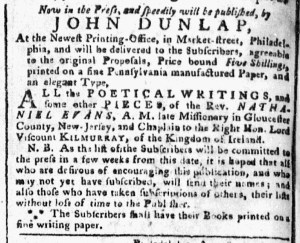
In the course of just a few days late in the summer of 1771, readers in New England, New York, Pennsylvania, and South Carolina encountered the same advertisement in their local newspapers.  John Dunlap, a printer in Philadelphia, distributed subscription notices for his current project, “ALL THE POETICAL WRITINGS, AND SOME OTHER PIECES, of the Rev. NATHANIEL EVANS,” in order to entice customers in distant places to reserve copies of the forthcoming work.  On September 2, Dunlap’s advertisement ran in the New-York Gazette and Weekly Mercury, the Pennsylvania Chronicle, and the South-Carolina and American General Gazette.  Four days earlier, the same advertisement ran in the Massachusetts Gazette and Boston Weekly News-Letter and the Pennsylvania Journal.

With one exception, the advertisements featured identical copy with minor variations in format, the copy being the domain of the advertiser and decisions about design at the discretion of the compositor.  The exception concerned the directions issued to prospective subscribers for submitting their names.  In the newspapers published in Philadelphia, Dunlap requested “that all who are desirous of encouraging this publication, and who may not yet have subscribed, will send their names” to him directly.  In addition, he asked that “those who have taken subscriptions of others,” acting as agents on Dunlap’s behalf, dispatch “their lists without loss of time to the Publisher.”  In the advertisements in the other newspapers, however, he instructed subscribers to submit their names “to the Printer hereof.”  Newspaper printers in other cities served as his local agents, including Richard Draper in Boston and Hugh Gaine in New York.  Robert Wells, printer of the South-Carolina and American General Gazette, underscored that he was Dunlap’s local agents, revising the copy in his newspaper to instruct subscribers to “send in their Names, without Loss of Time, to ROBERT WELLS.”

Dunlap did not rely merely on generating demand among local customers when he published “THE POETICAL WRITINGS … of the Rev. NATHANIEL EVANS.”  Instead, he inserted subscription notices in newspapers published in the largest cities in the colonies, hoping to incite greater interest in the project and attract additional buyers.  In the process, he recruited other printers to act as local agents who collected subscriptions on his behalf.  He created a network of associates that extended from New England to South Carolina as part of his marketing campaign.

September 1

What was advertised in a colonial American newspaper 250 years ago this week?

Massachusetts Gazette and Boston Weekly News-Letter (August 29, 1771).

“The List of Subscribers will be committed to the Press in a few Weeks.”

When John Dunlap set about publishing “ALL THE POETICAL WRITINGS, AND SOME OTHER PIECES, OF THE REV. NATHANIEL EVANS” at “the Newest Printing Office in Market-Street, Philadelphia,” he looked beyond the city in his efforts to cultivate customers.  On August 29, 1771, he advertised the book in the Massachusetts Gazette and Boston Weekly News-Letter in hopes of selling copies to readers in New England.  In so doing, Dunlap pursued marketing practices already familiar in the colonies.  In the eighteenth-century, American printers often distributed subscription notices for their projects.  They inserted advertisements in newspapers published in multiple cities, inviting “subscribers” to order copies in advance.  Some supplemented those advertisements with handbills and circular letters.  Others even printed forms with blanks for local agents, usually booksellers and printers, to fill in the names of customers who reserved copies.

In recognition of their commitment to a project, subscribers received a premium in the form of having their names published.  Printers marketed subscription lists as valuable items intended to be bound into books along with title pages, frontispieces, tables of contents, copperplate engravings, indexes, and other ancillary materials.  Each subscription list represented a community of readers and benefactors who supported a project.  Within those printed lists, subscribers found themselves in the company of others who shared their interests, gaining status through the association.  Those who chose not to subscribe missed opportunities for public acclaim.  For his part, Dunlap made it clear that prospective subscribers had only a limited time to see their names among the ranks of those who supported “THE POETICAL WRITINGS … OF THE REV. NATHANIEL EVANS.”  Even though the book already went to press, he had not yet printed the subscription list.  Instead, he warned that “the Lost of the Subscribers will be committed to the Press in a few Week” so “all who are desirous of encouraging this Publication, and who may not yet have subscribed” should “sent their Names, without Loss of Time” to his local agents in Boston.  Dunlap sought to create a sense of urgency to convince prospective subscribers to submit their names and commit to purchasing copies of the book.

August 22

What was advertised in a colonial American newspaper 250 years ago today?

Massachusetts Gazette and Boston Weekly News-Letter (August 22, 1771).

“As low a Price, as … can be purchased for at any Shop in th[i]s Town.”

In the summer of 1771, Richard Jennys sold a “Variety of English, Scotch and India Goods” at his shop across the street from the “Old Brick Meeting-House, in Cornhill” in Boston.  His inventory included “a Parcel of beautiful and newest Fashion Apron Gauzes, Gauze Handkerchiefs and Aprons” as well as “a few Pieces of handsome Lutestring and Mantua Silks.”  Like many purveyors of goods who advertised in the Massachusetts Gazette and Boston Weekly News-Letter and other colonial newspapers, Jennys made an appeal to price in his effort to incite demand and convince prospective customers to visit his shop.  He described his prices for the lutestring and silk as “very cheap.”

Yet Jennys did more than merely promise low prices.  In a nota bene that concluded his advertisement, he offered a price match guarantee to consumers.  “His Customers,” the shopkeeper declared, “may depend on having any Article at as low a Price, as the same can be purchased for at any Shop in th[i]s Town.”  Jennys certainly had plenty of competitors in Boston, a bustling port and one of the largest cities in the colonies, but that did not prevent him from vowing that he would not be undersold.  In such a crowded marketplace, he attempted to distinguish his shop from the many others that carried similar goods “IMPORTED from LONDON.”  Although he made a point of noting his low prices for certain textiles, his price match guarantee suggested that the bargains did not end there.  Instead, comparison shoppers could get a deal on every single item that Jennys had in stock.  Jennys leveraged every other advertisement that promised “the very lowest Rate” or “a very low Price” by alerting customers that he would offer the same deals.  Some retailers have made this practice a cornerstone of their marketing strategy in the twenty-first century, but they certainly did not invent the price match guarantee.  Entrepreneurs like Jennys deployed it centuries earlier.

August 15

What was advertised in a colonial American newspaper 250 years ago today?

Massachusetts Gazette and Boston Weekly News-Letter (August 15, 1771).

“Bickerstaff’s Almanack For the Year 1772, Will be published in September next.”

Even though the middle of August 1771 was early, John Fleeming apparently determined that it was not too early to begin marketing “Bickerstaff’s Almanack For the Year 1772.”  In an advertisement in the supplement that accompanied the August 15 edition of the Massachusetts Gazette and Boston Weekly News-Letter, Fleeming announced that the popular almanac “Will be published in September next.”  He did not even have copies ready for sale, but he gave both consumers and retailers advance notice about when the almanac would be available to purchase.  Doing so made sense in the crowded marketplace of Boston’s printers who annually published an array of almanacs and competed for customers.  Fleeming encouraged brand loyalty by letting readers who preferred “Bickerstaff’s Almanack” know that they could soon acquire an edition for the coming year.  He also attempted to incite anticipation among consumers, encouraging them to scan the pages of the public prints for further updates.

Like other printers who advertised the almanacs they published, Fleeming provided a brief overview of the contents.  It would contain “the usual Calculations” as well as “many excellent Receipts, interesting Stories, curious Anecdotes, useful Tables, &c. &c. &c.”  By concluding with the eighteenth-century abbreviation for et cetera (and repeating it), the printer hinted at the variety of informative and entertaining items that would be included.  He may have also intended for that portion of the advertisement to provoke curiosity and anticipation about what might be included among those recipes, stories, anecdotes, and tables.  Printers often revealed those details in longer advertisements, but Fleeming might have also hoped that prospective customers would visit his shop to peruse the almanac to learn more after it went to press.

For the moment, Fleeming’s advertisement stood out for being the earliest and only one for an almanac in the Massachusetts Gazette and Boston News-Letter and other newspapers printed in Boston, but soon enough that would no longer be the case.  With the arrival of fall, more and more advertisements for almanacs would appear, a sign of the changing seasons.  Fleeming was ready to serve loyal readers and prospective customers.

August 11

What was advertised in a colonial American newspaper 250 years ago this week?

Massachusetts Gazette and Boston Weekly News-Letter (August 8, 1771).

“The first Person that ever set up, and regularly maintain’d a Stage Carriage in New-England.”

John Stavers was not pleased when a competitor set up stagecoach service between Boston and Portsmouth in 1771.  In July, he placed an advertisement in the New-Hampshire Gazette to promote his “Stage-Coach, Number One,” proclaiming that “several Years” experience of transporting passengers, mail, and newspapers meant that his drivers provided superior service.  Stavers also suggested that the “Difficulty, Expence, Discouragements, and very little, if any profit” associated with operating the stagecoach for so many years meant that the public should “give his Coach the Preference” over a newcomer “big with Importance” yet lacking experience.

He placed a similar advertisement in the Massachusetts Gazette and Boston Weekly News-Letter, hoping to draw the attention of prospective passengers at the other end of the line.  Stavers declared that he “was the first Person that ever set up, and regularly maintain’d a Stage Carriage in New-England.”  Regardless of the weather and other conditions, operations continued “at all Seasons” for a decade.  In recognition of both the “Marks of Approbation” he received from prior clients and the “Utility” of the service he provided, he stated that he “therefore humbly hopes that his Carriages will still continue to be prefer’d to any other, that may set up in Opposition to them.”  For those who needed more convincing, Stavers asserted that “his Carriages are universally allow’d to be as convenient, genteel, and easy, and his Horses as good (if not better) than any that have as yet travelled the Road.”  In addition, he promised that “the greatest Care will be taken of all Bundles and Packages.”  For passengers who needed food and lodging upon arriving in Portsmouth, Stavers offered “Good Entertainment at the Earl of Halifax Tavern … equal to any on the Continent,” including any in Boston.  Stavers also listed prices for transporting passengers “in the most genteel and expeditious Manner” from Boston to Portsmouth and Boston to Newburyport so prospective customers could compare rates if they wished.

Stavers never named his competitor in either advertisement, but he did make it clear that he believed his experience resulted in better service for passengers traveling between Boston and Portsmouth.  In addition, he apparently felt that the investment he made operating a stagecoach along that route entitled him to the patronage of travelers who might otherwise choose his rival.  He deployed a carrot-and-stick approach in his marketing efforts, alternating between the describing the benefits associated with his coaches and constructing a sense of obligation for selecting his services.