What was advertised in a revolutionary American newspaper 250 years ago today?
New-York Journal (January 11, 1776).
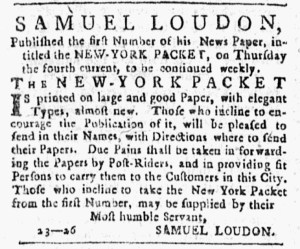
“SAMUEL LOUDON, Published the first Number of his News Paper, intitled the NEW-YORK PACKET.”
After spending several weeks distributing subscription proposals for a new newspaper, the New-York Packet, Samuel Loudon released the first issue on schedule on January 4, 1776. On that day, Loudon’s notice that he planned to establish the newspaper appeared for the fourth and final time in the New-York Journal. A week later, a new advertisement promoting the New-York Packet ran in the New-York Journal. The notation at the end, “23-26” (corresponding to the issue numbers), indicated that Loudon planned for that notice to run for four consecutive weeks as well.
In it, the printer announced that he “Published the first Number of his News Paper … on Thursday the fourth current, to be continued weekly.” He then provided an abbreviated version of the subscription proposal, stating that the New-York Packet “IS printed on large and good Paper, with elegant Types, almost new.” For readers who did not subscribe in time to receive that “first Number,” it was not too late to start a subscription that included the first issue and all subsequent issues. “Those who incline to encourage the Publication of it,” Loudon advised, “will be pleased to send in their Names, with Directions where to send their Papers.” Loudon had disseminated the subscription proposals widely, including in the Connecticut Journal and the Pennsylvania Gazette. He hoped to gain subscribers far beyond the city where he printed the New-York Packet. To that end, he promised that “Due Pains shall be taken in forwarding the Papers by Post-Riders, and in providing fit Persons to carry them to the Customers in this City.” That was a necessary part of satisfying both subscribers and advertisers.
Despite the fanfare around its founding, the New-York Packet lasted only eight months. Loudon suspended the newspaper shortly before the British occupation of New York. Unfortunately, surviving issues have not been digitized for greater access, so advertisements and other content from the New-York Packet will not appear in the Adverts 250 Project, though advertisements about the newspaper inserted in other publications testify to its short run at the beginning of the Revolutionary War.
What was advertised in a revolutionary American newspaper 250 years ago this week?
Connecticut Journal (December 27, 1775).
“He will publish No. I. of a News-Paper … THE NEW-YORK PACKET; OR THE AMERICAN ADVERTISER.”
The American Revolution resulted in an explosion of print. The disruptions of the war led to the demise of some newspapers, but others continued, joined by new publications during the war and, especially, even more newspapers after the war ended. The major port cities had one or more newspapers before the Revolutionary War. Many minor ports also had a newspaper. Once the new nation achieved independence, printers commenced publishing newspapers in many more towns. Thoughtful citizenship depended in part on the widespread dissemination of news. Samuel Loudon’s New York Packet was part of that story.
In December 1775, Loudon announced that he “will publish No. I. of a News-paper, (To be continued weekly)” on Thursday, January 4. He initially advertised in other newspapers printed in New York, but by the end of the month others carried his proposals, including the Connecticut Journal, published in New Haven, and the Pennsylvania Gazette, published in Philadelphia. Newspapers circulated far beyond their places of publication. Printers wanted them to supply content for their own newspapers. The proprietors of coffeehouses and taverns acquired them for their patrons. Merchants used them for updates about both commerce and politics. Loudon had a reasonable expectation of attracting subscribers beyond New York. A nota bene at the end of his advertisement in the Connecticut Journal noted that “Subscriptions [were] taken by the Printers, and all the Post Riders,” a network of local agents that assisted in distributing Loudon’s newspaper.
Pennsylvania Gazette (December 27, 1775).
To entice potential subscribers, Loudon explained that he “is encouraged to undertake this arduous work by the advice and promised literary assistance of a numerous circle of warm friends to our (at present much distressed) country.” That signaled to readers that Loudon supported the American cause. It also offered assurances that he had the means to acquire sufficient content to publish a weekly newspaper. To that end, Loudon pledged “to do everything in his power to render it a complete and accurate NEWS-PAPER, that the Public may thereby receive the earliest intelligence of the state of our public affairs, and of the several interesting occurrences which may occasionally happen whether at home or abroad.” In the spirit of newspaper providing the first draft of history, the printer declared that he “flatters himself that the NEW YORK PACKET, will influence every discerner of real merit, who may encourage the work, to preserve it in volumes, as a faithful Chronicle of our own time.”
In addition to expressing such ideals, Loudon also tended to the business aspects of establishing a newspaper. He reported that he “already possessed himself of a neat and sizeable set of TYPES … together with every other necessary for carrying on a splendid News Paper.” Soon enough, “the best of hands shall be procured to perform the mechanical part.” Subscribers could expect the New York Packet “will be printed … on a large Paper, of a good Quality, and equal in Size to the other News-Papers published in this City.” Subscriptions cost twelve shillings per year. Loudon also solicited advertisements, indicating that they “will be inserted at the usual Price of Five Shillings, when of a moderate Length, and continued Four Weeks.” As was the practice in other printing offices, “longer Advertisements to be charged accordingly.”
Loudon did indeed launch the New York Packet on January 4, 1776. It lasted only eight months in New York, suspended after the August 29 edition, as Clarence S. Brigham explains, “immediately prior to the entry of the British into New York. Loudon re-established the paper at Fishkill in January, 1777, and at the close of the War returned to New York.”[1] Without changing the volume numbering, he continued publishing the New York Packet from November 13, 1783, through January 26, 1792. By then, Loudon published the newspaper three times a week, part of that explosion of print that occurred during the era of the American Revolution. Shortly after closing the New York Packet, Loudon and his son, Samuel, established a daily newspaper, The Diary; or Loudon’s Register. Unfortunately, the issues of the New York Packet published in 1776 have not been digitized for greater access, though the run for 1783 through 1792 is available via Readex’s America’s Historical Newspapers. That means that advertisements and other content from that newspaper will not be featured in the Adverts 250 Project, its story confined to the subscription proposals that ran in other newspapers.
**********
[1] Clarence S. Brigham, History and Bibliography of American Newspapers, 1690-1820 (Worcester, Massachusetts: American Antiquarian Society, 1947), 675.
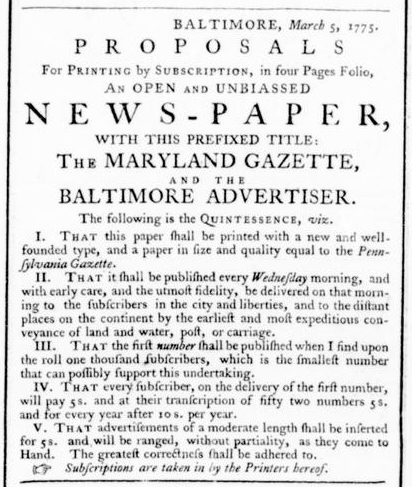
“Advertisements … will be ranged, without partiality as they come to Hand.”
Baltimore did not have its own newspaper until William Goddard commenced publication of the Maryland Journal on August 20, 1773. Less than two years later, John Dunlap, the printer of Dunlap’s Pennsylvania Packet, proposed publishing a second newspaper in that growing port on the Chesapeake Bay. He followed a model designed by Goddard, who had been publishing the Pennsylvania Chronicle in Philadelphia when he set about opening a second printing office and establishing another newspaper in a neighboring colony.
Dunlap disseminated subscription proposals widely, including inserting them in John Dixon and William Hunter’s Virginia Gazette. He announced a plan for an “OPEN AND UNBIASED NEWS-PAPER,” a claim made by many printers during the era of the American Revolution even though they often took an editorial stance that favored either Patriots or Loyalists. He planned to call it the “MARYLAND GAZETTE, AND THE BALTIMORE ADVERTISER,” distinguishing it from the Maryland Gazette published in Annapolis since 1745, but he would not take it to press until he attracted “one thousand subscribers, which is the smallest number that can possibly support this undertaking.” The proposed newspaper apparently drew that many subscribers (or at least enough that Dunlap considered it a viable enterprise) because he issued the “first number” of Dunlap’s Maryland Gazette; or the Baltimore General Advertiser on May 2, just two months after the date on the proposals. Perhaps subscribers grew eager for an additional source of news as the imperial crisis intensified, or perhaps news of the skirmishes at Lexington and Concord in April convinced Dunlap that the time was right to launch his newspaper, even if he did not yet have one thousand subscribers, because current events would guarantee its success.
His subscription proposal covered some of the usual nuts and bolts, what many printers called “conditions,” yet Dunlap referred to as “the QUINTESSENCE.” He indicated that the newspaper “shall be printed with a new and well-founded type, and a paper in size and quality to the Pennsylvania Gazette,” curiously drawing comparison to another newspaper published in Philadelphia rather than his own. He planned to publish a new issue “every Wednesday morning,” the same day that Goddard distributed copies of the Maryland Journal. He promised delivery “on that morning to the subscribers in the city and liberties.” Those in “the distant places on the continent,” such as readers of Dixon and Hunter’s Virginia Gazette, could expect “the earliest and most expeditious conveyance of land and water, post, or carriage.” Subscriptions cost five shillings, due at the time of delivery of the first issues, and then another five shillings upon receiving fifty-two issues. They continued at ten shillings each year.
While many subscription proposals for newspapers solicited advertisements, few specified how much they cost; instead, they declared that they charged the same fees as their competitors. In the proposals for the Pennsylvania Ledger that also circulated in the first months of 1775, for instance, Jame Humphreys, Jr., stated, “Advertisements to be inserted on the same Terms as is usual with other Papers in this City.” Similarly, Isaiah Thomas pronounced that advertisements in the Worcester Gazette would be “inserted in a neat and conspicuous [manner], at the same rates as they are in Boston.” Dunlap, in contrast, gave a price: “advertisements of a moderate length shall be inserted for 5s.” He did not, however, indicate how many times notices ran for that rate nor whether advertisers received discounts for subsequent insertions. He did assert that they “will be ranged, without partiality, as they come to Hand. The greatest correctness shall be adhered to.” In other words, he would print notices in the order they arrived in the printing office; no advertisements would receive a privileged place based on their content, the printer’s relationship with the advertiser, or other factors. All advertisers could depend on their notices appearing accurately in the Maryland Gazette. The inaugural issue featured one advertisement. The Adverts 250 Project will turn its attention to that advertisement and others in the coming months.
What was advertised in a colonial American newspaper 250 years ago today?
South-Carolina and American General Gazette (March 3, 1775).
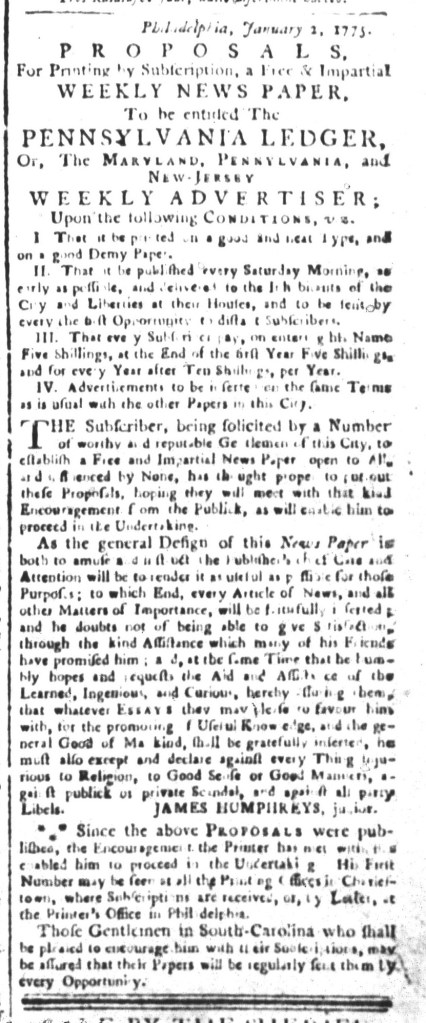
“PENNSYLVANIA LEDGER … His First Number may be seen at all the Printing Offices in Charlestown.”
When James Humphreys, Jr., launched the Pennsylvania Ledger in 1775, he sought local subscribers by placing the proposals for his “Free & Impartial WEEKLY NEWSPAPER” in other newspapers published in Philadelphia. Given the extended title – Pennsylvania Ledger, Or, the Maryland, Pennsylvania, and New-Jersey Weekly Advertiser (in the proposals) or Pennsylvania Ledger: Or the Virginia, Maryland, Pennsylvania, and New-Jersey Weekly Advertiser (on the masthead) – it made sense to promote the newspaper to prospective subscribers and advertisers in towns in Pennsylvania and neighboring colonies. After all, colonial newspapers served vast regions.
Yet they circulated even more widely than the expansive title of the Pennsylvania Ledger suggested. Realizing that was the case, Humphreys sent the proposals for the Pennsylvania Ledger to R. Wells and Son, the printers of the South-Carolina and American General Gazette, in Charleston. Dated “Philadelphia, January 2, 1775,” the proposals ran in the February 24 and March 3 editions. By that time, Humphreys had already commenced publication of his newspaper. A note at the end of the advertisement acknowledged that was the case: “Since the above PROPOSALS were published, the Encouragement the Printer has met with has enabled him to proceed in the Undertaking. His First Number,” published on January 28, “may be seen at all the Printing Offices in Charlestown, where Subscriptions are received.” Wells and Son acted as local agents for Humphreys, a common practice among eighteenth-century printers who also participated in exchange networks for sharing newspapers and reprinting content.
Another note directed to readers of the South-Carolina and American General Gazette advised, “Those Gentlemen in South-Carolina who shall be pleased to encourage [Humphreys] with their Subscriptions, may be assured that their Papers will be regularly sent them by every Opportunity.” That the January 28 edition was available for inspection at a local printing office by February 24 testified to Humphreys’s commitment to delivering newspapers to distant subscribers in a timely manner. While he certainly welcomed individual subscribers, the printer likely hoped that his newspaper would attract the attention of the proprietors of establishments where merchants and others gathered to do business. Coffeehouses, for instance, often supplied newspapers from near and far for patrons to peruse news about current events and consult the shipping news for updates about commerce in the British Atlantic world. Humphreys had a reasonable expectation that publishing proposals for the Pennsylvania Ledger would yield subscribers in South Carolina.
What was advertised in a colonial American newspaper 250 years ago today?
Massachusetts Spy (February 23, 1775).
“A New Weekly NEWS-PAPER … The WORCESTER GAZETTE; OR, AMERICAN ORACLE of LIBERTY.”
Among the advertisements in the February 23, 1775, edition of the Massachusetts Spy appeared “PROPOSALS For … A New Weekly NEWS-PAPER … To be entitled, The WORCESTER GAZETTE; OR, AMERICAN ORACLE of LIBERTY.” That newspaper would commence publication in Worcester, about forty miles west of Boston, “as soon as Seven Hundred Subscribers have entered their names.” It would be the first newspaper published in that town, giving residents greater access to “the most early and authentic Intelligence, and such Political Essays, as are worthy of Public notice, with other matters interesting and entertaining.”
In his History of Printing in America (1810), Isaiah Thomas explained, “In 1774, a number of gentlemen in the county of Worcester, zealously engaged in the cause of the country, were from the then appearance of public affairs, desirous to have a press established in Worcester.” In other words, supporters of the patriot cause wanted a local newspaper instead of relying on newspapers published in Boston, Salem, Newburyport, Providence, Portsmouth, Norwich, and Hartford. Although newspapers from each of those towns served readers in larger, overlapping regions, Patriots in Worcester believed that a local newspaper would both serve their community and strengthen their position. By the time they “applied to a printer in Boston” in December 1774, the “Worcester Revolution” had already closed the courts and removed British authority from that town. Thomas, that printer in Boston, “engaged to open a printing house, and to publish a newspaper there, in the course of the ensuing spring.” He initially intended to follow a model like the one for establishing the Essex Journal in partnership with Henry-Walter Tinges in Newburyport. Tinges, the junior partner, managed the printing office there while Thomas remained in Boston. As part of his preparations, Thomas published the proposals for the Worcester Gazette as he worked on recruiting “a suitable person to manage the concerns of it.” However, when the Revolutionary War began with the Battles of Lexington and Concord on April 19, Thomas “was obliged to leave Boston, and came himself to Worcester” and became the city’s first printer.[1]
When Thomas disseminated the first issue on May3, he combined the name of the newspaper he published in Boston for several years, the Massachusetts Spy, and the intended name for the new newspaper, calling it the Massachusetts Spy or American Oracle of Liberty. As outlined in the proposals from February, he published the newspaper “every WEDNESDAY Morning, as early as possible” so it could be “delivered to the Subscribers in Worcester at their houses, and sent by the first opportunity to such as are at a greater distance.” The annual subscription fee in the colophon matched the proposals, “Six Shillings and Eight Pence per annum, the same as the Boston news-papers.” The colophon did not list rates for advertising, though the proposals stated that they would be “inserted in a neat and conspicuous [manner], at the same rates as they are in Boston.” Little did Thomas know when he published the “PROPOSALS [for] The WORCESTER GAZETTE” in February 1775 that he would soon relocate to that town and become one of its most prominent residents, establishing the first printing office and, eventually, founding the American Antiquarian Society in 1812.
**********
[1] Isaiah Thomas, The History of Printing in America: With a Biography of Printers and an Account of Newspapers (1810; New York: Weathervane Books, 1970), 180-181.
What was advertised in a colonial American newspaper 250 years ago today?
Pennsylvania Ledger (February 4, 1775).
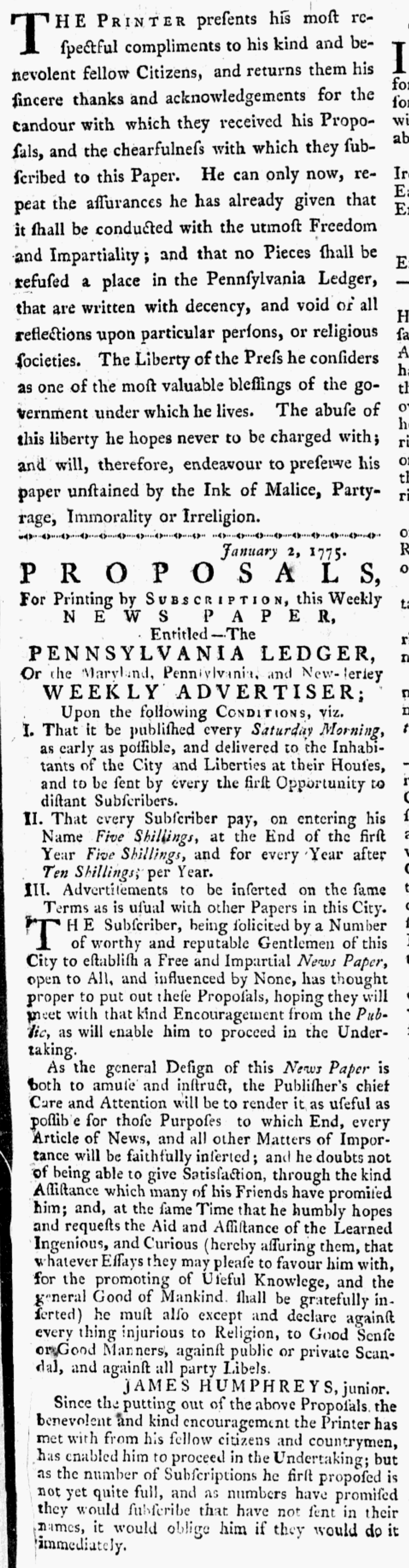
“Numbers have promised they would subscribe that have not sent in their names.”
The second issue of the Pennsylvania Ledger began with the same notice from the printer, James Humphreys, Jr., that appeared as the first item in the first column on the first page of the inaugural issue a week earlier. He apparently considered it worth running again, especially since the new publication had not yet achieved as wide a circulation as he hoped. Humphreys’s message to “his kind and benevolent fellow Citizens” thus bore repeating to reach as many readers (and prospective subscribers) as possible as copies of Philadelphia’s newest newspaper found their way into coffeehouses and taverns or passed from hand to hand.
In that address, the printer “repeat[ed] the assurances he has already given” in proposals for the newspaper “that it shall be conducted with the utmost Freedom and Impartiality; and that no Pieces shall be refused a place in the Pennsylvania Ledger, that are written with decency, and void of all reflections upon particular persons, or religious societies.” Printers often asserted that their publications would represent multiple perspectives when they addressed the public in the decade before the Revolutionary War, though many did not follow through on that promise. Some privileged their own political views while others responded to what they perceived to be the overwhelming sense (or the most vocal voices) in the communities where they operated their printing presses. In his subscription proposals, Humphreys promoted a “FREE and IMPARTIAL” newspaper. In his monumental History of Printing in America (1810), Isaiah Thomas acknowledged that Humphreys purported to publish an impartial newspaper, yet “[i]t was supposed that Humphrey’s paper would be in the British interest” and the Pennsylvania Evening Post, founded by Benjamin Towne at the same time, “took the opposite ground.”[1] In his address, Humphreys proclaimed that he considered “Liberty of the Press … one of the most valuable blessings of the government under which he lives,” though his ideas about what constituted “Liberty of the Press” may have differed from that of other colonizers. As the imperial crisis intensified, more and more newspapers became associated with either Patriots or Loyalists.
Still, Humphreys wanted to make a go of it with the Pennsylvania Ledger. In that second issue, he inserted the proposals immediately below his address to the public, filling the remainder of the column. He explained in even more detail that “the general Design of this News Paper is both to amuse and instruct” so “every Article of News, and all other Matters of Importance will be faithfully inserted.” In billing his newspaper as “Free and Impartial,” Humphreys may have intended to make a point that readers should expect to encounter pieces representing a variety of views, but, as Thomas suggested, many were suspicious of Humphreys’s intentions when it came to disseminating content from the Tory perspective. That could have contributed to a note that the printer added to the proposals. He claimed that he received enough “encouragement … to proceed in the Undertaking,” but “numbers have promised they would subscribe that have not sent in their names.” As they learned more about the positions the Pennsylvania Ledger would likely take, some prospective subscribers apparently decided they did not wish to support the newspaper.
**********
[1] Isaiah Thomas, The History of Printing in America: With a Biography of Printers and an Account of Newspapers (1810; New York: Weathervane Books, 1970), 399.
What was advertised in a colonial American newspaper 250 years ago today?
Pennsylvania Ledger (January 25, 1775).
“PROPOSALS For Printing by Subscription, a FREE and IMPARTIAL WEEKLY NEWS-PAPER.”
As the imperial crisis intensified, the number of newspapers published in Philadelphia, the largest city in the colonies, grew significantly. Throughout the early 1770s, readers had access to Dunlap’s Pennsylvania Packet, the Pennsylvania Gazette, and the Pennsylvania Journal. Until February 1774, the Pennsylvania Chronicle had also circulated in Philadelphia. Less than a year after that newspaper folded, Benjamin Towne commenced publication of the Pennsylvania Evening Post, the first tri-weekly newspaper attempted in that city, on January 24, 1775, and James Humphrey, Jr., distributed the first issue of the Pennsylvania Ledger four days later. Enoch Story and Daniel Humphreys also advertised plans for another newspaper, the Pennsylvania Mercury. They published their inaugural issue in April 1775, two weeks before the battles at Lexington and Concord.
On January 25, the Pennsylvania Journal carried the proposals for both the Pennsylvania Ledger and the Pennsylvania Mercury, placing them side by side on the final page. As was customary, the printers gave an overview of why they wished to publish their newspapers, explained what subscribers could expect among the contents, and listed the conditions for subscribing. Among the various purposes the Pennsylvania Mercury would serve, Story and Humphreys included, “To communicate advertisements of every kind.” The printers of both proposed newspapers sought advertisements, an essential revenue stream for any printer publishing a newspaper. After noting the prices for subscriptions to the Pennsylvania Ledger, Humphreys indicated, “Advertisements to be inserted on the same terms as is usual with the other papers in this city.” For the Pennsylvania Mercury, Story and Humphreys declared, “The Rates of the Paper and Advertisements will be the same with those now printed in this City.” Dunlap’s Pennsylvania Packet and the Pennsylvania Journal both gave the price for subscriptions – “Ten Shillings per Annum” – in their colophons, but none of the newspapers then printed in Philadelphia regularly published what they charged for advertising. Apparently, according to the proposals for the Pennsylvania Ledger and the Pennsylvania Mercury, none offered better deals than others.
Story and Humphreys did give a bit more attention to advertising in their proposals. “All Advertisements,” they promised, “shall be inserted in order as they come in, and shall appear in a fair and conspicuous manner.” They did not mean that paid notices would literally appear one after the other in the order received at the printing office but rather that a compositor would set type in that order and integrate them into the layout of the newspaper without privileging any later arrivals over those submitted sooner. After all, newspaper printers sometimes inserted notes that advertisements had been omitted due to lack of space. Story and Humphreys signaled that they would not take anything into consideration beyond the order that advertisers delivered their notices when delaying publication of some. They also acknowledged that compositors arranged content to make pieces of different lengths complete columns and fill pages. During that process, they would not privilege any advertisements over others, displaying each “in a fair and conspicuous manner.” With such appeals, Story and Humphreys solicited the trust of prospective advertisers who wanted a good return on the money they invested in disseminating information in the Pennsylvania Mercury.
Neither of these proposals for new newspapers discussed advertising extensively, but each did seek advertisers along with subscribers. Whatever goals they expressed for circulating news as the political situation deteriorated, the viability of pursuing their ideals of publishing “improving, instructive and entertaining” information depended in large part on recruiting advertisers as well as enlisting subscribers.
What was advertised in a colonial American newspaper 250 years ago today?
Essex Journal (December 4, 1773).
“THOSE LADIES and GENTLEMEN who are desirous of seeing the curious ART of PRINTING, are hereby informed that on MONDAY next the Printing Office, will be opened for their reception.”
When Isaiah Thomas and Henry-Walter Tinges formed a partnership to publish the Essex Journal and Merrimack Packet: Or, the Massachusetts and New-Hampshire General Advertiser in the fall of 1773, they devised a savvy marketing campaign. Thomas already published the Massachusetts Spy in Boston. He continued overseeing that newspaper, while Tinges ran the printing office in Newburyport. To generate interest in the new publication, the partners inserted a notice in the November 26 edition of the Massachusetts Spy, informing both prospective subscribers and prospective advertisers that they would distribute the inaugural issue of the Essex Journal “GRATIS” on December 4. They envisioned “a very large Number will be printed off, and distributed throughout the Provinces of Massachusetts Bay and New-Hampshire.”
Thomas and Tinges used that first issue as a vehicle for further promoting the newspaper as well as several ventures Thomas already had underway. An extensive address “To the PUBLIC” from the printers and “PROPOSALS For CONTINUING the ESSEX JOURNAL” filled most of the first page, appearing below a masthead that included woodcuts of the arms of the colony, an indigenous man holding an arrow in one hand and a bow in the other, on the left and a packet ship under sail, presumably carrying newspapers and letters, on the right. The title of the newspaper ran between the images. At short advertisement for a magazine that Thomas already marketed extensively completed the final column: “SUBSCRIPTIONS for the ROYAL AMERICAN MAGAZINE, which will speedily be published by I. THOMAS, in Boston, are taken in at the Printing-Office.” A longer advertisement addressed to “the generous Patrons and Promoters of useful KNOWLEDGE, throughout AMERICA,” a notice that previously appeared in several newspapers published in Boston, appeared on the final page of the inaugural issue. In it, Thomas solicited articles for the Royal American Magazine and warned prospective subscribers to submit their names soon or risk missing the first issue. A shorter advertisement on the final page promoted “Thomas’s Boston Sheet ALMANACK for the year ensuing, proper for all Merchants, Shopkeepers, &c. to paste or hang up in their Stores or Shops.”
Essex Journal (December 4, 1773).
On the third page, the first advertisement immediately following the news invited “LADIES and GENTLEMEN who are desirous of seeing the curious ART of PRINTING” to visit the printing office on the following Monday. The printers planned to open their shop to the public, prepared to “wait on all who will do them the honour of their company.” Thomas and Tinges highlighted demonstrations scheduled for “eleven o’clock in the forenoon, and at three in the afternoon.” They hoped that such exhibitions would help convince prospective subscribers and prospective advertisers to do business with them. Opening the printing office to the public “for their reception” anticipated open houses that many businesses now host to draw attention to new endeavors. Another advertisement, this one on the final page, asked “GENTLEMEN and LADIES in this and the neighbouring towns who will encourage the Publication of this Paper” to “send in their names with all convenient speed.” Thomas and Tinges suggested that publishing subsequent issues of the Essex Journal was not a foregone conclusion. Instead, they needed prospective subscribers to confirm their commitment before the next issue would go to press. A second issue depended on “a sufficient number of Subscribers.” As a final bonus, a supplement accompanied the inaugural issue. It featured news about “the detestable TEA sent out by the East-India Company, part of which being just arrived in [Boston] harbour,” that made its way to Newburyport the previous day via “Friday’s Post.” With the supplement, Thomas and Tinges made the point that subscribers to the Essex Journal could expect to receive the latest news as soon as it arrived in Newburyport rather than waiting for the Essex Gazette, published in Salem, the New-Hampshire Gazette, published in Portsmouth, or any of the newspapers published in Boston.
Despite these efforts, it took a few weeks for Thomas and Tinges to collect enough subscriptions to convince them of the viability of publishing the Essex Journal. The various marketing strategies incorporated into the inaugural issue, from distributing free copies to the extensive subscription proposals to the open house at the printing office to the news supplement, likely helped generate interest, but the process took time. Thomas and Tinges did not publish the second issue of the Essex Journal for more than three weeks. It appeared on December 29, once again carrying the proposals and conditions to entice readers who had not yet subscribed.
“PROPOSALS FOR PRINTING A WEEKLY NEWSPAPER, AT NORFOLK.”
It was a busy year for proposing and establishing new newspapers in the colonies. In 1773, printers in several colonies announced their intentions to publish new newspapers, some in towns that did not yet have their own newspapers and others in places already served by one or more newspapers. The first new newspaper of the year appeared in New York following an extensive campaign to attract subscribers in the city and far beyond. James Rivington distributed the first issue of Rivington’s New-York Gazetteer; or the Connecticut, New-Jersey, Hudson’s-River, and Quebec Weekly Advertiser on April 22, 1773. Alexander Robertson, James Robertson, and John Trumbull sought subscribers during the summer and began publishing the Norwich Packet and the Connecticut, Massachusetts, New-Hampshire, and Rhode-Island Weekly Advertiser in the fall. The first newspaper published in Norwich, it became the fourth published in Connecticut at the time. In Baltimore, William Goddard launched the Maryland Journal and the Baltimore Advertiser on August 20 after disseminating subscription proposals for many months. It was the first newspaper in a city not yet prepared for two weekly publications. Robert Hodge and Frederick Shober did not manage to attract enough subscribers to make their proposed newspaper a viable venture.
William Duncan hoped for a different outcome when he placed “PROPOSALS FOR PRINTING A WEEKLY NEWSPAPER, AT NORFOLK,” in the August 12 edition of Purdie and Dixon’s Virginia Gazette. Duncan hoped to gather enough subscribers to support the Norfolk Gazette and Virginia Advertiser. If successful, it would be the first newspaper published in that town and the first one published in Virginia beyond Williamsburg. Duncan indicated the cost for both subscriptions and advertisements “will be the same as those published in WILLIAMSBURG” in Purdie and Dixon’s Virginia Gazette and Rind’s Virginia Gazette. According to the colophons in both newspapers, subscriptions cost twelve shillings and six pence per year and advertisements “of a moderate Length” ran for three shillings for the first week and then two shillings for each additional insertion. Duncan pledged to subscribers that he would devote “Attention to their Interest, by procuring the earliest Intelligences” and selecting only “what may be really useful as well as entertaining” while avoiding filler that did not matter to readers.
To aid in this endeavor, “SUBSCRIPTIONS will be taken in by the different GENTLEMEN instructed with PROPOSALS,” a common practice for gauging interest in books, newspapers, magazines, and other publications in early America. Printed proposals usually included both an overview of the purpose of the publication, the plan for taking it to press, and the conditions for subscribing, including cost and descriptions of the paper and type. In his newspaper advertisement, Duncan acknowledged that a “Specimen or Paper, Size, and Arrangement, may be expected by some” who wished to examine a sample before subscribing. However, he had not yet arrived in Virginia and in his absence “does not purpose that any Thing of that Nature should be shown until he carries the Work into Execution.” Such circumstances may have made some prospective subscribers wary. William Duncan and Company did eventually distribute the first edition of the Virginia Gazette or Norfolk Intelligencer on June 9, 1774, ten months after the subscription proposals first appeared in Purdie and Dixon’s Virginia Gazette in Williamsburg. Duncan began working on the project in the summer of 1773, but it took the better part of a year to commence publication.
What was advertised in a colonial American newspaper 250 years ago today?
Connecticut Courant (June 22, 1773).
“PROPOSALS, For PUBLISHING, upon a PLAN entirely new, a Periodical PAPER.”
For several years, three newspapers served residents of Connecticut, the New-London Gazette (established as the Connecticut Gazette in November 1763), the Connecticut Courant (established October 1764), published in Hartford, and the Connecticut Journal and New-Haven Post-Boy (founded October 1767). In addition, the Newport Mercury, the Providence Gazette, and several newspapers published in New York circulated in Connecticut. In 1773, Alexander Robertson, James Robertson, and John Trumbull made plans to launch a fourth newspaper in the colony. To that end, they distributed subscription proposals for the “NORWICH PACKET, OR THE CONNECTICUT, MASSACHUSETTS, NEW-HAMPSHIRE, AND RHODE-ISLAND INTELLIGENCER, AND WEEKLY ADVERTISER.” They intended for their newspaper to serve a region that extended far beyond the town where they published it.
As was the case with the Maryland Journal (published in Baltimore) and Rivington’s New-York Gazetteer, it took some time for the printers to amass a sufficient number of subscribers to commence publication. The Robertsons and Trumbull stated that the “first Paper will be published as soon as a competent Number of Subscribers are procured.” They printed the first issue in October 1773, the Norwich Packet became the third new newspaper in the colonies that year. That brought the total to thirty-three newspapers throughout the colonies, most of them in English along with two in German published in Pennsylvania. By the end of the year, the New-York Gazette or Weekly Post-Boy folded, while Isaiah Thomas and Henry-Walter Tinges established the Essex Journal in Newburyport, Massachusetts. Even as a few newspapers, such as the Boston Chronicle, went out of business in the early 1770s, colonizers gained access to a greater variety of newspapers in the years just before the American Revolution. Overall, the total number rose from twenty-six in 1765 to thirty-one in 1770 to forty-three in 1775. During the Revolutionary War, several of those newspapers ceased or paused publication. Printers founded others to supply colonizers with information about the war, commerce, and other news.
The Norwich Packet continued publication throughout most of the war, though suspended from late September 1782 through late October 1783. The Robertsons and Trumbull, however, parted ways. In May 1776, Trumbull became the sole publisher when the Robertsons, who were Loyalists, relocated to New York. In their subscription proposals, the three printers asserted that they planned to publish a “succinct detail of the Proceedings of the Parliament of Great-Britain, especially such as relate to America, and the political Manoeuvres of the Statesmen in and out of Administration.” How to interpret and respond to those “Proceedings” and “Manoeuvres” eventually resulted in such deep fissures that some colonizers declared and fought for independence while others remained loyal to Britain. When the Robertsons and Trumbull established the Norwich Packet, the updates and editorials in the newspaper helped shape public discourse about the relationship between the colonies and Parliament. Within just a couple of years, the Norwich Packet related and recorded many of the events of the Revolutionary War. In order to publish “the most recent Advices of every remarkable Event,” however, the printers first had to convince “THE PUBLIC” to subscribe.