Slavery Advertisements Published March 11, 1771

The Slavery Adverts 250 Project chronicles the role of newspaper advertising in perpetuating slavery in the era of the American Revolution. The project seeks to reveal the ubiquity of slavery in eighteenth-century life from New England to Georgia by republishing advertisements about enslaved people – for sale as individuals or in groups, wanted to purchase or for hire for short periods, runaways who liberated themselves, and those who were subsequently captured and confined in jails and workhouses – in daily digests on this site as well as in real time via the @SlaveAdverts250 Twitter feed, utilizing twenty-first-century media to stand in for the print media of the eighteenth century.

The project aims to provide modern audiences with a sense of just how often colonists encountered these advertisements in their daily lives. Enslaved men, women, and children appeared in print somewhere in the colonies almost every single day. Those advertisements served as a constant backdrop for social, cultural, economic, and political life in colonial and revolutionary America. Colonists who did not purport to own enslaved people were still confronted with slavery as well as invited to maintain the system by purchasing enslaved men, women, and children or assisting in the capture of so-called “runaways” who sought to free themselves from bondage. The frequency of these newspaper advertisements suggests just how embedded slavery was in colonial and revolutionary American culture in everyday interactions beyond the printed page.

These advertisements also testify to the experiences of enslaved men, women, and children, though readers must consider that those experiences have been remediated through descriptions offered by enslavers rather than enslaved people themselves. Often unnamed in the advertisements, enslaved men, women, and children were not invisible or unimportant in early America.

These advertisements appeared in colonial American newspapers 250 years ago today.

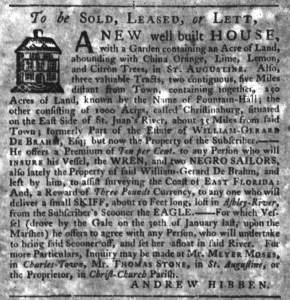
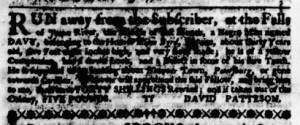
Boston Evening-Post (March 11, 1771).

**********

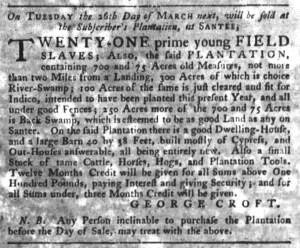
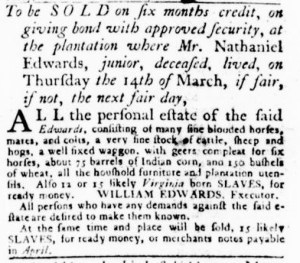
New-York Gazette and Weekly Mercury (March 11, 1771).

**********

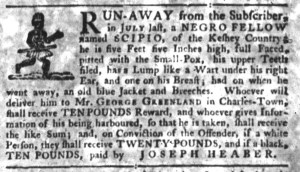
New-York Gazette and Weekly Mercury (March 11, 1771).

**********

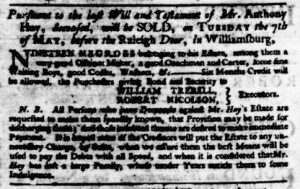
New-York Gazette and Weekly Mercury (March 11, 1771).

**********
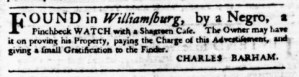
Supplement to the New-York Gazette and Weekly Mercury (March 11, 1771).

**********

Supplement to the New-York Gazette and Weekly Mercury (March 11, 1771).

**********
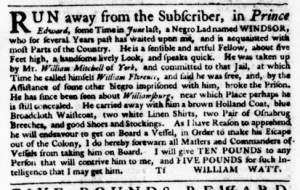
Pennsylvania Chronicle (March 11, 1771).

March 10

What was advertised in a colonial American newspaper 250 years ago this week?

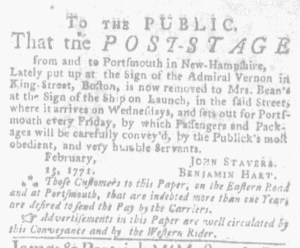
Massachusetts Gazette and Boston Weekly News-Letter (March 7, 1771).

Advertisements in this Paper are well circulated by this Conveyance and by the Western Rider.”

On March 7, 1771, John Stavers and Benjamin Hart inserted an advertisement in the Massachusetts Gazette and Boston Weekly News-Letter to inform thew public that the “POST-STAGE from and to Portsmouth in New-Hampshire” had a new location in Boston.  Formerly at the Sign of the Admiral Vernon on King Street, the stage now operated from “Mrs. Bean’s at the Sign of the Ship on Launch” on the same street.  It arrived on Wednesdays and departed on Fridays, carrying passengers, packages, and newspapers between the two towns.

Stavers and Hart’s advertisement included two notes that Richard Draper, printer of the Weekly News-Letter, likely added, perhaps after consulting with the stage operators.  Both appeared in italics, distinguishing them from the rest of the contents of the advertisement.  One note called on “Customers to this Paper, on the Eastern Road and at Portsmouth, that are indebted more than one Year … to send the Pay by the Carriers.”  In other words, Draper asked any subscribers who lived along the circuit traversed by Stavers and Hart to submit payment to them for delivery to his printing office in Boston.  The other note proclaimed that “Advertisements in this Paper are well circulated by this Conveyance and by the Western Rider.”  Colonial newspapers depended on revenues generated by advertising.  In this note, Draper sought to assure prospective advertisements that placing their notices in his newspaper would be a good investment because the Weekly News-Letter reached audiences well beyond Boston.  He also encouraged prospective advertisers who lived outside the city, both to the north and the west, to place notices in the Weekly News-Letter in order to reach readers in their own communities.

Draper seems to have piggybacked messages concerning his own business on an advertisement placed by clients who operated a stage between Boston and Portsmouth.  He likely figured that a notice about transporting passengers and packages between the two towns would attract the attention of current subscribers in arrears with their accounts.  He also seized the opportunity to tout the circulation of the newspaper in order to promote it as a vehicle for disseminating advertising.  An advertisement for the “POST-STAGE” ended up doing a lot of work in the interests of the printer.

March 9

What was advertised in a colonial American newspaper 250 years ago today?

Providence Gazette (March 9, 1771).

“Several Kinds of Blanks.”

Like his counterparts in other cities and towns, John Carter did more than print a newspaper at his printing office.  In addition to distributing a new edition of the Providence Gazette on Saturdays, Carter also produced and sold blanks (or printed forms) and did job printing on behalf of customers.  Many also sold books, most of them imported.  Those various services established multiple sources of revenue for printers throughout the colonies.

Printers regularly promoted blanks in short advertisements in their own newspapers.  Some of those notices were very brief, just a couple of lines that completed a column, but others were more extensive.  In the March 9, 1771, edition of the Providence Gazette, for instance, Carter died more than inform readers that he provided blanks for sale at his printing office “at Shakespear’s Head, in King-Street, near the Court-House.  Instead, he listed many of the different kinds of blanks on hand, including “SUPERIOR and INFERIOR Court Executions, … long and short Powers of Attorney, … Bills of Sales, Bills of Lading, … Policies of Insurance, [and] Apprentices Indentures.”  The Providence Gazette served an entire region, not just local residents, so Carter also printed and sold “several Kinds of Blanks for the Colony of Connecticut, such as Writs of Attachment, [Writs] for Recovery of Notes and Book-Debts at a County Court, [and Writs] before a Justice.”  Colonists used standardized blanks to facilitate a variety of legal and commercial transactions.

Carter focused primarily on the many different kinds of blanks available at his printing office, but he also promised quality.  He assured prospective customers that no matter which of his blanks they selected, they were “all neatly printed on good Paper.”  The printer combined skill in execution and quality of materials in his appeal to customers.  The appearance and durability of these blanks enhanced any legal or financial transaction they recorded.

Carter supplemented revenues from subscriptions and advertisements in the Providence Gazette with additional revenues from printing and selling blanks intended for a variety of legal and financial purposes.  Like other printers, he inserted notices about blanks in his newspaper, leveraging one of his endeavors in support of another for the overall benefit of the entire operation of his printing office.

March 8

What was advertised in a colonial American newspaper 250 years ago today?

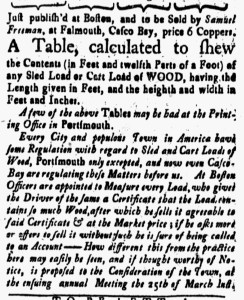
New-Hampshire Gazette (March 8, 1771).

Every City and populous Town in America have some Regulations with regard to Sled and Cart Loads of Wood.”

An advertisement for an ingenious “Table, calculated to shew the Contents … of any Sled Load or Cart Load of WOOD” ran in the March 8, 1771, edition of the New-Hampshire Gazette.  The helpful resource had been published in Boston, but Samuel Freeman sold copies at Falmouth in Casco Bay (or Maine, still part of Massachusetts at the time) and Daniel Fowle and Robert Fowle also had a few copies at their printing office in Portsmouth.  The bulk of the advertisement, that portion printed in italics unlike all other advertisements in that issue, consisted of an explanation of the purpose of the table and an argument for adopting new policies for selling wood in Portsmouth.  It does not seem clear that Samuel Freeman composed the entire advertisement.  Instead, the printers may have seized an opportunity to advocate on behalf of a measure they considered useful.

Every City and populous Town in America,” explained the portion of the advertisement possibly penned by the Fowles, “have some Regulation with regard to Sled and Cart Loads of Wood, Portsmouth only excepted.”  With some dismay, the advertisement exclaimed that “now even Casco-Bay are regulating these Matters before us.”  How did this work and why was it important?  Looking to Boston, the advertisement explained that “Officers are appointed to Measure every Load” and then they gave each driver “a Certificate that the Load contains so much Wood.”  The driver then sold that load “agreeable to said Certificate & at the Market price.”  Adopting this system of invoking weights and measures to regulate those selling wood meant that if a drive “asks more” than the market price or “offers to sell [wood] without” the certificate “he is sure of being called to an Account.”  This policy protected consumers when they purchased a valuable resource for heating their homes, stores, and workshops.

Portsmouth did not have such a policy.  “How different this from the practice here may easily be seen,” the advertisement noted, before recommending that residents of the town might benefit from such a system.  The advertisement concluded with a suggestion that a similar policy might be “proposed to the Consideration of the Town, at the ensuing annual Meeting” at the end of the month.  The Fowles stood to benefit from printing and selling tables measuring wood, but that would not necessarily have been their only motivation in advocating for a policy that benefited all consumers.  Like many other advertisements, this one demonstrates that discourses about politics and policies were not confined to news accounts and editorials that appeared elsewhere in colonial newspapers.  Advertisers regularly discussed politics, endorsed nonimportation agreements, and encouraged domestic manufactures throughout the imperial crisis that culminated in the American Revolution.  In this example, however, colonists used an advertisement to garner support for a local ordinance that would bring Portsmouth in line with other towns.

March 7

What was advertised in a colonial American newspaper 250 years ago today?

Massachusetts Gazette and Boston Weekly News-Letter (March 7, 1771).

“New Garden SEEDS, JUST IMPORTED By Elizabeth Greenleaf.”

It was a sign of spring approaching.  Each year in the late 1760s and early 1770s women who sold seeds placed advertisements in the several newspapers published in Boston, starting in early March and continuing for the next couple of months.  Although printers and compositors usually did not arrange advertisements according to any particular classification, they did often place together the notices from these female seed sellers when they made their annual appearances in the public prints.  Most did not advertise other goods at other times of the year.

The appropriately named Elizabeth Greenleaf was the first to advertise in 1771.  On March 7, she placed an advertisement about “New Garden SEEDS,” including “Early Pease, Beans, and Garden Seeds of all Sorts” in the Massachusetts Gazette and Boston Weekly News-Letter.  Her advertisement ran alone, but soon other women would place their own in the Weekly News-Letter and the other newspapers published in Boston.  Their numbers increased as the weather changed and colonists, especially women, anticipated planting gardens.

Two kinds of advertisements in colonial newspapers helped mark the passage of time and the transition from one season to another.  Advertisements placed by female seed sellers harkened the arrival of spring, while advertisements for almanacs signaled the end of one year and the beginning of another.  Advertisements for almanacs ran in newspapers from New Hampshire to Georgia, but notices about seeds sold by a coterie of female retailers were unique to Boston’s newspapers.

This is the sixth year that the Adverts 250 Project traces the appearance of these advertisements.  Each year they have been a welcome herald of spring’s imminent arrival, a harbinger of the end of winter and the beginning of a new season with warmer weather and more hours of sunlight each day.  In that regard, these advertisements certainly resonate in the twenty-first century, as much now as in the eighteenth century when colonial readers in Boston and its hinterlands first encountered them.

Slavery Advertisements Published March 7, 1771

The Slavery Adverts 250 Project chronicles the role of newspaper advertising in perpetuating slavery in the era of the American Revolution. The project seeks to reveal the ubiquity of slavery in eighteenth-century life from New England to Georgia by republishing advertisements about enslaved people – for sale as individuals or in groups, wanted to purchase or for hire for short periods, runaways who liberated themselves, and those who were subsequently captured and confined in jails and workhouses – in daily digests on this site as well as in real time via the @SlaveAdverts250 Twitter feed, utilizing twenty-first-century media to stand in for the print media of the eighteenth century.

The project aims to provide modern audiences with a sense of just how often colonists encountered these advertisements in their daily lives. Enslaved men, women, and children appeared in print somewhere in the colonies almost every single day. Those advertisements served as a constant backdrop for social, cultural, economic, and political life in colonial and revolutionary America. Colonists who did not purport to own enslaved people were still confronted with slavery as well as invited to maintain the system by purchasing enslaved men, women, and children or assisting in the capture of so-called “runaways” who sought to free themselves from bondage. The frequency of these newspaper advertisements suggests just how embedded slavery was in colonial and revolutionary American culture in everyday interactions beyond the printed page.

These advertisements also testify to the experiences of enslaved men, women, and children, though readers must consider that those experiences have been remediated through descriptions offered by enslavers rather than enslaved people themselves. Often unnamed in the advertisements, enslaved men, women, and children were not invisible or unimportant in early America.

These advertisements appeared in colonial American newspapers 250 years ago today.

Maryland Gazette (March 7, 1771).

**********

Maryland Gazette (March 7, 1771).

**********

Maryland Gazette (March 7, 1771).

**********

Maryland Gazette (March 7, 1771).

**********
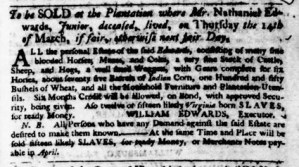
Massachusetts Gazette and Boston Weekly News-Letter (March 7, 1771).

**********

Massachusetts Gazette and Boston Weekly News-Letter (March 7, 1771).

**********
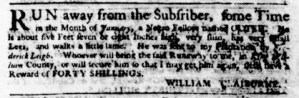
Pennsylvania Gazette (March 7, 1771).

**********

Pennsylvania Gazette (March 7, 1771).

**********

Pennsylvania Gazette (March 7, 1771).

**********

Pennsylvania Journal (March 7, 1771).

**********

Pennsylvania Journal (March 7, 1771).

**********

South-Carolina Gazette (March 7, 1771).

**********

South-Carolina Gazette (March 7, 1771).

**********

South-Carolina Gazette (March 7, 1771).

**********

South-Carolina Gazette (March 7, 1771).

**********

South-Carolina Gazette (March 7, 1771).

**********

South-Carolina Gazette (March 7, 1771).

**********

South-Carolina Gazette (March 7, 1771).

**********

South-Carolina Gazette (March 7, 1771).

**********

South-Carolina Gazette (March 7, 1771).

**********

South-Carolina Gazette (March 7, 1771).

**********

South-Carolina Gazette (March 7, 1771).

**********

South-Carolina Gazette (March 7, 1771).

**********

South-Carolina Gazette (March 7, 1771).

**********

South-Carolina Gazette (March 7, 1771).

**********

Virginia Gazette [Purdie and Dixon] (March 7, 1771).

**********

Virginia Gazette [Purdie and Dixon] (March 7, 1771).

**********

Virginia Gazette [Purdie and Dixon] (March 7, 1771).

**********

Virginia Gazette [Purdie and Dixon] (March 7, 1771).

**********

Virginia Gazette [Purdie and Dixon] (March 7, 1771).

**********

Virginia Gazette [Purdie and Dixon] (March 7, 1771).

**********

Virginia Gazette [Purdie and Dixon] (March 7, 1771).

**********

Virginia Gazette [Purdie and Dixon] (March 7, 1771).

**********

Virginia Gazette [Purdie and Dixon] (March 7, 1771).

**********

Virginia Gazette [Purdie and Dixon] (March 7, 1771).

**********

Virginia Gazette [Purdie and Dixon] (March 7, 1771).

**********

Virginia Gazette [Purdie and Dixon] (March 7, 1771).

**********

Virginia Gazette [Rind] (March 7, 1771).

**********

Virginia Gazette [Rind] (March 7, 1771).

**********

Virginia Gazette [Rind] (March 7, 1771).

**********

Virginia Gazette [Rind] (March 7, 1771).

**********

Virginia Gazette [Rind] (March 7, 1771).

**********

Virginia Gazette [Rind] (March 7, 1771).

March 6

What was advertised in a colonial American newspaper 250 years ago today?

Newport Mercury (March 6, 1771).

“Advertisements, not exceeding 10 or 12 Lines … will be inserted 3 Weeks for 3s9.”

Colonial printers regularly called on their customers to settle accounts.  Solomon Southwick, printer of the Newport Mercury, did so in the March 6, 1771, edition, enclosing his notice in a decorative border to draw attention.  He advised that “ALL Persons indebted to the Printer hereof, either for this Paper, Advertisements, or otherwise, are earnestly requested to make immediate Payment.”  Unlike some of his counterparts who published newspapers in other towns, he did not threaten legal action against those who ignored his notice.

Southwick did take the opportunity to invite others to become subscribers or place advertisements.  Some printers listed their subscription rates, advertising fees, or both in the colophon on the final page, but otherwise most rarely mentioned how much they charged.  Southwick’s notice listed the prices for both subscriptions and advertisements.  He specified that “Any Person may be supplied with this Paper at 6s9 Lawful Money per Year.”  That six shillings and nine pence did not include postage.  Southwick expected subscribers to pay “One Half on subscribing, and the other at the End of the Year.”  Extending credit for a portion of the subscription was standard practice among printers.

Southwick charged advertisers by the amount of space their notices occupied, not the number of words.  “Advertisement, not exceeding 10 or 12 Lines,” he declared, “will be inserted 3 Weeks for 3s9, and be continued, if required, at 1s per week.”  Once again adhering to standard practices in the printing trade, Southwick charged proportionally more for longer advertisements, contingent on their length.  If inserting an advertisement for an additional week cost one shilling, then the initial cost of running an advertisement for three weeks amounted to three shillings for the space in the newspaper and nine pence for setting type, bookkeeping, and other labor undertaken in the printing office.

Running an advertisement for only three weeks cost more than half as much as an annual subscription, demonstrating the significance of advertising revenue for early American printers.  Perhaps because that revenue helped to make publishing the Newport Mercury a viable enterprise, Southwick stated that advertisements should be “accompanied with the Pay” when delivered to his printing office.  He apparently extended credit for advertisements prior to March 1771, but then discouraged that practice in his notice that simultaneously requested that current customers submit payment and outlined the subscription and advertising fees for new customers.

March 5

What was advertised in a colonial American newspaper 250 years ago today?

Essex Gazette (March 5, 1771).

“Sermons on the Death of Mr. WHITEFIELD.”

A little more than five months following George Whitefield’s death on September 30, 1770, the commodification of that event continued in the pages of the Essex Gazette.  Printers, booksellers, and others produced and marketed a variety of commemorative items dedicated to the prominent minister in the weeks after his death.  The advertising for such items tapered off by the end of the year, but some notices occasionally appeared in newspapers from New England to South Carolina in 1771.  On March 5, Samuel Hall, the printer of the Essex Gazette, informed prospective customers of “Dr. Whitaker’s and Mr. Parsons’s Sermons on the Death of Mr. WHITEFIELD, with Mr. Jewet’s Exhortation at the Grave, annexed to the latter” available at his printing office in Salem.

This particular advertisement included thick black bands on both sides, a common symbol of mourning in early American print.  Whitefield’s death, however, was not the reason that Hall included that symbol in the March 5 edition.  The borders ran throughout the entire newspaper, enclosing every column on all four pages, to mark the first anniversary of “Preston’s Massacre–in King-Street–Boston, N. England–1770.  In which Five of his Majesty’s Subjects were slain, and Six wounded, By the Discharge of a Number of Muskets from a Party of Soldiers under the Command of Capt. Thomas Preston.”  Hall devoted the entire front page to commemorating the Boston Massacre, first in a “solemn and perpetual MEMORIAL Of the Tyranny of the British Administration of Government” that extended across all three columns and filled half of the space below the masthead.  A letter reprinted from the New-Hampshire Gazette accounted for the remainder of the page.  In it, an anonymous author, “CONSIDERATION,” encouraged residents of every colony to designate a day to commemorate “the Massacre of 5 Americans” and, more generally, reflect on “the most important Events that have happened relative to the Government and Liberties of the Country.”  Unless colonists set aside a day for “delivering Discourses upon Government, the fundamental Laws of the Land, [and] the Advantages of civil and religious Liberty,” Consideration feared that “People will grow inattentive to those Concerns” and tyrants would prevail.  The black bands around Consideration’s essay underscored the gravity of the proposal.  Consideration issued a call to action, one endorsed by the printers of the New-Hampshire Gazette when they inserted it in their newspaper and endorsed once again by Hall when he reprinted it.

Two of the most momentous events of 1770, the Boston Massacre and the death of George Whitefield, converged in the March 5, 1771, edition of the Essex Gazette.  Both events fueled acts of commemoration, sometimes mediated through commodification.  Vigilant printers played an important role in keeping those stories familiar among the general public, through news accounts, editorials, and advertisements.

Essex Gazette (March 5, 1771).

Slavery Advertisements Published March 5, 1771

The Slavery Adverts 250 Project chronicles the role of newspaper advertising in perpetuating slavery in the era of the American Revolution. The project seeks to reveal the ubiquity of slavery in eighteenth-century life from New England to Georgia by republishing advertisements about enslaved people – for sale as individuals or in groups, wanted to purchase or for hire for short periods, runaways who liberated themselves, and those who were subsequently captured and confined in jails and workhouses – in daily digests on this site as well as in real time via the @SlaveAdverts250 Twitter feed, utilizing twenty-first-century media to stand in for the print media of the eighteenth century.

The project aims to provide modern audiences with a sense of just how often colonists encountered these advertisements in their daily lives. Enslaved men, women, and children appeared in print somewhere in the colonies almost every single day. Those advertisements served as a constant backdrop for social, cultural, economic, and political life in colonial and revolutionary America. Colonists who did not purport to own enslaved people were still confronted with slavery as well as invited to maintain the system by purchasing enslaved men, women, and children or assisting in the capture of so-called “runaways” who sought to free themselves from bondage. The frequency of these newspaper advertisements suggests just how embedded slavery was in colonial and revolutionary American culture in everyday interactions beyond the printed page.

These advertisements also testify to the experiences of enslaved men, women, and children, though readers must consider that those experiences have been remediated through descriptions offered by enslavers rather than enslaved people themselves. Often unnamed in the advertisements, enslaved men, women, and children were not invisible or unimportant in early America.

These advertisements appeared in colonial American newspapers 250 years ago today.

South-Carolina and American General Gazette (March 5, 1771).

**********

South-Carolina and American General Gazette (March 5, 1771).

**********

South-Carolina and American General Gazette (March 5, 1771).

**********

South-Carolina and American General Gazette (March 5, 1771).

**********

South-Carolina and American General Gazette (March 5, 1771).

**********

South-Carolina and American General Gazette (March 5, 1771).

**********

South-Carolina and American General Gazette (March 5, 1771).

**********

South-Carolina and American General Gazette (March 5, 1771).

**********

South-Carolina and American General Gazette (March 5, 1771).

**********

South-Carolina and American General Gazette (March 5, 1771).

**********

South-Carolina and American General Gazette (March 5, 1771).

**********

South-Carolina Gazette and Country Journal (March 5, 1771).

**********

South-Carolina Gazette and Country Journal (March 5, 1771).

**********

South-Carolina Gazette and Country Journal (March 5, 1771).

**********

South-Carolina Gazette and Country Journal (March 5, 1771).

**********

South-Carolina Gazette and Country Journal (March 5, 1771).

**********

South-Carolina Gazette and Country Journal (March 5, 1771).

**********

South-Carolina Gazette and Country Journal (March 5, 1771).

**********

South-Carolina Gazette and Country Journal (March 5, 1771).

**********

South-Carolina Gazette and Country Journal (March 5, 1771).

**********

South-Carolina Gazette and Country Journal (March 5, 1771).

**********

South-Carolina Gazette and Country Journal (March 5, 1771).

**********

South-Carolina Gazette and Country Journal (March 5, 1771).

**********

South-Carolina Gazette and Country Journal (March 5, 1771).

**********

South-Carolina Gazette and Country Journal (March 5, 1771).

**********

Supplement to the South-Carolina Gazette and Country Journal (March 5, 1771).

**********

Supplement to the South-Carolina Gazette and Country Journal (March 5, 1771).

**********

Supplement to the South-Carolina Gazette and Country Journal (March 5, 1771).

**********

Supplement to the South-Carolina Gazette and Country Journal (March 5, 1771).

**********

Supplement to the South-Carolina Gazette and Country Journal (March 5, 1771).

**********

Supplement to the South-Carolina Gazette and Country Journal (March 5, 1771).

**********

Supplement to the South-Carolina Gazette and Country Journal (March 5, 1771).

March 4

What was advertised in a colonial American newspaper 250 years ago today?

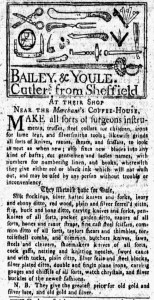
New-York Gazette and Weekly Mercury (March 4, 1771).

“All sorts of knives, razors, shears, and scissars.”

When Bailey and Youle, “Cutlers from Sheffield,” advertised in the New-York Gazette and Weekly Mercury in March 1771, a visual image distinguished their notice from others.  They devoted approximately one-third of the space in their advertisement to a woodcut that may have depicted the sign that marked the location of their shop.  A border contained their names and occupation as well as images of a razor, a knife, an awl, scissors, and a variety of other cutlery that they made and sold at their shop “NEAR THE Merchant’s COFFEE-HOUSE.”  That image represented an investment in their marketing efforts.  First, they had to commission a woodcut connected directly to their business.  Then, since newspaper printers charged by the amount of space advertisements filled rather than the number of words, they had to pay for the additional space required to include the woodcut.  That alone made their advertisement half again more expensive than if they had inserted only the copy with no image.

Was it worth the additional expense?  Bailey and Youle may have impressed prospective customers with their unique image.  The depictions of so many different kinds of cutlery underscored the range of choices in the list of merchandise that followed.  The woodcut almost certainly attracted notice and drew attention to their advertisement.  Consider its placement in the March 4, 1771, edition of the New-York Gazette and Weekly Mercury, the first issue that carried it.  Bailey and Youle’s advertisement ran on the third page in a standard issue created by printing two pages on each side of a broadsheet and then folding it in half.  If readers perused the interior of the newspaper by holding the second and third pages open, Bailey and Youle’s woodcut would have been the only visual image they encountered among two pages of dense text in both news accounts and advertisements.  If they folded the pages over and viewed only one at a time, the woodcut in Bailey and Youle’s advertisement still would have been the only visual image visible.  Only three other images appeared elsewhere in that edition, one in the masthead as usual and two much smaller depictions of ships at sea that accompanied advertisements for passage and freight on the last page.

Bailey and Youle made appeals to consumer choice twice over in their advertisement.  Like many other purveyors of goods, they provided an extensive list of their merchandise.  In addition, however, their woodcut also cataloged the many cutlery items they offered for sale.  Text and image reinforced each other in making overtures to consumers.