October 27

What was advertised in a colonial American newspaper 250 years ago today?
Norwich Packet (October 27, 1774).

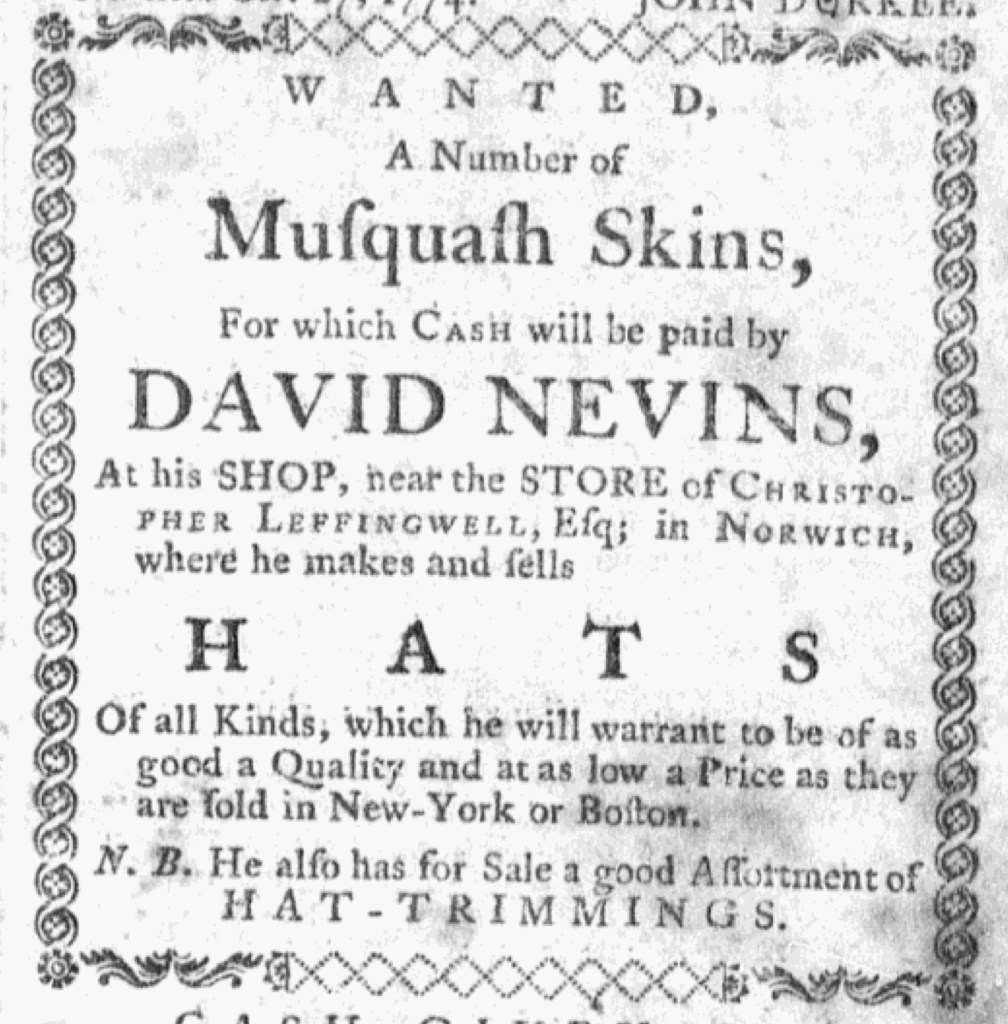
“HATS … of as good a Quality and at as low a Price as they are sold in New-York and Boston.”

The use of decorative type as a border certainly distinguished David Nevins’s advertisement from other content in the October 27, 1774, edition of the Norwich Packet.  It appeared in the final column on the third page along with several other advertisements.  News items filled the facing page as well as the first two columns of that page, each of them in relatively small type compared to some of the fonts in the advertisements.  The compositor used printing ornaments to separate those news items, but nothing as extensive as the border that surrounded Nevins’s advertisement.

Some of the advertisements featured larger fonts to draw attention to consumer goods and services and their purveyors and providers, including “THOMAS COIT” and “Drugs and Medicines” in one, “FLAX SEED, SMALL FURRS, BEES-WAX” in another, and “PUBLIC VENDUE” in a third.  The same was true in Nevins’s advertisement, with his name, “Musquash Skins,” and “HATS” each centered and in larger fonts.  Yet Nevins did not deploy those fonts alone in his effort to draw the attention of readers.  He must have submitted a request for the decorative border along with the copy for his advertisement when he contacted the printing office.

Even with that visual advantage, Nevins also devised copy intended to sell the hats that he produced at his shop.  In addition to hats made of musquash or muskrat pelts, he promoted others “Of all Kinds” that customers could depend on being “of as good a Quality and at as low a Price as they are sold in New-York and Boston.”  Norwich was a small town compared to those major urban ports, yet that did not mean that consumers had to settle for second best or inflated prices. Nevins consistently mad that point in his advertisements.  In February, he “warranted” his hats “to be of the best Quality, and as cheap and fashionable as can be purchased in Boston and New-York” in an advertisement in the Connecticut Gazette.

Other advertisers who placed notices in the Norwich Packet may or may not have made requests about the design elements.  In writing the copy, they may have assumed that the compositor would select certain words to capitalize, center, and print in larger font without providing instructions to do so.  After all, that was a common feature of advertisements in that newspaper.  Nevins, on the other hand, almost certainly stated that he wished to enhance his advertisement with a decorative border to aid in highlighting the appeals he made in his copy.
July 10

What was advertised in a colonial American newspaper 250 years ago this week?

Rivington’s New-York Gazetteer (July 10, 1774).

“Fashionable silver, and metal shoe buckles.”

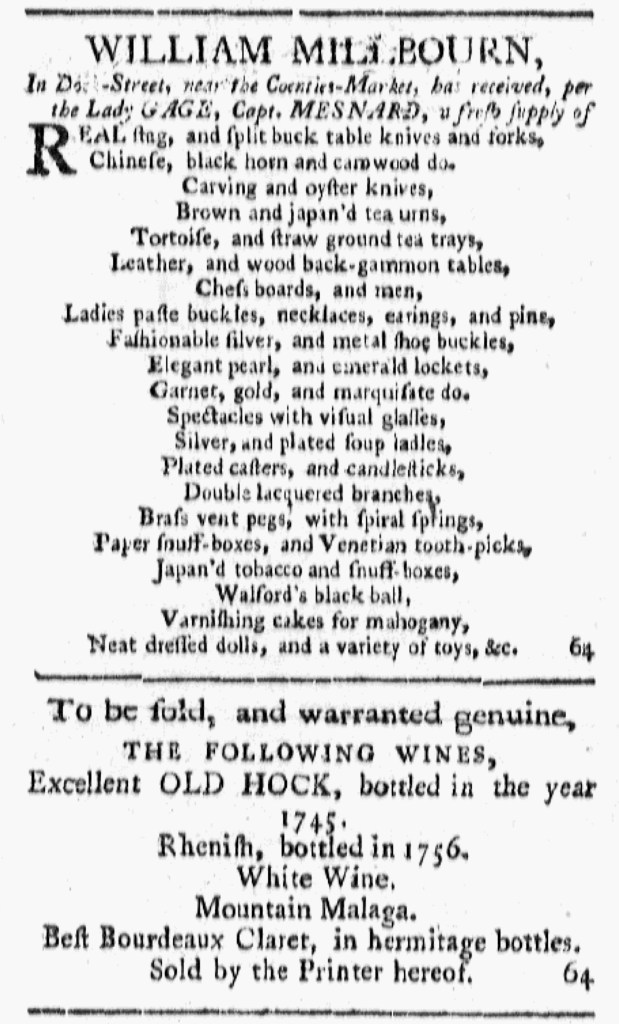
Like other merchants and shopkeepers who advertised imported goods for sale in the July 7, 1774, edition of Rivington’s New-York Gazetteer, William Millbourn listed many of his wares to give consumers a sense of the array of choices available to them.  Yet Millbourn’s advertisement had a different format than most others in that issue.  In the process of giving an inventory of everything from “Carving and oyster knives” to “Chess boards, and men” to “Paper snuff-boxes, and Venetian tooth-picks” to “neat dressed dolls, and a variety of toys,” he named only two or three related items on each line and centered each line.  That gave Millbourn’s advertisement a distinctive appearance with white space on the left and right, ebbing and flowing depending on the length of each line.

Other advertisers deployed other design elements to draw attention to their notices.  James Webb adorned his advertisement for “FRENCH BURR MILL-STONES” with a woodcut depicting a millstone.  Others used headlines in much larger font than the rest of their copy, such as “MUSIC,” “BULL-BAITING,” “NEW RICE,” and “CHINA, GLASS, AND Earthen Ware.”  Below their headline for “IRISH LINENS,” Woodward and Kip gave descriptions in two columns, including “Purple, blue and red copperplate furniture calicoes” and “Black, blue, brown, green, yellow, straw-colour, crimson, garnet, pink and purple moreens.”  Most entries ran two or more lines, with the second and subsequent lines indented and all lines justified on the right.  The indentations introduced some white space into what would have been a dense paragraph, the method that John Haydock used for listing his wares.  Still, the format of Millbourn’s advertisement included much more white space than most others.  He likely submitted instructions concerning how he wished his advertisement to appear along with the copy.

The compositor, either James Rivington himself or someone working in his printing office, apparently liked the look of Millbourn’s advertisement and decided to apply it to a notice about “THE FOLLOWING WINES … Sold by the Printer hereof.”  Both had their initial appearance in the July 7 edition, the advertisement for wine running immediately below Millbourn’s notice.  That suggests that the compositor set the type for one right after the other.  Rather than competing with Millbourn’s advertisement, the second advertisement may have helped focus attention on both notices by extending the unusual use of white space, especially since paragraphs with little white space ran on the right and left as well as above and below.  The distinctiveness of the format had the potential to incite curiosity, increasing the chances that readers engaged with Millbourn’s advertisement.

July 6

What was advertised in a colonial American newspaper 250 years ago today?

Essex Journal (July 6, 1774).

“Hour and Half-hour Glasses … of the neatest sort.”

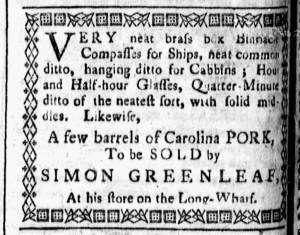
Simon Greenleaf advertised “VERY neat brass box Binnacle Compasses for Ships” and hourglasses “of the neatest sort” for sale at his store “on the Long-Wharf” in Newburyport in the summer of 1774.  He also hawked a “few barrels of Carolina PORK” in his advertisement in the Essex Journal.  Readers likely considered the decorative border that enclosed Greenleaf’s notice the most distinctive aspect of his marketing efforts.  It certainly distinguished his notice from the other advertisements in the July 6 edition and had done so since its first appearance on June 22.

Greenleaf apparently made a request when he submitted his copy to the printing office or met with the printer, Henry-Walter Tinges, to work out an arrangement for this enhancement to his advertisement.  Tinges and Isaiah Thomas commenced publication of the Essex Journal seven months earlier, with Tinges running the printing office in Newburyport while Thomas continued publishing the Massachusetts Spy in Boston.  Had Thomas overseen the Essex Journal, Greenleaf might not have managed to have the border included in his advertisement.  In the past, Thomas seemingly had not been amenable to such flourishes in the Massachusetts Spy, even when advertisers managed to have borders included with their notices published simultaneously in other newspapers.  Ultimately, graphic design depended not only on the imagination of advertisers and compositors but also the preferences of printers who published colonial newspapers.

For the Essex Journal, Greenleaf’s advertisement was a milestone.  It was the first that incorporated decorative type.  Tinges had experiments with using ornaments to as dividers between news items and in the headline for the “POETS-CORNER” on the final page of the newspaper.  Occasionally, he placed the first letter of the first word in an article or letter within a decorative border, but this was the first time that a border enclosed any content, whether news or advertising.  In addition, Tinges did not provide any of the common stock images, such as ships or houses, for the use of advertisers.  Throughout the publication of the Essex Gazette to that point, the only visual images appeared in the masthead, the coat of arms of the colony on the left of the title and a packet ship on the right.  That made Greenleaf’s advertisement even more noteworthy and memorable when readers encountered it since its appearance differed from anything else in that newspaper.

June 14

What was advertised in a colonial American newspaper 250 years ago today?

South-Carolina Gazette and Country Journal (June 14, 1774).

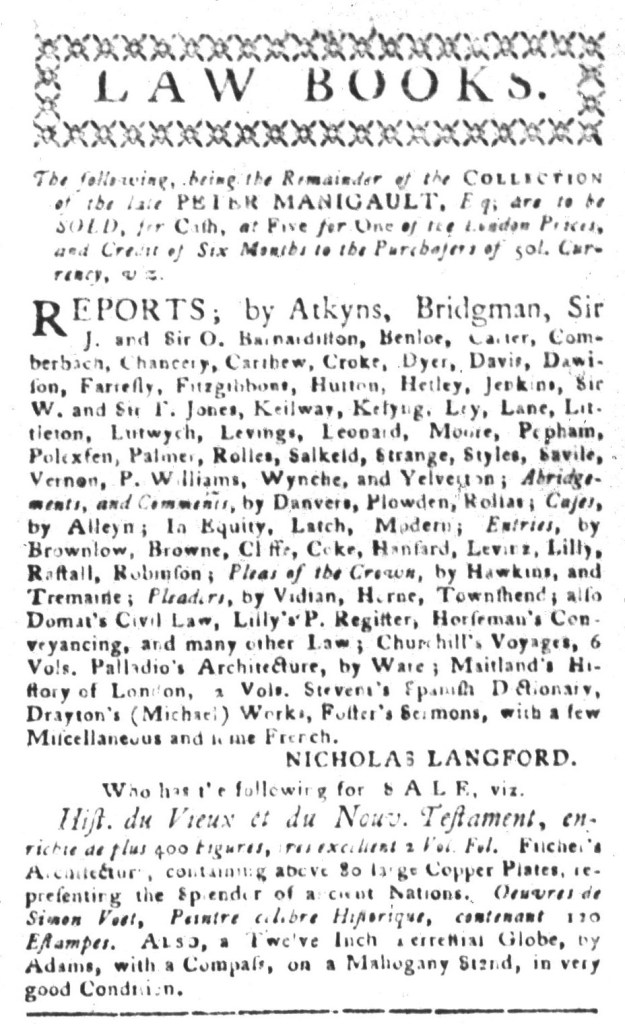
“LAW BOOKS … being the Remainder of the COLLECTION of the late PETER MANIGAULT, Esq.”

Nicholas Langford advertised dozens of law books for sale in the June 14, 1774, edition of the South-Carolina Gazette and Country Journal.  In addition to listing the authors and titles, his advertisement featured a headline, “LAW BOOKS,” enclosed within a border composed of decorative type.  It was the only notice in that issue that received such treatment.  Langford also advertised in the June 10 edition of the South-Carolina and American General Gazette, deploying the same headline with the list of books.  In that instance, the headline did not receive special treatment, suggesting that the printing office was responsible for the enhancement to the version in the South-Carolina Gazette and Country Journal instead of Langford issuing instructions or making a request.

Why might Charles Crouch, the printer of that newspaper, have decided that this advertisement merited such a headline?  Perhaps it was an act of deference.  Langford advertised “the Remainder of the COLLECTION of the late PETER MANIGAULT, Esq.”  Crouch and readers would have been familiar with the prominent lawyer, legislator, and plantation owner.  “Because of his large land and slave holdings,” Michelle Brown notes, Manigault “became one of the wealthiest men in eighteenth-century British North America.”  He owned thousands of acres and enslaved hundreds of men, women, and children.  Manigault served in the Commons House of Assembly from 1755 to 1772, elected as Speaker during the time that South Carolina and other colonies protested the Stamp Act and reelected seven times.  His political career began shortly after he returned from London, where he studied law at the Inner Temple from 1750 to 1754.  He resigned in 1772 due to ill health, returning to England in hopes of recuperating, but died there on November 12, 1773.  Brown reports that “his body was returned to Charleston for burial in the family vault of the Huguenot Church.”  His estate entrusted Langford, a bookseller, with selling his library of law books.  Given Manigault’s influence in the colony, Crouch may have decided that this advertisement deserved a more elaborate headline than others published in his newspaper.

June 5

What was advertised in a colonial American newspaper 250 years ago this week?

Norwich Packet (June 2, 1774).

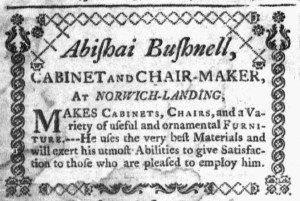
“CABINETS, CHAIRS, and a variety of useful and ornamental FURNITURE.”

Alexander Robertson, James Robertson, and John Trumbull had been publishing the Norwich Packet for less than a year when Abishai Bushnell, “CABINET AND CHAIR-MAKER,” ran an advertisement with distinctive graphic design elements.  One of the printers or one of the compositors who worked in the printing office enclosed Bushnell’s copy within a border comprised of decorative ornaments.  That set it apart from other content, both news and advertising, in the Norwich Packet.  Bushnell may have also arranged to have his advertisement printed separated to use as labels for the “CABINETS, CHAIRS, and a variety of useful and ornamental FURNITURE” he made in his shop.

Except for the packet ship carrying letters from one port to another depicted in the masthead, the Norwich Packet did not usually feature visual images, neither to accompany news nor to adorn advertisements.  That included woodcuts of ships, houses, horses, indentured servants, and enslaved people, stock images that many printers made available to advertisers.  Yet the compositors did make liberal use of printing ornaments to indicate where one news item or editorial ended and another began and, especially, to separate advertisements from each other.  An intricate border also enclosed the first letter of the first word in the first article on the first page of each edition of the Norwich Packet, a design that changed every few weeks.  The masthead also made use of decorative type above and below the date of the newspaper, though that was a more recent innovation as the compositor experimented with the appearance of the front page.

Apparently, that was enough to convince Bushnell that Robertson, Robertson, and Trumbull could produce an advertisement that would attract attention with an ornate border that made it unlike anything else that appeared in the pages of the Norwich Packet.  The cabinetmaker almost certainly placed a special order or gave specific instructions about how he wished his advertisement to look.  After all, even though the compositor incorporated a lot of decorative type into each edition of the newspaper, no other advertisements received such treatment.  Bushnell did not opt for a woodcut of a chair or other piece of furniture representing his trade, but he did find a way to make his advertisement more visible and more memorable.

Decorative borders enclosing the first letter of the first word in the first item on the first page of the Norwich Packet (left to right: March 24, 1774; April 21, 1774; April 28, 1774; May 5, 1774; May 12, 1774).

May 2

What was advertised in a colonial American newspaper 250 years ago today?

Boston-Gazette (May 2, 1774).

{ Blue }
Rich { Black and } Sattins
{ White }

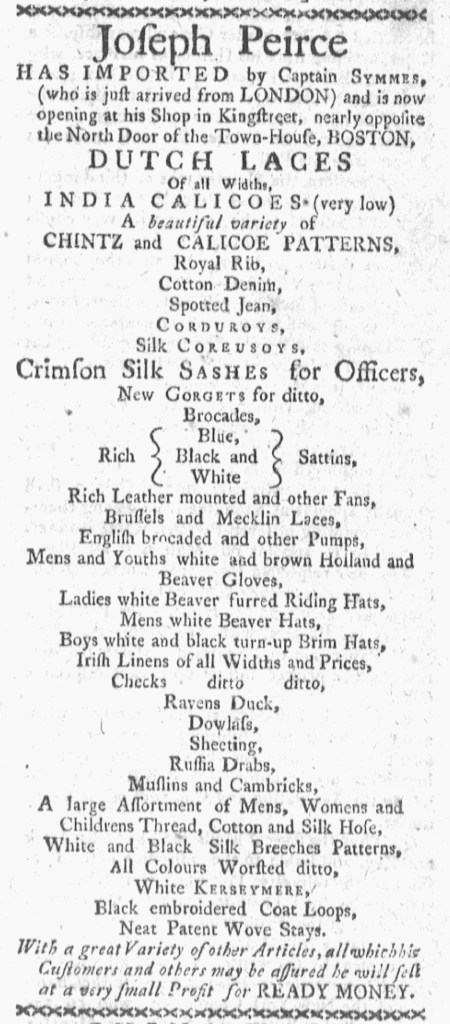
Joseph Peirce’s advertisement on the front page of the May 2, 1774, edition of the Boston-Gazette stood out thanks to its unique graphic design.  The shopkeeper provided a list of merchandise that he recently imported from London, but rather than arrange it in a dense paragraph, as in most advertisements, or create columns with one item per line, as in some advertisements, this one featured one item per line with each line centered.  As a result, the text created an irregular shape with a lot of white space on either side.  That certainly distinguished the advertisement from the news in the column to the right, justified on both sides.

Advertisers usually generated copy, while compositors made most decisions about format.  When merchants and shopkeepers ran advertisements with identical copy in multiple newspapers, variations in fonts, capitalization, italics, font size, and other design elements testified to the creative work done by the compositors in each printing office.  Advertisers likely submitted general instructions with the copy for advertisements that arranged goods in columns, but that may not have always been the case.  M.B. Goldthwait’s advertisement for “DRUGS and MEDICINES” in the April 28, 1774, edition of the Massachusetts Spy, for instance, listed a variety of patent medicines in a paragraph, while his advertisement in the May 2 edition of the Massachusetts Gazette and Boston Post-Boy separated them into side-by-side columns.

Peirce seems to have submitted specific instructions with the copy for his advertisement.  It had the same format in the May 2 editions of the Boston Evening-Post and the Massachusetts Gazette and Boston Post-Boy and the May 5 edition of the Massachusetts Gazette and Boston Weekly News-Letter.  They even gave the same treatment to three lines for:

{ Blue }
Rich { Black and } Sattins
{ White }

That indicates that the compositors incorporated the format that Peirce sketched when he composed the copy.  Curiously, the advertisements in the Boston-Gazette, the Boston Evening-Post and the Massachusetts Gazette and Boston Weekly News-Letter appear identical, as though the printing offices shared type set in one and transferred to the others.  If that was indeed the case, it raises questions about day-to-day operating practices and collaboration among printers in Boston. Even if some printing office shared type, Pierce’s advertisements in the Boston-Gazette and the Massachusetts Gazette and Boston Post-Boy had minor variations while retaining the same format.  That suggests that Peirce provided his vision for his advertisement to at least two printing offices, taking an active role in designing as well as writing his notice.

Left to right: Boston-Gazette (May 2, 1774); Boston Evening-Post (May 2, 1774); Massachusetts Gazette and Boston Weekly News-Letter (May 5, 1774).

March 6

What was advertised in a colonial American newspaper 250 years ago this week?

Supplement to Rivington’s New-York Gazetteer (March 3, 1774).

“All kinds of Windsor Chairs.”

On and off for several months, Thomas Ash, a “WINDSOR CHAIR MAKER, At the Corner below St. Paul’s Church, In the Broad Way,” adorned his advertisement in Rivington’s New-York Gazetteer with a woodcut depicting the item that he made and sold.  In contrast to Abel Buell’s advertisement featuring an image of a gun in the Connecticut Journal, Ash’s woodcut was not the only woodcut commissioned by an advertiser to appear in the March 3, 1774, edition of Rivington’s newspaper.  Elsewhere in that issue, Nesbitt Deane once again ran an advertisement featuring a tricorne hat with his name on a banner unfurled beneath it.  George Webster, “GROCER, AT THE SIGN OF THE Three Sugar Loaves & Scales,” included an image of three sugar loaves, two shorter ones flanking a taller one, enclosed within a simple border.

Those were not the only visual flourishes intended to draw attention to some of the advertisements in Rivington’s New-York Gazetteer.  Decorative borders became a trademark of that newspaper.  In the March 3 edition, five advertisements had such borders, including those placed by Richard Sause for merchandise at his “Hardware, Jewellery and Cutlery Store, John Siemon, a furrier, for muffs and tippets, John Simnet for cleaning and repairing watches, and S. Sp. Skinner for rum distilled in New York.  Except for Simnet, all those advertisers had experience running other notices with decorative borders, as the links indicate.  Simnet previously placed an identical advertisement, including the border. Sause and Siemon also sometimes ran advertisements with woodcuts tied to their businesses.  Indeed, Siemon did so in the New-York Journal published the same day, choosing one method of adding visual interest in one newspaper and another method in the other.  Webster was the fifth advertiser to use a border of decorative type, taking advantage of both methods in a single newspaper notice.

All the woodcuts and borders in Rivington’s New-York Gazetteer made its pages more vibrant than those in the Connecticut Journal.  Advertisements with woodcuts and borders still stood out from others since most did not have either of those features, yet they collectively contributed to a cohesive look that distinguished newspapers published in busy ports from those printed in smaller towns.

February 25

What was advertised in a colonial American newspaper 250 years ago today?

Norwich Packet (February 24, 1774).

“CLOCKS and WATCHES, if left with Mr. JOHN CHAMPLIN, in New-London, will be carefully forwarded to the said HARLAND, and returned with all Expedition.”

In February 1774, Thomas Harland, “WATCH & CLOCK MAKER, From LONDON,” ran an advertisement in the Norwich Packet “to acquaint the public, that he has opened a Shop … in Norwich.”  In it, he incorporated some of the appeals commonly advanced by artisans who migrated across the Atlantic.  In particular, Harland emphasized the quality of his work, declaring that he “makes, in the neatest manner, and on the most improved principles, horizontal, repeating, and plain watches.”  Like others in his trade, he also “cleans and repairs watches and clocks with the greatest care and dispatch.”  Harland devoted a nota bene to engraving and finishing clock faces and cutting and finishing parts, such as watch wheels and fusees, as “neat as in LONDON and at the same price.”  Harland suggested that he offered the sort of superior workmanship available in the largest and most cosmopolitan city in the empire.

Connecticut Gazette (February 25, 1774).

Residents of Norwich and surrounding towns were not the only prospective customers that Harland sought to attract.  He simultaneously ran the same advertisement, with a few modifications, in the Connecticut Gazette, published in New London.  His notice appeared on the front page of the February 25, 1774, edition, supplemented with a short paragraph that informed readers, “CLOCKS and WATCHES, if left with Mr. JOHN CHAMPLIN, in New-London, will be carefully forwarded to the said HARLAND, and returned with all Expedition.”  In his own advertisement on the fourth page of that issue, Champlin, a “GOLDSMITH and JEWELLER,” promoted the work he undertook in his shop and “likewise informs his Customers and others that they may have Clocks and Watches repaired at his Shop as usual.”  Harland’s advertisement suggests that those repairs did not take place in Champlin’s shop, that he instead sent them to Norwich.  Champlin had a history of partnering with associates to provide ancillary services to attract customers to his shop.  The previous fall, Champlin and Daniel Jennings jointly advertised in the New-London Gazette.  In April 1772, Champlin placed a notice in which he stated that he “employed a Person well acquainted” with “Clock and Watch making, mending, cleaning and repairing.”  In December 1769, James Watson advertised that he moved from one silversmith’s shop to Champlin’s shop “where he makes, mends and repairs all kinds of clocks and watches.”  Harland and Champlin mutually benefited from their partnership.  Harland, a newcomer, had an established artisan generating business for him, while Champlin continued providing the same array of services to current and prospective customers.

Champlin may have also played a role in Harland’s marketing efforts.  The watch- and clockmaker in Norwich may have sent his advertising copy to Champlin as part of their regular correspondence rather than directly to the printing office in New London.  An advertisement that had a rather plain appearance in the Norwich Packet featured a variety of embellishments in the Connecticut Gazette.  That version had greater variation in fonts as well as a decorative border.  Champlin’s advertisement also had a decorative border, while most paid notices in the Connecticut Gazette did not.  The compositor could have been responsible for sprucing up Harland’s advertisement, but the connection between Champlin and Harland suggests that the changes may have resulted from specific instructions from one of the advertisers.

February 21

What was advertised in a colonial American newspaper 250 years ago today?

New-York Gazette and Weekly Mercury (February 21, 1774).

“☛K ☛E ☛Y ☛S ☛E ☛R’s Famous Pills.”

Hugh Gaine, “PRINTER, BOOKSELLER, and STATIONER” (as he described himself in the masthead of the New-York Gazette and Weekly Mercury), continued marketing “KEYSER’s Famous Pills,” a remedy for syphilis, in the February 21, 1774, edition of his newspaper.  He gave his advertisement a privileged place.  It was the first item in the first column on the first page, making it difficult for readers to miss.  The advertisement consisted of several portions, collectively extending half a column.  The first two portions, enclosed within a border composed of decorative type, provided a description of the efficacy of the pills in “eradicating every Degree of a certain DISEASE” and curing other maladies and offered an overview of “a Letter from the Widow Keyser, and a Certificate from under her own Hand” testifying to the “Genuineness” of the pills Gaine sold.  In recent months, both apothecaries and printers in New York and Philadelphia engaged in public disputes about who stocked authentic pills and who peddled counterfeits.  Even though Gaine invited the public to examine the letter and certificate at his store in Hanover Square (where they could shop for “Books and Stationary Ware”), the final two portions of his advertisement consisted of transcriptions of those items and a representation of the widow’s “Seal of my Arms.”

The decorative border, the only one in that issue of the New-York Gazette and Weekly Mercury, made Gaine’s advertisement more visible among the contents of the newspaper, yet that was not his only innovative use of graphic design.  For several weeks he had been playing with manicules as a means of drawing attention to his advertisements.  In this instance, a manicule appeared before each letter of “KEYSER,” pointing to the right.  Such had been the case when the advertisement ran on January 24 and 31 and February 7 and 14.  The first time he incorporated manicules into his advertisement for “KEYSER’s FAMOUS PILLS,” however, he had twelve pairs pointing at each other, six pairs above the name of the product and six pairs below the name of the product.  That version appeared just once, on November 1, 1773.  Subsequently, Gaine positioned manicules above each letter of “KEYSER,” pointing down, in six issues.  That arrangement ran on November 8, 15, and 22 and December 6 and 13, each time with a border.  When Gaine used it again on January 17, 1774, he did not include a border but once again had six manicules pointing down, one above each letter of “KEYSER.”  He apparently did not expect the appeals in his advertisements to do all the work of marketing the patent medicine.  Instead, Gaine believed that graphic design aided his efforts to reach prospective customers who much preferred fingers literally pointing at the name of the pills in advertisements over fingers figuratively pointing at them by others who suspected them of being afflicted with “a certain DISEASE.”

New-York Gazette and Weekly Mercury (November 1, 1773).

**********

New-York Gazette and Weekly Mercury (January 17, 1774).

December 14

What was advertised in a colonial American newspaper 250 years ago today?

Essex Gazette (December 14, 1773).

“He is determined to sell so low as to give every Purchaser full Satisfaction.”

Nathaniel Sparhawk emphasized all the choices available to consumers when he advertised a “general Assortment of English and India GOODS” in the December 14, 1773, edition of the Essex Gazette.  To demonstrate some of those choices, he listed some of his merchandise.  His inventory included a “Beautiful assortment [of] superfine, middling and low priced Broad-Cloaths of the most fashionable colours,” “Ribbons of all sorts,” “MEN’s black & cloth colour’d worsted Hose,” “Women’s black, white and cloth-colour’d silk Gloves and Mitts,” “black and white gauze Handkerchiefs,” and “Silk & worsted Knee Garters.”  To further entice prospective customers, Sparhawk pledged to “sell so low as to give every reasonable Purchaser full Satisfaction.”  The shopkeeper intended for the combination of low prices and wide selection to draw customers to his shop in Salem.

In addition to those appeals, Sparhawk used graphic design to attract the attention of readers of the Essex Gazette.  His advertisement was the most visually striking of those that appeared in the December 14 edition.  A border composed of florettes enclosed the entire advertisement, setting it apart from news articles and other advertisements.  It was the only item that featured that sort of adornment on that page or anywhere in the issue.  George Deblois once again published his advertisement promoting a “fine Assortment of ENGLISH and HARD-WARE GOODS.”  It appeared in the column next to Sparhawk’s advertisement.  Both entrepreneurs enumerated many of their goods, but Deblois listed his wares in two dense paragraphs.  Sparhawk, in contrast, opted to divide his advertisement into two columns and list only one or two items on each line.  That likely made it easier for readers to peruse his notice.  In addition to the florettes that surrounded this advertisement, a line of other printing ornaments ran between the two columns, further enhancing its visual appeal.  Sparhawk stocked much of the same merchandise as Deblois and other competitors, but he leveraged graphic design in his advertisement to distinguish his business from the others.