April 27

What was advertised in a colonial American newspaper 250 years ago today?

Apr 27 - 4:27:1770 South-Carolina and American General Gazette
South-Carolina and American General Gazette (April 27, 1770).

“It is impossible to carry on Business without Money.”

Printers, like members of other occupations, frequently extended credit to their customers in early America.  Indeed, the consumer revolution of the eighteenth century depended on extensive networks of credit on both sides of the Atlantic.  As a result, colonial newspapers carried notices calling on consumers to settle accounts nearly often as advertisements hawking goods and services.  Robert Wells, printer of the South-Carolina and American General Gazette, profited from both sorts of advertisements … provided that his customers paid their bills.  He sometimes found himself in the position of placing his own notices “earnestly request[ing] all his good Friends and Customers to pay off their Accounts.”

Such was the case at the end of April 1770.  He declared it “impossible to carry on Business without Money.”  Wells offered generous terms to his “Friends and Customers,” asking them to catch up only “to the End of last Year.”  He did not call on them to pay any charges incurred in the past five months, nor did he threaten legal action.  Most similar advertisement concluded with such warning, some of them more polite than others.  Wells also challenged his customers to compare what they owed him to the magnitude of credit he extended to all of his customers.  Their “Accounts separately amount only to small Sums,” he declared, while implicitly suggesting that those small sums represented a much larger total when considered together.  Wells pleaded with customers not to dismiss the impact of settling accounts just because they considered what they owed so trifling as to not matter.  The printer issued a special appeal to “Ladies and Gentlemen in the Country” to pay for their “Gazettes, Advertisements, and other Articles,” advising that they could have “their Factors or other Friends in Town” settle accounts on their behalf.  Rather than overlook his entreaty because they lived at a distance, Wells offered a solution.  What they owed made it just as “impossible to carry on Business” as what those who resided in Charleston owed.

Like other printers, Wells frequently placed notices in his own newspaper.  Usually he advertised books and stationery, but on occasion he placed another sort of notice.  He could not continue to publish the South-Carolina and American General Gazette if “Friends and Customers” did not settle accounts.  More than any advertisements placed by merchants, shopkeepers, or others calling on customers to pay what they owed, Wells stood to generate the most revenue from this particular advertisement, provided that his customers heeded it and submitted payment.

February 10

What was advertised in a colonial American newspaper 250 years ago this week?

Feb 10 - 2:8:1770 Pennsylvania Gazette
Pennsylvania Gazette (February 8, 1770).

“Advertisements, &c. of a moderate size, shall be done at two hours notice.”

Having previously advertised in the Pennsylvania Chronicle, the Pennsylvania Gazette, and the Pennsylvania Journal in November 1770 when he first acquired “ALL the large and valuable assortment of Printing-Types, together with all the other necessary utensils for carrying on the printing business” from the estate of Andrew Steuart, William Evitt placed a new advertisement in the Pennsylvania Gazette in February 1770. That advertisement reiterated much of the previous one, but more extensively described the various services Evitt provided at “the Bible-in-Heart, in Strawberry-Alley,” the new location for his printing office.

The “various branches” of the printing trade practiced by Evitt included producing advertising materials, especially handbills and broadsides. He assured prospective customers that they “may depend upon having their work done with great care and dispatch” before noting that “Great care will be taken of blanks and hand-bills in particular.” Evitt also gave details about the extent of the assistance he provided in the production of advertisements. While advertisers were welcome to submit copy of their own, “Transient and other persons, who are not acquainted with drawing up advertisements in a proper manner … may have them done gratis.” Evitt meant that he guided advertisers through the process of writing copy as a free service.

Evitt also revealed how quickly he could produce advertisements in his printing office. He proclaimed, “Advertisements, &c. of a moderate size, shall be done at two hours notice, and larger ones in proportion.” Presumably this promise applied to those customers who submitted copy ready to go to press and excluded any time spent on consultation about the copy. The process required operating a manual press after first setting type, hence the variation in the amount of time needed to prepare an order. Evitt could produce handbills and broadsides with a “moderate” amount of copy in just two hours, but needed slightly more time to set type for advertisements with extensive copy.

Newspaper printers and job printers rarely discussed the mechanics of advertising in their newspapers or in the notices they placed to promote the “various branches” of the printing trade, although they did frequently call on colonists to employ them to print advertisements. Evitt provided more detail than most, encouraging a culture of advertising in early America while also helping readers understand how the process worked.

January 28

What was advertised in a colonial American newspaper 250 years ago this week?

Jan 28 1770 - 1:25:1770 New-York JournalFREEMAN’s NEW-YORK ALMANACK, For the Year 1770.”

In the final week of January 1770, John Holt continued in his efforts to rid himself of surplus copies of Freeman’s New-York Almanack, for the Year of Our Lord 1770. He did so much more vigorously than other printers who reduced the length and size of their advertisements significantly as January came to an end, perhaps an indication that Holt seriously miscalculated demand for Freeman’s New-York Almanack, printed far too many, and now had an excessive quantity on hand.

Three advertisements for the almanac appeared on the final page of the January 25 edition of the New-York Journal, Holt’s newspaper. He exercised his privilege as the printer to insert and arrange advertisements as he saw fit. The first of those notices was not at first glance an advertisement for the almanac. Instead, it appeared to be a public interest piece about “raising and preparing FINE FLAX” and the advantages of “farmers in North America” doing so. A separate paragraph at the end, just two lines preceded by a manicule, informed readers that “The whole process of raising and managing this flax is inserted in Freeman’s New-York Almanack for the year 1770.” That note appeared immediately above the most extensive of Holt’s advertisements for the almanac. He had previously run the notices about “FINE FLAX” and the almanac separately, sometimes even on different pages, and left it to readers to discover the synergy for themselves. A month into the new year, however, he no longer left it to prospective customers to make the connection on their own.

To further increase the likelihood that prospective customers would take note of the almanac, Holt placed a third advertisement next to the second one. Even if readers perused a page comprised almost entirely of advertisements so quickly that they did not notice how the “FINE FLAX” advertisement introduced an advertisement listing the contents of the almanac, it would have been difficult to skim all three columns without taking note of Freeman’s New-York Almanack.

Holt’s advertisements for the almanac accounted for a significant portion of the January 25 edition of the New-York Journal. Even taking into account the two-page supplement distributed with it, the entire issue consisted of only eighteen columns. The three advertisements for the almanac filled more than an entire column, displacing news items and editorials that Holt could have published instead. He apparently calculated that he included sufficient news between the standard issue and the supplement to satisfy subscribers, thus allowing him to aggressively advertise the almanac.

November 26

What was advertised in a colonial American newspaper 250 years ago this week?

Nov 26 - 11:23:1769 South-Carolina Gazette Additional Supplement
Additional Supplement to the South-Carolina Gazette (November 23, 1769).

“New Advertisements.”

In the fall of 1769 Peter Timothy did good business when it came to publishing advertisements in the South-Carolina Gazette. Consider the November 23 edition. Advertising appeared on every page. Indeed, the space devoted to advertising eclipsed the space for news items. A headline directing readers to “New Advertisements” appeared at the top of the first column of the first page. The other two columns consisted of news items. The second page also delivered news, but two “New Advertisements” ran at the bottom of the last column. Timothy divided the third page evenly between news items (including a list of prices current in Charleston and the shipping news from the customs house, branded as “Timothy’s Marine List”) and more “New Advertisements.” The final page consisted entirely of advertisements. Overall, paid notices compromised half of the standard issue, which likely suited Timothy just fine since advertising usually generated greater revenue than selling subscriptions.

Yet even giving over that much space to advertising in the standard issue did not allow Timothy to disseminate all of the advertisements submitted to his printing office. A two-page Supplement to the South-Carolina Gazette accompanied the November 23 edition. Except for the masthead, it consisted entirely of advertisements, though the “New Advertisements” headline that ran three times in the standard issue did not appear in the supplement. Timothy may have made a concerted effort to give new content, whether news or advertising, a privileged place in the standard issue. Still, even by publishing the supplement Timothy did not gain sufficient space to include all of the advertisements for the week. He went to the extraordinary step of printing and distributing an Additional Supplement to the South-Carolina Gazette. Printed on a smaller sheet, this two-page supplement featured only two columns per page. It still allowed Timothy to circulate an additional sixteen advertisements. The “New Advertisements” headline ran at the top of the first column on the first page, though the notices were repeats from previous editions. Did Timothy deploy that headline indiscriminately? Or did he use it strategically in an attempt to draw readers weary of advertisements into the Additional Supplement rather than dismiss it as content they had already perused in recent weeks?

Timothy very nearly had more advertisements than he could publish in the South-Carolina Gazette. Assuming that advertisers actually settled accounts in a timely manner, Timothy operated a booming business at his printing office. The volume of paid notices testified to both the extensive circulation of the newspaper and colonists’ confidence in the effectiveness of advertising. Some colonial newspapers, such as the Massachusetts Gazette and Boston Post-Boy and Advertiser, the New-York Journal or General Advertiser, the Pennsylvania Chronicle and Universal Advertiser, and the Pennsylvania Journal and Weekly Advertiser, positioned their purpose as twofold right in the masthead. Timothy very well could have billed the South-Carolina Gazette as an Advertiser.

September 5

What was advertised in a colonial American newspaper 250 years ago today?

Sep 5 - 9:5:1769 Essex Gazette
Essex Gazette (September 5, 1769).

“BLANKS.”

Like printers in other towns and cities in the colonies, Samuel Hall sought to generate revenue by taking advantage of his access to the press to promote his own enterprises in the Essex Gazette. In addition to publishing a newspaper, Hall also produced “BLANKS” at his printing office in Salem. Colonists used blanks (or printed forms, as they would be described today) for a variety of common commercial and legal purposes. They saved significant time compared to writing out the same transaction repeatedly. In some instances, resorting to blanks allowed colonists to sidestep hiring a conveyancer or lawyer to draw up documents.

Most printers simply announced that they stocked blanks of all sorts at their printing offices. On occasion, however, some printers listed the different kinds of blanks, providing a better glimpse of how purchasing them could increase efficiency and streamline all variety of transactions. In his advertisement, Hall listed sixteen different blanks for purposes that ranged from “Apprentices Indentures” to “Bills of Lading” to “Short Powers of Attorney.”

Through his typographical choices, he made sure that readers of the Essex Gazette would notice his advertisement. Many eighteenth-century advertisements that listed goods for sale, especially those that ran in the Essex Gazette in the late 1760s, clustered the items together in dense paragraphs. Hall’s advertisement, on the other hand, listed only one type of blank per line, making it easier to read and identify forms of particular interest. Hall also selected a larger font for his advertisement than appeared throughout the rest of that edition of the Essex Gazette. His notice occupied nearly twice as much space as any other in the same issue. The combination of white space incorporated into Hall’s advertisement and the oversized type made it one of the most striking items on a page that included both news and paid notices. Another advertisement featured a woodcut depicting a ship at sea, but it appeared immediately above Hall’s advertisement for blanks, leading directly into it.

Hall promoted other aspects of his business in the Essex Gazette, hoping to generate revenue beyond subscriptions and advertising fees. In the process, he effectively used graphic design to draw attention to other products from his printing office, an array of blanks for commercial and legal purposes. His access to the press gave him opportunities to experiment with the format of his own advertisements to an extent not available to other colonists.

June 18

What was advertised in a colonial American newspaper 250 years ago this week?

Jun 18 - 6:15:1769 Pennsylvania Journal
Pennsylvania Journal (June 15, 1769).

“ROBERT AITKEN, Bookseller, From Glasgow.”

Robert Aitken, a bookseller, kept shop in Philadelphia only briefly in 1769. In an advertisement in the Pennsylvania Journal, he announced that he had “just now arrived” from Glasgow and “opened his store” on Front Street. His inventory consisted of “a valuable variety of books,” including literature, history, law, medicine, and divinity as well as novels, plays, songs, and ballads. Aitken offered something agreeable to the tastes of practically any reader.

To stimulate sales, the bookseller advised “Such who intend to furnish themselves with any of the above articles” to make their purchases as soon as possible or else miss their chance because he did not intend to remain in Pennsylvania long. Indeed, he did make “but a short stay” in Philadelphia, returning to Scotland before the year ended. Yet he must have been encouraged by the prospects available in Philadelphia. He returned two years later and remained in the city until his death in 1802.

In his History of Printing in America, Isaiah Thomas offers an overview of Aitken’s career. Born in Dalkeith, Scotland, Aitken apprenticed to a bookbinder in Edinburgh. After his initial sojourn as a bookseller in Philadelphia in 1769, he returned in 1771 and “followed the business of bookselling and binding, both before and after the revolution.”[1] In 1774, he became a printer. In January 1775 he founded the Pennsylvania Magazine, one of only seventeen magazines published in the colonies before the American Revolution.[2] It survived for a little over a year, ending its run in July 1776. He earned some renown for publishing an American bible in 1802, though Thomas contests the claim that it was the first printed in America.

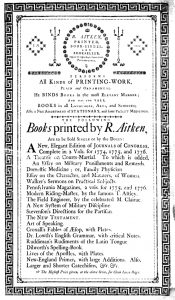
Aitken Broadside
Robert Aitken, Advertising Broadside (Philadelphia: 1779). Courtesy Library Company of Philadelphia.

Like other eighteenth-century printers, Aitken contributed to the culture of advertising in early America. His ledger, now in the collections of the Historical Society of Pennsylvania, lists several broadsides, billheads, and other printed materials distributed for the purposes of advertising that are otherwise unknown since, unfortunately, copies have not survived. He delivered the Pennsylvania Magazine enclosed in advertising wrappers; these are also rare, though some can be found among the collections of the Library Company of Philadelphia. He also printed broadsides listing books he printed in Philadelphia. One also advised prospective clients that Aitken bound books and “PERFORMS All KINDS of PRINTING-WORK, PLAIN and ORNAMENTAL.” The ornamental printing on that broadside was a model of the advertising that Aitken could produce for his customers.  Aitken’s first newspaper advertisements in 1769 barely hinted on the influence he would exert over early American advertising, both as an advertiser of his own goods and services and as a producer of advertising for others who enlisted him in printing broadsides, handbills, magazine wrappers, trade cards, and other media intended to stimulate consumer interest.

**********

[1] Isaiah Thomas, History of Printing in America with a Biography of Printers and an Account of Newspapers (1810; 1874; New York: Weathervane Books, 1970), 401.

[2] See “Chronological List of Magazines” in Frank Luther Mott, A History of Americasn Magazines, 1741-1850 (Cambridge, Massachusetts: Harvard University Press, 1939), 787-788.

May 23

What was advertised in a colonial American newspaper 250 years ago today?

May 23 - 5:23:1769 Essex Gazette
Essex Gazette (May 23, 1769).

“3s. 4d. to be paid at Entrance.”

Eighteenth-century newspaper printers often treated the colophon as advertising space, promoting the goods and services they provided at the printing office. They encouraged readers to purchase subscriptions and place advertisements, though most remained silent about the costs for doing so. In May 1769, Samuel Hall, printer of the Essex Gazette, updated his colophon to indicate the price for subscriptions: “Six Shillings and Eight Pence per Annum.” Previously the colophon simply stated that the Essex Gazette was “Printed by S. HALL, at his Printing-Office a few Doors above the Town-House” in Salem.

When he updated his colophon, Hall actually reverted to the style that more closely resembled what had been in place at the beginning of the year. This time, however, instead of simply listing the yearly subscription fee he also specified “3s. 4d. to be paid at Entrance.” In other words, subscribers had to pay half of the subscription fee up front; Hall extended credit for a portion of the subscription, but he did not assume the risk for it entirely. Given how frequently printers throughout the colonies published notices calling on debtors to settle accounts, Hall may have wished to avoid some of that difficulty as well as the somewhat unseemly practice of threatening legal action against customers.

Consider also that he commenced publication of the Essex Gazette less than a year earlier. He managed to attract advertisers, but not nearly as many as placed notices in the several newspapers published in Boston. The number of advertisements in some even overflowed into half sheet supplements. Like other printers who understood the market for newspapers, Hall realized that he would likely attract more advertisers and revenue to sustain his enterprise if he expanded his roster of subscribers. After all, greater circulation meant a better return on investment for advertisers who placed their notices in front of more prospective customers. Hall likely sought to balance several concerns when he required only partial payment from subscribers: he enticed subscribers with credit, simultaneously took in some revenue and reduced his own risk, and made his newspaper more attractive to advertisers who would supply even more revenue.

May 21

What was advertised in a colonial American newspaper 250 years ago this week?

May 21 - 5:18:1769 Pennsylvania Journal
Pennsylvania Journal (May 18, 1769).

“Particular care will be taken to do Advertisements, Blanks, &c. on very short notice.”

When Joseph Crukshank opened a printing office in Philadelphia in 1769, he attempted to attract clients by placing an advertisement in the Pennsylvania Journal. He pledged that his customers “may depend on having their work done in a neat and correct manner.” Crukshank anticipated that his job printing would include producing “Advertisements, Blanks, &c. on very short notice.” In that regard, he emphasized some of the same services as some newspaper printers regularly promoted in the colophons of their publications. The colophon on the final page of the Georgia Gazette, for instance, stated, “Hand-Bills, Advertisements, &c. printed at the shortest Notice.” Similarly, the colophon for the Pennsylvania Chronicle concluded with “Blanks and Hand-Bills in particular are done on the shortest Notice, in a neat and correct Manner.”

Printers generated revenue by printing handbills and other advertisements. For those who published newspapers, this revenue supplemented what they earned from subscriptions and advertisements inserted in the newspapers. For those who did not publish newspapers, like Crukshank, advertisements were an especially important component of their business. Handbills accounted for some of that work, but a variety of other sorts of advertising media came off of eighteenth-century printing presses, including trade cards, billheads, broadsides, furniture labels, catalogs, subscription notices, and magazine wrappers. Crukshank even promoted a catalog of the books he sold, inviting prospective customers to visit his shop to pick up their own copies.

All advertising could be considered ephemeral, but these other forms of advertising proved to be even more ephemeral than newspaper advertisements. Printers and others created repositories of eighteenth-century newspapers at the time of their creation, but handbills, trade cards, and other printed media deployed as advertising did not benefit from the same systematic collection and preservation. As a result, the sources for reconstructing the history of advertising in the colonial and revolutionary eras are skewed in favor of newspaper advertisements. Certainly newspaper advertisements were the most common form of advertising and merit particular attention, but they do not tell the entire story. The scattered billheads found among household accounts, labels still affixed to furniture, and other relatively rare eighteenth-century advertising media in modern libraries and archives belie their original abundance, according to the frequent references to “Hand-Bills, Advertisements, &c.” and “catalogues” in newspaper advertisements and colophons. Printers’ ledgers and correspondence also include references to advertisements with no known extant copies. These various sources indicate that, especially in the second half of the eighteenth century, Americans encountered a rich visual and textual landscape of advertising as they went about their daily lives.

November 26

What was advertised in a colonial American newspaper 250 years ago today?

Nov 26 - 11:26:1768 Providence Gazette
Providence Gazette (November 26, 1768).

“The GAZETTE is daily receiving an additional Number of Subscribers.”

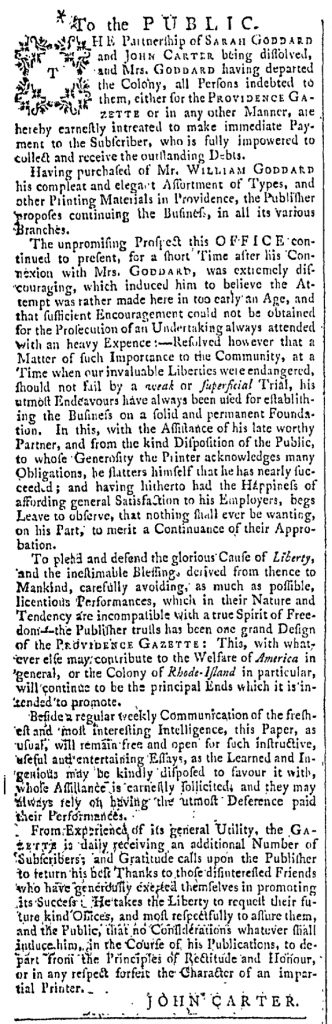
John Carter became the sole proprietor of the Providence Gazette upon the retirement of his partner, Sarah Goddard, in November 1768. He immediately inserted an editorial note to that effect as the first item of the first page in the November 12 edition. His notice “To the PUBLIC,” however, functioned as more than a mere announcement. It also marketed the newspaper to readers, encouraging current subscribers to continue patronizing the publication and all readers to support the various enterprises undertaken at the printing office. Carter stated that he had purchased the “compleat and elegant Assortment of Types, and other Printing Materials.” He stood ready to pursue the printing trade “in all its various Branches,” including publishing the Providence Gazette. Carter promised “that no Consideration whatever shall induce him, in the Course of his Publications, to depart from the Principles of Rectitude and Honour.” He touted himself as an “impartial Printer” who provided a valuable public service to the entire colony.

Carter apparently considered his notice as much an advertisement as an editorial. Had it been an editorial he would have inserted it once and then discontinued it in favor of other content. He did, after all, promote the Providence Gazette as “a regular weekly Communication of the freshest and most interesting Intelligence.” Yet Carter published “Intelligence” that included news items, editorial content, and advertisements, including his own. His notice ran in five consecutive issues, not unlike paid advertisements contracted by other colonists. For regular readers of the Providence Gazette, it would have become as familiar as advertisements placed by Samuel Chace or Joseph Bucklin and Company. In subsequent issues it moved from the front page to the third or fourth page. No longer did it appear alongside news items exclusively. In most instances both news and advertising were featured on the same page as Carter’s notice, but at the end of its run it did appear on a page otherwise devoted entirely to advertising. The placement within each issue testifies to the various purposes Carter intended for his address “To the PUBLIC.”