May 17

What was advertised in a revolutionary American newspaper 250 years ago today?

Virginia Gazette [Purdie] (May 17, 1776).

“COMMON SENSE … to be sold at the CONSTITUTIONAL POST OFFICE.”

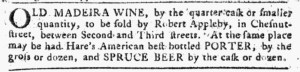
In an advertisement in the May 17, 1776, edition of the Virginia Gazette, Alexander Purdie, the printer, listed a trio of books and “WRITING PAPER, in small quantities, to be sold at the CONSTITUTIONAL POST OFFICE” in Williamsburg.  Those books included two military manuals, “Simes’s MILITARY GUIDE” and “Stevenson’s MILITARY INSTRUCTIONS,” as well as Thomas Paine’s Common Sense, a popular political pamphlet that boldly advocated for declaring independence rather than seeking redress of grievances within the imperial system.  All three works, each of them related to the war, had been published in Philadelphia and transported to Williamsburg.  This was a rare instance of Common Sense being advertised along with other books rather than featured exclusively.

Common Sense appeared first in the advertisement, a fitting placement considering other content in that issue of the Virginia Gazette.  A report from the provincial convention informed readers of a resolution, approved unanimously on May 15, that “the delegates appointed to represent this colony in General Congress be instructed to propose to that respectable body “TO DECLARE THE UNITED COLONIES FREE AND INDEPENDENT STATES, absolved from all allegiance to, or dependence upon, the crown or parliament of Great Britain.”  The following day, the Committee of Safety, members of the General Convention, and residents of Williamsburg gathered for a ceremony at which the resolution was “read aloud to the army,” followed by a series of toasts to “The American independent states,” “The Grand Congress of the United States, and their respective legislatures,” and “General Washington, and victory to the American arms.”  A “discharge of the artillery and small-arms, and the acclamations of all present” followed each toast.  In addition, the “UNION FLAG of the American states waved upon the Capitol during the whole of this ceremony.”  Those present embraced Paine’s arguments for independence that had seemed too radical to many only a few months earlier.

Virginia Gazette [Purdie] (May 17, 1776)

That Purdie sold the pamphlet and the military manuals “at the CONSTITUTIONAL POST OFFICE” also resonated with readers.  They knew that the Second Continental Congress established the Constitutional Post Office as an alternative to the imperial post, appointing Patriots as postmasters.  In addition, Purdie introduced a new masthead for the May 17 edition of the Virginia Gazette.  The previous one featured an image depicting the arms of the monarch and the motto, “En Dat Virginia Quartam” or “Behold, Virginia gives the fourth.”  That referred to the colony as a dominion of the crown along with Great Britain (England and Scotland) and claims to Ireland and France.  The new masthead, however, did not include an image.  Instead, a border of decorative type enclosed, “THIRTEEN UNITED COLONIES” and “United, we stand—Divided, we fall,” a message that echoed the one represented by the severed snake that other printers previously incorporated into the mastheads of the Massachusetts Spy, the New-York Journal, and the Pennsylvania Journal.  As Purdie advertised Common Sense, several elements of his newspaper revealed his endorsement of arguments presented in the political pamphlet.

Virginia Gazette [Purdie] (May 10, 1776).

May 16

What was advertised in a revolutionary American newspaper 250 years ago today?

New-York Journal (May 16, 1776).

“STOP A TORY!”

The headline almost certainly grabbed the attention of readers of the New-York Journal.  Other advertisements had headlines that announced, “WRITING PAPER,” “SCRIVENER’S OFFICE,” or “GEORGE WEBSTER, GROCER,” but this one proclaimed, “STOP A TORY!”  It delivered news that Moses Kirkland “MADE his escape from the gaol” in Philadelphia on the evening of May 7, 1776.  Colonel Kirkland, a Loyalist planter from South Carolina, had been confined in the jail “by order of the Honourable Congress, for practices inimical to this Colony.”  An account that first appeared in the January 17, 1776, edition of the Pennsylvania Journal and subsequently in many other newspapers reported that Kirkland had been “at the head of the tories in the back parts of South Carolina” before making his way to Lord Dunmore, the royal governor of Virginia who offered freedom to enslaved people who fled from Patriot enslavers and joined the king’s forces.  Dunmore dispatched Kirkland “to general Howe at Boston,” but he was captured along the way, imprisoned in Cambridge, and then transported to Philadelphia.

The advertisement provided a physical description of Kirkland and documented the clothes he had been wearing when he made his escape, though he “may possibly have taken other clothes with him” and donned them to elude capture.  The advertisement also gave an account of Kirkland’s likely movements, noting that he crossed the Delaware River into New Jersey at Cooper’s Ferry and “it is supposed [he] will either endeavour to get on board one of the men of war in the river, or at Sandy Hook.”  According to Michael Adelberg, Sandy Hook became a haven for Loyalists as the Revolutionary War entered its second year.  The British Navy took possession of Sandy Hook in April 1776, making it an appealing destination for Loyalists seeking refuge and a good place for Kirkland to make his escape.

The notice further advised that the “public are earnestly desired to endeavour to apprehend this dangerous enemy to the American cause.”  To that end, “a reward of One Hundred Dollars is hereby offered to any person, or persons that shall take and bring him back” to the jail in Philadelphia.  A nota bene called on the “Printers of the several news papers in the Colonies” to aid in the search for Kirkland by running the advertisement.  Several newspapers from New York to Virginia, Adelberg states, did publish the notice, though not all of them gave it a vivid headline that called on readers to “STOP A TORY!”  Despite the reward and the widespread dissemination of the advertisement, Kirkland managed to elude capture and went on to serve as a Loyalist officer in southern campaigns during the Revolutionary War.[1]

**********

[1] See, for instance, Randall M. Miller, “A Loyalist Plan to Retake Georgia and the Carolina, 1778,” South Carolina Historical Magazine 75, no. 4 (October 1974): 207-214.

May 15

What was advertised in a revolutionary American newspaper 250 years ago today?

Pennsylvania Gazette (May 15, 1776).

PREMIUMS … to be given by the Managers of the Contributions for promoting the culture of Silk in the province of Pennsylvania.”

At various times in the eighteenth century, Americans sought to establish and expand silk production in the colonies.  During the first years of the Revolutionary War, for instance, the “Managers of the Contributions for promoting the culture of Silk in the province of Pennsylvania” advertised “PREMIUMS” to be awarded to those who engaged in the enterprise.  Their notice appeared in the Pennsylvania Gazette and the Pennsylvania Journal on May 15, 1776.

Silk production depended on raising silkworms.  Four of the premiums recognized those who presented the “greatest quantity of Cocoons” that were “raised in the province of Pennsylvania and brought to the Filature at Philadelphia for sale, or to be reeled for the Claimant’s own use” between August 1 and November 1.  At the filature, an establishment for reeling silk, filaments from the cocoons would be drawn and spun into thread.  The managers offered a premium of fifteen pounds for the most cocoons, provided that they amounted to “not less than Sixty Thousand,” and premiums of ten pounds and five pounds for the next greatest quantities, “not less than Fifty Thousand” and “not less than Forty Thousand.”  They gave one more premium, “a SILK REEL and COPPER KETTLE on the best construction,” to the fourth largest quantity of cocoons, “not less than Thirty Thousand.”  Setting such thresholds required industriousness on the part of those who wished to claim the premiums.

Three more premiums went to those “who shall produce to the managers the best specimen of sample of Raw Silk, of his or her own raising and reeling.”  Whoever produced the “best specimen … not less than Thirty-two ounces” received a silk reel and a copper kettle.  The “second and third next best samples of Raw Silk, not less than Sixteen ounces,” each received a silk reel.  Finally, another trio of premiums went to those “who shall raise [cocoons] entirely on the White or Italian Mulberry-tree, of the Claimant’s own planting and cultivation.”  Raising “Twenty Thousand Cocoons” yielded a premium of five pounds with two more premiums of three pounds each for raising “not less than Fifteen Thousand Cocoons each.”  A nota bene at the end of the advertisement indicated, “The Italian Mulberry-Seed to be had gratis by applying to JOHN KAIGHN.”

This contest was part of an effort to encourage “domestic manufacture” and local industry during the era of the American Revolution, but attempts to produce silk did not emerge because of the imperial crisis.  Instead, colonizers had been striving for decades to establish silk production in North America.  The premiums offered by the “Managers of the Contributions for promoting the culture of Silk in the province of Pennsylvania” were part of a longer history of seeking to make silk production a viable enterprise in the colonies.

May 14

What was advertised in a revolutionary American newspaper 250 years ago today?

Pennsylvania Evening Post (May 14, 1776).

“Teapots, Cups and Saucers – Regimental Buttons, &c. &c.”

In the spring of 1776, Alexander Bartram “inform[ed] the public, that he has on hand a genteel Assortment of Merchandize.”  In an advertisement in the May 14 edition of the Pennsylvania Evening Post, he stated that he would sell his wares “for a small profit,” signaling to prospective customers that he would not take advantage of the disruptions to trade caused by the war to jack up prices.  Like any other shopkeeper, he needed to earn his livelihood, so a slight markup seemed reasonable under the circumstances.

Bartram devoted most of his advertisement to a list of some of his inventory, including “Broad Cloths and Trimmings, such as brown, buff, green, blue, and light colours, … a good Assortment of Glass Ware, … most sizes of China and Delph Bowls fit for taverns, blue and white and enamelled Dishes and Plates, [and] Teapots, Cups and Saucers.”  At what seemed to be the end of the list, he added “&c.” (the abbreviation for et cetera commonly used in the eighteenth century) to indicate that he had even more goods on hand at his shop.  Then he continued with shorter list that resonated with current events.  He declared that he also stocked “An Assortment of Queen’s Ware, Teapots, Cups and Saucers – Regimental Buttons, &c. &c.”  A month earlier, the Second Continental Congress relaxed the prohibition on buying and selling tea, so Bartram may have seen an opportunity to promote “Teapots, Cups and Saucers” more than once in his advertisement.  His reference to “Regimental Buttons” suggested that he sold other accessories for military uniforms.  Some men who refrained from other forms of conspicuous consumption during the imperial crisis welcomed the opportunity to outfit themselves in attire made fashionable by military service when the war began.  Bartram likely hoped that would work to his advantage.  By including “&c.” so many times, Bartram underscored that he carried so many more items than appeared in his short advertisement.  His extensive catalog of merchandise, after all, extended an entire column in an advertisement that appeared in Story and Humphreys’s Pennsylvania Mercury the previous fall.  While not nearly as long, his new advertisement spoke volumes to readers who perused it in the Pennsylvania Evening Post.

May 13

What was advertised in a revolutionary American newspaper 250 years ago today?

Postscript to Dunlap’s Pennsylvania Packet (May 13, 1776).

“A large number of children will be deprived of the means of acquiring learning.”

The colonies experienced a paper shortage when they adopted the Continental Association, a nonimportation agreement devised by the Second Continental Congress in response to the Coercive Acts, and then compounded by the disruptions of the war after fighting commenced at Lexington and Concord.  Some newspapers skipped or reduced the size of some of their issues.  Printers published notices informing subscribers about the difficulty in acquiring paper.  Stationers also struggled to supply their customers.

In Philadelphia Jospeh Crukshank and James Truman attempted to increase the amount of paper produced locally, but to do so they needed “CLEAN LINEN RAGS” to recycle into that increasingly scarce commodity.  That meant enlisting the aid of others, far and wide, in collecting rags and sending them to Crukshank or Truman.  A few months earlier, Nathanil Patten, a bookbinder and stationer in Norwich, Connecticut, issued a similar call to “all true Friends to America, [to] exert their utmost Endeavours to promote and encourage” paper production by collecting “Clean Linen Rags.”  There was more on the line, Crukshank and Truman warned, than just the newspapers that kept colonizers updated about current events.  “THE great scarcity of writing and printing papers must make the necessity of saving linen rags obvious to every person,” they declared, “and unless cares is taken of this very necessary article, it will not be in the power of the Paper-makers to furnish a sufficient quantity of writing paper for the use of schools.”  If that happened, then “a large number of children will be deprived of the means of acquiring learning.”  In addition, it would result in a “great obstruction to business which must arise from the want of paper.”  Education and commerce would both suffer if the colonies did not produce more paper, yet practically everyone could help to avoid that outcome.

That included women as they went about their daily tasks.  “In many parts of Great-Britain,” Crukshank and Truman observed, “it is customary for the women that sew, to have a small bag hanging to their chair.”  That made it easy to collect “the cuttings of linen, even to the smallest shred.”  Even as the colonies contested with Britain over their rights within the empire, Crukshank and Truman suggested that American women should follow a custom common on the other side of the Atlantic.  “If this were generally adopted here,” they asserted, “there is very little doubt but we should have paper enough to serve this province, and probably some to supply our neighbours.”  They were not the first to recruit women during the imperial crisis, making a mundane task resonate with political principles.  When John Keating needed clean linen rags for his “Paper Mill at Peek’s-Kill” in New York in 1773, he proclaimed that he “must humbly address the Fair Sex, requesting their aid, without which it will be impossible for him to establish this manufactory.”  He recommended that women “hang up a bag in some convenient part of the house, and take care to put every piece of linen that is unfit for any other use, in it.”  Every woman who did so, he pledged, “will have the satisfaction of being conscious of contributing her part to the advancement of her country.”  In February 1776, Ebenezer Watson, the printer of the Connecticut Courant, asked “the Ladies, to be very careful of their Rags,” because the local paper manufactory “must fail” without them.  Crukshank and Truman made a similar appeal to women in Philadelphia and its hinterlands, acknowledging that they could play a vital role as both education and commerce were threatened by the shortage of paper.

They also made an appeal to shopkeepers to act as local agents who organized the collection of clean linen rags.  “Persons sending rags” to Crukshank or Truman, they offered, “may generally be supplied with writing paper in proportion to the quantity of rags sent.”  In particular, “store-keepers in the country, who take in rags and send them” would benefit from this system.  Everyone could play a part in this endeavor.  What seemed like a small effort for any one person would have cumulative effects when they all joined together.

May 12

What was advertised in a revolutionary American newspaper 250 years ago this week?
Pennsylvania Ledger (May 11, 1776).

“All the newest political pamphlets, either for or against independency, may be had at said Bell’s.”

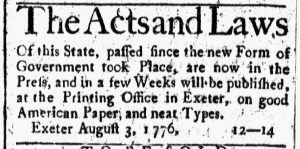
Robert Bell, one of the most prominent American printers and booksellers of the second half of the eighteenth century, advertised his publications widely.  In the spring of 1776, he ran an advertisement that announced, “Just printed, published and now selling … THE DISEASES incident to ARMIES” and other medical treatises compiled in a single volume “for the use of military and naval surgeons.  He deployed identical copy in the Pennsylvania Evening Post and the Pennsylvania Ledger, stating that the volume would “contributeth to promote the health and happiness of such valuable lives as those of American soldiers and sailors.”  The savvy publisher sought to convince “land and sea officers,” in particular, and “all the friends of liberty and humanity,” in general, that they should endorse the publication and perhaps even purchase copies to supply to “military and naval surgeons” who treated American soldiers and sailors.

Despite such marketing appeals, Bell did not take a position on whether the colonies should declare independence, at least not in the works he selected to print, advertise, and sell.  He concluded his advertisement with at noted that “All the newest political pamphlets, either for or against independency, may be had at said Bell’s.”  Other printers and booksellers had pursued a similar course, though not as recently.  James Humphreys, Jr., the printer of the Pennsylvania Ledger, advertised “POLITICAL PAMPHLETS, ON Both Sides of the Question” a month after the battles at Lexington and Concord.  James Rivington listed political pamphlets that took opposing positions, some of them written in direct response to others, in advertisements with headlines like “THE AMERICAN CONTEST” and “The American Controversy” before the Sons of Liberty attacked his office, destroyed his press, and forced him to discontinue publishing Rivington’s New-York Gazetteer.  More than a year into the war, Bell was the only printer who promoted pamphlets “for or against independency” in his advertisements.  Other printers and booksellers likely stocked and sold some of those pamphlets, but they did not call attention to it as boldly as Bell did.

Pennsylvania Ledger (May 12, 1776).

Indeed, an advertisement for the second edition of Plain Truth appeared immediately below Bell’s advertisement for the medical manual in the May 11 edition of the Pennsylvania Ledger.  That pamphlet “contain[ed] remarks on … COMMON SENSE; Wherein are shewn that the Scheme of Independence is ruinous, delusive and impracticable.”  In another advertisement in the same issue, Bell advertised “Additions to Plain Truth.”  In both advertisements, he made an appeal for freedom of the press to justify publishing and selling “political pamphlets, either for or against independency.”  A nota bene at the end of the first advertisement declared, “To this pamphlet is subjoined a Defence of the Liberty of the Press, by the sagacious and patriotic Junius.”  The other pamphlet, according to the second advertisement, included a similar supplementary work.  “To this Pamphlet is annexed, for the information of all Americans, who wish to know and to enjoy the very Laws and Privileges which themselves have decreed,” a nota bene announced, “A Defence of the Liberty of the Press, by the Honorable the CONTINENTAL CONGRESS.”  If that did not provide sufficient cover, Bell also opined, “The enjoyment of Liberty, and even its support and preservation consists, in every man’s being allowed to speak his thoughts and lay open his sentiments.”  Bell had also published the first edition of Thomas Paine’s Common Sense, demonstrating that his press did disseminate diverse political views.

The advertisement concluded with a “Memorandum,” perhaps penned by Bell or possibly inserted by Humphreys, a loyalist printer known for charting a more moderate course than fellow printers in Philadelphia.  “If to preserve any part of the works of valuable writers, hath been looked upon as doing good service to the Public,” the memorandum explained, “The EDITOR hereof may hope, this his present endeavours will prove acceptable, at least to all the Loversof Freedom.”  Leveraging the principles that those “Lovers of Freedom” embraced and enunciated, the memorandum insisted that they must be “so consistent as to acknowledge the Press ought to be free for others as well as themselves.” They could not have it both ways and still claim to be “Lovers of Freedom.”  Rivington had made similar arguments.  Bell and Humphreys hoped for more success in doing so, encouraging greater consistency in their views about “Libertyof the Press” from those who did not like everything that they printed or sold.

May 11

What was advertised in a revolutionary American newspaper 250 years ago today?

Virginia Gazette [Dixon and Hunter] (May 11, 1776).

“Those who are deficient will have their Names exposed in the Gazette.”

George Lafong, a hairdresser in Williamsburg, meant business.  In the spring of 1776, he took to the pages of John Dixon and William Hunter’s Virginia Gazette to call on “ALL Persons in my Debt, for Shaving, Dressing,” and other services “to discharge their Accounts.”  In particular, he addressed clients from “before I entered into Partnership with Mr. Wylie” at the beginning of the year, reporting that some of those unsettled accounts “have been standing for years.”

He started by asking those clients to be reasonable and consider his own situation and, especially, his responsibilities to support his family.  He asked them to make payment “that I may be enabled to pay those Debts which I have been under a Necessity of contracting for the Support of my Family” but had been forced to “Neglect” because of his recalcitrant clients.  In other circumstances he could have threatened legal action against those who refused to pay their overdue bills, but Lafong suggested the possible that “the Law” (or the courts) might not “be open to force Compliance,” perhaps due to disruptions caused by the war that began at Lexington and Concord and spread to other colonies.  Without legal remedies, he would resort to public shaming by publishing the names of those who owed for the services he provided: “those who are deficient will have their Names exposed in the Gazette.”  Notices about settling accounts frequently appeared in early American newspapers, but rarely did anyone make such threats.  In November 1768, Daniel Fowle and Robert Fowle, the printers of the New-Hampshire Gazette, threatened to publish “a List of those Customers … whose Accounts are of long standing, with the Sum due, in order to show how injuriously they are treated by them,” though they did not follow through on it.  In September 1774, Charles Willson Peale did publish an advertisement calling on Elie Vallette to pay for a family portrait he had painted.  Peale and Vallette made their dispute public with a series of advertisements in the Maryland Gazette.

Would Lafong publish the names of clients who did not settle accounts?  He made clear that “Gentlemen who pay me punctually may rely on my constant Attendance, and utmost Endeavours to give Satisfaction,” yet “others can expect no more of my Service.”  At the very least, they could not depend on Lafong extending additional credit, but the possibility of even more drastic consequences remained.

May 10

What was advertised in revolutionary American newspaper 250 years ago today?

Thomas’s Massachusetts Spy (May 10, 1776).

“A SERMON, preached [on] the day appointed by civil authority, for a public THANKSGIVING.”

Like many other newspaper printers, Isaiah Thomas used the pages of his own newspaper to promote other items that came off his press.  On May 10, 1776, for instance, he ran two advertisements for sermons preached on November 23, 1775, a day designated as a “Public THANKSGIVING” by the Massachusetts Provincial Congress and announced in the November 16 edition of the New-England Chronicle.

The first of those advertisements appeared on the first page of the May 10 edition.  When setting the type, the compositor had enough space for news from Philadelphia and Charleston with just a small amount left at the bottom of the last column.  Several of the advertisements that ran on other pages would have fit there, but Thomas opted to give a privileged place to an advertisement for “A SERMON,” by Henry Cumings, “preached in Billerica on … the day appointed by civil authority, for a public THANKSGIVING throughout the Province of Massachusetts-Bay.”  The notice declared that the sermon was “Just published” and cost “Nine-Pence.”  Eighteenth-century readers knew that “Just published” meant that an item was now available for purchase, but it did not necessarily indicate that the advertiser who sold it had printed it.  In this case, however, Thomas clarified that he “Printed and sold” the sermon in Worcester.

Thomas’s Massachusetts Spy (May 10, 1775).

His advertisement for “A SERMON, preached at Worcester,” by Thaddeus MacCarty followed a similar format.  It opened with a header that declared, “Just published, price Nine-Pence,” and reminded readers that November 23 had been “a Day of public THANSKGIVING, by the appointment of the General Assembly.”  Once again, the printer stated that the pamphlet was “Printed and sold by I. THOMAS” rather than an item that he acquired from another printing office and retailed at his own.  Although this advertisement now appeared on the fourth page among paid notices placed for a variety of purposes, when the two advertisements first ran in the April 26, 1775, edition of Thomas’s Massachusetts Spy they appeared together on the third page as the first commercial notices following the news.  The printer sought to increase the chances that prospective customers would take note of advertisements for the sermons he published.

May 9

What was advertised in a revolutionary American newspaper 250 years ago today?

New-England Chronicle (May 9, 1776).

“The Sign of the YANKEE HERO.”

The May 9, 1776, edition of the New-England Chronicle once again carried an advertisement for the “American Coffee-House,” the establishment that Daniel Jones opened on King Street not long after British troops brought the siege to an end by departing from Boston on March 17.  Jones invited the “Gentlemen of the UNITED COLONIES” to enjoy the “best of liquors, lodgings, and a variety of provisions” in addition to coffee.  Jones made clear that the “American Coffee-House” was a place for patriots to gather.

That was also the case at the tavern that John Newell ran “in Wing’s-Lane, near the Market.”  He published a short advertisement that announced, “ENTERTAINMENT for Gentlemen and keeping for Horses, at the sign of the YANKEE HERO.”  That name honored the accomplishments and the sacrifices made in Massachusetts over the past year and throughout the imperial crisis.  It included the victims of the Boston Massacre on March 5, 1770, and the Sons of Liberty who tossed tea into the harbor on December 16, 1773.  The “YANKEE HERO” referred to the men involved in the first battles of the war, the battles at Lexington and Concord on April 19, 1775.  Some had been killed, but others forced the British back into Boston where they were besieged for nearly a year.  The “YANKEE HERO” referred to the men from Massachusetts and throughout New England who left their towns to participate in the siege.  It also referred to the men who fought at the Battle of Bunker Hill on June 17, 1775, especially the men died in that engagement.  Those casualties included Joseph Warren, recently commissioned a major general in the colony’s militia, president of the Massachusetts Provincial Congress, and an advocate of American liberties during the imperial crisis that became a war.  Yet Newell did not name his tavern after Warren nor after John Adams, Samuel Adams, John Hancock, or any of the other leaders who had been so active at town meetings in Boston or represented Massachusetts in the Second Continental Congress.  Instead, he likely intended for prospective patrons to think of the many men who answered the call to defend their colony and their liberties, some making a final sacrifice to do so, and perhaps even to see themselves in the character of the “YANKEE HERO” as they continued in their resistance to British tyranny.  Where they chose to gather to drink, socialize, and discuss politics resonated with an identity shifting from British to American on the eve of declaring independence.

May 8

What was advertised in a revolutionary American newspaper 250 years ago today?

Pennsylvania Gazette (May 8, 1776).

“It hath been a noted and good-accustomed store for looking-glasses near 14 years.”

At the same time that John Elliott promoted a “CONSIDERABLE assortment” of looking glasses available at his store on Walnut Street in Philadelphia, he also aimed to sell the entire business to an entrepreneur who would purchase his complete inventory and the location that had been familiar to residents of the bustling port for more than a decade.  To draw attention to his advertisement in the May 8, 1776, edition of the Pennsylvania Gazette, he included a woodcut depicting “the sign of the Bell and Looking-glass” that, according to previous advertisements, marked his location.

Among his inventory, Elliott had “Pier and Sconces GLASSES” as well as “a large choice of neat Dressing GLASSES, together with a great number of smaller sizes.”  He made retail sales, but he also hoped to supply “country stores and shopkeepers” who would make wholesale purchases to augment the merchandise they had on hand in their towns and villages.  The consumer revolution, after all, extended far beyond major urban ports, reaching eager consumers in the countryside.  Elliott hoped that the enthusiasm for acquiring goods would convince someone to purchase his entire store, despite the uncertainty of the war.  After all, even if consumers shifted from purchasing imported textiles and accessories to homespun fabrics, they still wanted to assess how they appeared in looking glasses.  As fashions changed, due to either tastes or politics, consumers continued to strive to make themselves presentable to others and depended on looking glasses in their efforts to do so.

That made selling looking glasses an attractive venture.  At least Elliott hoped that was the case.  He announced that he planned “to sell the house he lives in, which is properly fitted up for carrying on the LOOKING-GLASS business, particularly for quicksilvering.”  A prospective buyer did not need to have previous experience peddling looking glasses. Elliott declared that he was “willing to communicate to any person who may purchase” his house, store, and “the remaining stock on hand” the methods of the “art” of quicksilvering and “all other instructions for carrying on said trade.”  To sweeten the deal, he also assured prospective buyers that the location “hath been a noted and good-accustomed store for looking-glasses near 14 years.”  Elliott offered an opportunity for an entrepreneur interested in running their own business to take over a successful enterprise, one that he would “sell very low.”  For a small investment, a new owner could benefit from all the advantages that Elliott accumulated over the years.  Did those advantages outweigh the risks? Elliott tried to convince prospective buyers that they did.