What was advertised in a revolutionary American newspaper 250 years ago this week?
Providence Gazette (July 13, 1776).
“[Advertisements omitted will be in our next.]”
The July 13, 1776, edition of the Providence Gazette included a note from the printer, John Carter, that “[Advertisements omitted will be in our next.]” Even though some advertisements received in the printing office “at Shakespear’s Head, in Meeting-Street,” did not make it into print in that issue, it still carried a significant number of paid notices. Carter devoted the entire fourth page to advertising as well as the final column of the third page. That meant that advertising accounted for four out of twelve columns or one-third of the content of that issue.
What prevented Carter from inserting certain advertisements? Acquiring a copy of the Declaration of Independence and printing it for his subscribers and other readers likely played a part. Consider where the Declaration of Independence and the note from the printer appeared within the July 13 issue. Both ran on the third page, the last page for which the compositor set type. Like other newspapers published during the era of the American Revolution, the Providence Gazetteconsisted of four pages created by printing two pages on each side of a broadsheet and folding it in half. Printers produced both pages on one side, let the broadsheets dry, and then printed the other two pages on the other side. In most printing offices, that meant taking the first and fourth pages to press first and later printing the second and third pages.
Carter wedged the note that advertisements that did not appear in the July 13 edition would appear in the next issue into the last column on the third page, placing it at the very bottom after squeezing in as many advertisements as possible. The Declaration of Independence started near the top of the first column and filled most of the second column as well. It did not, however, start at the top of the column. Carter concluded a news update from New York. He also included a short introduction: “The following Declaration of the General Congress was Yesterday received from Philadelphia.” That further suggests that he set type for the momentous document as soon as he received it and inserted it into the July 13 edition where it would fit. Doing so displaced some of the advertisements he intended to print before a copy of the Declaration of Independence came to hand.
What was advertised in a revolutionary American newspaper 250 years ago today?
Pennsylvania Ledger (July 13, 1776).
“The True Interest of America Impartially Stated.”
A week after the Pennsylvania Evening Post became the first newspaper to publish the Declaration of Independence, the Pennsylvania Ledger became the last newspaper printed in Philadelphia to carry that momentous document. The news had certainly reached readers by word of mouth long before July 13. Some may have attended the public reading of the Declaration of Independence at the Pennsylvania State House (now known as Independence Hall) on July 8. They could have also read the document in the Pennsylvania Ledger (July 6), Dunlap’s Pennsylvania Packet (July 8), Henrich Millers Pennsylvanischer Staatsbote (in German, July 9), the Pennsylvania Gazette (July 10), or the Pennsylvania Journal (July 10). The text may not have been readily available to James Humphreys, Jr., in time for the July 6 edition of the Pennsylvania Ledger, though he may not have invested the same effort in acquiring it as did Benjamin Towne, the printer of the Pennsylvania Evening Post. Like the printers of the other newspapers published in Philadelphia, Humphreys did not move forward his weekly publication schedule to disseminate the Declaration of Independence, nor did he print a supplement or extraordinary issue.
Still, Humphreys may have published the Declaration of Independence with less enthusiasm than his fellow printers in Philadelphia. Humphreys was widely suspected of being a Loyalist, though Isaiah Thomas, a printer who did not shy away from condemning other printers who did not support the American cause, had a more nuanced view of Humphreys and “his intention to conduct his paper with political impartiality.” Thomas noted “perhaps, in times more tranquil than those in which it appeared, he might have succeeded in his plan.” Humphreys stood by his “oath of allegiance to the king of England … and refused to bear arms against the British government; in consequence of which, he was deemed a tory, and his paper denounced as being under corrupt influence.”[1] In the end, the “impartiality of the Ledger did not comport with the temper of the times” and Humphreys left Philadelphia for his safety by the end of 1776. He eventually returned during the British occupation of the city, accompanied the army to New York, and, following the war, established a newspaper, the Nova Scotia Packet, in Shelburne, a town founded by Loyalists who went into exile.[2]
That “impartiality” described by Thomas found expression in other items that came off Humphreys’s press and appeared in advertisements in the Pennsylvania Ledger. Without comment on the contents of the pamphlet, Thomas reported that Humphreys printed “Strictures on Paine’s Common Sense. Two editions …, consisting of several thousand copies each, were sold in a few months.”[3]The True Interest of America Impartially Stated, as the pamphlet was also known, offered a response to Common Sense. Humphreys placed an advertisement for the second edition of The True Interest of America Impartially Stated on the first page of the issue of the Pennsylvania Ledger that carried the Declaration of Independence. That document appeared on the second page, though probably not the result of Humphreys inserting news only when it arrived. He almost certainly had access to a copy of the Declaration of Independence with sufficient time to place it on the front page of the Pennsylvania Ledger if he wished. After all, the printers of the Pennsylvania Gazette and the Pennsylvania Journal made room for the Declaration of Independence on the front page of their newspapers three days earlier.
The advertisement for The True Interest of America Impartially Stated even carried a quotation from the Continental Congress’s “Address to the People of Great-Britain” in October 1774 that contradicted the action they took in declaring independence less than two years later: “You have been told that we are seditious, impatient of government, and desirous of Independency. Be assured that these are not Facts, but Calumnies – Permit us to be as free as yourselves, and we shall ever esteem a union with you to be our greatest glory and our greatest happiness. – Place us in the same situation we were at the close of the last war, and our former harmony will be restored.” Even as Humphreys published the Declaration of Independence in the Pennsylvania Ledger, not all readers celebrated or agreed with the action taken by the Continental Congress. The Revolutionary War became a civil war among colonizers as much as a contest between a nation seeking independence and Great Britain.
**********
[1] Isaiah Thomas, The History of Printing in America: With a Biography of Printers and an Account of Newspapers (1810; New York: Weathervane Books, 1970), 439-440.
What was advertised in a revolutionary American newspaper 250 years ago today?
Connecticut Gazette (July 12, 1776).
“We have been obliged to issue only a Half Sheet paper this Week; in which, however, is digested every material Occurrence that is come to Hand.”
Newspapers published during the era of the American Revolution usually consisted of four pages created by printing two pages on each side of a broadsheet and then folding it in half. Due to paper shortages, some issues occasionally had only two pages, one on each side of a half sheet. The July 12, 1776, edition of the Connecticut Gazette had only two pages, but apparently factors other than disruptions in the paper supply led Timothy Green, the printer, to make that decision. In a note to readers at the top of the first column on the first page, he advised, “[In order to expedite some necessary Business for the Government, we have been obliged to issue only a Half Sheet Paper this Week; in which, however, is digested every material Occurrence that is come to Hand.]” Green did not mention the impact that had on advertisements, unlike John Carter, the printer of the Providence Gazette, who inserted a notice in his newspaper the following day that “[Advertisements omitted will be in our next.]” Green found space to publish four advertisements, whereas he filled an entire page with advertising in the previous issue.
The printer undersold the contents of that issue of the Connecticut Gazette when he claimed that he “digested every material Occurrence that is come to Hand.” It carried updates from Charleston, South Carolina; the provincial congress in North Carolina; Williamsburg, the capital of Virginia; Philadelphia; New York; Boston and nearby Watertown in Massachusetts; Portsmouth, New Hampshire; Halifax, Nova Scotia; and Gibraltar by way of London. That issue also carried a few brief items of local news from New London. Yet none of that was the most significant news that the Connecticut Gazette carried. Near the top of the second column on the second page, Green printed the Declaration of Independence, making the Connecticut Gazette the first newspaper in New England to disseminate that momentous document to its readers. Unlike other news, the Declaration of Independence had not been “digested” to fit in the limited space available on the half sheet that Green resorted to publishing that week. Instead, he printed the Declaration of Independence in its entirety. The nation’s founding document was a “material Occurrence” indeed! Its placement in the middle of the second page does not necessarily indicate that Green did not consider the Declaration of Independence significant. Instead, he likely set the type and integrated the document into his newspaper as soon as he acquired a copy. The first page may have already been printed by that time. For eighteenth-century printers and readers, where an item appeared on the page of a newspaper did not necessarily signal the importance associated with it but rather the realities of the printing technology of the period.
What was advertised in a revolutionary American newspaper 250 years ago today?
New-York Journal (July 11, 1776).
“The Declaration of the United States of America, is inserted in this paper.”
A day after the Constitutional Gazette became the first newspaper in New York to print the Declaration of Independence, the New-York Journal and the New York Packet both published it on July 11, 1776. The printers may have had access to the complete text sooner than that, but, like their counterparts in Philadelphia, they did not adjust their weekly publication schedule nor print a supplement or extraordinary issue to disseminate the Declaration of Independence. Readers almost certainly heard that the Continental Congress had declared independence before they had an opportunity to read the document approved on July 4.
The New York Packet, printed by Samuel Loudon, carried the Declaration of Independence on the second page, under a heading for news from Philadelphia. It started halfway down the third column and concluded at the bottom of the fourth (and final) column on that page. While that placement may seem unusual to modern readers who would expect the Declaration of Independence to be front-page news, it did not indicate any less importance or urgency to eighteenth-century readers who were accustomed to a different layout for newspapers than what evolved in the nineteenth century. The New York Packet, like other newspapers published during the era of the American Revolution, consisted of four pages created by printing two pages on each side of a broadsheet and then folding it in half. Printers often printed the side with the first and fourth pages first, frequently placing older news on the first page and advertisements on the fourth page. As a result, news that arrived closest to publication appeared on the second or even third page. Readers knew to look for it there. Such was the case when Loudon printed the Declaration of Independence in the New York Packet.
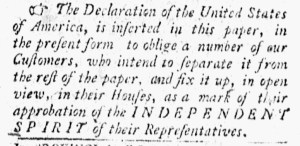
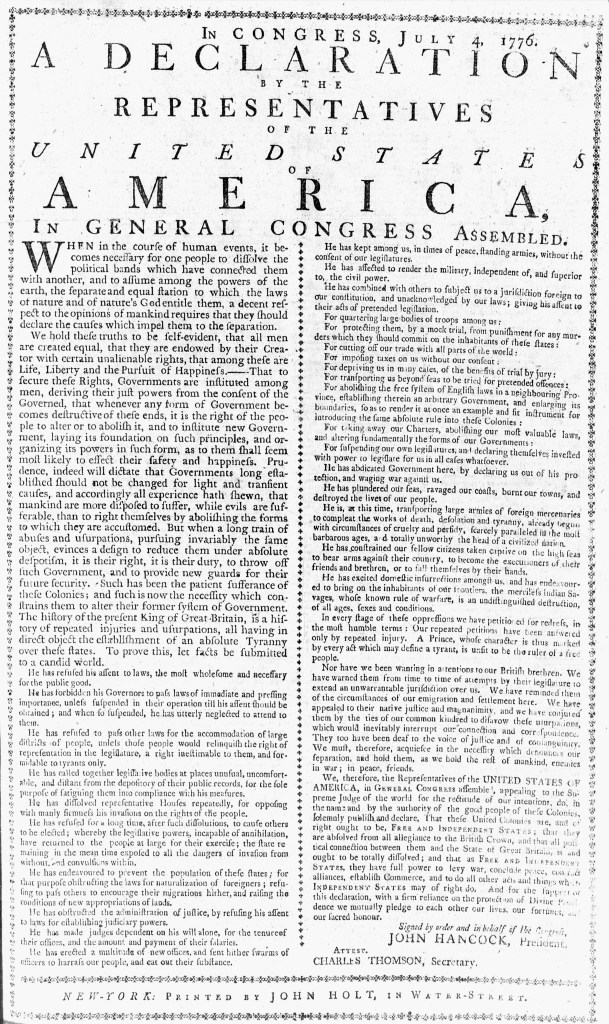
John Holt, the printer of the New-York Journal, devoted the entire third page of the July 11 edition to the Declaration of Independence. Like Loudon, he apparently had type set and printed the first and fourth pages before he acquired a copy of the Declaration of Independence. He opted, however, to make it the only item on the third page. He enclosed the text of the document within a border composed of printing ornaments and devised a headline in font larger than that of the title of the newspaper in the masthead. Holt wanted readers to take note of the Declaration of Independence … and he wanted them to do more than just read it the first time they saw it in his newspaper. In a note that appeared above other advertisements on the second page, Holt stated, “The Declaration of the United States of America, is inserted in this paper, in the present form to oblige a number of our Customers, who intend to separate from the rest of the paper, and fix it up, in open view, in their Houses, as a mark of their approbation of the INDEPENDENT SPIRIT of their Representatives.” Holt provided his subscribers with a piece of patriotic memorabilia. Newspapers were ephemeral, usually discarded once they had been read, but this was a document to save and to display to demonstrate support for the American cause and, especially, the Continental Congress’s bold action of declaring independence.
Even though his name and location appeared in the colophon at the bottom of the fourth page (on the reverse side of the page that carried the Declaration of Independence), Holt added an imprint at the bottom of the third page that he intended for subscribers to “separate … from the rest of the paper” and display “in open view, in their Houses.” It stated, “NEW-YORK: PRINTED BY JOHN HOLT, IN WATER-STREET.” In so doing, Holt simultaneously demonstrated his own patriotism and crafted an advertisement for the services available at his printing office.
What was advertised in a revolutionary American newspaper 250 years ago today?
Constitutional Gazette (July 10, 1776).
“A Choice Collection of American Liberty Songs and Pamphlets to be sold by the Printer.”
On July 10, 1776, the Constitutional Gazette became the first newspaper published in New York to print the Declaration of Independence. John Anderson, the printer, devoted the first two pages of that issue to “A Declaration by the Representatives of the United States of America, in General Congress assembled.” The same day, Mary Katharine Goddard printed the Declaration of Independence in the Maryland Journal and the Baltimore Advertiser. Unlike most other printers, Goddard inserted as triumphant headline: “THE THIRTEEN United STATES OF AMERICA, Have declared INDEPENDENCY.” She used decorative type to draw attention to the headline and manicules at either end of the phrase “Have declared INDEPENDENCY” for even more emphasis. The Declaration of Independence appeared in Dunlap’s Maryland Gazette, also published in Baltimore, the previous day. The Pennsylvania Gazette and the Pennsylvania Journal, both printed in Philadelphia, also published the Declaration of Independence on July 10, joining other newspapers from that city that already published it.
Maryland Journal (July 10, 1776).
News about independence spread quickly. No doubt word of mouth carried the news more quickly than printers set type for their newspapers, yet printing the Declaration of Independence in newspapers gave citizens of the new nation the opportunity to examine the complete text for themselves, engaging with the theory of government established in the first paragraphs of the document, the many grievances against the king in the middle, and, finally, the bold action taken by the Continental Congress. The copy of July 10 edition of the Constitutional Gazette that has been digitized for America’s Historical Newspapers includes a handwritten note above the masthead on the first page: “A Good thing.” One reader not only perused the Declaration of Independence but also recorded their endorsement of it.
On the final page of that issue, Anderson offered another chance for that reader and everyone else to demonstrate their patriotism. In a brief but well-timed advertisement, he announced, “A Choice Collection of American Liberty Songs and Pamphlets to be sold by the Printer.” He likely hoped that the excitement caused by the Declaration of Independence would inspire readers to become consumers of patriotic memorabilia. After all, they now had even more reason to learn “American Liberty Songs” and join in singing them with their friends and neighbors.
What was advertised in a revolutionary American newspaper 250 years ago today?
American Gazette (July 9, 1776).
“May be had, if applied for immediately, a dew Setts of this Gazette, from the First Number.”
When John Rogers printed the fourth issue of the American Gazette: Or, the Constitutional Journal in Salem, Massachusetts, on July 9, 1776, he updated the colophon to advertise the availability of the first three issues for new subscribers who wished to have a complete set of the newspaper. From the first issue, he had used the colophon to promote subscriptions, solicit advertisements, and offer other services available at the printing office, just as many other printers did with the colophons for their own newspapers. The original colophon stated that the American Gazette was “Printed by J. ROGERS, at E. RUSSELL’S Printing-Office, Upper End of Main-street: Where all Persons may be supplied with this Paper at EIGHT SHILLINGS per Annum (exclusive of Postage.) ADVERTISMENTS and Articles of INTELLIGENCE are gratefully received. ☞ The PRINTING-BUSINESS, in its several Branches, still carried on as usual by said RUSSELL.”
For the fourth issue, Rogers added a line to the colophon, advising that readers could acquire, “if applied for immediately, a few Setts of this Gazette, from the First Number.” He did not indicate whether that included an unnumbered “Extraordinary” issue published on June 12 to entice subscribers. Whatever the case, he encouraged new subscribers to collect a complete set of the newspaper. Unfortunately for Rogers, the American Gazette folded less than two months after he commenced publication. Clarence Brigham noted that the “last issue located is that of July 30, 1776, vol. 1, no. 7, and it is probably that this issue was the last published.”[1] Brigham does not, however, report why Rogers ceased printing the American Gazette, nor did Isaiah Thomas in his History of Printing in America in 1810. Rogers may have found the endeavor more difficult than he anticipated. He repeated the extended colophon that offered back issues in the fifth issue on July 16, but he reduced the colophon to a single line – “SALEM: Printed by JOHN ROGERS” – at the bottom of the final column of the last page in the June 23 edition. That issue consisted of only two pages instead of the usual four, perhaps due to shortages of paper. The seventh issue once again had four pages and the extended colophon. At the same time that Rogers printed his final issue, he encouraged readers to purchase the issues they had missed so they could put together complete sets.
**********
[1] Clarence S. Brigham, History and Bibliography of American Newspapers, 1690-1820 (Worcester, Massachusetts: American Antiquarian Society, 1947), 394.
What was advertised in a revolutionary American newspaper 250 years ago today?
Boston-Gazette (July 8, 1776).
“A commodious genteel Coach … will set off for New-York in a few Days.”
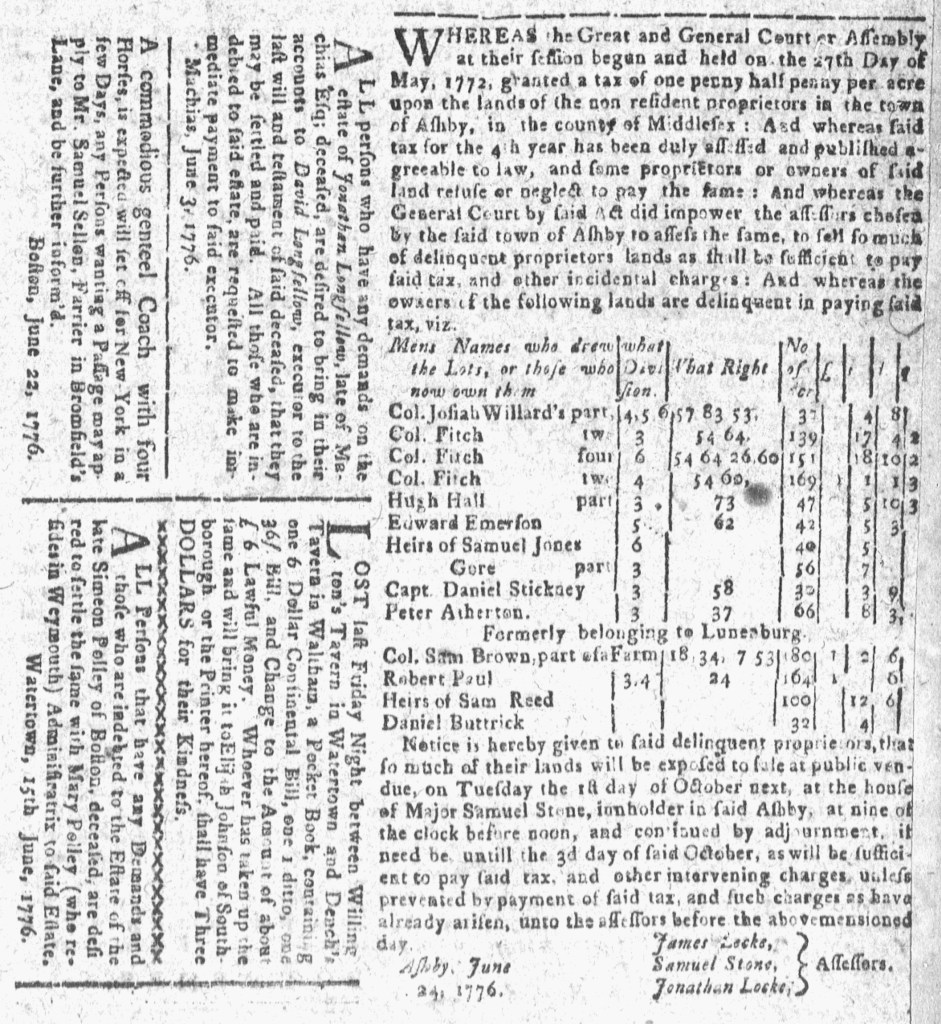
When Benjamin Edes, the printer of the Boston-Gazette, published a legal notice in the July 8, 1776, edition of his newspaper, he had to get creative with the format. The notice featured several columns, enough that the notice was wider than the usual column width, but not so wide that it extended two columns. That would have made preparing that issue more straightforward.
Since that was not an option, however, Edes placed the wider notice in the bottom right corner on the last page and then filled in the rest of the page. The column on the left appeared as usual. The middle column began as usual, but halfway down the page it could not continue because the legal notice protruded into that column. Edes also began the right column as usual, filling in the space until reaching the legal notice in the lower corner. That left a blank space at the bottom of the middle column.
Edes filled that empty space by rotating four advertisements with type set such that they would otherwise fit in any column in the Boston-Gazette, placing then in a two-by-two grid with text that ran perpendicular to everything else on the page. That meant that type already set could be used in a standard column or in a rotated column, saving the printer time and effort. It was a clever solution that allowed the printer to publish the various notices submitted to his printing office, collect revenue for each, and not sacrifice any space in his newspaper. Doing so required careful planning and a good eye for assessing which notices would fit in which places on the page.
How did the advertisers feel about their notices receiving such treatment? Did they believe that the unique format called more attention to their advertisements and thus worked to their benefit? Did they worry that the minor inconvenience of rotating the newspaper to read those advertisements might make them easier to overlook? Did they care at all as long as their notices appeared in print? The format testifies to Edes’s ingenuity but not to the reception it received from advertisers and readers.
What was advertised in a revolutionary American newspaper 250 years ago this week?
Freeman’s Journal (July 6, 1776).
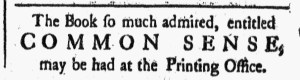
“The Book so much admired, entitled COMMON SENSE, may be had at the Printing Office.”
The July 6, 1776, edition of the Freeman’s Journal concluded with an advertisement for Thomas Paine’s Common Sense, the most influential political pamphlet published during the era of the American Revolution. Benjamin Dearborn, the printer of the newspaper, repeated the advertisement that first appeared a week earlier: “The Book so much admired, entitled COMMON SENSE, may be had at the Printing Office.” He apparently stocked copies produced by other printers since no records exist of a local edition published in Portsmouth, New Hampshire, in 1776.
The same advertisement appeared in the next two issues of the Freeman’s Journal on July 13 and July 20. The type for the fourth page of the July 13 edition, the page that carried the advertisement, may have already been set by the time that Dearborn received word, via Boston, that the Continental Congress declared independence. He reprinted news from the July 11 edition of the New-England Chronicle: “We are assured that on July the 2d, the Congress voted for INDEPENDENCY, not one colony dissenting; but the delegates of New-York remaining neuter, for want of being instructed on the head.” In the next issue, Dearborn’s final advertisement for Common Sense moved from the bottom of the last page to the bottom of the first page. He devoted the entire final page to the Declaration of Independence (with the colophon running across the bottom). Dearborn offered readers one last chance to acquire the pamphlet that had played such an important role in the decision to declare independence.
What was advertised in a revolutionary American newspaper 250 years ago today?
Pennsylvania Evening Post (July 6, 1776).
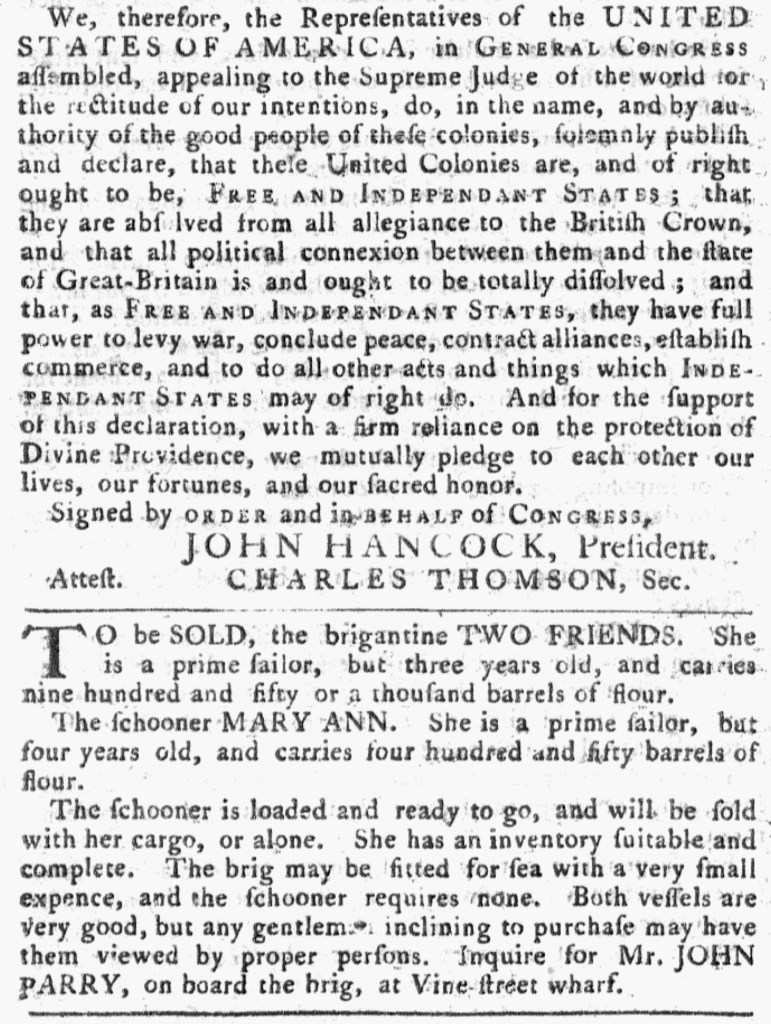
“TO be SOLD, the brigantine TWO FRIENDS.”
After the Continental Congress approved the Declaration of Independence on July 4, 1776, John Dunlap, the printer of Dunlap’s Pennsylvania Packet, set about printing approximately two hundred broadside copies. By the next morning, they were ready to dispatch to colonial assemblies, provincial conventions, and military commanders to inform them of the reasons and rationale for declaring independence. The Dunlap Broadside was the first printing of the Declaration of Independence … but Dunlap was not the first printer to publish the Declaration of Independence in a newspaper. He did indeed print it in the next edition of his weekly newspaper on July 8, but he did not move up the publication day, nor did he issue a supplement or extraordinary issue to disseminate the Declaration of Independence to his subscribers before the usual publication day.
Benjamin Towne, the printer of the Pennsylvania Evening Post, was the first to publish the Declaration of Independence in a newspaper. His newspaper had also been the first to inform the public that the Continental Congress voted in favor of independence on July 2. Unlike other newspapers published in Philadelphia and most other newspapers published in America at the time, the Pennsylvania Evening Post was not a weekly newspaper. Instead, Towne distributed new issues on Tuesday, Thursday, and Saturday. Without deviating from its usual publication schedule, the Pennsylvania Evening Post was the first newspaper to (twice!) deliver momentous news about independence to the public.
This timeline shows when the news circulated in newspapers printed in Philadelphia and cities with their own newspapers nearest Philadelphia:
Wednesday, July 3 – The Pennsylvania Gazette and the Pennsylvania Journal both report that the Continental Congress declared independence from Great Britain.
Thursday, July 4 – The Pennsylvania Evening Post makes no mention of a declaration of independence. Towne does not repeat the same-day scoop he managed two days earlier.
Friday, July 5 – Henrich Millers Pennsylvanischer Staatsbote, published in German, reports that the Continental Congress declared independence and makes first mention of the Declaration of Independence in a newspaper: “Die Declaration in Englisch ist jetzt in der Presse; sie ist datirt, den 4ten July, 1776, und wird beut order morgen im deuct erscheinen.” [The Declaration in English is now in the press; it is dated July 4, 1776, and will appear in German today or tomorrow.]
Saturday, July 6 – The Pennsylvania Evening Post publishes the Declaration of Independence. The Pennsylvania Ledger does not.
Monday, July 8 – Dunlap’s Pennsylvania Packet publishes the Declaration of Independence and announces a public reading: “THIS DAY, at Twelve o’clock, the DECLARATION of INDEPENDENCE, will be PROCLAIMED at the STATE-HOUSE.”
Tuesday, July 9 – The Pennsylvania Evening Post reports, “Yesterday, at twelve o’clock, INDEPENDANCY was declared at the State-House in this city, in the presence of many thousand spectators, who testified their approbation of it by repeated acclamations of joy.” Henrich Millers Pennsylvanischer Staatsbote publishes a translation of the Declaration of Independence in German. Dunlap’s Maryland Gazette, printed in Baltimore, publishes the Declaration of Independence. News quickly spread beyond Philadelphia. Newspapers in Philadelphia adhered to their regular publication schedules. That meant that some did not publish the Declaration of Independence until after it appeared in newspapers in other cities.
Wednesday, July 10 – The Pennsylvania Gazette and the Pennsylvania Journal publish the Declaration of Independence. The Maryland Journal, another newspaper printed in Baltimore, publishes the Declaration of Independence. The Constitutional Gazette becomes the first newspaper in New York to publish the Declaration of Independence.
Thursday, July 11 – The New-York Journal and the New York Packet publish the Declaration of Independence. The Pennsylvania Evening Post reports on the reception the “DECLARATION OF INDEPENDANCY” received in Easton, Pennsylvania. After a public reading, a “great number of spectators … gave their hearty assent with three loud huzzas.”
Saturday, July 13 – The Pennsylvania Ledger publishes the Declaration of Independence a week after it appeared in the Pennsylvania Evening Post. The Pennsylvania Ledger was the last newspaper published in Philadelphia to print the Declaration of Independence. On the same day, the Pennsylvania Evening Post carries a report of “INDEPENDANCY proclaimed under a triple volley of musketry” in Princeton, New Jersey. It met with “universal acclamation for the prosperity of the UNITED STATES.”
What was the connection to advertisements that appeared in the Pennsylvania Evening Post on July 6 when it became the first newspaper to publish the Declaration of Independence? John Parry’s advertisement for the sale of two ships, the brigantine Two Friends and the schooner Mary Ann, followed the Declaration of Independence, immediately below the signature of “JOHN HANCOCK, President.” Parry’s advertisement previously appeared right after that newspaper’s announcement on July 2, the first in print, that the “CONTINENTAL CONGRESS declared the UNITED COLONIES FREE and INDEPENDENT STATES.” That was almost certainly by coincidence rather than by design. Quite by accident, Parry’s advertisement twice followed the first publication of one of the most consequential stories ever reported in American newspapers.
What was advertised in a revolutionary American newspaper 250 years ago today?
Massachusetts Spy (July 5, 1776).
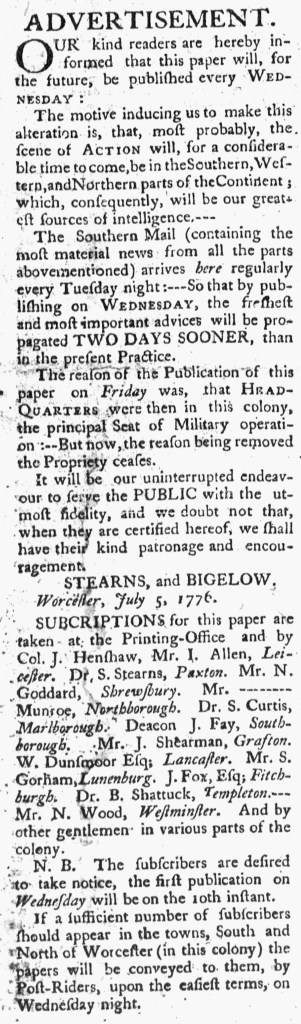
“The freshest and most important advices will be propagated TWO DAYS SOONER.”
After the siege of Boston ended, Isaiah Thomas considered seeking new opportunities in the city where he had formerly operated a printing office or perhaps in Salem or elsewhere along the coast. In the spring of 1775, he relocated to Worcester just before the battles at Lexington and Concord. He had already planned to open a printing office there, establish the town’s first newspaper, and install a junior partner to oversee both endeavors, but the outbreak of hostilities caused him to transfer the Massachusetts Spy from Boston to Worcester and print it himself. Once the British evacuated Boston in March 1776, Thomas contemplated what to do next. In June, he transferred the Massachusetts Spyto William Stearns and Daniel Bigelow.
Two weeks after publishing their first issue, Stearns and Bigelow inserted an announcement in the July 5 edition to inform readers that they were changing the publication day of the weekly newspaper from Friday to Wednesday. They explained the “motive inducing us to make this alteration is, that, most probably, the scene of ACTION will, for a considerable time to come, be in the Southern, Western, and Northern parts of the Continent; which, consequently, will be our greatest sources of intelligence.” In other words, now that Boston was not at the center of the war, the printers adjusted the publication day to accommodate when they received news from the south, through networks that included New York and Philadelphia, rather than from Boston and its surrounding towns to the east. “The reason of the Publication of this paper on Friday,” Stearns and Bigelow elaborated, “was, that HEAD-QUARTERS were then in this colony, the principal Seat of Military operation.” Since that was no longer the case, “the Propriety [of publishing the Massachusetts Spy on Friday] ceases.” Instead, the “Southern Mail (containing the most material news from all the parts abovementioned) arrives here regularly every Tuesday night.” By moving publication to Wednesday, “the freshest and most important advices will be propagated TWO DAYS SOONER, than in the present practice.” Stearns and Bigelow framed this as part of their “uninterrupted endeavour to serve the PUBLIC with the utmost fidelity.” The printers planned to make the change immediately. The next issue would be published on Wednesday, July 10, just five days after the issue announcing the change.
At the same time, Stearns and Bigelow attempted to increase the number of subscribers. In addition to receiving subscriptions at the printing office in Worcester, they also designated local agents in a dozen towns in central Massachusetts and noted that “other gentlemen in various parts of the colony” collected the names of subscribers. They also planned to hire riders to carry the Massachusetts Spy to other towns on Wednesday night “[i]f a sufficient number of subscribers should appear.”
Thomas had built his reputation through his long experience as a printer. Stearns and Bigelow did not have the same advantage, yet they likely hoped that proactively adjusting the day of publication, enlisting local agents to accept subscriptions, and hiring riders to deliver newspapers if the number warranted doing so would cultivate confidence among current and prospective subscribers. They did not have Thomas’s experience, but they demonstrated that they were responsive to changing conditions and would cater to the convenience of their customers.