April 27

What was advertised in a revolutionary American newspaper 250 years ago today?

Providence Gazette (April 27, 1776).

“He is persuaded that none of his Readers will think him unreasonable in adding a Shilling to the Price per Year.”

The first advertisement in the April 27, 1776, edition of the Providence Gazette featured news for subscribers.  John Carter, the printer, informed them of an imminent price increase.  His own expenses had gone up in the year since the war began at Lexington and Concord.  “THE increased Price of Paper (the chief Article of a Printer’s Stock) and of almost every Necessary of Life, has been so great,” he explained, “that it must have naturally fallen within the Notice of every Reader of this Gazette.”  Given the circumstances that Carter believed honest readers acknowledged, he was “thereforecompelled to acquaint his Customers, that the Price thereof in future will be Eight Shillings per Annum.”

He emphasized that the situation “compelled” him to take this action rather than doing so willingly or eagerly.  Carter also noted that other printers had recently done the same, so he was not alone in seeking such a remedy to his financial woes.  “He likewise begs leave to inform [subscribers],” the printer stated, “that for the same Reason the Price of the Cambridge Paper,” the New-England Chronicle, “has been raised to Eight Shillings” and “the Philadelphia Evening-Post to Two Dollars.”  (Carter meant the Pennsylvania Evening Post.)  In addition, John Dunlap had recently advertised a price increase from ten to fifteen shillings for Dunlap’s Maryland Gazette; or, the Baltimore General Advertiser.  In consideration of those recent precedents, Carter was “persuaded that none of his Readers will think him unreasonable in adding a Shilling to the Price per Year, which is not quite a Farthing on each Gazette” or each issue of the newspaper.[1]

The printer pledged to honor the previous price for current subscribers “till the Year, or other Time for which each Subscriber contracted, shall be expired.”  Once their current year (or other amount of time previously agreed between printer and subscriber) came to an end, the new price went into effect.  Those who did not wish to continue their subscriptions “at the Price above mentioned, … are requested to give Notice to the Printer.”  Carter understood that money was also tight for his subscribers, but he hoped that they would accept a small increase in the annual subscription fee in order to continue receiving the news (about the war, politics, and other matters), editorials, advertisements, and other content he published and disseminated each week.

**********

[1] A farthing was worth one-quarter of a penny.  Carter published the Providence Gazette weekly.  An additional farthing for fifty-two issues amounted to thirteen pence … or one shilling and one penny.  Carter raised the price by only one shilling, so indeed “not quite a Farthing” for each issue.
April 26

What was advertised in a revolutionary American newspaper 250 years ago today?

Essex Journal (April 26, 1776).

“A NEW WEEKLY PAPER ENTITLED The FREEMAN’s JOURNAL, OR New-Hampshire GAZETTE.”

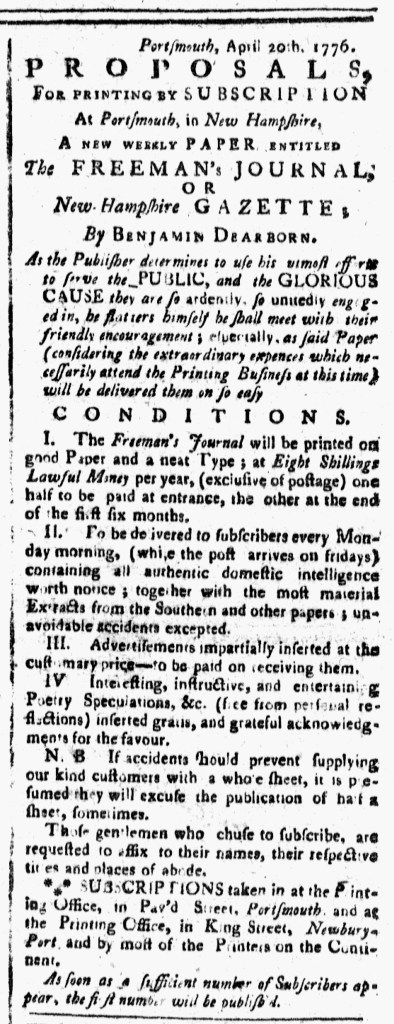
A year after the battles at Lexington and Concord, Benjamin Dearborn issued “PROPOSALS, FOR PRINTING BY SUBSCRIPTION … A NEW WEEKLY PAPER ENTITLED The FREEMAN’s JOURNAL, OR New-Hampshire GAZETTE.”  Dated April 20, 1776, the subscription proposals appeared in the April 26 edition of the Essex Journal, printed in Newburyport, Massachusetts, though they may have circulated separately as well.  Dearborn intended to publish the Freeman’s Journal in Portsmouth, making it the only newspaper printed in the colony since Daniel Fowle suspended the New-Hampshire Gazette earlier in the year.  The printer asserted that “As soon as a sufficient number of Subscribers appear, the first number will be publish’d.”  A month later, he distributed the first issue on May 25.

The title of the Freeman’s Journal made the editorial stance clear.  So did the explanation that Dearborn gave for establishing the newspaper: “As the Publisher determines to use his utmost efforts to serve the PUBLIC, and the GLORIOUS CAUSE they are so ardently, so unitedly engaged in, he flatters himself he shall meet with their friendly encouragement.”  He took on this service despite the “extraordinary expences which necessarily attend the Printing Business at this time,” simultaneously asking prospective subscribers to “excuse the publication of half a sheet, sometimes,” when “accidents … prevent supplying our kind customers with a whole sheet.”  During the first year of the war, shortages of paper, fears of impending attacks by British forces, post riders arriving behind schedule, and other “accidents” disrupted publication of the newspapers in New England and beyond.

The “CONDITIONS” in Dearborn’s subscription proposals outlined the expectations for the printer and subscribers.  A subscription cost “Eight Shillings Lawful Money per year, (exclusive of postage),” with half due immediately and the other half due in six months.  Newspaper printers often extended generous credit to subscribers, but circumstances did not permit Dearborn to do so for the Freeman’s Journal.  He pledged, “Advertisements impartially inserted at the customary price,” though he did not specify what that was.  He apparently expected that prospective advertisers knew the going rate for running notices in newspapers in the region.  He did declare that advertisements had “to be paid on receiving them.”  The printer did not allow any credit for advertisements.

New issues would circulate “every Monday morning” for as long as “the post arrives on Fridays.”  That allowed time for Dearborn to peruse other newspapers to select items to reprint in the Freeman’s Journal, sift through his own correspondence, and collaborate with others who received letters containing news.  The printer would collate “all authentic domestic intelligence worth notice; together with the most material Extracts from the Southern and other papers.”  He also solicited “[i]nteresting, instructive, and entertaining Poetry Speculations,” presumably for “Poet’s Corner,” a standard feature in many colonial newspapers, that he would publish “gratis” with “grateful acknowledgments for the favour.”

Dearborn accepted subscriptions at his printing office in Portsmouth.  John Mycall, the printer of the Essex Journal, also gathered subscriptions at the printing office in Newburyport.  Dearborn also expected that “most of the Printers on the Continent” would forward any subscriptions they received, signaling to the public that he was part of an expansive network that exchanged news for the benefit of “the PUBLIC, and the GLORIOUS CAUSE.”  Despite the upheavals of the war (or perhaps because of them), Dearborn and other printers established new newspapers during the summer of 1776.

April 25

What was advertised in a revolutionary American newspaper 250 years ago today?

New-England Chronicle (April 25, 1776).

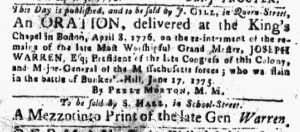
“An ORATION … on the re-interment of the remains of … JOSEPH WARREN.”

Samuel Hall, the printer of the New-England Chronicle, published the last issue of that newspaper “at his Printing-Office in Stoughton-Hall, HARVARD-COLLEGE,” in Cambridge on April 4, 1776.  Three weeks later, he resumed publication “at his Office next to the OLIVER CROMWELL Tavern, in SCHOOL-STREET,” in Boston.  The newspaper continued with the same volume and issue numbering.  The evacuation of the British and the end of the siege of Boston on March 17 presented an opportunity for Hall to enter the city, making the New-England Chronicle the only newspaper printed in Boston at the time.  Benjamin Edes continued publishing the Boston-Gazette in Watertown until late October and returned the newspaper to Boston in early November.

The end of the British occupation also allowed for events and rituals that could not be undertaken while they remained.  For example, the annual commemoration of the Boston Massacre occurred in Watertown rather than in Boston.  A month later, however, the British had departed and patriots gathered “at the King’s Chapel in Boston [for] the re-interment of the remains of the late Most Worshipful Grand Master, JOSEPH WARREN, Esq; President of the late Congress of this Colony, and Major-General of the Massachusetts forces; who was slain in the battle of Bunker’s-Hill, June 17, 1775.”  On that solemn occasion, Perez Morton delivered an oration, yet colonizers did not have to attend the reinterment on April 8 to learn about the minister’s message.  John Gill, Edes’s former partner in printing the Boston-Gazette, advertised that he published and sold Morton’s Oration in the April 25 edition of the New-England Chronicle, that first issue published in Boston.  It was simultaneously an act of commemoration and an act of commodification of the events of the revolutionary era, not unlike the publication and dissemination of the annual oration delivered on the anniversary of the Boston Massacre.  Putting copies of Morton’s Oration into circulation in Boston and beyond contributed to the veneration of Warren as a hero who made the ultimate sacrifice on behalf of his country.  The pamphlet met with such demand that Gill published a second edition.  In addition, John Holt published a local edition in New York and John Dunlap did the same in Philadelphia, disseminating Morton’s oration in memory of Warren beyond New England.

Hall, a savvy entrepreneur, piggybacked on Gill’s advertisement for Morton’s Oration.  Immediately below, he inserted his own advertisement for a “Mezzotinto Print of the late Gen. Warren.”  He apparently expected that demand for one would enhance demand for the other, providing consumers with another opportunity to demonstrate their patriotism through their decision to purchase commemorative items.

April 24

What was advertised in a revolutionary American newspaper 250 years ago today?

Pennsylvania Journal (April 24, 1776).

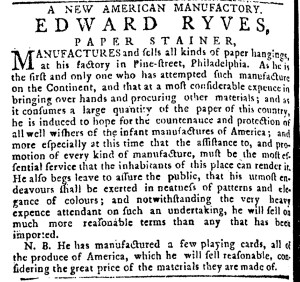
“A NEW AMERICAN MANUFACTORY.”

In the spring of 1776, Edward Ryves, a “PAPER STAINER, advertised that he “MANUFTURES and sells all kinds of paper hangings” or wallpaper “at his factory in Pine-street, Philadelphia.”  It was not the first time that Ryves placed such an advertisement.  The previous summer, the partnership of Ryves and Fletcher ran a similar advertisement, one that also proclaimed, “A NEW AMERICAN MANUFACTORY,” in its headline.  Ryves and Fletcher apparently parted ways, but the former retained their marketing strategy and updated it accordingly.  An advertisement that previously stated, “they are the first who have attempted that manufacture on this continent,” now asserted that “he is the first and only one who has attempted such manufacture on the Continent.”  Now that he was on his own, Ryves reserved that accolade exclusively for himself.

He also reiterated appeals intended to enlist consumers who supported the American cause: “he is induced to hope for the countenance and protection of all well wishers of the infant manufactures of America.”  Ryves then expanded on the appeal that he and Fletcher made, stating that “most especially at this time,” a year after a war began at Lexington and Concord, “that the assistance to, and promotion of every kinds of manufacture, must be the most essential service that the inhabitants of this place can render it.”  The paper stainer suggested that buying goods produced in the colonies gave every consumer an opportunity to support the American cause.  Military service was not an option for every colonizer, but every colonizer was a consumer who made decisions about which goods to purchase.  Throughout the imperial crisis, many colonizers advocated for encouraging “domestic manufactures” as an alternative to importing goods from Great Britain.  The Second Continental Congress codified such calls in the eighth article of the Continental Association: “we will, in our several Stations, encourage Frugality, Economy, and Industry; and promote Agriculture, Arts, and the Manufactures of this Country.”  Ryves banked on prospective customers acting on that provision.

As a bonus, Ryves promoted a new product.  In a nota bene, he announced that he “has manufactured a few playing cards, all of the produce of America, which he will sell reasonable, considering the great price of the materials they are made of.”  Readers not in the market for paper hangings could instead support his business (and, by extension, the “infant manufactures of America’) by purchasing a deck of cards for use in their leisure time.

April 23

What was advertised in a revolutionary American newspaper 250 years ago today?

Pennsylvania Evening Post (April 23, 1776).

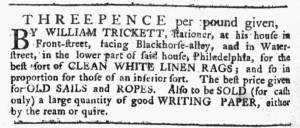
“THREE PENCE per pound … for the best sort of CLEAN WHITE LINEN RAGS.”

A year after the battles at Lexington and Concord, the landscape of newspapers published throughout the colonies had changed.  Some ceased publication, including most of the newspapers previously printed in Boston and Charleston as well as the only newspaper printed in Georgia.  During that time, one printer also launched a new newspaper.  Samuel Loudon commenced the New York Packet on January 4, 1776.  Printers and others experienced a scarcity of paper because of the war and nonimportation agreements.  That contributed to the suspension or irregular publication of some newspapers.  On April 23, 1776, William Trickett, a stationer in Philadelphia, ran an advertisement offering “THREE PENCE per pound … for the best sort of CLEAN WHITE LINEN RAGS.”  Readers knew that he planned to recycle that linen into paper.

I periodically provide a census of newspapers consulted for the Adverts 250 Project.  These are the newspapers published throughout the colonies as the Revolutionary War entered its second year.  This list includes only those that have been digitized and made widely accessible.  A couple titles have not survived or have not been digitized, so this list does not reflect every newspaper that circulated in the colonies in late April 1776.

Published on Mondays

  • Boston-Gazette (Watertown, Massachusetts)
  • Connecticut Courant (Hartford, Connecticut)
  • Dunlap’s Pennsylvania Packet (Philadelphia, Pennsylvania)
  • Newport Mercury (Newport, Rhode Island)
  • New-York Gazette and Weekly Mercury (New York, New York)
  • Norwich Packet (Norwich, Connecticut)

Published on Tuesdays

  • Dunlap’s Maryland Gazette (Baltimore, Maryland)
  • Pennsylvania Evening Post (Philadelphia Pennsylvania)

Published on Wednesdays

  • Connecticut Journal (New Haven, Connecticut)
  • Constitutional Gazette (New York, New York)
  • Henrich Millers Pennsylvanischer Staatsbote (Philadelphia, Pennsylvania)
  • Maryland Journal (Baltimore, Maryland)
  • Pennsylvania Gazette (Philadelphia, Pennsylvania)
  • Pennsylvania Journal (Philadelphia, Pennsylvania)

Published on Thursdays

  • Maryland Gazette (Annapolis, Maryland)
  • New-England Chronicle (final issue in Cambridge, Massachusetts on April 4; first issue in Boston, Massachusetts, on April 25)
  • New-York Journal (New York, New York)
  • New York Packet (New York, New York)
  • Pennsylvania Evening Post (Philadelphia, Pennsylvania)

Published on Fridays

  • Connecticut Gazette (New London, Connecticut)
  • Essex Gazette (Newburyport, Massachusetts)
  • Henrich Millers Pennsylvanischer Staatsbote (Philadelphia, Pennsylvania)
  • Thomas’s Massachusetts Spy (Worcester, Massachusetts)
  • Virginia Gazette [Purdie] (Williamsburg, Virginia)

Published on Saturdays

  • Constitutional Gazette (New York, New York)
  • Pennsylvania Evening Post (Philadelphia, Pennsylvania)
  • Pennsylvania Ledger (Philadelphia Pennsylvania)
  • Providence Gazette (Providence, Rhode Island)
  • Virginia Gazette [Dixon and Hunter] (Williamsburg, Virginia)

These American newspapers published in late April 1776 either have not survived or have not been digitized for greater accessibility.

  • Germantowner Zeitung (Germantown, Pennsylvania; few numbers known)
  • North-Carolina Gazette (New Bern, North Carolina; possibly suspended)

April 22

What was advertised in a revolutionary American newspaper 250 years ago today?

Dunlap’s Pennsylvania Packet (April 22, 1776).

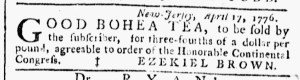
“GOOD BOHEA TEA, to be sold … agreeable to order of the Honorable Continental Congress.”

Advertisements for tea returned to Dunlap’s Pennsylvania Packet on April 22, 1776, after having disappeared for a while due to the prohibition on selling and consuming tea.  In a brief advertisement, Ezekiel Brown announced, “GOOD BOHEA TEA, to be sold by the subscriber, for three-fourths of a dollar per pound, agreeable to order of the Honorable Continental Congress.”  He did not elaborate on the details; instead, he expected readers knew the history of tea during the political crisis and how it became the most politicized commodity in the colonies.

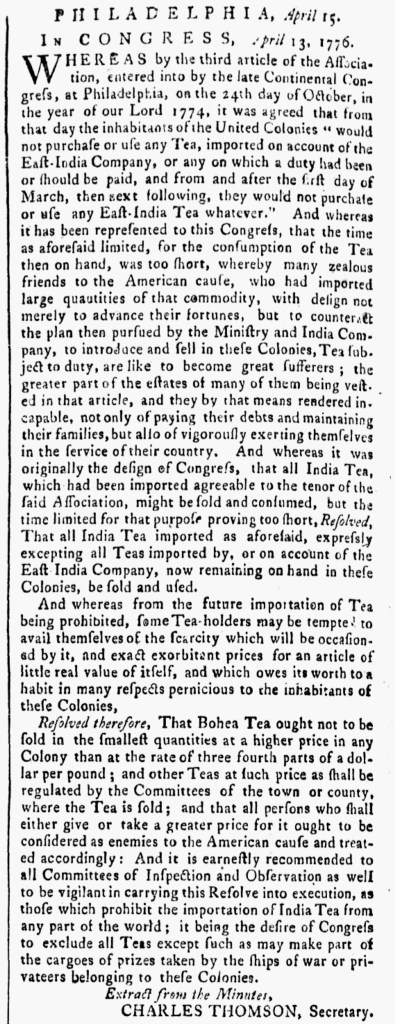
Dunlap’s Pennsylvania Packet (April 15, 1776).

In response to the Intolerable Acts and other abuses perpetrated by Parliament, the First Continental Congress devised the Continental Association, a nonimportation, nonconsumption, and nonexportation agreement, in the fall of 1774.  The first article concerned a general boycott of imported goods, while the third article addressed consuming tea: “we will not purchase or use any Tea imported on Account of the East India Company, or any on which a Duty hath been or shall be paid; and, from and after the first day of March [1775], we will not purchase or use any East India Tea whatever.”  The Second Continental Congress reconsidered some aspects of that third article and passed a new resolution on April 13, 1776.  Two days later, Dunlap’s Pennsylvania Packet carried the resolution along with other news.  It came to the attention of the Second Continental Congress that some “zealous friends to the American cause” had imported “large quantities” of tea in an effort “to counteract the plan then pursued by the Ministry and India Company, to introduce and sell in these Colonies, Tea subject to duty.”  In other words, they stocked up on tea before Parliament and the East India Company could put their plan into effect, doing so as acts of resistance rather than merely “to advance their fortunes.”  Now, however, they stood to become “great suffers” because of their investment in tea, “incapable, not only of paying their debts and maintaining their families, but also of vigorously exerting themselves in the service of their Country.”  According to the new resolution, the First Continental Congress intended that “all India Tea, which had been imported agreeable to the tenor of said Association, might be sold and consumed,” but the March 1, 1775, deadline did not allow enough time for that to happen.  Accordingly, the Second Continental Congress passed a new resolution that “all India Tea imported as aforesaid, expressly excepting all Teas imported by, or on account of the East India Company, now remaining on hand in these Colonies, be sold and used.”  Even though advertisements for tea ceased for a while, colonizers never stopped consuming it in secret.  The new resolution allowed them to drink tea without subterfuge.

It also allowed for the selling of tea, yet it introduced some restrictions since “some Tea-holders may be tempted to avail themselves of the scarcity … and exact exorbitant prices.”  In another resolution, the Second Continental Congress set price controls: “Bohea Tea ought not to be sold … at a higher price in any Colony than at the rate of three fourths of a dollar per pound; and other Teas at such price as shall be regulated by the Committees of the town or county, where the tea is sold.”  That resolution also instructed “all Committees of Inspection and Observation … to be vigilant” in overseeing the sale of tea now that it was allowed once again and to discipline “enemies to the American cause” who engaged in price gouging.

For his part, Brown set the price for his “GOOD BOHEA TEA” at “three-fourths of a dollar per pound, agreeable to the order of the Honorable Continental Congress.”  He placed his advertisement as quickly as possible.  The Second Continental Congress passed the resolution on April 13.  It appeared in Dunlap’s Pennsylvania Packet on April 15.  Brown, who gave his location only as “New-Jersey,” likely saw it in that issue and immediately composed his advertisement, dated April 17.  It ran in the next issue of Dunlap’s Pennsylvania Packet, published once a week, on April 22.  Brown was ready to sell tea in the open (but according to the rules) and he believed that consumers would purchase it once they knew he made it available to them.

April 21

What was advertised in a revolutionary American newspaper 250 years ago this week?

Providence Gazette (April 20, 1776).

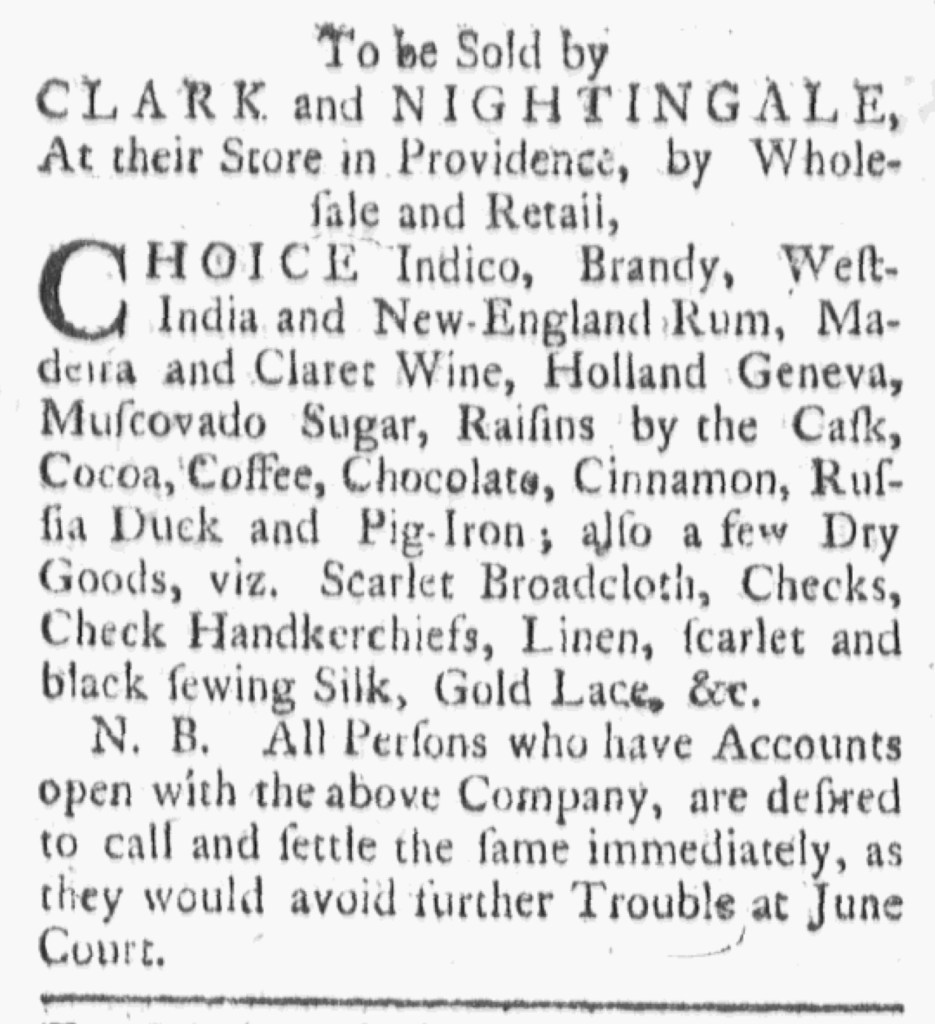
“Rasins by the Cask, Cocoa, Coffee, Chocolate, [and] Cinnamon.”

In the spring of 1776, the partnership of Clark and Nightingale advertised a variety of commodities available “At their Store in Providence, by Wholesale and Retail.”  Their inventory included “Muscovado Sugar, Rasins by the Cask, Cocoa, Coffee, Chocolate, [and] Cinnamon.”  Among the beverages they listed, tea was conspicuously absent.  That popular beverage had been so thoroughly politicized that it disappeared from newspaper advertisements.

Does this explain the rise of coffee as the more popular beverage in America?  Historian Michelle Craig McDonald, author of Coffee Nation: How One Commodity Transformed the Early United States, cautions that we should not be too hasty in reaching that conclusion.  Yes, the Tea Act angered colonizers to the point that members of the Sons of Liberty disguised as Indigenous Americans dumped tea into Boston Harbor in December 1773 and residents of cities and towns throughout the colonies gathered for the ritual destruction of their own tea in bonfires.  That could have been the opening for coffee to eclipse tea in popularity.  For a time, coffee did become a substitute for tea.  McDonald relays a story of an innkeeper refusing to serve tea to John Adams but instead offering him coffee in July 1774.[1]  Yet she also cautions, as she did in a presentation at the American Antiquarian Society, that coffee eventually became a prohibited item enumerated in nonimportation agreements.  The first article of the Continental Association, a nonimportation agreement devised by the First Continental Congress that went into effect on December 1, 1774, specified that the colonizers “will not import into British America … any Molosses, Syrups, Paneles, Coffee, or Pimenta, from the British Plantations” in the Caribbean.  McDonald asserts that “by 1775, coffee had become a political liability in its own right.”[2]

Yet coffee, unlike tea, did not disappear from newspapers advertisements.  It seemingly did not have the same political valence as tea.  In addition, as McDonald explains, “privateering stepped into the breach” by the time Clark and Nightingale advertised that they sold coffee.[3]  Loopholes allowed colonizers to enjoy the beverage.  In general, consumers never completely abstained from consuming tea or coffee.  Too much evidence demonstrates that they continued to drink both beverages even though they pretended otherwise.  Yet the notoriety associated with tea meant that it stopped appearing alongside coffee in advertisements.  Despite the boycott, readers still saw coffee listed alongside other commodities.

**********

[1] Michelle Criag McDonald, Coffee Nation: How One Commodity Transformed the Early United States (Philadelphia: University of Pennsylvania Press, 2025),115.

[2] Coffee Nation, 115.

[3] Coffee Nation, 117.

April 20

What was advertised in a revolutionary American newspaper 250 years ago today?

Pennsylvania Evening Post (April 20, 1776).

“OBSERVATIONS on the RECONCILIATION of GREAT-BRITAIN and the COLONIES … ARGUMENTS for and against.”

As colonizers marked the first anniversary of the battles of Lexington and Concord in April 1776, they debated the purpose of the war.  When it began, most wanted a redress of grievances within the imperial system, just as they had sought in response to the Stamp Act in 1765 and 1766 and the Townshend Acts in the late 1760s.  Yet as the war continued, more and more colonizers determined that it was no longer possible nor desirable to return to their position within the British Empire before the imperial crisis began.  The publication and widespread dissemination of Thomas Paine’s Common Sense in January 1776 convinced many readers to support declaring independence.

Robert Bell, the bold printer who published the first edition of Common Sense, contributed to the debate by printing, advertising, and selling several political pamphlets that expressed a range of views.  For instance, he published and sold “PLAIN TRUTH … containing Remarks on a late Pamphlet intituled COMMON SENSE,” a pamphlet that argued that “permanent Liberty, and true Happiness can only be obtained by Reconciliation” with Great Britain.  For readers interested in a pamphlet that considered both sides of the issue, Bell also marketed “OBSERVATIONS on the RECONCILIATION of GREAT-BRITAIN and the COLONIES.  In which are exhibited ARGUMENTS for and against that MEASURE.  By a FRIEND of AMERICAN LIBERTY.”

When Bell’s advertisement for that pamphlet appeared in the April 20, 1776, edition of the Pennsylvania Evening Post, much of the other content argued against reconciliation.  The column next to Bell’s advertisement featured a list of seven “Reasons for a DECLARATION of the INDEPENDANCE of the American Colonies” submitted by a reader.  On the final page, another item submitted by a reader outlined “The PROGRESS of an American’s CREED for obtaining a redress of grievances, and brining about a reconciliation with Great-Britain.”  That timeline mocked colonizers who consistently advocated for one more effort to restore the colonies’ relationship with George III and Parliament.  It started with the rationale given in September 1774, “I believe in the efficacy of the union of the colonies,” and continued with other milestones, including “I believe in the efficacy of Lord Chatham’s speech, and Mr. Wilke’s opposition to the court,” invoking support from politicians in Britain, in January 1775, “I believe in the efficacy of a second petition to the King,” now known as the Olive Branch Petition, in July 1775, and “I believe in the efficacy of the reduction of Chamblee, St. John’s and Montreal,” referring to the invasion of Canada, in November 1775.  The final item, dated March and April 1776, stated, “I believe in the efficacy of COMMISSIONERS coming over to redress all our grievances, and to bring about a constitutional reconciliation with Great-Britain.”  Colonizers who advocated for reconciliation, this litany suggested, snatched at false hope as they made rationalization after rationalization for not declaring independence.  No matter the political or military measures that should have worked to the colonies’ advantage, they were never enough to get the king and Parliament to reach a satisfactory settlement.  It was time to stop generating new excuses and insisting that their opponents would finally see the light and negotiate in good faith.  The correspondents who submitted these items to the Pennsylvania Evening Post did not have much use for the arguments for reconciliation presented in latest pamphlet that came off Bell’s press.

April 19

What was advertised in a revolutionary American newspaper 250 years ago today?

Essex Journal (April 19, 1776).

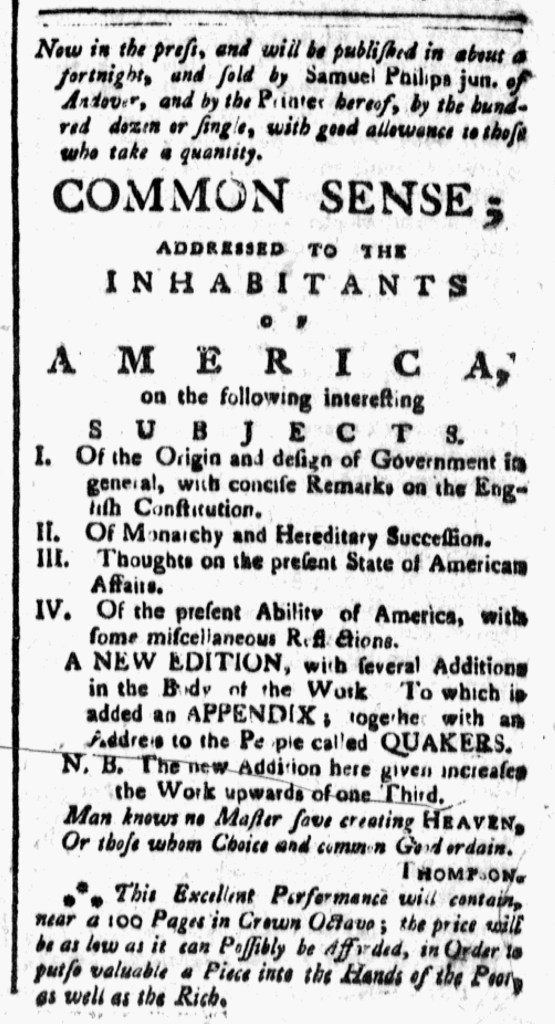
By the hundred[,] dozen or single, with good allowance to those who take a quantity.  COMMON SENSE.”

One year after the battles at Lexington and Concord that started the Revolutionary War, the first advertisement for Thomas Paine’s Common Sense appeared in the Essex Journal and New-Hampshire Packet.  John Mycall, the printer of that newspaper, prepared a local edition in Newburyport, Massachusetts, just as printers in many other cities and towns in Pennsylvania, New York, and New England had done in the three months since Robert Bell made the first edition available in Philadelphia.

This newest edition was not yet ready for sale.  Instead, Mycall announced that it was “Now in the press, and will be published in about a fortnight.”  He encouraged readers to anticipate its publication, priming the pump for distributing the popular political pamphlet within the next couple of weeks.  His advertisement replicated many that appeared in other newspapers.  He gave the title of the pamphlet, provided an overview of its contents by listing the subject headings, and gave two lines from the poem “Liberty” by Scottish poet James Thompson.  He also described his edition as “A NEW EDITION, with several Additions in the Body of the Work To which is added an APPENDIX; together with an Address to the People called QUAKERS.”  That suggested that Mycall drew the Newburyport edition from one of the expanded editions that Paine collaborated with William Bradford and Thomas Bradford in publishing in Philadelphia after the author parted ways with Bell, though the printer of the first edition pirated that bonus content when he published unauthorized subsequent editions.  A nota bene in Mycall’s advertisement, “The new Addition here given increases the Work upwards of one Third,” echoed the Bradfords’ advertisements.

To increase sales and disseminate the pamphlet widely, Mycall enlisted a local agent in Andover, and both of them sold copies “by the hundred[,] dozen or single, with good allowance to those who take a quantity.”  In other words, he gave a discount to customers who bought multiple copies.  Those who purchased a dozen may have distributed them to friends, while those who purchased “by the hundred” likely planned to sell them retail in their own shops.  The discount for volume allowed them to set competitive prices while turning a profit.  In addition, Mycall proclaimed that “the price will be as low as it can Possibly be Afforded, in Order to put so valuable a Piece into the Hands of the Poor, as well as the Rich.”  Such efforts likely helped Common Sense become the most widely read political pamphlet published in the colonies during the era of the American Revolution.

April 18

What was advertised in a revolutionary American newspaper 250 years ago today?

New-York Journal (April 18, 1776).

The Sign of the THREE SUGAR LOAVES.”

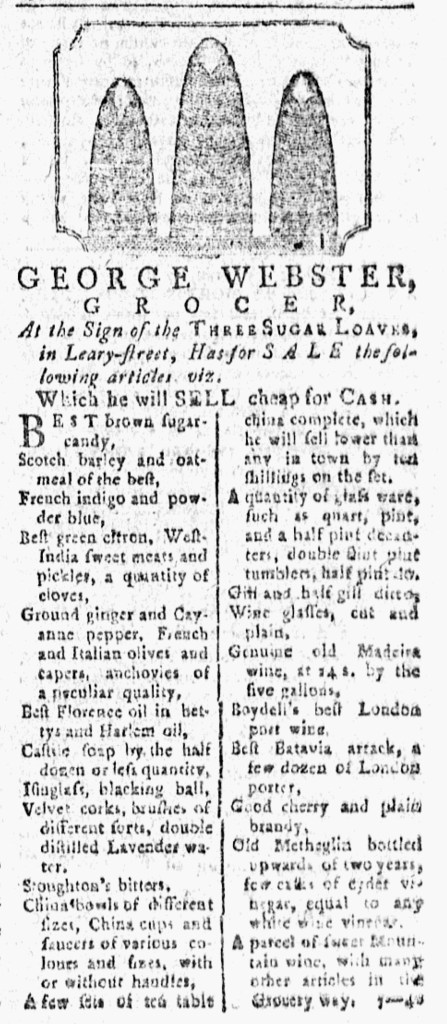
George Webster, a grocer, kept shop “At the Sign of the THREE SUGAR LOAVES, in Leary-street,” in New York during the era of the American Revolution.  In an advertisement in the April 18, 1776, edition of the New-York Journal, he listed a variety of items, including “Best green citron, West-India sweet meats and pickles, a quantity of cloves, Ground ginger and Cayanne pepper, French and Italian olives and capers, [and] anchovies of a peculiar quality.”  He also stocked some housewares, such as “China bowls of different sizes, Chinas cups and saucers of various colours and sizes, with or without handles, [and] A few sets of tea table china complete, which he will sell lower than any in town by ten shillings on the set.”  That was a bargain for a tea seat, though colonizers were supposedly abstaining from drinking tea in protest of the Intolerable Acts.

The “Sign of the THREE SUGAR LOAVES” must have been a familiar sight for many residents of New York.  It had marked Webster’s location on Leary Street for several years.  In addition, the grocer commissioned a woodcut that depicted his sign to adorn some of his newspaper advertisements.  It featured a taller sugar loaf in the center, flanked by two shorter sugar loaves, all enclosed in a thin border with scalloped corners.  It may have replicated the sign that marked Webster’s location, creating a visual identity or brand through the consistency.  Webster used the woodcut in his advertisements in the fall of 1772 and then discontinued it for a few years before using it again in his advertisements in the spring of 1776.  Perhaps he retrieved it from the printing office and tucked it away at his shop, though he could have left it in the care of the printer during that time.  After all, the image was so tied to his business that it would not have been of much use to other advertisers.  Unlike some entrepreneurs who commissioned woodcuts and advertised in multiple newspapers, Webster did not collect his woodcut from one printing office and deliver it to another.  His advertisements in Rivington’s New-York Gazetteer in the fall of 1773 featured a decorative border and gave his location as “the THREE SUGAR LOAVES, In LEARY-STREET,” but did not include the woodcut.  When he revived the image, it helped distinguish his advertisement from others in the New-York Journal.  In the April 18 edition for instance, only one other advertisement included a woodcut.  A stock image of a horse, a fraction of the size of Webster’s woodcut, appeared in an advertisement offering the stud services of True Briton.  The “Sign of the THREE SUGAR LOAVES” at the top of Webster’s advertisement no doubt helped draw attention to it.