July 4

Who was the subject of an advertisement in a revolutionary American newspaper 250 years ago today?
Maryland Gazette (July 4, 1776).

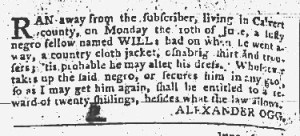
“RUN AWAY … [a] negro fellow named WILL.”

On July 4, 1776, the delegates to the Continental Congress in Philadelphia voted to approve a revised version of a declaration of independence written by Thomas Jefferson, John Adams, Benjamin Franklin, and others appointed for that task.  In the 250 years that have passed since that momentous event, the document they approved has become known as the Declaration of Independence and July 4 has been celebrated as the day the colonies, now states, declared their independence from Great Britain.  Celebrations and commemorations of that event often overlook other declarations of independence made on July 4, 1776.  On that day, American newspapers published more than half a dozen advertisements concerning enslaved people who declared their independence by running away from their enslavers.

Maryland Gazette (July 4, 1776).

The Maryland Gazette, published in Annapolis, carried two such notices.  In one, Alexander Ogg of Calvert County offered a reward for the capture and return of Will, a “negro fellow” who liberated himself three weeks earlier on June 10.  Ogg described what Will wore when he departed, but he also reported that “‘tis probable he may alter his dress” to avoid detection.  In so doing, Ogg acknowledged that Will was clever as well as courageous.  In the other advertisement, Anne Gaither of Annapolis sought the return of “a negro fellow named FLANDERS.”  She mentioned that he “has been used to go by water,” indicating that he had experience working on boats or ships just like many other enslaved men who lived on or near the Chesapeake Bay.  Gaither also reported that Flanders “has no toes,” though she did not elaborate on that detail.  Flanders, no doubt, would have told a much more robust story about who he was and what he had experienced if given the opportunity.
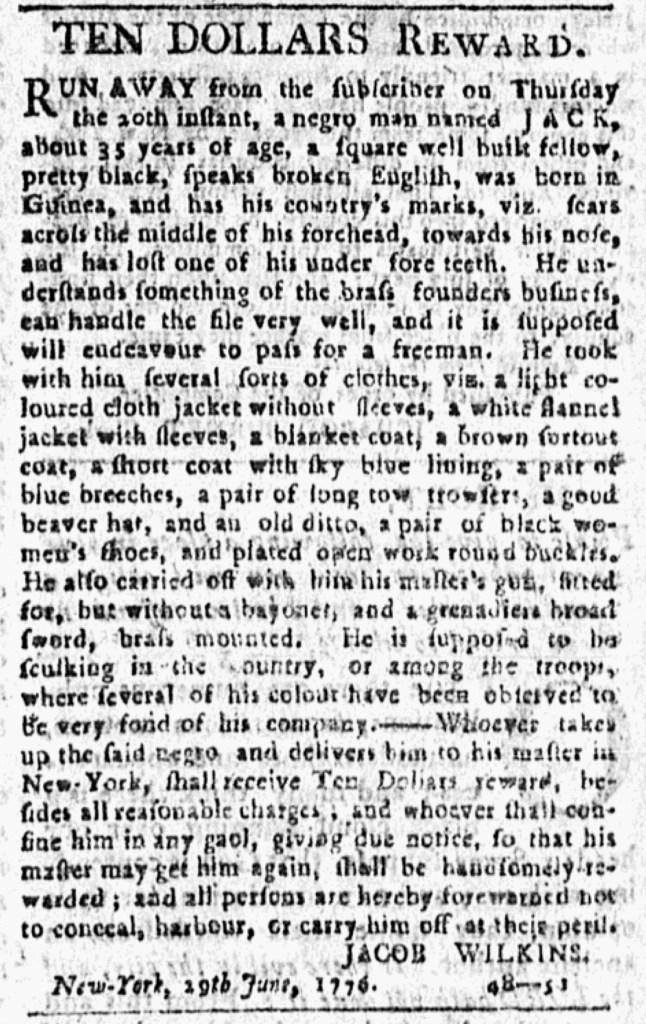
New-York Journal (July 4, 1776).

Enslaved people in southern colonies were not the only ones who liberated themselves by running away at the same time that the Continental Congress voted to declare independence.  The New-York Journal carried Jacob Wilkins’s advertisement regarding “a negro man named JACK” who liberated himself from his enslaver on June 20.  Jack “carried off with him his master’s gun, fitted for, but without a bayonet, and a grenadiers broad sword, brass mounted.”  Wilkins suspected that Jack made his way out of the city and was “sculking in the country, or among the troops, where several of his colour have been observed to be very fond of his company.”  The many disruptions caused by the war presented opportunities for enslaved people to free themselves by fleeing from their enslavers.  To help readers recognize Jack, Wilkins gave his age, “about 35 years,” and mentioned some distinguishing physical characteristics.  Having been “born in Guinea,” Jack had “his country’s marks” or ritual scarring “across the middle of his forehead, [and] towards his nose.”  At some point, he “lost one of his under fore teeth.”  During his enslavement, Jack learned to speak “broken English.”  He also developed valuable skills: he “understands something of the brass founders business, [and] can handle the file very well.”  Many enslaved people were skilled artisans.  Wilkins lamented that Jack “will endeavour to pass for a freeman.”  Jack made himself a free man with his decision to escape from Wilkins.

New-York Packet (July 4, 1776).

The New York Packet carried another advertisement, this one regarding “a Negro Man, named BEN,” placed by John Taylor of “New Germantown, Hunterdon county, West Jersey.”  Ben liberated himself on June 5 and had evaded capture for a month.  Taylor focused primarily on describing Ben and his clothing, noting the young man’s height, age (“twenty-two years old”), and a left leg “considerably larger than the other, with a large scar on the small of said leg.”  Ben wore a blue coat, red jacket, black breeches, and “calf skin shoes, [with] a pair of carved silver buckles,” though he also took another coat and jacket, “a fine shirt with ruffles at the bosom, a pair of woollen trowsers, [and] a half worn wool hat” in a bag “marked I.T. near the mouth.”  Given a chance to write about himself, Ben certainly would have chosen to a tell a different story than the one that Taylor relayed.  If readers detected a young black man carrying a bag with his former enslaver’s initials, Taylor offered a reward for securing him in any jail until he could retrieve him.
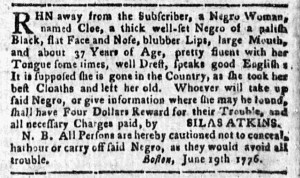
Continental Journal (July 4, 1776).

The Continental Journal, published in Boston after the siege of that city ended, carried two advertisements about enslaved people who liberated themselves.  Silas Atkins described Cloe, “a Negro Woman” who was “likely gone in the Country, as she took her best Cloaths and left her old.”  Atkins gave Cloe’s age (“37 Years’), provided a physical description, and noted that she “speaks good English,” all characteristics that would aid readers in identifying her.  Cloe had been gone since the middle of June.  Atkins promised that anyone who “will take up said Negro, or give information where she may be found, shall have Four Dollars for their Trouble” as well as any expenses they incurred. In a nota bene, he added a standard warning that appeared in many such advertisements: “All Persons are hereby cautioned not to conceal, harbour or carry off said Negro, as they would avoid all trouble.”  The “trouble” would not come from Cloe but rather from legal action undertaken by Atkins.
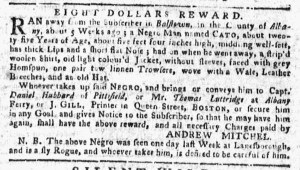
Continental Journal (July 4, 1776).

The other advertisement in the Continental Journal concerned “a Negro Man named CATO, about twenty-five Years of Age,” who liberated himself from Andrew Mitchel of “Balstown [Ballston], in the County of Albany, about 5 Weeks ago.”  Mitchel described Cato’s features and clothing, but he did not provide other details.  He devoted nearly as much space to the network of associates who agreed to aid him by holding Cato until he could retrieve him if a reader managed to capture him.  Those seeking the reward could deliver Cato “to Capt. Daniel Hubbard of Pittsfield, [Massachusetts], or Mr. Thomas Luttridge at Albany Ferry, or J. GILL, Printer in Queen Street, BOSTON, or secure him in any Goal [Jail]” and notify Mitchel.  In a nota bene, the enslaver reported that Cato “was seen one day last Week at Lanesborough [in western Massachusetts], and is a sly Rogue, and whoever takes him, is desired to be careful of him.”  Mitchel meant “sly Rogue” as an insult, not intending to compliment Cato on the ingenuity and perseverance he expected the young Black man to demonstrate in attempting to escape if captured.
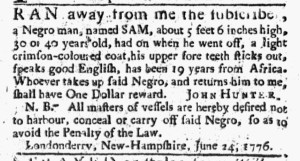
New-England Chronicle (July 4, 1776).

One more advertisement in a newspaper published in Boston, the New-England Chronicle, identified an enslaved man who liberated himself by running away from his enslaver.  This one concerned Sam, “a Negro man” who escaped from John Hunter of Londonderry, New Hampshire, in late June.  Hunter did not know Sam’s age, estimating that he was “30 or 40 years old,” but he did know that Sam “has been 19 years from Africa” and in that time learned to speak “good English.”  Readers might recognize Same from his “upper fore teeth” that stuck out or by the “light crimson-coloured coat” that he wore.  Hunter inserted a nota bene with a warning like the one that appeared in Atkins’s advertisement about Cloe: “All masters of vessels are hereby desired not to harbour, conceal or carry off said Negro, so as to avoid the Penalty of the Law.”  Hunter included an evocative phrase when he said that Sam “has been 19 years from Africa.” What kind of stories would Sam have told about his own life and his decision to liberate himself after so many years of bondage?

The men who gathered in the Pennsylvania State House (now known as Independence Hall) to declare independence from Great Britain are often called the founders of the nation, yet they were not the only ones who envisioned freedom from oppression.  They were members of a founding generation that included soldiers and farmers, women and youth, and many others from diverse backgrounds who contributed to the American cause.  Will, Flanders, Jack, Ben, Cloe, Cato, and Sam were all founders as well.  They made their own declarations of independence during the era of the American Revolution and their former enslavers published those declarations of independence on July 4, 1776.  Will, Flanders, Jack, Ben, Cloe, Cato, and Sam joined countless other enslaved men and women who seized their liberty during the seventeenth, eighteenth, and nineteenth centuries.  Those courageous and resilient men and women sought freedom long before the American Revolution and continued seeking freedom long after the American Revolution.  Their stories matter and must be told alongside the stories of other founders as we celebrate and commemorate 250 years of independence.

For other stories of enslaved people liberating themselves originally published on July 4 during the era of the American Revolution, see:

July 3

What was advertised in a revolutionary American newspaper 250 years ago today?

Connecticut Journal (July 3, 1776).

“Said Deforest expects a good Assortment of Chintz by the 10th of July.”

The Continental Congress made a momentous decision when it voted to declare independence on July 2, 1776.  News would spread as quickly as it could via the communication infrastructure in place in the late eighteenth century, yet it would take time to reach all the former colonies and their residents.  Thomas Green and Samuel Green, the printers of the Connecticut Journal in New Haven, did not yet have access to the news when they distributed the July 3 edition of their newspaper.  They could not pass it along to their readers.  They did publish updates from London, Halifax, Boston, Williamsburg, New York, and Philadelphia, some of them more recent than others.  The first column on the first page of that issue, however, featured the paid notices that underwrote publication of the newspaper rather than updates and editorials.

The first of those advertisements came from Benjamin Deforest, Jr.  He promoted an array of goods for sale at his store in Ripton (now Shelton), providing a long list that included several textiles, “Silk Gloves and Mitts,” “Buttons of various Kinds,” “Shoe and Knee Buckles,” “Sattin Ribbons of various Sorts,” “Crockery and Earthen Ware,” and “pewter Platters, Plates, Pots, Porringers, Basons, [and] Chamber Pots.”  He also stocked grocery items, such as wine and spirits, “Loaf Sugar,” coffee, and chocolate, but not tea for the “Tea Pots” that appeared among his inventory of housewares.  Deforest concluded his account of his merchandise with an assertion that customers would also discover “sundry other Articles too tedious to mention” when they visited his store.  That familiar refrain harkened back to some of the longest and most elaborate newspaper advertisements that encouraged readers to participate in the transatlantic consumer revolution.  It encouraged them to engage their imaginations in hopes of prompting them to browse the shelves at Deforest’s store to see what they might discover.  Deforest did even more to elicit a sense of wonder and anticipation for his wares.  He added a nota bene to inform prospective customers that he “expects a good Assortment of Chintz,” a fashionable fabric, “by the 10th of July,” giving them another reason to shop at his store.  Current events, neither the war nor the decision to declare independence, brought commerce and consumption to a halt.  Despite the disruptions, Deforest and other retailers attempted to continue with business as usual (or as close to usual as possible), devising advertisements that deployed familiar marketing strategies.

July 2

What was advertised in a revolutionary American newspaper 250 years ago today?

Pennsylvania Evening Post (July 2, 1776).

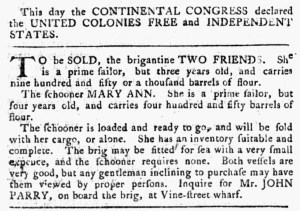
“TO be SOLD, the brigantine TWO FRIENDS.”

The most significant news from the Continental Congress first appeared in just three lines between an update from Pennsylvania’s Committee of Safety and an advertisement offering a brigantine and a schooner for sale in the June 2, 1776, edition of the Pennsylvania Evening Post.  At the end of the news and before the paid notices, Benjamin Towne, the printer, informed readers that “[t]his day the CONTINENTAL CONGRESS declared the UNITED COLONIES FREE and INDEPENDENT STATES.”  The following day, the Pennsylvania Gazette and the Pennsylvania Journaleach carried the news in their weekly issues, though neither provided many more details.  The Pennsylvania Gazette replicated what appeared in the Pennsylvania Evening Post almost exactly, changing “This day” to “Yesterday” and placing the news first among the updates from Philadelphia but after news from London, Halifax, Charleston, Williamsburg, Watertown (outside of Boston), Providence, and New York.  The Pennsylvania Journal have the news similar treatment, but did note that “the Congress Unanimously Resolved to Declare the UNITED COLONIES FREE AND INDEPENDANT STATES.”

Three newspapers reported that the Continental Congress declared independence before July 4, 1776.  How does that square with the most common narrative about the American Revolution and the long practice of celebrating Independence Day on July 4?  On July 2, the Continental Congress approved the Lee Resolution.  On June 7, Richard Henry Lee, a delegate from Virginia, acting on instructions received from the Virginia Convention, proposed that the colonies declare independence, seek foreign alliances, and form a confederation for their mutual benefit.  The Second Continental Congress did not immediately vote on Lee’s resolution since many delegates were waiting for instructions from their own colonies.  Even though they delayed the vote, they established three committees to work on the elements of the resolution, including a committee to draft a declaration of independence.  On July 2, the Continental Congress approved this resolution: “That these united colonies are and of right ought to be free and independent states; that they are absolved from all allegiance to the british crown and that all political connection between them and the state of great Britain is and out to be totally dissolved.”

The following day, John Adams included the news in a letter to his wife, Abigail.  “The Second Day of July 1776,” he proclaimed, “will be the most memorable Epocha, in the History of America.  I am apt to believe that it will be celebrated, by succeeding Generations, as the great anniversary Festival.  It ought to be commemorated, as the Day of Deliverance by solemn Acts of Devotion to God Almighty.  It ought to be solemnized with Pomp and Parade, with Shews, Games, Sports, Guns, Bells, Bonfires and Illuminations from one End of this Continent to the other from this Time forward forever more.”  Yet history did not work out that way.  On July 4, 1776, the Continental Congress approved a revised draft of a declaration of independence submitted by Thomas Jefferson and the other members of that committee.  The Declaration of Independence then circulated in newspapers and on broadsides, each bearing the date July 4, 1776, the date that became associated with declaring independence.

News that the Continental Congress declared independence was much more substantial than the details of the sale of the brigantine Two Friends and the schooner Mary Ann that appeared immediately below it in the Pennsylvania Evening Post on July 2, 1776, yet such a momentous event has been largely overlooked in the narrative most familiar to the public.  Historians of early America chronicle what occurred, but the importance of July 2 is not widely recognized in the popular memory of the events of the imperial crisis and the American Revolution.

July 1

What was advertised in a revolutionary American newspaper 250 years ago today?

Dunlap’s Pennsylvania Packet (July 1, 1776).

“PROCEEDINGS OF THE PROVINCIAL CONFERENCE of COMMITTEES, Of the PROVINCE of PENNSYLVANIA.”

The Pennsylvania Provincial Congress met at Carpenters’ Hall in Philadelphia in June 1776.  Delegates from the city of Philadelphia and each of the ten counties in the colony convened on June 18 and adjourned on June 25.  Over the course of a week, the Pennsylvania Provincial Congress reached some momentous decisions.  Newspapers carried updates about the work undertaken and news almost certainly reached even more colonizers via word of mouth, yet those were not the only means of learning about the debates and decisions of the ninety-seven delegates who participated in the congress.

On July 1, William Bradford and Thomas Bradford advertised that they published and sold “PROCEEDINGS OF THE PROVINCIAL CONFERENCE of COMMITTEES, Of the PROVINCE of PENNSYLVANIA,” less than a week after the meeting concluded.  They were so eager to make the record of the Pennsylvania Provincial Congress and its outcomes available to the public that they did not wait to advertise the pamphlet in the next issue of their own newspaper, the Pennsylvania Journal, scheduled for July 3 (though they did also publish the same advertisement in that issue, giving it a prominent place right after news from Pennsylvania’s Committee of Safety).

What decisions did the delegates to Pennsylvania Provincial Congress make?  According to the overview of the sestercentennial commemorations sponsored by Carpenters’ Hall and other cultural, academic, and political institutions in Pennsylvania, they voted to “[d]eclare Pennsylvania’s independence from the British Empire, thus establishing the Commonwealth of Pennsylvania, [m]obilize the Pennsylvania militia for the American Revolutionary War, [and o]rganize elections to select delegates to a constitutional convention, which framed the influential Pennsylvania Constitution of 1776,” a constitution often considered the most democratic of all the state constitutions adopted during the War for Independence.  (For more on the Pennsylvania Provincial Congress, see Carl G. Karsh’s short essay, “Pennsylvania: From Colony to State.”

The Bradfords and many other printers throughout the colonies published, advertised, and sold proceedings of provincial congresses and the Continental Congress.  In so doing, they offered colonizers greater access and more complete coverage of those meetings, reporting not only the outcomes but also the processes and the debates that led to them.  The publication and sale of the Proceedings of the Provincial Conference of Committees, of the Province of Pennsylvania and similar conventions in other colonies helped the public stay informed about current events and perhaps even shaped opinions during the transition from resistance to revolution.

June 30

What was advertised in a revolutionary American newspaper 250 years ago this week?

Virginia Gazette [Purdie] (June 28, 1776).

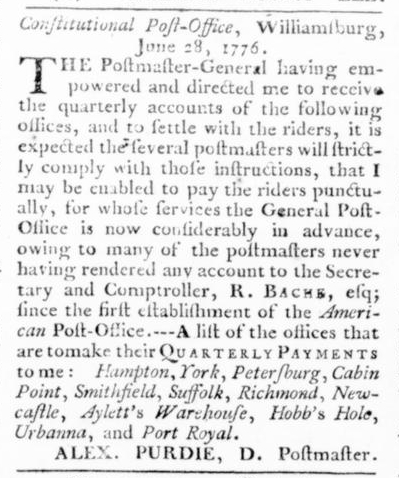
Constitutional Post-Office, Williamsburg, June 28, 1776.”

The colophon that ran across the bottom of the final page of the June 28, 1776, edition of Alexander Purdie’s Virginia Gazette testified to the multiple roles that the printer played in the community: “WILLIAMSBURG: Printed by ALEXANDER PURDIE, at the CONSTITUTIONAL POST-OFFICE.”  Note that Purdie did not describe his location as printing office but rather as the local branch of the Constitutional Post Office approved by the Second Continental Congress as an alternative to the imperial postal system in the summer of 1775.  Purdie took the same approach in giving his location in an advertisement for Thomas Paine’s Common Sense, two military manuals, and writing paper in the May 17 edition, stating that he sold them “at the CONSTITUTIONAL POST OFFICE, Williamsburg,” rather than at his printing office.  The two locations were the same, but Purdie chose to emphasize the responsibility entrusted to him as a supporter of the American cause.

In addition, he ran advertisements to conduct business on behalf of the Constitutional Post Office, underscoring his position to readers of his newspaper.  Some advertisements featured a dateline that included the location and date, such as John Moody’s notice that the smith and farrier opened a shop.  That dateline stated, “WILLIAMSBURG, June 28, 1776.”  For his advertisement placed as a deputy to the Postmaster General, Purdie included more than just the town in the dateline: “Constitutional Post-Office, Williamsburg, June 28, 1776.”  He advised readers and especially the postmasters in several towns in Virginia that the “Postmaster-General … empowered and directed me to receive the quarterly accounts” from a dozen offices and “to settle with the riders” who carried mail between them.  In turn, “it is expected the several postmasters will strictly comply with those instructions” to maintain the services of the “American Post-Office.”

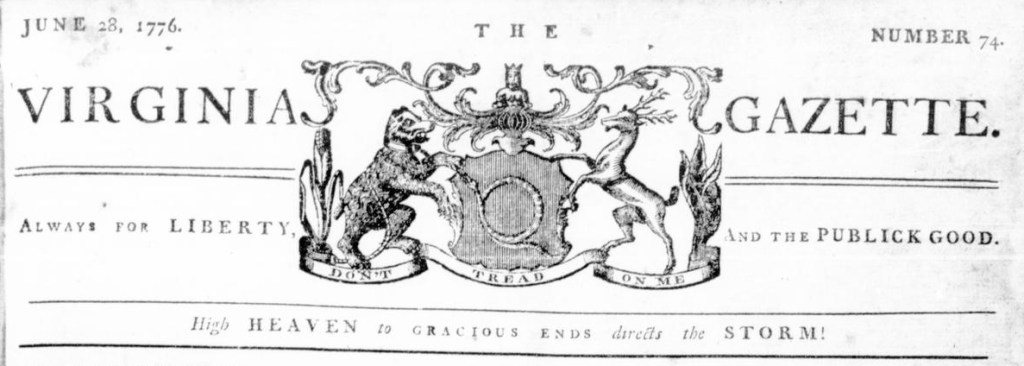
That advertisement and the colophon helped to make Purdie’s politics clear to readers, distinguishing his Virginia Gazette from John Dixon and William Hunter’s Virginia Gazette, also published in Williamsburg but not at a branch of the Constitutional Post Office.  The competing newspapers often took a more measured approach in covering current events, perhaps because Hunter was a Loyalist.  In addition, Purdie’s Virginia Gazette had yet another new masthead.  The decorative type enclosing “THIRTEEN UNITED COLONIES. United, we stand—Divided, we fallappeared in the masthead of only three issues before being replaced with a more sophisticated image depicting a bear and a stag, symbolizing the British Empire, flanking a snake, a symbol of the colonies that previously appeared in mastheads of other newspapers.  Below the bear, the snake, and the stage, a ribbon featured the motto “DON’T TREAD ON ME.”  As a printer and as a postmaster, Purdie signaled his allegiance to the American colonies.

Virginia Gazette [Purdie] (June 28, 1776).

June 29

What was advertised in a revolutionary American newspaper 250 years ago today?

Providence Gazette (June 29, 1776).

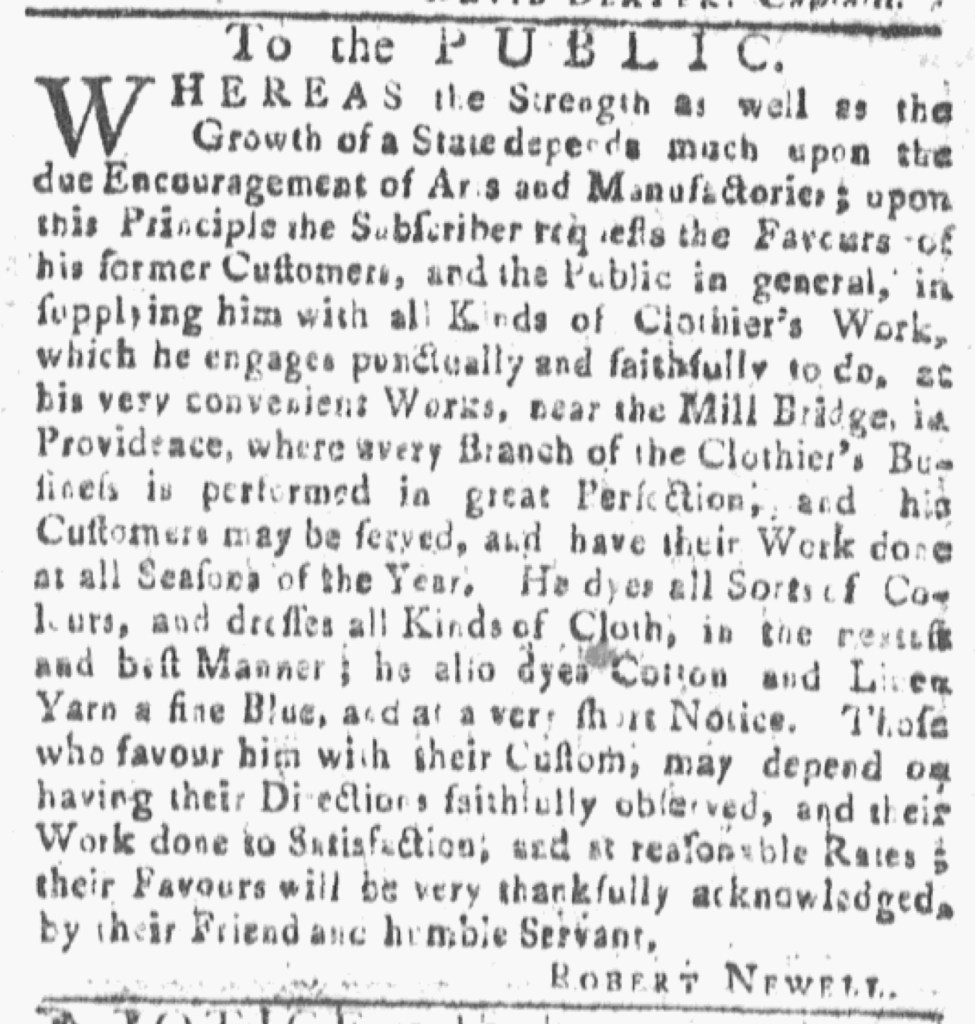
“The Strength as well as the Growth of a State depends much upon the due Encouragement of Arts and Manufactories.”

Robert Newell undertook “all Kinds of Clothier’s Work … at his very convenient Works, near the Mill Bridge, in Providence.”  In an advertisement in the June 29, 1776, edition of the Providence Gazette, he informed the public that “every Branch of the Clothier’s Business is performed in great Perfection” when customers entrusted him their instructions for treating textiles.  For instance, he “dyes all Sorts of Colours, and dresses all Kinds of Cloth, in the neatest and best Manner.”  In addition, he “also dyes Cotton and Linen Yarn a fine Blue, and at a very short Notice.”  Newell made skill and quality centerpieces of his appeals to the public, yet he also emphasized price and customer service.  He declared that he “engaged punctually and faithfully to do” the work delivered to his “convenient Works,” pledging that “[t]hose who favour him with their Custom, may depend on having their Directions faithfully observed, and their Work done to Satisfaction, and at reasonable Rates.”

Artisans and others regularly made all those appeals in their newspaper advertisements.  Newell added one more that he believed would resonate with the public as they contemplated current events, especially the war and calls for the colonies to declare independence rather than seek redress of grievances within the British imperial system.  The clothier opened his notice with a pronouncement with wording that echoed the resolutions made by provincial congresses that appeared elsewhere in the public prints.  “WHEREAS the Strength as well as the Growth of a State depends much upon the due Encouragement of Arts and Manufactories,” Newell asserted, “upon this Principle the Subscriber requests the Favours of his former Customers, and the Public in general, in supplying him with all Kinds of Clothier’s Work.”  Beyond all his appeals concerning quality and customer service, Newell claimed that residents of Providence and other towns in the area had a civic duty to employ him if they wished for their country to prosper and thrive.  He deployed language similar to the eighth article of the Continental Association devised by the Second Continental Congress and adopted throughout the colonies: “we will, in our Several Stations, encourage Frugality, Economy, and Industry; and promote Agriculture, Arts, and the Manufactures of this Country.”  The decisions that colonizers made in the marketplace, as producers and as consumers, had political implications.  The Second Continental Congress made that clear.  Newell endorsed that position and sought to use it to his own advantage to attract customers for his “Clothier’s Business.”

June 28

What was advertised in a revolutionary American newspaper 250 years ago today?

Massachusetts Spy (June 28, 1776).

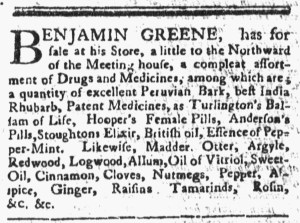
“Patent Medicines … Turlington’s Balsam of Life, Hooper’s Female Pills.”

In the summer of 1776, Benjamin Greene advertised a “compleat assortment of Drugs and Medicines” available “at his Store, a little to the Northward of the Meeting house,” in Worcester.  He listed some of the items he stocked, including “a quantity of excellent Peruvian Bark, best India Rhubarb, … British oil, [and] Essence of Pepper-Mint.”  Greene also carried popular patent medicines, such as “Turlington’s Balsam of Life, Hooper’s Female Pills, Anderson’s Pills, [and] Stoughtons Elixir.”  Consumers were so familiar with those products that he did not need to say anything about their uses.  In addition, Greene sold a variety of spices, from cinnamon and cloves to allspice and pepper.  Whatever illnesses readers experienced, Green could supply some sort of medicine to alleviate their symptoms.

Greene’s notice was one of the few advertisements that appeared in the June 28 edition of the Massachusetts Spy.  Isaiah Thomas had published the newspaper in Worcester for more than a year after relocating from Boston just as the Revolutionary War began, but, after the siege of Boston ended, he decided to seek opportunities in a larger town on the coast once again.  He opted for Salem rather than returning to Boston, perhaps because of a smallpox outbreak in the colony’s largest port.  William Stearns and Daniel Bigelow began printing the Worcester Spy on June 21.  Greene advertised in that issue and again the following week, one of the few who trusted that the Massachusetts Spy had a large enough circulation under new management to justify the fee for purchasing space in the newspaper.  He was the only purveyor of goods and services to place an advertisement in either issue.  Joseph Jaseph advertised a stolen horse on June 21 and Solomon Jones advertised a lost pocketbook on June 28.  The printers inserted a call for rags to recycle into paper in both issues, echoing their counterparts in towns throughout the colonies.  That meant that Stearns and Bigelow generated some revenue from advertisements, but not much.  Just as they had to convince residents of Worcester and other towns in central Massachusetts to become subscribers, they also had to build a clientele of advertisers following Thomas’s departure.  For a while, it had been uncertain whether the newspaper would continue so advertisers fell away during its suspension.  As they started the process, Greene experienced a lack of competition in the public prints, something that may have benefited his business as much as the advertising copy that he composed.

June 27

What was advertised in a revolutionary American newspaper 250 years ago today?

New York Packet (June 27, 1776).

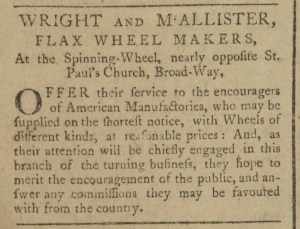
“WRIGHT AND McALLISTER, FLAX WHEEL MAKERS, … OFFER their service to the encouragers of American Manufactories.”

Wright and McAllister, “FLAX WHEEL MAKERS,” marked their location “nearly opposite St. Paul’s Church, Broad-Way,” in New York with a sign depicting a spinning wheel.  The placed an advertisement in the June 27, 1776, edition of the New York Packet to “OFFER their service to the encouragers of American Manufactories.”  In so doing, they echoed the language that so often appeared in editorials about producing goods in the colonies rather than importing them from Great Britain, in advertisements that promoted such products, and in nonimportation agreements adopted as acts of resistance.  The eighth article of the Continental Association, the most significant of the nonimportation agreements, for instance, stated, “That we will, in our several Stations, encourage Frugality, Economy, and Industry; and promote Agriculture, Arts, and the Manufactures of this Country.”  That meant producing homespun textiles as alternatives to the array of imported fabrics that dominated newspaper advertisement for imported goods, yet colonizers could not focus solely on the final product.  Purchasing and wearing homespun depended on having the equipment necessary for producing it.

Wright and McAllister aimed to do their part in such a worthy endeavor.  They made “Wheels of different kinds” that they sold “at reasonable prices.”  Under other circumstances they might have described themselves as turners rather than “FLAX WHEEL MAKERS,” but they decided that “their attention will be chiefly engaged in this branch of the turning business” on the eve of the Second Continental Congress declaring independence.  They joined other entrepreneurs who marketed American-made equipment for producing textiles, including Robert White and David Poe, who both made spinning wheels, and Fergus McIllroy, who made looms.  Given the service that they undertook on behalf of the American cause, Wright and McAllister “hope[d] to merit the encouragement of the public” in New York as well as “answer any commissions they may be favoured with from the county.”  In turn, their work would enable others, especially women, to participate in politics through their activities in the marketplace, not only as consumers but also as producers of the thread necessary for producing homespun textiles.

June 26

What was advertised in a revolutionary American newspaper 250 years ago today?

Pennsylvania Gazette (June 26, 1776).

“A COMPLETE TUTOR FOR THE FIFE.”

The June 26, 1776, edition of the Pennsylvania Gazette carried an advertisement in which Michael Hillegas announced the publication and sale of “A COMPLETE TUTOR FOR THE FIFE, comprehending the first Rudiments of Music, and of the Instrument, in an easy familiar Method.”  That was not all that was in the manual.  This American edition included “the Fife Duty, and the usual Collections of Lessons, Airs and Marches, in the English Edition, [and] a Variety of new favourite ones never before printed.”  Hillegas may have hoped that the promise of tunes not previously available would entice even customers who already knew how to play the fife or had a copy of another edition of the musical manual.

According to JoAnn Taricani, Hillegas is “[p]erhaps best known as the First Treasurer of the United States,” yet he “maintained a number of mercantile enterprises during his lifetime, one of which was the music store he operated from approximately 1759 to 1779.”  At the time he advertised an American edition of “A COMPLETE TUTOR FOR THE FIFE,” his music shop, “the first business devoted specifically to musical merchandise in Philadelphia” and “the only specialty store for music in the colonies prior to the Revolutionary war,” had been open for more than fifteen years, likely making it familiar to many residents of the busy urban port.  “Virtually all printed music had to be imported,” Taricani notes, with “only a few efforts at music printing … attempted prior to the war.”[1]  A series of nonimportation agreements interrupted trade before the war, prompting American entrepreneurs to produce and to promote “domestic manufactures” or goods made in the colonies.  Hillegas apparently joined that effort with an American edition of a manual for learning to play the fife, though the advertisement did not make clear whether he published “A COMPLETE TUTOR FOR THE FIFE” or merely sold copies of it.  Eighteenth-century readers knew to separate the phrases “JUST PUBLISHED” and “to be SOLD,” with the latter referring to the advertisers but not necessarily the former.  Taricani suggests that the partnership of Hall and Sellers, the printers of the newspaper in which the advertisement appeared, published the musical manual.[2]  While Hillegas did not print “A COMPLETE TUTOR FOR THE FIFE,” he may have collaborated with Hall and Sellers in publishing it.  Neither the advertisement nor the imprint allows for a definitive conclusion.  What they do reveal is that the publisher believed a market exited for an American edition of the manual as the Revolutionary War continued and Hillegas attempted to incite even greater demand.

**********

[1] JoAnn Taricani, “Musical Commerce in Eighteenth-Century Philadelphia: The Letters of Michael Hillegas,” Pennsylvania Magazine of History and Biography 113, no. 4 (October 1989): 609-610.

[2] Taricani, “Musical Commerce,” 618.

June 25

What was advertised in a revolutionary American newspaper 250 years ago today?

Pennsylvania Evening Post (June 25, 1776).

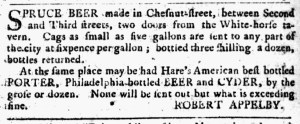
“SPRUCE BEER made in Chesnut-street … Hare’s American best bottled PORTER.”

Was advertising in early American newspapers effective?  Robert Appleby apparently thought so.  At the end of June 1776, he invested in placing an advertisement in the Pennsylvania Evening Post that he previously published in March.  “SPRUCE BEER made in Chestnut-street,” he announced.  For the convenience of his customers, “Cags [or kegs] as small as five gallons are sent to any part of the city at sixpence per gallon” or three shillings for a dozen bottles of spruce beer.  That was not the only product that Appleby stocked.  “At the same place may be had,” de declared, “Hare’s American best bottled PORTER, [and] Philadelphia bottled BEER and CYDER, by the grose or dozen.”  He was one of several tavernkeepers and other purveyors of beer in Philadelphia who promoted Hare’s Best American Draught Porter.  Other than patent medicines, Robert Hare’s porter was one of the first products recognized by a brand name.  Appleby also promised quality: “None will be sent out but what is exceeding fine.”

Appleby deployed the same copy in both advertisements, but this was not a case of the type remaining set and inserting it once again.  The new iteration of his advertisement had a different format.  The use of capital letters for “SPRUCE BEER,” “PORTER,” “BEER,” and “CYDER” remained the same and the first two lines broke at the same point, but the remainder of lines did not.  The compositor may have referred to a clipping of the previous advertisement when setting the type for the new one.  In addition, this version removed the date, “March 19,” and featured a variant spelling of the advertiser’s name, “APPELBY” rather than “APPLEBY.”  Sometimes type for advertisements remained set and undisturbed in printing offices for weeks, but that was not the case for Appleby’s advertisement.  The differences make clear that the compositor set the type for the same advertising copy a second time.  Appleby seemingly had confidence that his notice worked the first time and merited inserting in the Pennsylvania Evening Post once again.