June 16

What was advertised in a revolutionary American newspaper 250 years ago this week?
Virginia Gazette [Dixon and Hunter] (June 15, 1776).

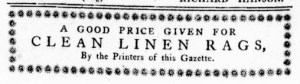
“A GOOD PRICE GIVEN FOR CLEAN LINEN RAGS, By the Printers of this Gazette.”

John Dixon and William Hunter continued to publish the Virginia Gazette on a smaller sheet than usual two weeks after running a notice that explained the circumstances.  The “present Scarcity of Paper” forced them to resort to what they had on hand, the smaller sheets, but they assured readers that despite “the Size of this Gazette” it did contain “all the material Intelligence that came to Hand this Week.”  The printers also declared that a “considerable Supply of Paper is daily expected from NEW YORK and PHILADELPHIA.”  Once they received it, “our Customers shall be served as formerly.”  Those deliveries took longer than anticipated.  Dixon and Hunter expanded the June 8, 1776, edition to eight pages printed on the smaller sheet, allowing them to disseminate more news and advertisements.  They did so again with the June 15 edition.  The new format meant that that could not include the usual masthead at the top of the first page, but that may have been the least of Dixon and Hunter’s concerns.

The printers aimed to do their part to increase the production of paper in the colonies amid the disruption in trade with England due to the war.  That meant collecting linen rags that could be transformed into paper.  They concluded the June 15 edition with a short advertisement, just three lines, that proclaimed, “A GOOD PRICE GIVEN FOR CLEAN LINEN RAGS, By the Printers of this Gazette.”  A border comprised of printing ornaments enclosed that notice, distinguishing it from all the other advertisements in that issue.  Dixon and Hunter used printing ornaments sparingly.   Plain lines separated most news items and paid notices, though a delicate line of decorative type indicated where news ended and advertisements began on the fifth page of that issue.  Even bolder lines of decorative type appeared above and below the poem in the upper left corner on the final page (a weekly feature in many colonial newspapers), setting the poet’s corner apart from the advertisements.  Dixon and Hunter also enclosed an initial capital for the first news item on the first page within decorative type.  Beyond these few examples, they did not use printing ornaments in that issue of the Virginia Gazette.  That made the border enclosing their call for “CLEAN LINEN RAGS” even more remarkable.  Even if readers quickly passed over other advertisements, the printers wanted to increase the chances that they took note of that final notice.
June 15

What was advertised in a revolutionary American newspaper 250 years ago today?

Providence Gazette (June 15, 1776).

Palmer and Allen … are determined to dispose of many articles at prime cost.”

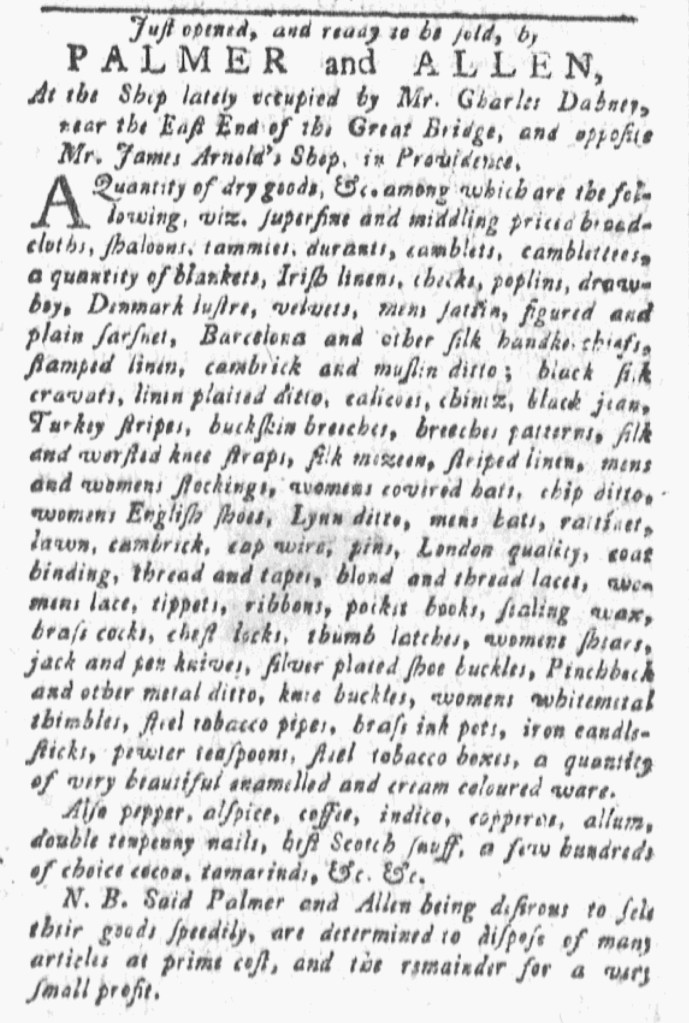
In the summer of 1776, Palmer and Allen sold a “Quantity of dry goods” and various spices at “the Shop lately occupied by Mr. Charles Dabney, near the East End of the Great Bridge, … in Providence.”  They ran an advertisement in the June 15 edition of the Providence Gazette, announcing that they “Just opened” and made the selection available to consumers. To entice prospective customers, Palmer and Allen provided a lengthy list of dozens of items, including “superfine and middling priced broadcloths, … a quantity of blankets, … Barcelona and other silk handkerchiefs, … buckskin breeches, … silk and worsted knee straps, … mens and womens stockings, … blond and thread laces, … jack and pen knives, … womens white metal thimbles, … brass ink pots, … steel tobacco boxes, [and] a quantity of very beautiful enamelled and cream coloured ware.”  Spices and other groceries on hand included pepper, allspice, tamarind, coffee, and “choice cocoa.”  With such a lengthy list, Palmer and Allen provided a catalog of their merchandise.

In a nota bene at the end of the advertisement, the partners indicated that they wished to liquidate their inventory as quickly as possible.  “Said Palmer and Allen being desirous to sell their goods speedily,” they informed readers, “are determined to dispose of many articles at prime cost, and the remainder for a very small profit.”  By “prime cost,” they meant the direct cost to them as shopkeepers.  In other words, Palmer and Allen claimed that they did not intend to charge any sort of retail markup for many of their wares, though they did not specify which of them customers could acquire at such a bargain.  For the rest, they generated only a “small profit” with a small retail markup.  Customers could not go wrong when they shopped at Palmer and Allen’s new store!  The savvy entrepreneurs hoped that their pricing would attract consumers, especially those who imagined getting extraordinary deals.  For some prospective customers, bargain prices may have transformed “wants” into “needs” as they envisioned themselves getting the better end of the deal when they made purchases from Palmer and Allen.

June 14

What was advertised in a revolutionary American newspaper 250 years ago today?

Essex Journal (June 14, 1776).

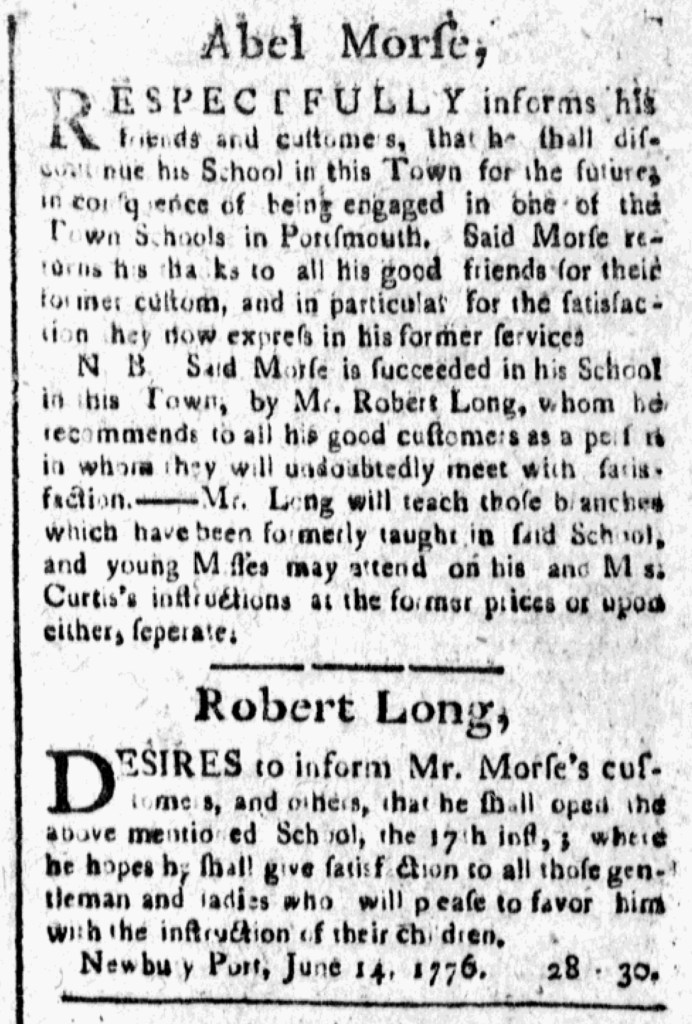
“Said Morse is succeeded in his School in this Town, by Mr. Robert Long.”

In the summer of 1776, Abel Morse, a schoolmaster, took to the pages of the Essex Journal to “RESPECTFULLY” inform the residents of Newburyport, Massachusetts, that “he shall discontinue his School … in consequence of being engaged in one of the Town Schools” in Portsmouth, New Hampshire.  He expressed his appreciation to “all his good friends for their former custom, and in particular for the satisfaction they now express in his former services.”

On the heels of the endorsement he claimed to have earned from his students and their families, Morse inserted a nota bene that announced that Robert Long “succeeded [him] in his School in this Town.”  Morse recommended Long “to all his good customers as a person in whom they will undoubtedly meet with satisfaction.”  Rather than leaving his former pupils to find a new instructor, Morse directed them to his replacement, noting that Long “will teach those branches which have been formerly taught in said School.”  Furthermore, Long would charge “the former prices” so Morse’s students would not incur higher expenses if they continued with the new teacher.

He also mentioned that “young Misses” could continue to benefit from “Mrs. Curtis’s instructions.”  In an advertisement that first ran in the Essex Journal on March 15, 1776, Morse reported that the “Working-School is continued by Mrs. Curtis and daughter as usual, by whom gentlemen and ladies may have sewing work done upon the shortest notice.”  Morse and Long apparently taught subjects like reading, writing, and arithmetic while Curtis and her daughter taught sewing and other traditionally feminine skills.  Students could opt for lessons from Long, Curtis, or both.

Morse’s nota bene served as an introduction to Long’s own address to readers of the Essex Journal.  With his name as a headline, Long stated that he “DESIRES to inform Mr. Morse’s customers, and others, that he shall open the above mentioned School” on Monday, June 17.  The advertisement gave advance notice of only a few days.  He would endeavor to meet the standards established by Morse and “hopes he shall give satisfaction to all those gentlemen and ladies who will please to favor him with the instruction of their children.”  Despite the departure of Morse, the advertisement emphasized continuity for students who could learn the same subjects from Long as well as continue learning household skills from Curtis.

June 13

What was advertised in a revolutionary American newspaper 250 years ago today?

New-England Chronicle (June 13, 1776).

“Rendering due praise and honour to the manly and virtuous supporters of the GLORIOUS CAUSE OF AMERICA.”

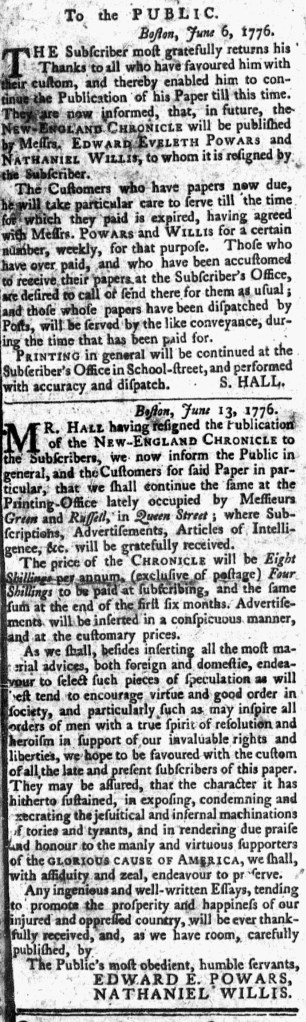
It was the first issue of the New-England Chronicle published by Edward E. Powars and Nathaniel Willis after Samuel Hall transferred the newspaper to them.  Their names appeared in the colophon integrated into the masthead at the top of the first page: “BOSTON: Printed by POWARS and WILLIS at their Office opposite the new COURT-HOUSE, Queen-Street.”  For the first order of business in the June 13, 1776, edition, the former printer and the new printers reminded readers about the transition in notices that ran in the first column on the first page.  They previously made the announcement in separate advertisements in the last issue.  Hall’s notice ran again without revisions or additions (except for a salutation, “To the PUBLIC,” and the original date, “Boston, June 6, 1776”) while Powars and Willis took the opportunity to add to their previous advertisement.

In so doing, they vowed to continue the editorial stance practiced by Hall.  The public, Powars and Willis promised, “may be assured, that the character [the New-England Chronicle] has hitherto sustained, in exposing, condemning, and execrating the jesuitical and infernal machinations of tories and tyrants, and in rendering due praise and honour to the manly and virtuous supporters of the GLORIOUS CAUSE OF AMERICA, we shall, with assiduity and zeal, endeavour to preserve.”  The New-England Chronicle catered to Patriots in Boston less than two months after the siege of that city ended when British troops departed on March 17.  Powars and Willis took their responsibilities seriously, stating that they would “select such pieces … as will best tend to encourage virtue and good order in society, and particularly such as may inspire all orders of men with a true spirit of resolution and heroism in support of our invaluable rights and liberties.”  With such promises made, they hoped “to be favoured with the custom of all the late and present subscribers of this paper.”  In other words, they encouraged readers who previously subscribed to renew their subscriptions and current subscribers to continue receiving the New-England Chronicle.  Their previous notice solicited subscribers and advertisers.  That portion appeared again, but this time the printers also requested “ingenious and well-written Essays, tending to promote the posterity and happiness of our injured and oppressed country.”  Through an eighteenth-century version of crowdsourcing, the public could play a role in maintaining the editorial voice that readers expected from the New-England Chronicle.  The publication had new printers, but those new proprietors pledged that the newspaper would remain the same.

June 12

What was advertised in a revolutionary American newspaper 250 years ago today?

Pennsylvania Journal (June 12, 1776).

“THE engagement between the Row-Gallies of this city, and the Roebuck and Liverpool English men of war.”

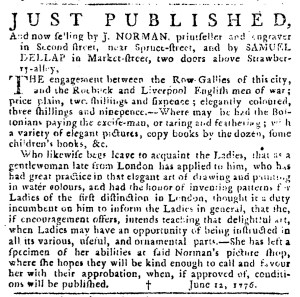
John Norman, an engraver from London, sold prints at his shop on Second Street in Philadelphia.  He also gained acclaim as the publisher of American editions of architectural manuals for which he engraved the images, but it was the prints available at his shop that he advertised in the June 12, 1776, edition of the Pennsylvania Journal.

One print showed the “engagement between the Row-Gallies of this city, and the Roebuck and Liverpool English men of war.”  It depicted a recent battle familiar to residents of Philadelphia and its hinterland.  In March, the Roebuck and the Liverpool blockaded the mouth of the Delaware Bay, eliminating access to the Delaware River and Philadelphia.  The American Revolution’s first battle on the Delaware River occurred on May 8 and 9 when the British frigates sailed up the river.  Thirteen row galleys built by the Pennsylvania Committee of Safety in 1775 repulsed the Roebuck and the Liverpool, demonstrating that the smaller yet agile boats could hold their own against the warships in shallow waters.  The outcome boosted the morale of Patriots in Philadelphia and beyond.  Norman proclaimed that the print was “JUST PUBLISHED” and available for sale (for two shillings and six pence plain or for three shillings and nine pence “elegantly coloured”) less than five weeks after the battle.  He likely did the engraving himself.

He did not, however, engrave “the Bostonians paying the excise-man, or taring and feathering” and many others from the “variety of elegant pictures” he sold.  Instead, he imported most of thoseThe Bostonians Paying the Excise-Man, or Tarring & Feathering was one of five satirical prints engraved by Philip Dawe, printed by Robert Sayer and John Bennett, and sold in both England and the colonies.  The series included The Alternative of Williams-Burg, The Bostonians in Distress, The Patriotick Barber of New York, of the Captain in the Suds, and A Society of Patriotic Ladies, at Edenton in North Carolina.  Although some supporters of the American cause may have embraced these images, Dawe included details that critiqued or mocked their acts of resistance.  The depictions of the women signing a nonimportation agreement in A Society of Patriotic Ladies, for instance, demeaned them as silly, stupid, or disturbingly masculine.  An unattended child dumps a platter of food on the floor as a dog licks its face and urinates on a tea canister, suggesting that the women abandoned their appropriately feminine roles to participate in politics they did not understand.  In Bostonians Paying the Excise-Man, five men dumping tea into the harbor can be seen in the background as Patriots force tea down the throat of John Malcom, a Loyalist tax collector, beneath the city’s Liberty Tree.  A noose hangs from one branch, commenting on the brutality of the Patriots and their methods.  Yet not all viewers necessarily agreed that the Patriots had gone too far.  Some of Norman’s customers in Philadelphia may have appreciated that image of the Boston Tea Party and subsequent events, just as they celebrated the row galleys forcing the Roebuck and the Liverpool to retreat.

June 11

What was advertised in a revolutionary American newspaper 250 years ago today?

Pennsylvania Evening Post (June 11, 1776).

“I thus publicly deny ever carrying any such papers, or being privy to the carrying of them.”

As the printer and editor of the Pennsylvania Evening Post, Benjamin Towne made decisions about the news that appeared in his newspaper.  In the June 11, 1776, edition, for instance, he selected an open letter “To Mr. JAMES RANKIN, one of the Representatives for the country of York, in the province of Pennsylvania” from “A FREEMAN,” updates from Watertown, Massachusetts; New London, Connecticut; and New York, and local news from Philadelphia.  Yet that was not all the news that appeared in that issue of the Pennsylvania Evening Post.  Advertisers also played a role in choosing which news to disseminate, paying for the opportunity to do so.  Hamilton and Leiper announced the dissolution of their partnership in yet another newspaper, Captain Thomas Houston alerted the public about four men who “DESERTED … from on board the Provincial armed galley Warren,” and “Dr. L. BUTTE, Surgeon-Dentist,” advised the public of his new location on Chestnut Street.

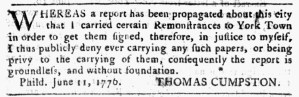
Thomas Cumpston also placed an advertisement with the intention of spreading news that was especially important to him.  “WHEREAS a report has been propagated about this city,” he declared, “that I carried certain Remonstrances to York Town in order to get them signed, therefore in justice to myself, I thus publicly deny ever carrying such papers, or being privy to the carrying of them.”  To make it clear, he asserted that “the report is groundless, and without foundation.”  The open letter to Rankin from “A FREEMAN” that filled the entire first page and spilled over onto the second concerned the circulation of the “certain Remonstrances” that Cumpston supposedly carried to York to gather signatures,” though “A FREEMAN” did not mention Cumpston.  That letter was a response to Rankin’s own open letter “To the WORTHY INHABITANTS of YORK COUNTY” in the June 8 edition of the Pennsylvania Evening Post.  It also filled the entire first page and overflowed to the second page.  Rankin stated that he had been “injuriously treated by a Resolve of your County Committee, published in the several newspapers.”

The controversy revolved around Rankin’s reaction to the a resolution passed by the Second Continental Congress on May 15, 1776, a resolution that the “Assemblies and Conventions of the United Colonies, where no Government sufficient to the Exigencies of their affairs hath been hitherto established, … adopt such Government as shall in the Opinion of the Representatives of the People best conduce to the happiness and Safety of their Constituents in particular and America in General.”  In other words, each colony should establish its own government.  Tories and moderates took a different approach to this resolution than Patriots did.  In Pennsylvania, that resulted in both a “Remonstrance,” favored by Tories, and a “Protest,” favored by Patriots, circulating; “A FREEMAN” accused Rankin of embracing the former and ignoring the latter even though Rankin claimed that he wished to be guided by the views of all his constituents.  Rankin insisted that he acted from “love for the charter constitution of Pennsylvania” when he took into account “a Remonstrance …  sign[ed] by multitudes of the most respectable names in the city of Philadelphia, and the neighbouring counties, in opposition to the doctrines in the Protest.”  The “Remonstrance” argued that “public service has been, and might still be, carried on as vigorously by the Assembly of this province as by any other public body on the continent.”  Therefore, it was not necessary to create a new government.

Cumpston wanted no part of that controversy, at least not as an agent who circulated “certain Remonstrances … in order to get them signed.”  His advertisement served as a supplement to the news as he attempted to shape the narrative as far as his own actions were concerned.  Towne, the printer and editor, may not have had any interest in how the story that appeared on the first page of his newspaper had an impact on one resident of Philadelphia, but he did aim to generate revenue by selling advertising space.  Cumpston inserted a paid notice as a means of publishing news and rehabilitating his reputation as political debates in Pennsylvania intensified.

June 10

What was advertised in a revolutionary American newspaper 250 years ago today?

Dunlap’s Pennsylvania Packet (June 10, 1776).

“THOMAS LEIPER … manufactures in the best manner Snuff and Tobacco of the first quality.”

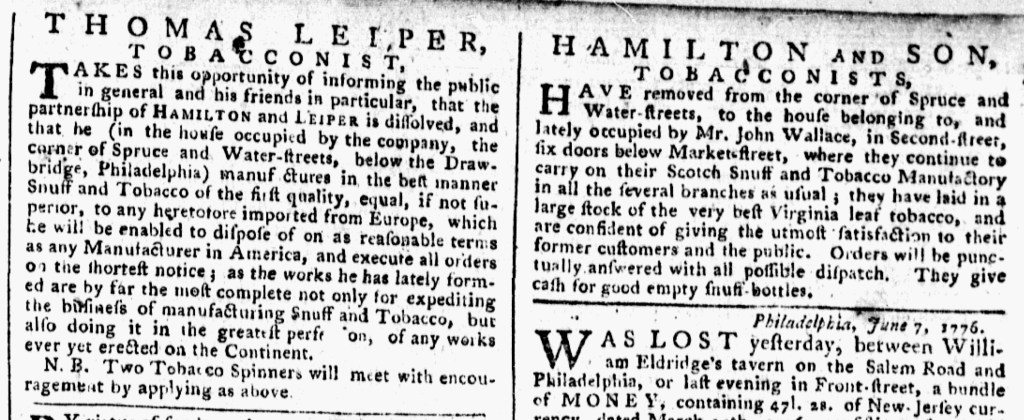
Two days after tobacconists Hamilton and Leiper announced that they dissolved their partnership with an advertisement in the Pennsylvania Ledger, an advertisement with identical copy ran at the top of the middle column on the front page of Dunlap’s Pennsylvania Packet.  An editorial submitted by a readers filled the rest of the column, whereas an advertisement for the new partnership of Hamilton and Son ran immediately below the same notice in the Pennsylvania Ledger.  Hamilton and Son did insert their advertisement in the June 10, 1776, edition of Dunlap’s Pennsylvania Packet, though it ran in the upper right corner on the third page, separated from the advertisement about the end of the partnership.

In this instance, Hamilton and Son’s advertisement appeared immediately to the right of a new advertisement from “THOMAS LEIPER, TOBACCONIST,” who made his own announcement to “the public in general and his friends in particular, that the partnership of HAMILTON and LEIPER is dissolved, and that he … manufacturers in the best manner Snuff and Tobacco of the first quality, equal, if not superior, to any heretofore imported from Europe.”  Now in competition with his former partner, Leiper proclaimed that he could sell his products “on as reasonable terms as any Manufacturer in America” and he could “execute all orders on the shortest notice.”  To make that possible, “the works he has lately formed are by far the most complete not only for expediting the business of manufacturing Snuff and Tobacco, but also doing it in the greatest perfection, of any works ever yet erected on the Continent.”  Leiper gave good reasons why the clientele that he and Hamilton had cultivated while in business together for several years should stick with him rather than take their business to Hamilton and Sons.  He also had the advantage of remaining “in the house occupied by the company,” a familiar location to both former customers and the public.

Hamilton and Son may have initially had a leg up on Leiper by publishing their advertisement with the notice about the dissolution of the partnership.  In response, Leiper disseminated a more elaborate advertisement that made even bolder claims.  He may even have made arrangements for the compositor of Dunlap’s Pennsylvania Packet to separate the notices that appeared together in the Pennsylvania Ledger.  That the advertisements for the two new ventures appeared next to each other put them on equal footing.  Two days later, all three advertisements ran in the Pennsylvania Gazette.  The compositor placed them one after the other after the other on the third page, staring with the announcement about dissolving the company, then Hamilton and Son’s advertisements, and Leiper’s notice at the end.  Readers could peruse all the news about these tobacconists in one convenient place.

June 9

What was advertised in a revolutionary American newspaper 250 years ago this week?

Pennsylvania Ledger (June 8, 1776).

“THE Copartnership of HAMILTON and LEIPER, Tobacconists, is dissolved.”

The “Copartnership of HAMILTON and LEIPER, Tobacconists,” provided their products to consumers for more than half a decade in the early 1770s.  In May 1772, they placed an advertisement in the Pennsylvania Gazette to advise the public that they “established a MANUFACTORY in Market-street, Baltimore,” and they continued “to manufacture and sell as usual at Frederick-Town,” Maryland.  (At the time, Baltimore did not yet have its own newspapers, so the partners resorted to the Pennsylvania Gazette as a regional newspaper for their advertisement.)  Less than a year and a half later, they opened a new location in Philadelphia. In an advertisement in the Pennsylvania Journal in September 1772, they promoted “KITE-FOOT TOBACCO … manufactured and sold … In Second-street,” Philadelphia.  To entice prospective customers who might not believe that their tobacco was “Of an excellent quality, equal to any imported from Europe,” Hamilton and Leiper made samples available “at the Bar of the London Coffee-House.”

As summer arrived in 1776, however, Hamilton and Leiper ran a new advertisement in the Pennsylvania Ledger, this time announcing that they dissolved their partnership and calling on associates who “have any demand against that concern … to bring in their accounts as soon as possible.”  They could present any such accounts to Leiper “in the house lately occupied by the Company, at the corner of Spruce and Water-streets,” or to Hamilton and Son “in Second-street.”  That notice implied that Hamilton and Son commenced their own partnership.  An advertisement that conveniently appeared immediately below that notice made clear that “HAMILTON and SON, Tobacconists[,] … continue to carry on their Scotch snuff and to bacco Manufactory in all the several branches as usual.”  To that end, they “have laid in a large stock of the very best Virginia leaf tobacco.”  The news partners declared that they “are confident of giving the utmost satisfaction to their former customers and the publick” and pledged that orders “will be punctually answer’d with all possible dispatch.”  In running one advertisement after the other, they aimed to maintain the clientele that Hamilton and Leiper had cultivated over several years in business together.

June 8

Who was the subject of an advertisement in a revolutionary American newspaper 250 years ago today?

Freeman’s Journal (June 8, 1776).

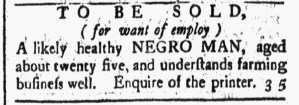
“A likely healthy NEGRO MAN … Enquire of the printer. 3 5”

Benjamin Dearborn published the third issue of the Freeman’s Journal on June 8, 1776.  Among the various advertisements that appeared in that issue, one announced, “TO BE SOLD, (for want of employ) A likely healthy NEGRO MAN, aged about twenty five, and understands farming business well.”  For interested parties who wanted to know more, the notice instructed them to “Enquire of the printer” at his printing office in Portsmouth, New Hampshire.  The previous issue of the Freeman’s Journal featured an advertisement in which Samuel Hall described Seneca, an enslaved man who liberated himself by running away from his enslaver on May 29, and offered a reward for his capture and return.  In the course of the first three issues, Dearborn went from proclaiming “the most sacred rights of a free people” in an address to readers to encouraging the surveillance of Black men in a notice placed for the purpose of capturing a fugitive from slavery to actively participating in the slave trade as a broker and proxy for an anonymous advertiser.

Notations in both advertisements suggests that each met with success.  Hall’s advertisement concerning Seneca concluded with “2–4,” a notation intended for the compositor who set type rather than for readers.  It indicated that Hall’s advertisement should appear in issue “No. 2” through issue “No. 4.”  However, Hall’s advertisement did not run in any subsequent issue, suggesting that Seneca had been captured and returned and, in turn, the notice withdrawn.  The anonymous “enquire of the printer” advertisement concluded with a similar notation, “3 5.”  It first appeared in issue “No. 3” and should have appeared in the next two issues as well.  It did not run the following week, but a note from the printer promised that “Advertisements &c. omitted, will be in our next.”  The advertisement did indeed appear in issue “No. 5” the following week, with the notation revised to “3 6” to allow for the week it did not run.  That meant that it should have appeared in the third (June 8), fifth (June 22) and sixth (June 29) issues of the Freeman’s Journal.  The advertisement did not run again, suggesting that someone had indeed enquired of the printer and completed the transaction.  Dearborn commenced advertising the “Books so much admired, entitled COMMON SENSE,” the most influential political pamphlet advocating for the colonies to declare independence, on June 22, the last issue that carried the advertisement offering the enslaved man for sale.  Dearborn deployed the power of the press to promote the liberty of some Americans while restricting the liberty of others.

June 7

What was advertised in a revolutionary American newspaper 250 years ago today?

Connecticut Gazette (June 7, 1776).

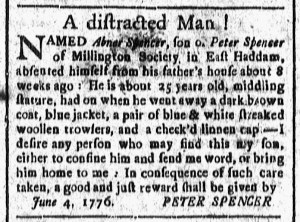
“A distracted Man!”

Peter Spencer sought the public’s assistance in locating his son Abner.  He placed an advertisement in the June 7, 1776, edition of the Connecticut Gazette because Abner “absented himself from his father’s house” in East Haddam “about 8 weeks ago.”  This does not seem to have been a case of any sort of discord that resulted in a rebellious son running away from the obedience demanded by his father.  Instead, the headline described Abner as “A distracted Man,” suggesting that he had cognitive, intellectual, or developmental disabilities.  Somehow, Abner had “absented himself” from the care of his father’s household.

Spencer published an alert, just as Elizabeth Fales of Walpole, Massachusetts, had done in the summer of 1774 when Jonathan Fales, a “Non Compos Mentis” man, “did … leave his House and Family … and has not been Home since.”  Fales offered a reward to anyone “so kind to a distress’d Woman as to bring him home (without abusing him) or give Information that he may be found.”  Similarly, Spencer promised a “good and just reward” to “any person who may find this my son, either to confine him and send me word, or bring him home to me.”  To help identify Abner, his father described him as “about 25 years old, middling stature,” and wearing a “dark brown coat, blue jacket, a pair of blue & white streaked woollen trowsers, and a check’d linnen cap.”

Spencer’s advertisement about Abner happened to appear immediately below James Rogers’s notice offering a reward for the capture and return of a “Mustee Fellow named SY,” also “about 25 Years of Age,” who had liberated himself by running away from his enslaver in March.  Rogers provided a lengthy description of Sy, even noting that he took a fiddle with him, and warned that “Masters of Vessels are forbid to carry off said Slave.”  These notices that ran one after the other both concerned missing persons, yet the advertisers who placed them had very different purposes in doing so.  Rogers aimed to use the power of the press to return a young man to slavery, while Spencer treated his advertisement as a means of disseminating news that was exceptionally important to a household responsible for providing care for a son who needed their support.  One young man would benefit if the advertisement was successful, while the other certainly would not.