June 24

What was advertised in a revolutionary American newspaper 250 years ago today?
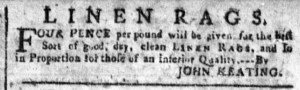
New-York Gazette and Weekly Mercury (June 24, 1776).

“FOUR PENCE per pound will be given for the best Sort of good, dry, clean LINEN RAGS.”

Colonial printers regularly inserted advertisements offering cash for rags in their newspapers.  They collected linen rags to supply to paper mills to transform into paper that they could then use to print more newspapers (with more calls for rags) or sell to consumers for other purposes.  Such notices seemed to multiply during the Revolutionary War.  Colonizers already participated in nonimportation agreements that reduced the amount of imported paper and then the war further disrupted trade.  Some printers briefly suspended their newspapers or resorted to smaller sheets amid the disruptions.

Two calls for rags appeared in the June 24, 1776, edition of the New-York Gazette and Weekly Mercury, just days after similar notices ran in the Freeman’s Journal, published in Portsmouth, New Hampshire, Dunlap’s Maryland Gazette and the Maryland Journal, both published in Baltimore, and John Dixon and William Hunter’s Virginia Gazette, published in Williamsburg.  Other newspapers in New England, the Middle Atlantic, and the Chesapeake also carried calls for rags.  In the Lower South, James Johnston published the last known issue of the Georgia Gazette in Savannah on February 7, 1776, and John Wells suspended the South-Carolina and American Gazette from May 31 to August 2, 1776, when the British fleet approached Charleston, leaving the entire region without any newspapers and, as a result, no notices offering cash for rags.

In the New-York Gazette and Weekly Mercury, John Keating ran a short advertisement with a headline that proclaimed, “LINEN RAGS.”  He promised four pence per pound for “the best Sort of good, dry clean LINEN RAGS, and so in Proportion for those of an inferior Quality.”  Many readers likely knew that Keating operated a “Paper Manufactory” since he frequently advertised in the various newspapers published in New York.  On many occasions he went into greater detail in his efforts to encourage the public to assist him in that enterprise by supplying rags from their households.  He depicted doing so as a patriotic duty and a way that everyone, especially women, could demonstrate their political principles.  He was much more constrained in his latest notice.
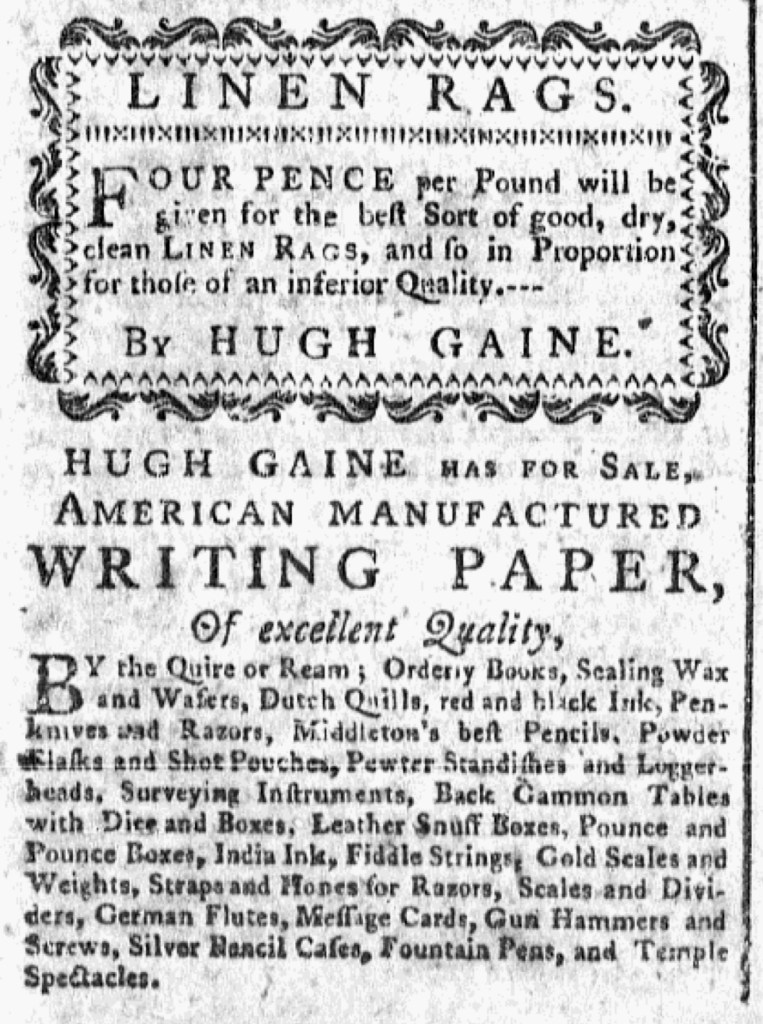
New-York Gazette and Weekly Mercury (June 24, 1776).

Hugh Gaine, the printer of the New-York Gazette and Weekly Mercury, ran an advertisement with identical copy except he substituted his name for Keating’s name.  Gaine likely collected rags to supply to Keating, perhaps receiving a discount on paper in return.  He distinguished his own advertisement with an elaborate border composed of printing ornaments, a line of decorative type that separated the headline from the body of the advertisement, and printing his name in a larger font.  Gaine’s advertisement ran on the first page along with notices for patent medicines that he peddled as an alternate revenue stream.  Immediately below his call for linen rags, the printer informed readers that he “HAS FOR SALE, AMERICAN MANUFACTURED WRITING PAPER, Of Excellent Quality, BY the Quire of Ream,” as well as writing supplies and a variety of other goods.  The rags that he collected might become broadsheets for printing the news or writing paper for letters that carried news that might eventually appear in the public prints.
June 23

What was advertised in a revolutionary American newspaper 250 years ago this week?

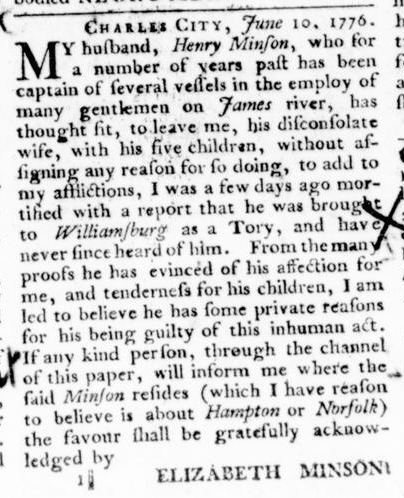
Virginia Gazette [Purdie] (June 21, 1776).

“I was a few days ago mortified with a report that he was brought to Williamsburg as a Tory.”

Marital discord often found its way into advertisements in early American newspapers, usually via notices placed by husbands to announce that their wives abandoned their households and warning merchants, shopkeepers, and others not to extend credit to them.  The husbands thus controlled the narrative that appeared in print, though they could not exert the same amount of influence over gossip that circulated.  On rare occasions, wives published responses that justified their actions and revealed abuse, neglect, and other bad behavior on the part of their husbands.  In the summer of 1776, however, Elizabeth Minson placed an advertisement about her husband, Henry, in Alexander Purdie’s Virginia Gazettewithout first having been a subject of an advertisement placed by him.  She suspected that some readers might be familiar with Henry because “for a number of years past [he] has been captain of several vessels in the employ of many gentlemen on James river.”

Her husband, Elizabeth lamented, “has thought fit, to leave me, his disconsolate wife, with his five children, without assigning any reason for so doing.”  Under normal circumstances, that would have been distressing enough, but the war made the situation even worse.  “[T]o add to my afflictions,” the aggrieved wife declared, “I was a few days ago mortified with a report that he was brought to Williamsburg as a Tory, and have never since heard of him.”  Despite that report, she did not believe that her husband had been imprisoned or otherwise detained.  Instead, she suspected that he resided in Hampton or Norfolk and asked readers to inform her of Henry’s whereabouts.  Did Elizabeth intend to seek out her husband, reunite him with their five children, and compel him to resume his responsibilities as head of household and provider?  Or did she have another motive for publishing this advertisement?  Although she reported that he had abandoned his family “without assigning any reason,” she acknowledged the “many proofs of his affection for me, and tenderness for his children.”  That caused her “to believe he has some private reasons for his being guilty of this inhuman act.”  Whether “this inhuman act” referred to deserting his wife and children or siding with the Tories was not clear.  In addition, Elizabeth did not explicitly reveal her own views on politics.  Perhaps she published her advertisement as a strategy for protecting herself, her children, and the family’s property, hoping that Patriots would leave them alone because she expressed dismay at the report that her husband was a Tory and that Loyalists would similarly not bother them out of respect for Henry’s supposed allegiance.

June 22

What was advertised in a revolutionary American newspaper 250 years ago today?

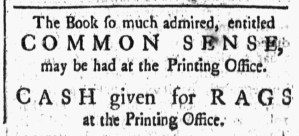
Freeman’s Journal (June 22, 1776).

“The Book so much admired, entitled COMMON SENSE.”

“CASH given for RAGS.”

Benjamin Dearborn launched the Freeman’s Journal in Portsmouth, New Hampshire, on May 25, 1776.  He quickly gained advertisers, including advertisers who offered rewards for capturing and returning enslaved people who liberated themselves by running away and advertisers who offered enslaved people for sale.  An advertisement for a “likely healthy NEGRO MAN, aged about twenty-five,” for instance, made its second appearance on the final page of the June 22 edition.  Like every other newspaper printed in the colonies, the Freeman’s Journal simultaneously perpetuated slavery (of some) and advocated for liberty (for others).

On the first page, Dearborn inserted his own advertisement for Thomas Paine’s popular political pamphlet: “The Book so much admired, entitled COMMON SENSE, may be had at the Printing Office.”  It was the first time that Dearborn offered Common Sense for sale.  Neither he nor any other printer in New Hampshire published a local edition, so he apparently acquired copies from a colleague in another town.  By the end of June, local editions published in New England had proliferated to the point that he could have received the pamphlet from printers in Boston, New Haven, Norwich, Providence, or Salem.  In Philadelphia, the Second Continental Congress tasked a committee that included Thomas Jefferson with drafting a statement of independence for the colonies on June 10.  As Jefferson worked on a draft of what would become the Declaration of Independence, Dearborn disseminated the pamphlet that made the boldest and clearest call for separation from Great Britain.

Dearborn also issued a call for rags, offering cash for them at his printing office.  Throughout the colonies, printers of other newspapers were doing the same as they all attempted to gather materials for paper mills to recycle into one of the most essential supplies necessary for publishing newspapers.  Throughout the war, paper shortages had an impact on the dissemination of the news.  Printers sometimes suspended their newspapers for short periods or published them on smaller sheets when that was the only paper available.  Dearborn inserted lines to separate most advertisements from those that appeared above and below, but he did not do so with his notices about Common Sense and rags.   That may have been especially fitting because any rags he collected might have been transformed into paper for printing more copies of Common Sense or, more likely, new issues of the Freeman’s Journal with advertisements for the pamphlet and news about the war and the Continental Congress’s decision to declare independence.  Four weeks after his first advertisement for Common Sense, Dearborn devoted an entire page of the Freeman’s Journal to printing the Declaration of Independence.

June 21

What was advertised in a revolutionary American newspaper 250 years ago today?

Massachusetts Spy (June 21, 1776).

“ISAIAH THOMAS, having relinquished the Printing business in Worcester.”

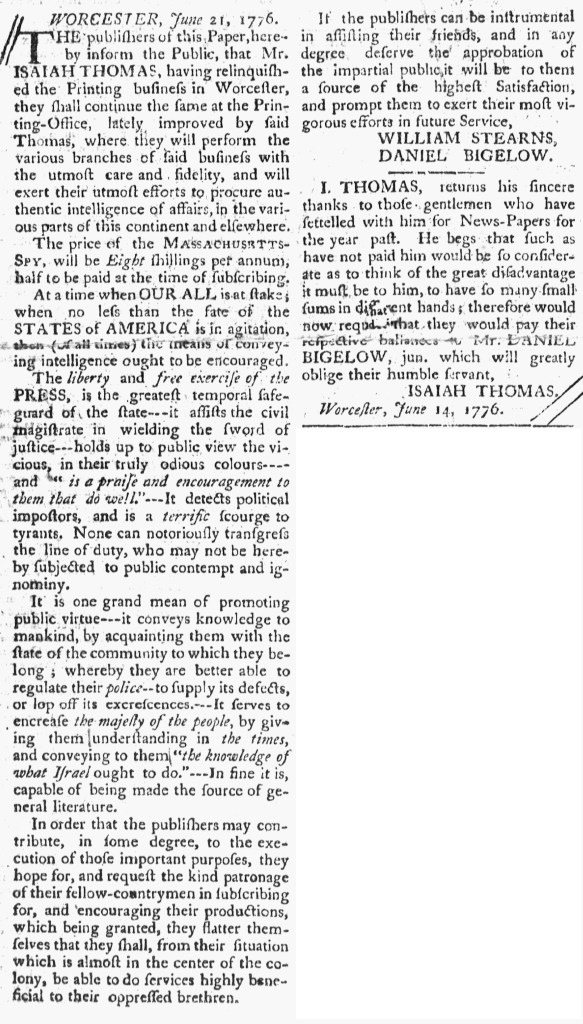
The title changed from Thomas’s Massachusetts Spy to The Massachusetts Spy with issue “NUMB. 269” on June 21, 1776.  Two months earlier, Isaiah Thomas informed readers that he intended to remain in Worcester “for the present,” but since then he decided to pursue new opportunities in Salem.  He previewed that decision in a notice in the May 31 edition, the last one he published.  In a lengthy address on the first page, William Stearns and Daniel Bigelow, the new “publishers of this Paper,” informed the public that Thomas “relinquished the Printing business in Worcester” to them.  They now occupied the printing office “near the COURT-HOUSE,” where they undertook “the various branches of said business with the utmost care and fidelity, and will exert their utmost efforts to procure authentic intelligence of affairs, in the various parts of this continent and elsewhere.”  They hoped to attract customers for job printing as well and maintain and expand their subscribers.

The title shifted slightly, but the subtitle, American Oracle of Liberty, remained the same.  Stearns and Bigelow made their editorial stance clear in their address.  “At a time when OUR ALL is at stake, when no less than the fate of the STATES of AMERICA is in agitation,” they proclaimed, “then (of all times) the means of conveying intelligence ought to be encouraged.”  That meant that subscribers had a duty to continue to subscribe and others had a responsibility to support Worcester’s only newspaper by becoming subscribers, placing advertisements, and sharing news as they received it in letters and by other means.  In turn, the printers would do their civic duty.  “The liberty and free exercise of the PRESS,” Stearns and Bigelow continued, “is the greatest temporal safeguard of the state—it assists the civil magistrate in wielding the sword of justice—holds up to public view the vicious, and in their odious colours— … —It detects political impostors, and is a terrific scourge to tyrants.”  Readers could expect the same vigilance and advocacy for the American cause from Stearns and Bigelow that Thomas had a reputation for delivering.

Following Stearns and Bigelow’s address, Thomas inserted a brief notice in which he expressed “sincere thanks to those gentlemen who have settelled with him for News-Papers for the year past.”  The spelling error may have been an actual error rather than an eighteenth-century variation.  Despite their pledge to “do services highly beneficial to their oppressed brethren” in central Massachusetts, their skill as printers paled in comparison to Thomas.  For his part, the printer did not offer words of encouragement or general expressions of gratitude as he departed Worcester.  After thanking subscribers who already settled accounts, he called on those who still owed to “pay their respective balances” to Stearns and Bigelow.  After a hiatus of three weeks, a new issue of the Massachusetts Spy carried news (and a couple of advertisements) to readers.  When news of the Declaration of Independence reached Worcester about three weeks later, Thomas may (or may not) have made the first public reading in New England, but he no longer ran his own newspaper.  He published an account of the battles at Lexington and Concord in the first edition of the Massachusetts Spy printed in Worcester, but now others would cover the Declaration of Independence and its reception in the commonwealth of Massachusetts and other states.

June 20

What was advertised in a revolutionary American newspaper 250 years ago today?

Continental Journal (June 20, 1776).

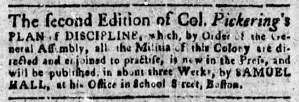
“Col. Pickering’s PLAN of DISCIPLINE, which … all the Militia of this Colony are directed and enjoined to practise.”

When he transferred the New-England Chronicle to Edward E. Powars and Nathaniel Willis in June 1776, Samuel Hall informed the public that “PRINTING in general will be continued at the Subscriber’s Office in School-street [in Boston], and performed with accuracy and dispatch.”  Although he would no longer publish a newspaper, Hall continued to earn his livelihood through job printing and other projects.  One of those projects was a second edition of Timothy Pickering’s Easy Plan of Discipline for a Militia.  Hall and his brother, Ebenezer, published and advertised the first edition nearly a year earlier.  As the war continued, the American army needed more copies military manuals, including Pickering’s manual.

On June 20, Hall inserted advertisements in both the Continental Journal and the New-England Chronicle, the only newspapers published in Boston at the time.  “The second Edition of Col. Pickering’s PLAN of DISCIPLINE, which by Order of the General Assembly, all the Militia of this Colony are directed and enjoined to practise,” Hall announced, “is not in the Press, and will be published, in about three Weeks.”  The advance notice gave interested parties an opportunity to reserve copies.  That, in turn, helped Hall determine how many copies to print.  After all, he did not publish the manual solely as a service.  He aimed to generate revenue with the venture.  He did not want an excessive number of surplus copies to eat into profits.

That an “Order of the General Assembly” directed the colony’s militia to consult Pickering’s military manual no doubt helped sales.  Yet Pickering received yet another important endorsement for his Easy Plan of Discipline for a Militia.  He sent a copy to George Washington following his appointment as commander-in-chief of the Continental Army by the Second Continental Congress.  In turn, according to the American Revolution Institute, “Washington promoted the use of several published works, including Timothy Pickering’s An Easy Plan of Discipline for a Militia and Thomas Hanson’s The Prussian Evolutions” in the years before the Baron von Stueben’s Regulations for the Order and Discipline of the Troops of the United States became the first official manual of the Continental Army in 1779.  With such support, Hall could feel confident that a second edition of Pickering’s military manual would meet with success.

June 19

What was advertised in a revolutionary American newspaper 250 years ago today?

Maryland Journal (June 19, 1776).

“The Presses, the important vehicles of instruction and amusement, must soon be reduced to the same unhappy situation.”

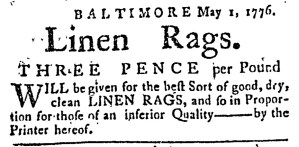
During an ongoing shortage of paper, John Dixon and William Hunter, the printers of the Virginia Gazette in Williamsburg, were not the only printers in the Chesapeake who inserted a call for “CLEAN LINEN RAGS” to recycle into paper in their newspaper in June 1776.  Frederick Green, the printer of the Maryland Gazette in Annapolis, inserted such a notice in the June 20 edition: “THREE PENCE per pound is given for fine white LINEN RAGS, and one penny per pound for coarse, by the Printer hereof.”  On June 19, the printers of both newspapers published in Baltimore ran similar notices.  Mary Katharine Goddard, the printer of the Maryland Journal, ran (once again!) an advertisement similar to Green’s notice.  Since May 1, she had been informing readers that “THREE PENCE per Pound WILL be given for the best Sort of good, dry, clean LINEN RAGS, and so in Proportion for those of an inferior Quality.”  To draw attention, she used “Linen Rags” in a much larger font as a headline for the advertisement.

Dunlap’s Maryland Gazette (June 19, 1776).

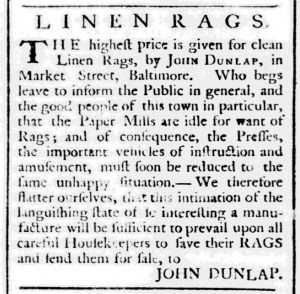
John Dunlap composed a more elaborate notice for Dunlap’s Maryland Gazette.  Beneath a headline that proclaimed, “LINEN RAGS,” in capital letters, he informed readers that the “highest price is given for clean Linen Rags, by JOHN DUNLAP.”  He went on to explain to “the Public in general, and the good people of this town in particular” that “the Paper Mills are idle for want of Rags.”  As a result, “the Presses, the important vehicles of instruction and amusement” – and news about politics, commerce, and current events as the war continued and the Continental Congress moved closer and closer to declaring independence – “must soon be reduced to the same unhappy situation” of sitting idle.  “We therefore flatter ourselves,” Dunlap confidently asserted, “that this intimation of the languishing state of so interesting a manufacture will be sufficient to prevail upon all careful Housekeepers to save their RAGS and send them for sale.”  In other words, anyone who wanted to continue receiving the news via Dunlap’s Maryland Gazette or any other newspaper needed to do their part in supplying rags for the paper mills.  Women in particular, those “careful Housekeepers,” had an important role to play in making it possible for newspapers to disseminate the “FRESHEST ADVICES, both FOREIGN and DOMESTIC,” promised in the masthead of the Maryland Journal and other newspapers.

June 18

What was advertised in a revolutionary American newspaper 250 years ago today?

American Gazette (June 18, 1776).

“THE AMERICAN GAZETTE; OR, THE CONSTITUTIONAL JOURNAL; To be published every TUESDAY.”

Samuel Hall and Ebenezer Hall moved the Essex Gazette from Salem to Cambridge and renamed it the New-England Chronicle shortly after the battles at Lexington and Concord.  At the same time, the Salem Gazette ceased publication.  That left Salem without its own newspaper until the publication of the American Gazette: Or, the Constitutional Journal in June 1776.  John Rogers signed an address “To the PUBLIC” from the publisher and the colophon stated that the newspaper was “Printed by J. ROGERS, at E[zekiel]. RUSSELL’S Printing-Office.”  The final line of the colophon advised readers that the “PRINTING-BUSINESS, in its several branches, [was] still carried on as usual by said Russell.”  Russell previously published The Censor, a political newspaper-magazine “supported, during the short period of its existence, by those who were in the interest of the British government.,” from November 1771 to May 1772.[1]  Russell had also published the Salem Gazette from July 1775 to April 1775.  He was apparently the publisher of the American Gazette, though Rogers printed and managed the newspaper and presented himself as the publisher.

In the address “To the PUBLIC,” Rogers expressed “his Gratitude, in this First Number, to all the good LADIES and GENTLEMEN, who have so cheerfully, and in such Numbers appeared … by their Subscriptions already come to Hand.”  Rogers (and Russell) likely distributed subscription proposals for the newspaper in advance of issue “NUMB. 1” appearing on June 18, 1776.  “PROPOSALS FOR CONTINUING BY SUBSCRIPTION, THE AMERICAN GAZETTE” appeared immediately below Roger’s address.  The proposal was dated June 3, suggesting that they had been printed separately and circulated in Salem and beyond.  In addition, an unnumbered “Extraordinary” issue was published in June 12.  The only known copy has not been digitized for greater accessibility.  Russell had previously distributed an unnumbered prospectus issue when he announced his plans to publish the Salem Gazette in the summer of 1774.  The unnumbered “Extraordinary” issue of the American Gazette likely featured the subscription proposal, including instructions for “Gentlemen in Town or Country who are possessed of Proposals” with subscribers’ names added to them “to return them by Saturday next, and give Directions for the Conveyance of their Papers.”  Local agents aided Rogers (and Russell) in recruiting subscribers and delivering newspapers.  That explains how Rogers could already “good LADIES and GENTLEMEN, who have so cheerfully, and in such Numbers” subscribed before the publication of the first issue of the American Gazette.

Despite the editorial stance that Russell took in The Censor, the American Gazette, according to the subscription proposal, would “contain the freshest and most important INTELLIGENCE” as part of an “Undertaking agreable to every FRIEND to the RIGHTS and LIBERTIES of Mankind in general” at a time that Patriots fought for the “GLORIOUS CAUSE of the AMERICAN COLONIES.”  The subscription proposal also outlined the “CONDITIONS,” including the price of the newspaper (“one third than the New-York or Philadelphia Papers”) and day of publication (“every Tuesday, unavoidable Accidents excepted”).  The publisher promised that it “will be printed on good Paper and a neat Type, of which this is a Specimen.”  The reference to a “Specimen” or sample suggests that Rogers (and Russell) circulated separated proposals on June 3.

American Gazette (June 18, 1776).

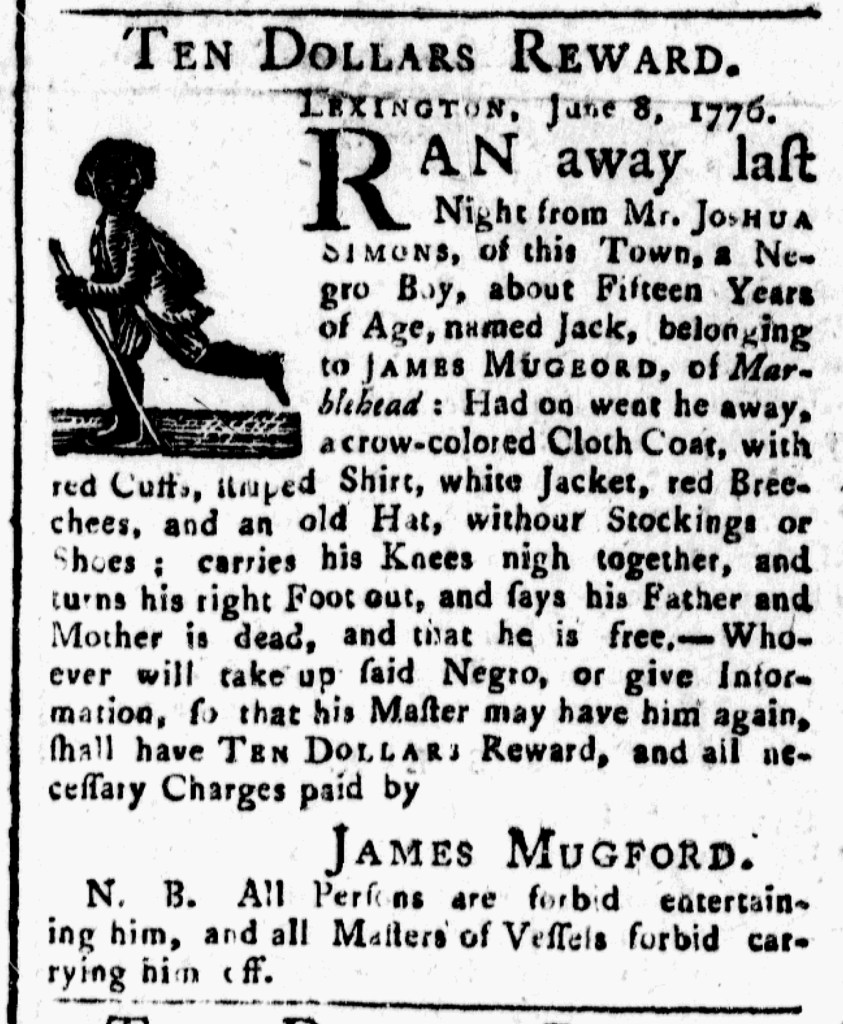
One of the “CONDITIONS” stated that “Advertisements will be thankfully received and inserted in a conspicuous Manner, and at a moderate price.  The unnumbered “Extraordinary” issue from June 12 and separate subscription proposals already in circulation would help explain how Rogers (and Russell) attracted a handful of advertisements for issue “NUMB. 1” on June 18.  That edition contained an advertisement about a mare for sale, another offering a reward for horse that strayed, and one about an auction of several ships.  Rogers (and Russell) also heeded the call for the “Printers of the several News-Papers in the colonies” to assist in the effort to “STOP A TORY” by inserting an advertisement about Moses Kirkland escaping from jail in Philadelphia.  That issue also included one more advertisement.  James Mugford described Jack, a “Negro Boy” who liberated himself by running away from his enslaver in early June.  Mugford offered a reward for Jack’s capture and return.  Mugford resided in Lexington, the site where the war began just over a year earlier.  Even though the subscription proposal stated that the American Gazette would be an “Undertaking agreable to every FRIEND to the RIGHTS and LIBERTIES of Mankind in general,” issue “NUMB. 1” carried an advertisement intended to deprive Jack of his rights and liberties.

**********

[1] Isaiah Thomas, The History of Printing in America: With a Biography of Printers and an Account of Newspapers (1810; New York: Weathervane Books, 1970), 153.

June 17

What was advertised in a revolutionary American newspaper 250 years ago today?

Boston-Gazette (June 17, 1776).

It is also well worthy the Perusal of every lover of Civil Liberty and good Government in America.”

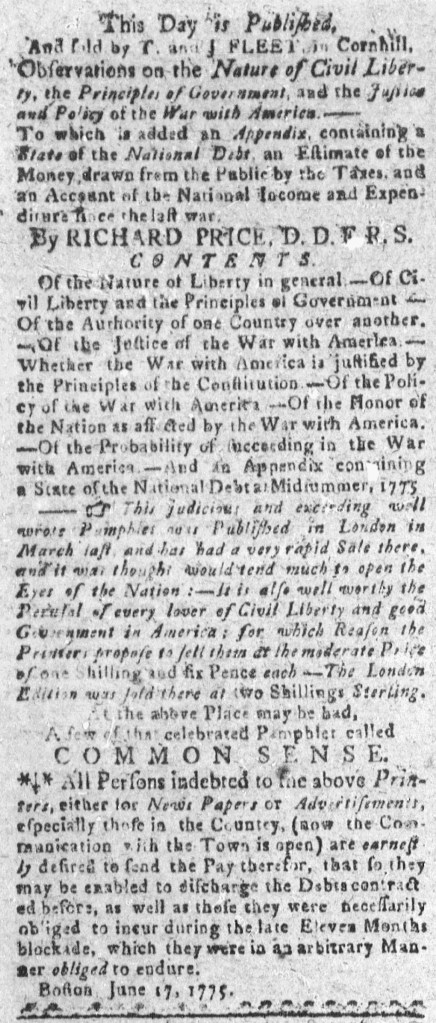
In June 1776, Thomas Fleet and John Fleet announced that they published a Boston edition of Richard Price’s Observations on the Nature of Civil Liberty, the Principle of Government, and the Justice and Policy of the War with America.  Like many other advertisements for books and pamphlets, their notice included an overview of the contents to entice prospective customers with a preview of what they would encounter when they purchased and read the work.  Section headings included “Of the Nature of Liberty in general,” “Whether the War with America is justified by the Principles of the Constitution,” and “Of the Honor of the Nation as affected by the War with America.”

Yet the Fleets did not leave it at that.  They also composed their own address to the public, drawing attention to it with a manicule.  “This judicious and exceeding well wrote Pamphlet,” they reported, “was Published in London in March last and has had a very rapid Sale there.”  The arguments presented combined with the popularity of the pamphlet, the Fleets explained, “was thought would tend much to open the Eyes of the Nation.”  The pamphlet demonstrated that the American cause had supporters on the other side of the Atlantic, though its publication did not have as much impact on policy as the Fleets suggested that it deserved.  Despite that disappointment, the Fleets considered the pamphlet “well worthy the Perusal of every lover of Civil Liberty and good Government in America.”  That being the case, the Fleets sold copies of their Boston edition “at the moderate Price of one Shilling and six Pence each” instead of the “two Shillings Sterling” that printers in London charged for copied printed there.

During the years that they published the Boston Evening-Post before the battles at Lexington and Concord, the Fleets did not gain the same reputation for advocating for the American cause as Benjamin Edes and John Gill, the printers of the Boston-Gazette, and Isaiah Thomas, the printer of the Massachusetts Spy.  The outbreak of the war may have caused them to stake a stronger position, though they may have also aimed to generate revenue in a city that the British had occupied for nearly a year and departed only a few months earlier.  They followed their promotion of Price’s pamphlet with a reminder that they stocked “A few of that celebrated Pamphlet called COMMON SENSE,” another work embraced by the Patriots who remained in Boston after British forces and their Loyalist supporters evacuated from the city.  The Fleets collaborated with the Edes and Gill in publishing and selling Thomas Paine’s influential political pamphlet.  Even though their advertisement did not necessarily reveal their political principles, the Fleets sought to activate the political principles of their prospective customers to sell their Boston edition of Observations on the Nature of Civil Liberty, the Principle of Government, and the Justice and Policy of the War with America.

June 16

What was advertised in a revolutionary American newspaper 250 years ago this week?

Virginia Gazette [Dixon and Hunter] (June 15, 1776).

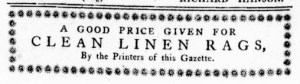
“A GOOD PRICE GIVEN FOR CLEAN LINEN RAGS, By the Printers of this Gazette.”

John Dixon and William Hunter continued to publish the Virginia Gazette on a smaller sheet than usual two weeks after running a notice that explained the circumstances.  The “present Scarcity of Paper” forced them to resort to what they had on hand, the smaller sheets, but they assured readers that despite “the Size of this Gazette” it did contain “all the material Intelligence that came to Hand this Week.”  The printers also declared that a “considerable Supply of Paper is daily expected from NEW YORK and PHILADELPHIA.”  Once they received it, “our Customers shall be served as formerly.”  Those deliveries took longer than anticipated.  Dixon and Hunter expanded the June 8, 1776, edition to eight pages printed on the smaller sheet, allowing them to disseminate more news and advertisements.  They did so again with the June 15 edition.  The new format meant that that could not include the usual masthead at the top of the first page, but that may have been the least of Dixon and Hunter’s concerns.

The printers aimed to do their part to increase the production of paper in the colonies amid the disruption in trade with England due to the war.  That meant collecting linen rags that could be transformed into paper.  They concluded the June 15 edition with a short advertisement, just three lines, that proclaimed, “A GOOD PRICE GIVEN FOR CLEAN LINEN RAGS, By the Printers of this Gazette.”  A border comprised of printing ornaments enclosed that notice, distinguishing it from all the other advertisements in that issue.  Dixon and Hunter used printing ornaments sparingly.   Plain lines separated most news items and paid notices, though a delicate line of decorative type indicated where news ended and advertisements began on the fifth page of that issue.  Even bolder lines of decorative type appeared above and below the poem in the upper left corner on the final page (a weekly feature in many colonial newspapers), setting the poet’s corner apart from the advertisements.  Dixon and Hunter also enclosed an initial capital for the first news item on the first page within decorative type.  Beyond these few examples, they did not use printing ornaments in that issue of the Virginia Gazette.  That made the border enclosing their call for “CLEAN LINEN RAGS” even more remarkable.  Even if readers quickly passed over other advertisements, the printers wanted to increase the chances that they took note of that final notice.

June 15

What was advertised in a revolutionary American newspaper 250 years ago today?

Providence Gazette (June 15, 1776).

Palmer and Allen … are determined to dispose of many articles at prime cost.”

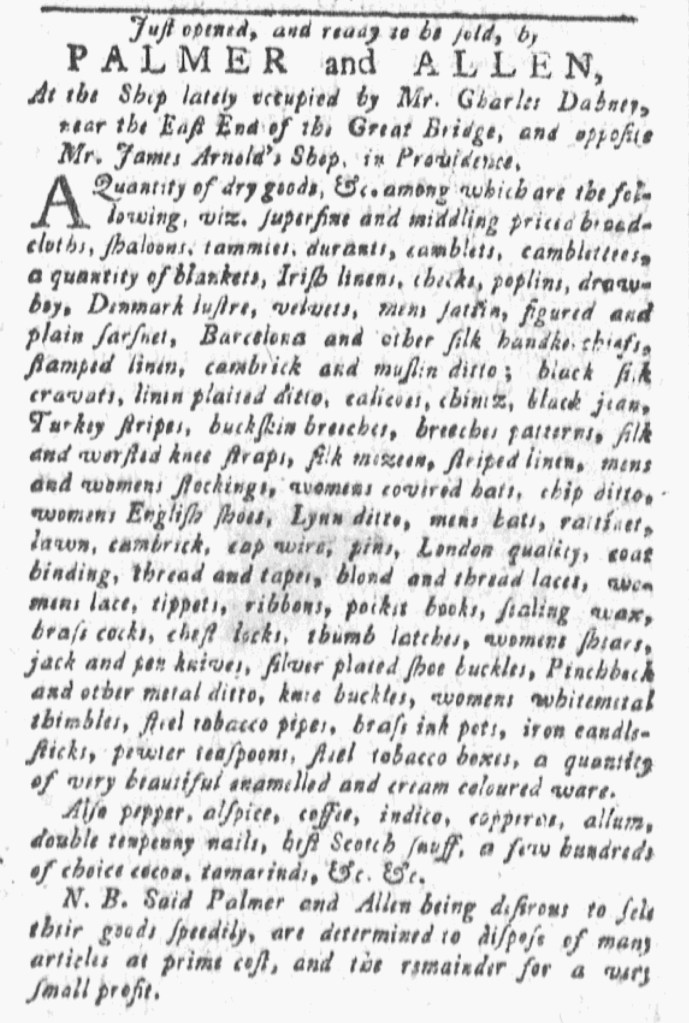
In the summer of 1776, Palmer and Allen sold a “Quantity of dry goods” and various spices at “the Shop lately occupied by Mr. Charles Dabney, near the East End of the Great Bridge, … in Providence.”  They ran an advertisement in the June 15 edition of the Providence Gazette, announcing that they “Just opened” and made the selection available to consumers. To entice prospective customers, Palmer and Allen provided a lengthy list of dozens of items, including “superfine and middling priced broadcloths, … a quantity of blankets, … Barcelona and other silk handkerchiefs, … buckskin breeches, … silk and worsted knee straps, … mens and womens stockings, … blond and thread laces, … jack and pen knives, … womens white metal thimbles, … brass ink pots, … steel tobacco boxes, [and] a quantity of very beautiful enamelled and cream coloured ware.”  Spices and other groceries on hand included pepper, allspice, tamarind, coffee, and “choice cocoa.”  With such a lengthy list, Palmer and Allen provided a catalog of their merchandise.

In a nota bene at the end of the advertisement, the partners indicated that they wished to liquidate their inventory as quickly as possible.  “Said Palmer and Allen being desirous to sell their goods speedily,” they informed readers, “are determined to dispose of many articles at prime cost, and the remainder for a very small profit.”  By “prime cost,” they meant the direct cost to them as shopkeepers.  In other words, Palmer and Allen claimed that they did not intend to charge any sort of retail markup for many of their wares, though they did not specify which of them customers could acquire at such a bargain.  For the rest, they generated only a “small profit” with a small retail markup.  Customers could not go wrong when they shopped at Palmer and Allen’s new store!  The savvy entrepreneurs hoped that their pricing would attract consumers, especially those who imagined getting extraordinary deals.  For some prospective customers, bargain prices may have transformed “wants” into “needs” as they envisioned themselves getting the better end of the deal when they made purchases from Palmer and Allen.